Zero-Day Exploits are among the most discussed topics in cybersecurity, often presented as attacks that can bypass every security tool and compromise systems before anyone has a chance to respond. But how much of that is actually true? A zero-day vulnerability can create serious risk, particularly when attackers exploit it before a patch is available. However, the term is frequently misunderstood, and headlines do not always explain the difference between a vulnerability, an exploit and an attack.
Recent research provides a more useful perspective. Google Threat Intelligence Group tracked 90 zero-day vulnerabilities exploited in the wild during 2025. That figure shows that zero-day exploitation remains a real security concern, but it does not mean every organisation faces the same level of risk or that every attack is impossible to prevent. Understanding the evidence is more valuable than relying on dramatic assumptions.
What Is a Zero-Day Vulnerability?
A zero-day vulnerability is a security weakness in software, hardware or firmware for which the affected vendor or defender has had no meaningful opportunity to provide a fix before exploitation. The term zero-day refers to the limited time available to address the vulnerability before it is exploited or publicly known in the relevant context.
NIST defines a zero-day attack as an attack that exploits a previously unknown hardware, firmware or software vulnerability. This definition is important because it distinguishes the vulnerability from the attack that uses it.
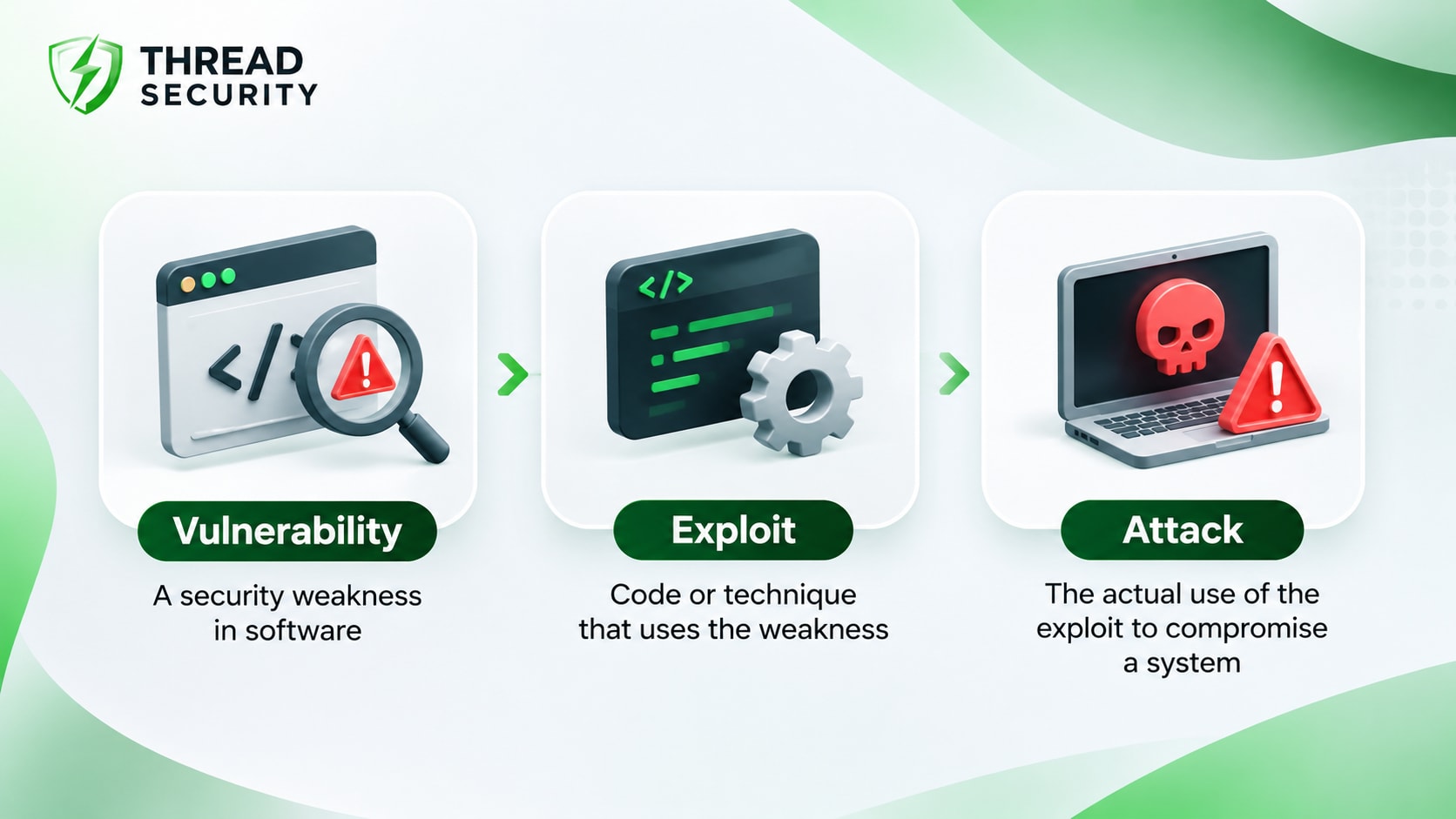
Three terms are commonly used together:
Zero-day vulnerability: The underlying security weakness.
Zero-day exploit: The code, technique or method used to take advantage of that weakness.
Zero-day attack: An actual attack that exploits the vulnerability.
These terms are related, but they are not interchangeable. A vulnerability may exist without being exploited. An exploit may be developed without being used in a real attack. A zero-day attack occurs when an attacker actually uses the weakness.
How Does a Zero-Day Exploit Work?
A zero-day attack generally begins with a weakness that is not yet adequately addressed by the vendor or organisation. An attacker discovers the flaw, obtains information about it or develops a method to exploit it. Depending on the affected product and vulnerability, exploitation may allow actions such as executing code, bypassing authentication, escalating privileges or accessing sensitive information.
Consider a hypothetical example involving a web application. A previously unknown flaw allows an attacker to execute unauthorised commands through a vulnerable component. If the application is exposed to the internet and the weakness can be exploited remotely, an attacker may attempt to use it before a vendor patch is available.
Once exploitation is identified, the vendor may investigate, develop a patch or issue mitigation guidance. Security teams then need to determine whether their systems are affected, whether exploitation has occurred and which actions are appropriate. The response may include restricting exposure, disabling a vulnerable feature, applying vendor workarounds, increasing monitoring and deploying a patch when available.
What Does the Data Actually Show?
Zero-day discussions often rely on isolated incidents or alarming headlines. Research reports provide a more structured view, although their figures must be interpreted within the methodology and visibility of the organisation publishing them.
Google's 2025 Zero-Day Review
In its report published on March 5, 2026, Google Threat Intelligence Group (GTIG) reported tracking 90 zero-day vulnerabilities exploited in the wild during 2025. Its comparable tracked totals were 78 in 2024 and 100 in 2023.
The report also identified a significant enterprise trend. In 2025, 43 of the tracked vulnerabilities, representing 48% of the total, affected enterprise technologies. This was the highest enterprise count and proportion in the period discussed by the report.
GTIG also reported nine zero-days exploited by likely or confirmed financially motivated threat groups during 2025. Two were associated with operations that led to ransomware deployment.
These figures matter because they show that zero-day exploitation is not limited to consumer devices or theoretical research. Enterprise products, security appliances and business infrastructure are also relevant targets. However, the figures represent vulnerabilities tracked by GTIG under its research methodology. They should not be presented as a complete count of every zero-day exploited globally.
Why Statistics Need Context
A yearly count does not tell an organisation exactly how likely it is to be attacked. Risk depends on the products it uses, whether affected systems are exposed, the availability of exploit code, attacker interest, existing controls and the time required to apply mitigations.
It is also important to distinguish zero-day exploitation from exploitation of known vulnerabilities. Attackers frequently target weaknesses for which patches already exist but have not been installed. A known vulnerability can remain dangerous long after a vendor has released a fix.
Common Zero-Day Exploit Myths vs Reality
Myth 1: Every Zero-Day Attack Is Completely Undetectable
Reality: A zero-day vulnerability may be unknown, but that does not mean every action performed through it is invisible. Security tools can sometimes detect suspicious process behaviour, unusual network connections, unexpected privilege changes or abnormal access patterns. Detection may be more difficult when security products lack visibility into the affected system, but unknown vulnerabilities do not automatically make all malicious activity undetectable.
Myth 2: Zero-Day Exploits Affect Only Large Companies
Reality: The affected products determine who may be exposed. Consumer applications, operating systems, browsers, enterprise software, network appliances and cloud-related components can all contain vulnerabilities. The 2025 GTIG findings included both enterprise and end-user technologies. An organisation should therefore assess the products it actually operates rather than assume that zero-day risk belongs only to large enterprises.
Myth 3: Installing Antivirus Software Is Enough
Reality: Antivirus and endpoint security products are useful controls, but no single tool can eliminate vulnerability risk. Effective defence requires multiple layers, including secure configuration, access control, network segmentation, application security, monitoring, vulnerability management, backups and incident-response planning.
Myth 4: Every Critical Vulnerability Is a Zero-Day
Reality: Severity and disclosure status are different concepts. A vulnerability may receive a critical severity rating even when a patch is already available and the weakness is publicly documented. A zero-day concerns the timing and availability of knowledge or remediation relative to exploitation, not simply how severe the technical impact is.
Myth 5: A Patch Immediately Ends All Risk
Reality: Patching is essential, but organisations must also consider whether an attacker exploited the vulnerability before the update was installed. A compromised system may still require investigation, credential resets, containment and recovery. Applying a patch does not automatically remove an existing attacker from an environment.
Why Zero-Day Exploits Are Difficult to Defend Against
The main challenge is the gap between discovering a vulnerability and making effective protection available. Security teams may have limited information about the weakness, its affected products or the attack techniques being used. Vendors need time to investigate and develop fixes, while organisations need time to identify affected assets and deploy updates safely.
Another challenge is asset visibility. An organisation cannot reliably protect systems it does not know it operates. Older applications, unmanaged devices, third-party components and internet-facing services may be overlooked. This makes accurate asset inventory and software visibility important parts of vulnerability management.
Attackers may also target products that sit at the edge of an organisation's network, such as VPN appliances, firewalls and other security devices. These systems can provide valuable access if compromised and may not always have the same endpoint monitoring coverage as employee workstations.
How Organisations Can Reduce Zero-Day Risk
1. Maintain an Accurate Asset Inventory
Know which applications, operating systems, devices and software components are deployed. Identify internet-facing systems and business-critical assets so that security teams can quickly determine whether new vulnerability advisories apply.
2. Prioritise Vulnerabilities Based on Risk
Do not rely only on severity scores. Consider evidence of active exploitation, exposure, asset importance, available mitigations and the potential business impact. CISA's Known Exploited Vulnerabilities (KEV) Catalog is a useful resource for identifying vulnerabilities with evidence of exploitation in the wild.
3. Apply Vendor Patches and Mitigations
Monitor official security advisories and vendor guidance. If a patch is unavailable, assess whether a vendor-approved workaround, configuration change or temporary isolation measure can reduce exposure. Test updates where necessary, but avoid unnecessary delays for high-risk vulnerabilities.
4. Improve Detection and Monitoring
Monitor endpoint activity, authentication events, network traffic, application logs and unexpected system changes. SIEM and EDR tools can help identify suspicious behaviour, while threat intelligence can provide additional context about exploitation patterns and related indicators.
5. Prepare an Incident Response Plan
Define how the organisation will investigate suspected exploitation, isolate affected assets, preserve evidence, communicate with stakeholders and recover systems. Run exercises so that technical teams understand their responsibilities before an incident occurs.
What Security Teams Should Learn from Zero-Day Exploitation
Zero-day exploitation reinforces the importance of defence in depth. Organisations cannot assume that every vulnerability will be discovered before an attacker finds it. They should therefore prepare to identify suspicious behaviour, limit the impact of a compromise and recover when preventive controls fail.
For security professionals, this topic connects several disciplines: vulnerability research, secure software development, threat intelligence, penetration testing, incident response and detection engineering. Understanding how vulnerabilities are discovered and exploited helps defenders make better decisions about testing, patching and monitoring.
How Thread Security Connects to Zero-Day Awareness
At Thread Security, understanding zero-day vulnerabilities connects with the broader work of identifying security weaknesses, assessing exposure and strengthening defensive controls. Thread Security Education aims to help learners build practical foundations in cybersecurity, including vulnerability assessment, ethical hacking, application security and threat analysis. Studying zero-day exploitation should not mean focusing only on advanced attack techniques. It should also involve understanding responsible vulnerability disclosure, secure development practices, risk-based patch management and defensive monitoring. These concepts help aspiring security professionals understand how vulnerabilities affect real systems and how organisations can reduce their exposure.
Conclusion: Focus on Evidence, Not Fear
Zero-day exploits are a genuine cybersecurity concern, but they are often surrounded by exaggerated claims. The evidence shows that attackers continue to exploit previously unknown vulnerabilities, including weaknesses affecting enterprise technologies. It also shows why organisations need reliable asset visibility, timely mitigation, layered detection and tested incident-response processes.
The most useful response is not panic or the assumption that every system is defenceless. It is a disciplined security programme that reduces exposure, monitors suspicious activity and responds quickly when new information becomes available. Understanding the difference between a vulnerability, an exploit and an attack is the first step towards making better security decisions.
References and Further Reading
Want to understand cybersecurity beyond the headlines? Explore more research-based cybersecurity articles from Thread Security and discover the learning opportunities offered by Thread Security Education. Build your understanding of vulnerability assessment, ethical hacking, application security and threat intelligence through structured learning and responsible hands-on practice. Follow Thread Security for more practical insights that help turn cybersecurity knowledge into stronger digital defence.
Akshay Kumar
VERIFIEDAcademic Coordinator · Thread Security
Faculty mentor & research guide at Thread Security Education.