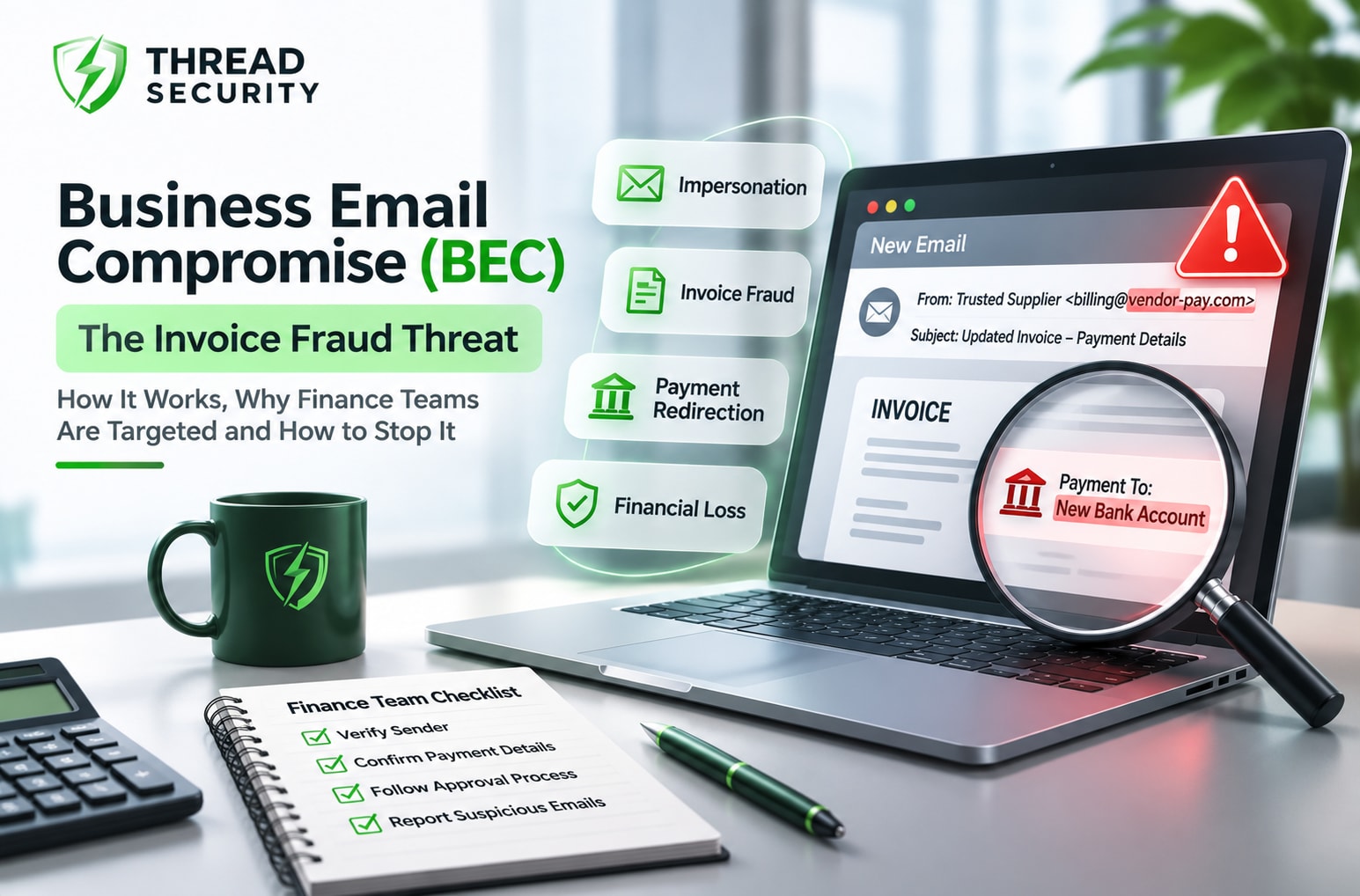
Business Email Compromise (BEC) is a form of cyber-enabled fraud in which criminals use impersonation, compromised email accounts or social engineering to trick organisations into transferring money or sharing sensitive information. One of its most damaging forms is invoice fraud: a finance employee receives what appears to be a genuine supplier invoice, but the payment details have been changed or the request itself is fraudulent.
Business Email Compromise is particularly dangerous because the message may arrive during an ordinary business process. It can look like a routine invoice, a reminder from a known vendor or an urgent request from a senior executive. The fraud is not always caused by a poorly written phishing email. In some cases, criminals use access to a legitimate email account and exploit trust built between businesses.
For finance teams, the lesson is important: checking whether an email looks genuine is not enough. Payment instructions must be independently verified through a trusted channel, and changes to supplier details must follow a controlled approval process.
What Is Business Email Compromise?
Business Email Compromise is a scam that targets organisations and individuals involved in financial transactions. According to the FBI's Internet Crime Complaint Center (IC3), BEC commonly involves criminals compromising legitimate business email accounts through social engineering or computer intrusion, then using those accounts to induce unauthorised transfers of funds.
Attackers may impersonate a CEO, finance director, supplier, lawyer or business partner. Their objective is to make a fraudulent request appear normal and credible. Because business email is already used for invoices, purchase orders and payment approvals, criminals exploit familiar communication patterns rather than relying only on obvious malware.
BEC can involve several methods, including display-name spoofing, lookalike domains, compromised mailboxes and stolen credentials. These methods are related, but they are not identical. A spoofed email may imitate a sender's identity, while a compromised account may be a real account that an attacker has gained access to.
How Does Invoice Fraud Work?
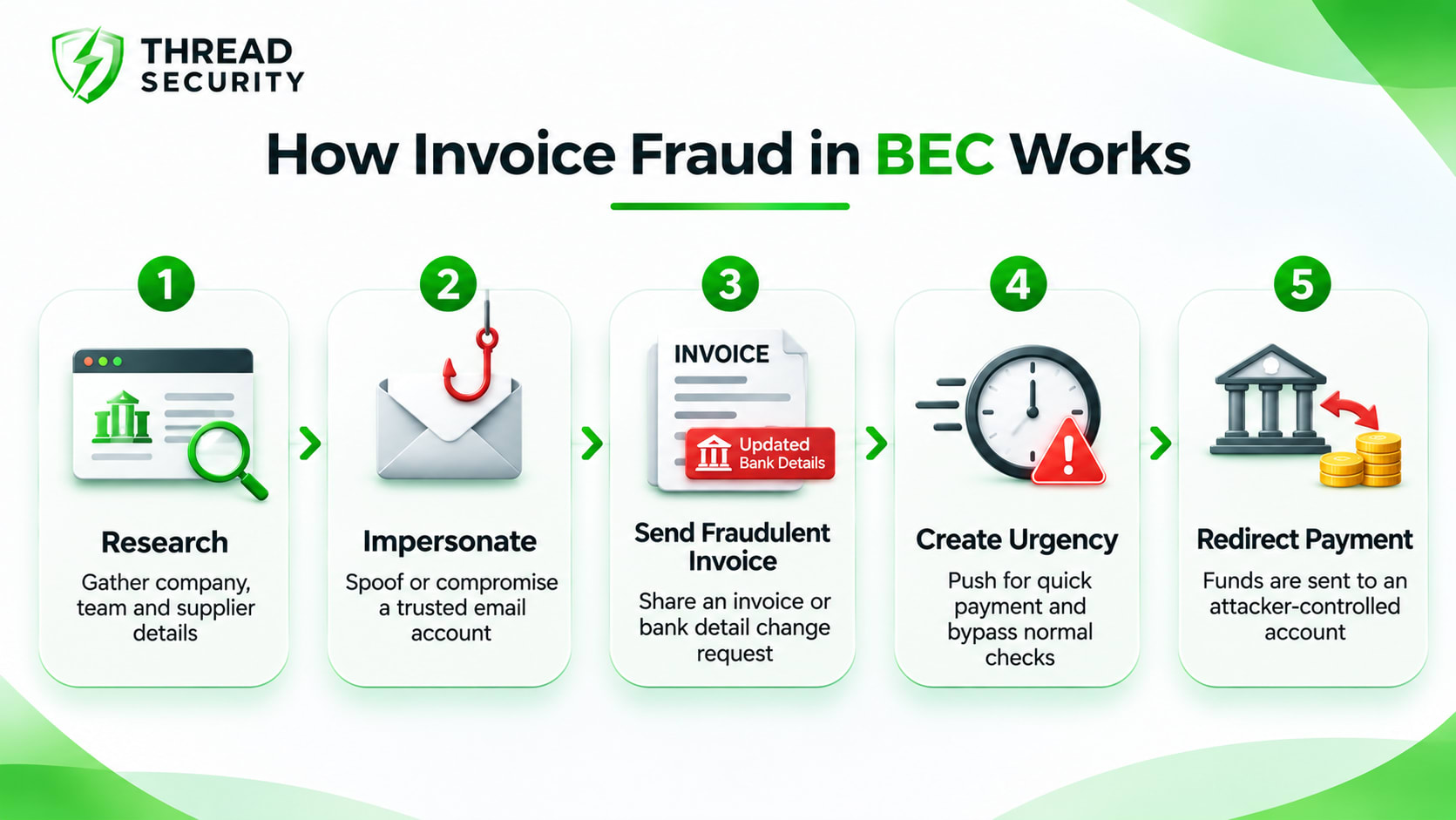
Invoice fraud often follows a sequence of steps designed to take advantage of normal supplier relationships and accounts payable procedures.
1. Researching the organisation
Criminals may study a company's website, employee profiles, supplier relationships and publicly available business information. They look for finance contacts, payment cycles, executives and vendors. This information helps them create believable messages and choose a suitable moment to approach the victim.
2. Impersonating or compromising an email account
An attacker may register a domain that looks similar to a supplier's real domain, use a misleading sender display name or gain access to a genuine mailbox. A compromised account can be especially convincing because the attacker may see previous conversations, invoice formats and contact details.
3. Sending a fraudulent invoice or bank-detail change
The criminal may send an invoice with altered bank information, claim that the supplier has changed banks, or ask the finance team to use a new account for an upcoming payment. In some cases, the attacker inserts themselves into an existing email conversation and sends modified payment instructions.
4. Creating urgency
The message may say that payment is overdue, that a project will be delayed, or that the new account must be used immediately. Urgency discourages employees from following normal verification procedures. Requests for secrecy or instructions to bypass established approval steps should also be treated as warning signs.
5. Redirecting the payment
If the finance team accepts the request without independent verification, the payment may be sent to an account controlled by the criminal or an intermediary. Once the transfer is completed, recovering the money can be difficult. That is why the speed of the response after discovering fraud matters.
Common Types of Business Email Compromise
Supplier invoice fraud: A criminal impersonates a vendor or compromises its mailbox and sends an invoice with fraudulent payment details.
Bank account change fraud: A message claims that a supplier has changed its bank account and asks the customer to update payment records.
Executive impersonation: An attacker pretends to be a senior leader and requests an urgent transfer or confidential financial information.
Lawyer or adviser impersonation: A criminal poses as a trusted professional involved in a confidential transaction and pressures an employee to transfer funds.
Payroll diversion: A fraudster attempts to change an employee's bank details so that salary payments are redirected.
These schemes differ in their details, but they share a common weakness: the victim is persuaded to trust a payment instruction that has not been properly authenticated.
Why Finance Teams Are a Major Target
Finance teams regularly process invoices, supplier onboarding, refunds, payroll and bank transfers. They work with sensitive financial information and often operate against payment deadlines. This makes accounts payable and treasury processes attractive targets for criminals.
Fraudsters do not necessarily need to break into a company's accounting software. If they can manipulate the communication that triggers a payment, they may be able to exploit a gap between email and financial controls.
The FBI's IC3 2024 Internet Crime Report recorded approximately $2.77 billion in reported losses associated with Business Email Compromise and 21,442 BEC complaints. These are reported figures, not a complete measure of every incident worldwide. They nevertheless demonstrate why organisations should treat BEC as a serious financial and cybersecurity risk.
Warning Signs of Invoice Fraud
Finance employees should pay particular attention to unusual requests, especially when they involve changes to established payment instructions.
A supplier suddenly asks for payment to a different bank account.
The sender's email domain contains a small spelling difference.
An invoice arrives with changed contact information or payment instructions.
A message creates unusual urgency or demands secrecy.
A familiar supplier requests a process change that has never been used before.
The sender asks employees to ignore normal approval procedures.
Payment information in the invoice does not match the supplier details already held in the accounting system.
None of these signs alone proves that a message is fraudulent. However, they should trigger verification before money is transferred.
How Finance Teams Can Prevent Business Email Compromise
1. Verify bank-detail changes independently
This is one of the most important controls. If a supplier requests a change to its bank account, do not rely on the phone number or contact details in the new email. Use a previously verified telephone number or an established supplier portal to confirm the change with an authorised contact.
2. Introduce dual approval for payments
High-value payments and changes to beneficiary details should require approval from more than one authorised person. A second reviewer should verify the payment against the original purchase order, supplier records and approved invoice. Approval should not simply mean clicking a button in the same email thread.
3. Protect business email accounts
Enable multi-factor authentication, use strong unique passwords and restrict access to sensitive mailboxes. Review suspicious sign-in activity, forwarding rules and mailbox permissions. These controls help reduce the risk of account compromise, although they do not replace payment verification.
4. Maintain an approved supplier database
Store verified supplier names, account details and authorised contacts in a controlled system. Changes should be recorded with the date, the person who requested them, the person who verified them and the person who approved them. Avoid updating supplier records solely on the basis of an email.
5. Train finance and procurement employees
Training should use realistic examples of invoice fraud, executive impersonation and payment redirection. Employees need to know how to pause a suspicious transaction, report it and verify a request without feeling pressured to act immediately.
6. Create a clear payment verification policy
Define which payments require additional checks, who can approve supplier changes and which communication channels are acceptable for verification. The policy should apply consistently, including when a request appears to come from a senior executive.
What Should You Do If a Fraudulent Payment Has Been Made?
Time is critical. If a business discovers that it has transferred money to a fraudulent account, it should immediately contact its bank using an official, independently verified channel. Ask the bank to attempt a recall or hold of the transfer and provide the transaction details requested. Do not wait until the next routine finance review.
The organisation should also notify its internal incident-response or security team, preserve the relevant emails and headers, record payment details and document the timeline. If a mailbox may have been compromised, secure the account, review active sessions and forwarding rules, reset credentials and investigate whether other accounts or transactions were affected.
Report the incident to the appropriate law enforcement or cybercrime reporting authority in the relevant jurisdiction. In India, businesses can use the National Cyber Crime Reporting Portal and the cybercrime helpline 1930 for financial cyber fraud reporting. The bank should still be contacted immediately; reporting does not replace the need to request urgent action from the financial institution.
Do not delete the suspicious messages or make changes that destroy useful evidence. Preserve the original communications and coordinate with legal, compliance and technical specialists where necessary.
The Role of Cybersecurity in Protecting Finance Operations
Business Email Compromise sits at the intersection of cybersecurity and financial control. Email security can help detect suspicious messages, spoofing and account compromise. Identity controls can reduce unauthorised access. Monitoring can help identify unusual mailbox activity. But technology alone cannot reliably stop a fraudulent payment if a finance process allows bank details to be changed without independent verification.
Effective protection combines technical safeguards with documented procedures, staff awareness and separation of duties. Finance leaders and cybersecurity teams should therefore work together to review how payment instructions are received, checked, approved and stored.
How Thread Security Helps Businesses Build Cyber Awareness
At Thread Security, cybersecurity is approached through practical security services and awareness of the risks that affect real business operations. Its VAPT services help organisations assess technical weaknesses in systems and applications within an authorised scope, while Thread Security Education supports learners who want to develop practical knowledge of cybersecurity, ethical security practices and threat awareness. Business Email Compromise shows why this knowledge must extend beyond IT teams: finance, procurement, HR and management all play a role in protecting business processes. Building a security-aware workforce, strengthening technical controls and reviewing operational procedures can help organisations reduce opportunities for email-based fraud.
Conclusion: Make Payment Verification a Security Control
Business Email Compromise succeeds when criminals exploit trust and routine business processes. Invoice fraud and payment redirection can appear convincing, particularly when attackers impersonate known suppliers or compromise genuine email accounts. Finance teams should never treat an email alone as sufficient proof of a bank-detail change. Independent verification, dual approval, secure email accounts, supplier record controls and employee training are essential parts of a stronger defence. The most effective approach is to make payment verification a standard business control—not an optional step used only when something looks suspicious.
References and Further Reading
Want to strengthen your organisation's email security and reduce the risk of invoice fraud? Connect with Thread Security to explore cybersecurity assessments and VAPT services, or explore Thread Security Education to build practical cybersecurity awareness and skills. Make payment verification, employee awareness and stronger security practices part of your organisation's everyday operations.
Akshay Kumar
VERIFIEDAcademic Coordinator · Thread Security
Faculty mentor & research guide at Thread Security Education.