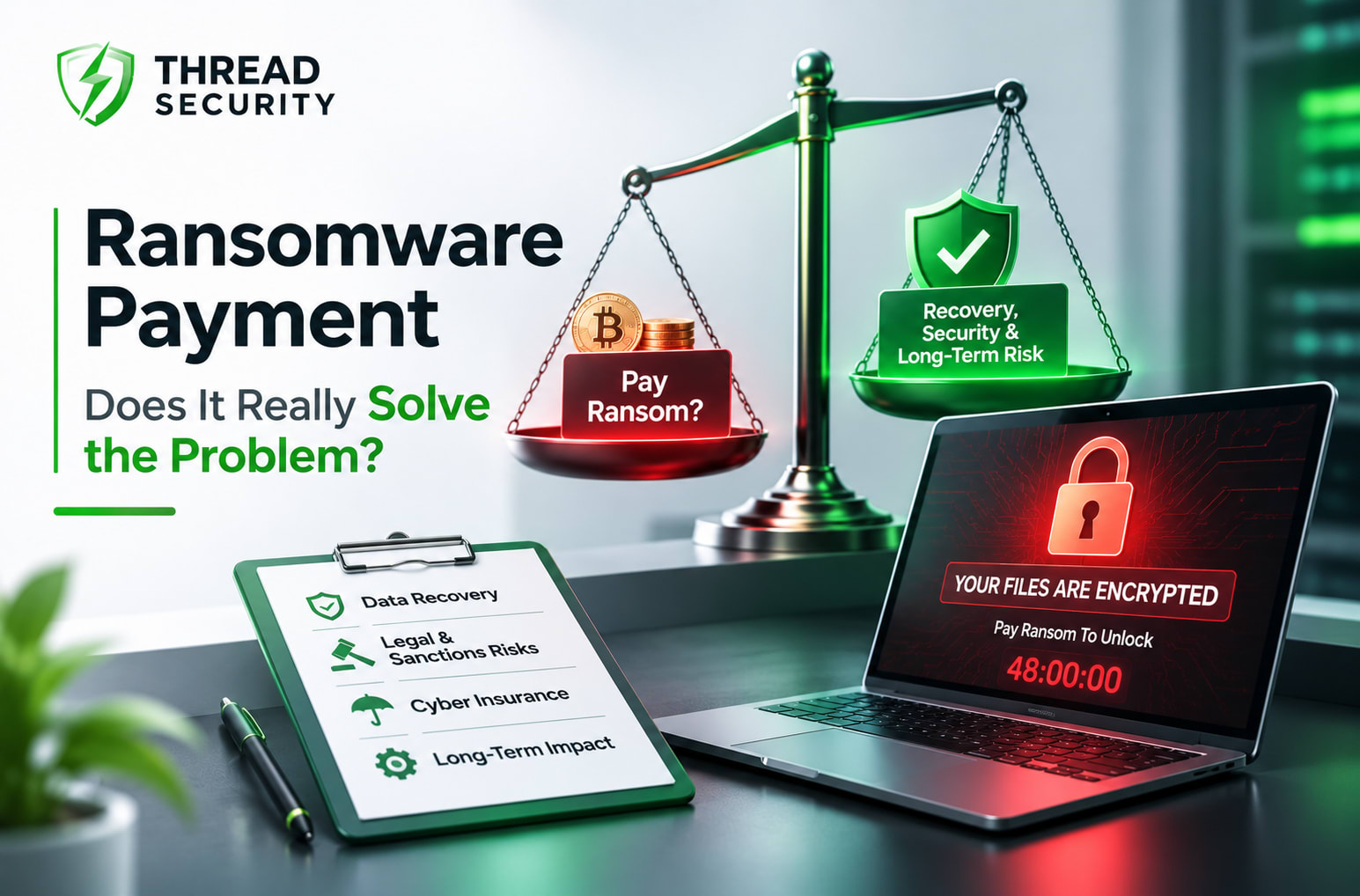
Should companies pay ransomware demands? It is one of the most difficult decisions a business can face after a cyberattack. When critical systems are encrypted, important files become inaccessible and attackers threaten to publish stolen information, management may feel that paying the ransom is the fastest way to restore operations. But does paying actually guarantee data recovery, prevent a data leak or protect the company from another attack?
The answer is no. Ransom payment does not guarantee any of these outcomes. Understanding the risks, legal implications and recovery alternatives is essential before making such a decision.
What Happens During a Ransomware Attack?
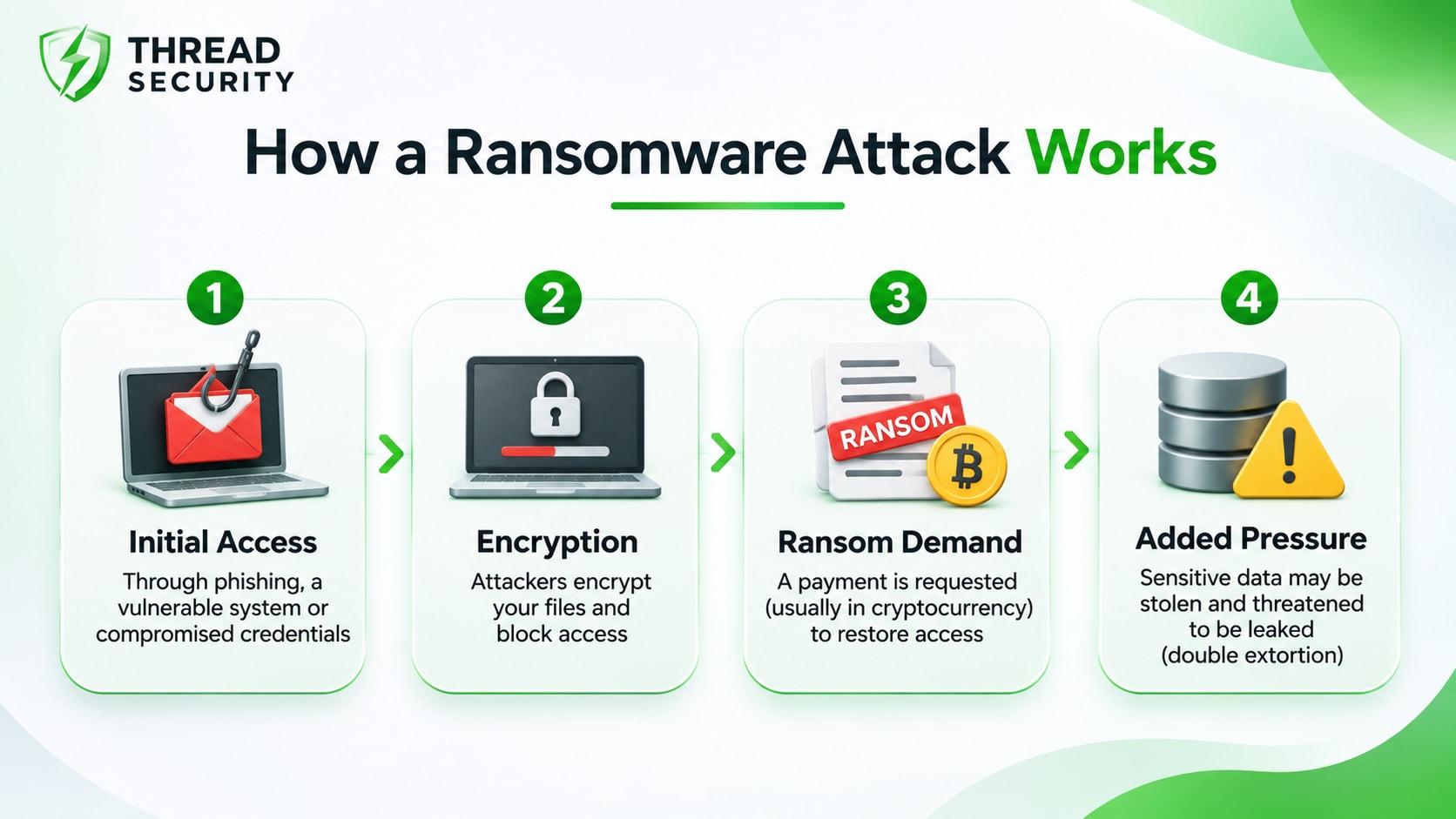
Ransomware is malicious software used to deny access to systems or data, commonly by encrypting files. Attackers then demand payment, often in cryptocurrency, in exchange for a purported decryption key. Modern ransomware incidents may involve more than encryption. Some attackers first steal sensitive information and then threaten to publish or sell it if the victim refuses to pay. This is commonly called double extortion.
An incident can disrupt several parts of a business at once: employee access, customer services, manufacturing, billing, internal communication and third-party operations. A ransom note may impose a deadline and threaten to increase the demand or release stolen data. These pressure tactics are designed to push decision-makers into acting before they understand the full extent of the incident.
That is why organisations should treat a ransom note as a criminal demand, not as a trustworthy recovery agreement. The attacker has an incentive to make promises, but the victim has very limited means of enforcing them.
What Does Law Enforcement Say About Paying?
The Federal Bureau of Investigation (FBI) states that it does not support paying a ransom. Its guidance explains that payment does not guarantee an organisation will recover its data. It can also encourage further criminal activity by making ransomware a profitable business model.
The Cybersecurity and Infrastructure Security Agency (CISA) similarly advises organisations against paying. Its ransomware guidance warns that victims who pay may still fail to regain access, may be targeted again, or may face additional demands before receiving a working decryption key.
The UK's National Cyber Security Centre (NCSC) also warns that payment does not guarantee access to data or systems. It highlights the possibility that malware may remain active even after a victim receives a decryption tool.
These recommendations are not simply moral arguments. They reflect practical problems: attackers may disappear after receiving payment, provide faulty tools, retain stolen data or return with another demand. A payment may therefore add financial loss without resolving the original security incident.
Does Paying a Ransom Guarantee Data Recovery?
No. A company may receive a decryption tool after paying, but that does not mean every file will be restored or that operations will immediately return to normal. Decryption tools can be slow, unreliable or incompatible with some affected files. In some incidents, victims have paid and never received a usable key.
There is also an important difference between recovering encrypted files and securing the organisation. A decryptor does not automatically remove malware, close the exploited vulnerability, disable compromised accounts or identify how attackers entered the network. If the original access path remains open, the organisation may be exposed to another compromise.
Data theft creates a separate problem. If attackers copied confidential files before encrypting systems, restoring those files from backups does not undo the theft. Nor does payment provide a technically enforceable guarantee that criminals have deleted every copy.
Companies should therefore separate three questions: Can we restore our systems? Was sensitive information stolen? And have we removed the attacker's access? Each requires investigation and evidence. Treating payment as a single solution to all three problems is a serious mistake.
What Does Cyber Insurance Actually Cover?
Cyber insurance can help organisations manage certain costs associated with a cyber incident. Depending on the policy, coverage may include incident-response services, forensic investigation, legal advice, business interruption, data restoration and other eligible expenses. Some policies may address cyber-extortion payments, but coverage is not universal.
The exact wording matters. Policies can contain exclusions, sub-limits, waiting periods, approval requirements and conditions relating to security controls. A company should not assume that an insurer will reimburse a ransom simply because it has purchased cyber insurance.
Organisations should notify their insurer or broker promptly and follow the policy's incident-reporting process. They should also confirm whether the insurer requires the use of approved incident-response providers, legal advisers or negotiation specialists. Making an unauthorised payment before consulting the insurer could create coverage complications.
Insurance is a risk-transfer mechanism, not a substitute for security. It cannot guarantee that a company will avoid downtime, reputational damage, regulatory scrutiny or customer distrust. Nor should an organisation treat an insurer's involvement as an automatic recommendation to pay.
Can Paying a Ransom Create Legal or Sanctions Risks?
Whether a ransom payment is lawful depends on the jurisdictions involved, the identity of the recipient, applicable sanctions and other relevant laws. It is inaccurate to claim that every ransomware payment is automatically illegal. However, a payment can create serious legal exposure if it involves a sanctioned individual, organisation or prohibited transaction.
For example, the US Department of the Treasury's Office of Foreign Assets Control (OFAC) has warned that ransomware payments involving sanctioned persons or jurisdictions may expose parties to sanctions violations. OFAC has explained that civil penalties can apply on a strict-liability basis in relevant circumstances. This means that a lack of knowledge about the recipient does not necessarily eliminate the risk for a person subject to the applicable rules.
The UK's financial sanctions guidance also warns that making funds available to a designated person can be prohibited. These rules may affect not only the victim organisation but also intermediaries involved in arranging or processing a payment.
For a company operating internationally, legal review is essential before any payment is considered. Management should involve qualified legal counsel and relevant compliance specialists rather than relying solely on a negotiator's assurances about the attacker's identity.
Organisations in India should also assess their applicable Indian legal, regulatory and contractual obligations. International sanctions exposure may be relevant where foreign entities, financial institutions or jurisdictions are involved. The legal position should be assessed on the facts of the specific incident.
What Should a Company Do Instead of Paying Immediately?
The first priority is to contain the incident and preserve evidence. Organisations should activate their incident-response plan and involve internal security teams or qualified external responders. The exact technical actions depend on the environment, but the following steps are useful starting points:
1. Isolate affected systems
Disconnect compromised devices and systems from networks where appropriate to limit further spread. Avoid actions that could destroy evidence or disrupt critical recovery work without technical guidance.
2. Preserve evidence
Keep ransom notes, suspicious emails, relevant logs, endpoint alerts, attacker communications and available forensic information. Record the timeline of events and decisions. This evidence can support investigation, legal review, insurance claims and reporting.
3. Identify the scope of the compromise
Determine which systems are encrypted, which accounts may be compromised, whether data was exfiltrated and how the attackers gained access. Do not assume the visible encrypted machines represent the entire incident.
4. Check backup integrity
Identify offline, immutable or otherwise protected backups and verify that they are clean before restoration. A backup that is connected to the compromised environment may also have been affected. Test recovery procedures instead of assuming that a backup is usable.
5. Contact relevant experts and authorities
Inform the cyber insurer, legal advisers and incident-response specialists as appropriate. Report the incident to the relevant national or sectoral authorities according to applicable requirements. In the United States, the FBI and CISA provide ransomware reporting channels and guidance.
6. Rebuild and secure the environment
Remove attacker access, address the exploited weaknesses, reset compromised credentials and restore systems from verified clean sources. Monitor the environment for signs of persistence or reinfection.
How Should Management Evaluate a Ransom Demand?
A ransom decision should not be made by one executive under pressure from an attacker. It should involve senior leadership, technical responders, legal counsel, compliance teams, insurers and other relevant stakeholders.
Management should evaluate the operational impact of the incident, the availability and reliability of backups, the possibility of data exposure, the cost and time required for recovery, and the legal implications of any proposed transaction. It should also assess whether payment would realistically change the outcome.
There is no universally correct calculation that turns a ransom demand into an obvious business decision. A low ransom can still carry substantial legal and security risks. A high ransom does not necessarily mean that rebuilding is the cheaper option. The comparison must include investigation, restoration, business interruption, customer impact, legal obligations and the possibility of repeat attacks.
Most importantly, organisations should document the reasoning behind their decisions. A clear record helps demonstrate that management considered the available evidence and obtained appropriate advice.
What the Evidence Means for Businesses
The consistent message from law enforcement and national cybersecurity authorities is that paying a ransom is not a dependable recovery strategy. The FBI, CISA and NCSC all warn that payment does not guarantee data recovery and may support further criminal activity. UK government guidance developed with the Counter Ransomware Initiative also encourages organisations to examine alternatives, consult experts and understand the consequences before considering payment.
Cyber insurance can support incident response, but policy terms and legal restrictions matter. A payment may not restore stolen data, remove an attacker or prevent another incident. These are reasons to prepare before an attack rather than trying to negotiate a recovery plan while business systems are already unavailable.
How Thread Security Helps Build Ransomware Readiness
At Thread Security, cybersecurity is approached as an organisational capability rather than a last-minute technical fix. Through cybersecurity services, security assessments and VAPT (Vulnerability Assessment and Penetration Testing), Thread Security focuses on helping organisations identify weaknesses that could expose their systems and data. Thread Security Education complements this approach by helping learners build practical knowledge of cybersecurity fundamentals, threat analysis, defensive security and incident-response concepts. For businesses, stronger security practices and better-informed teams can improve preparedness before a ransomware incident occurs. For students and aspiring cybersecurity professionals, structured learning can build the technical foundation needed to understand how attacks happen and how organisations defend against them.
Conclusion: Should Companies Pay Ransomware Demands?
Companies should not treat ransom payment as their default response to ransomware. Law enforcement guidance, technical recovery risks, insurance conditions and sanctions rules all point to the need for careful investigation before any payment is considered. Paying may not restore data, stop a leak or prevent another attack. A reliable response starts with containment, evidence preservation, expert advice, verified backups and a secure recovery process. Preparation is far more useful than making critical decisions under an attacker's deadline.
Want to strengthen your organisation's ransomware readiness or build practical cybersecurity skills? Explore Thread Security's cybersecurity services and Thread Security Education to learn more about security assessments, VAPT and cybersecurity training. Visit Thread Security's official channels, connect with the team and take the next step towards building a more security-aware organisation.
References and Further Reading
Akshay Kumar
VERIFIEDAcademic Coordinator · Thread Security
Faculty mentor & research guide at Thread Security Education.