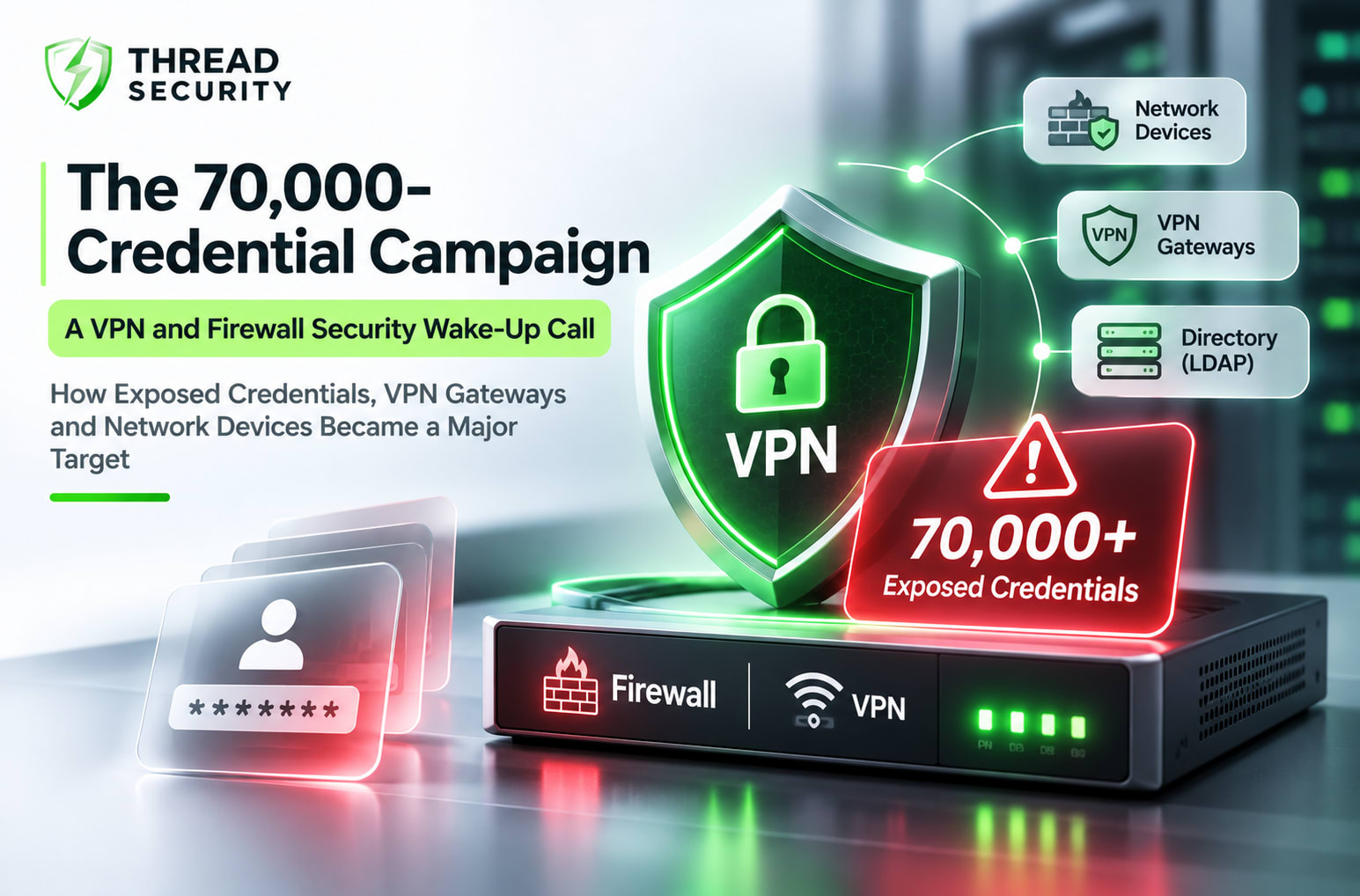
VPN security is no longer just about encrypting remote connections. A VPN gateway or firewall can also become an entry point into an organisation's internal network when its credentials, configuration, or authentication controls are compromised. In October 2026, cybersecurity researchers Group-IB and NyxLab published findings about a campaign attributed to a threat actor tracked as k0t. Their investigation identified more than 70,000 exposed credentials and related records associated with network devices and directory data. The campaign is a reminder that securing the network perimeter means protecting the identities and systems behind it—not simply keeping a VPN service online.
What Happened in the 70,000-Credential Campaign?
In an investigation published on October 21, 2026, Group-IB and NyxLab described a large-scale operation targeting internet-facing network edge devices. The researchers tracked the threat actor as k0t, also known by names including CryptoFeel, Member19, and QazWsxShop.
The campaign involved Fortinet FortiGate firewalls, Fortinet FortiWeb appliances, and Palo Alto Networks GlobalProtect systems. The researchers reported finding more than 70,000 exposed credentials and related records, including network-device credentials and LDAP data.
That number needs context. It represents exposed credential records and associated data, not 70,000 confirmed victim organisations. It also does not establish that every record represents a working password today. Organisations should treat the finding as a serious exposure warning without interpreting the headline figure as a precise count of successful company breaches.
The investigation also described persistent access to corporate networks, remote-management tools, and data exfiltration activity. Some affected organisations later appeared on ransomware leak sites associated with Qilin and The Gentlemen. However, Group-IB and NyxLab explicitly stated that the relationship between the campaign operators and those ransomware groups was not confirmed.
Why VPN Gateways and Firewalls Are Valuable Targets
VPN gateways and firewalls sit at important points between the public internet and internal business systems. They manage remote access, enforce network policies, and may store or use credentials that connect to identity infrastructure such as Active Directory or LDAP.
When attackers gain administrative access to an edge device, the consequences can extend beyond that appliance. Depending on its configuration and permissions, an intruder may be able to access stored credentials, alter security settings, create accounts, or use the device as a stepping stone towards other systems.
This is why a compromised VPN gateway should not be treated as an isolated hardware issue. It can become an identity-security problem, a network-security problem, and potentially an incident affecting the wider organisation.
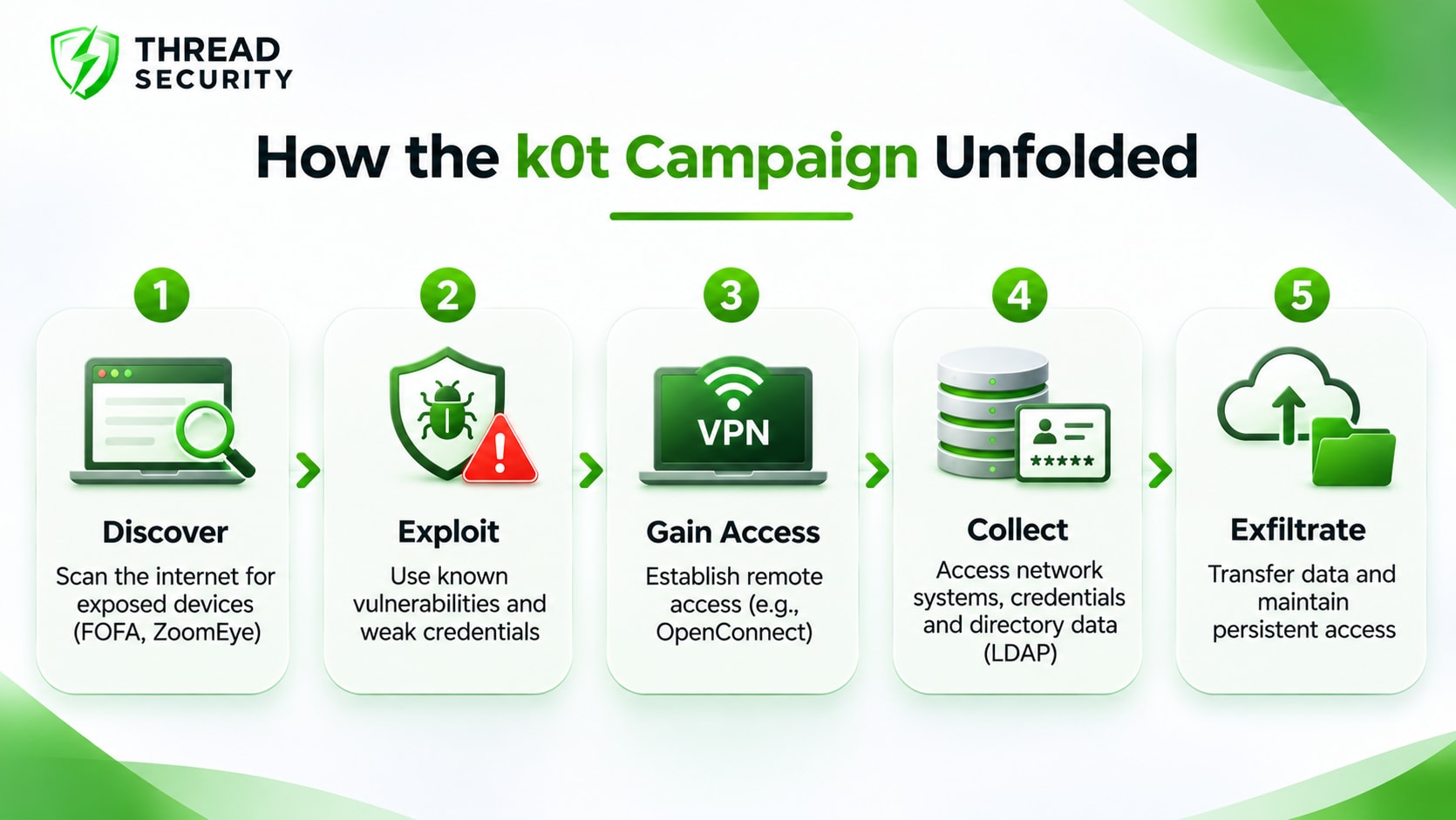
How the k0t Campaign Gained Access
Group-IB and NyxLab described several methods used against exposed devices. The investigation included bulk discovery of internet-facing systems, exploitation of known vulnerabilities, and password-guessing activity. The methods differed by product, so it would be inaccurate to suggest that one vulnerability affected every device in the campaign.
1. Discovering exposed devices
The researchers reported the use of internet-scanning platforms such as FOFA and ZoomEye to identify reachable network appliances. These services can help security teams discover their own exposed infrastructure, but attackers can also use them to locate devices that may have weak configurations or vulnerable software.
An organisation may believe its internal network is protected while an administrative interface or remote-access portal remains unnecessarily accessible from the internet. Asset discovery and external attack-surface monitoring are therefore important parts of network defence.
2. Exploiting known weaknesses and weak credentials
The investigation described attempts involving CVE-2025-64446, a FortiWeb vulnerability, and CVE-2026-0257, affecting certain Palo Alto Networks PAN-OS GlobalProtect configurations. It also reported brute-force activity against FortiGate devices.
These are different products and different attack paths. FortiWeb's vulnerability should not be confused with a FortiGate vulnerability, and the GlobalProtect issue has its own affected configuration conditions. Organisations must check the relevant vendor advisories and determine whether their specific versions and configurations are affected.
The broader lesson is that attackers do not always need a previously unknown zero-day vulnerability. Exposed management interfaces, weak passwords, reused credentials, and unpatched software can provide opportunities for intrusion.
3. Maintaining access after initial compromise
The researchers described the use of OpenConnect VPN connections, remote monitoring and management tools, and command-and-control tooling to maintain access and interact with compromised environments. They also reported evidence of data being transferred out of some environments.
Remote administration tools are not inherently malicious. Businesses use them for legitimate IT support. The security concern arises when unknown tools appear, approved tools are abused, or remote access is established without a valid business reason.
What Is the Difference Between Credential Exposure and a Confirmed Breach?
Credential exposure means authentication information or related records have become accessible to an unauthorised party. A confirmed breach requires evidence that an organisation's systems or data were actually accessed or compromised.
These terms should not be used interchangeably. A leaked record may be old, duplicated, incomplete, or no longer valid. At the same time, a credential that remains active can create a serious risk, particularly when it provides administrative access or is reused across multiple systems.
Organisations should investigate exposed credentials rather than assume either that every record is usable or that old records can be ignored. The correct response depends on the account, device, access privileges, logs, and evidence available.
How Organisations Should Strengthen VPN Security
1. Review internet-facing access
Identify every firewall, VPN gateway, and management interface reachable from the internet. Disable unnecessary exposure and restrict administrative access to trusted networks, approved source addresses, or dedicated management paths. Maintain an accurate inventory of edge devices, their owners, software versions, and business purpose.
2. Patch affected systems
Review the official Fortinet and Palo Alto Networks security advisories for the vulnerabilities relevant to your products. Apply the vendor-recommended updates and configuration changes. Do not assume that changing a password fixes a vulnerable authentication mechanism, or that installing a patch automatically removes an attacker's existing access.
3. Reset credentials and terminate suspicious sessions
If a device may have been compromised, review and rotate its administrative credentials, VPN accounts, directory bind accounts, and other secrets stored in or accessible through its configuration. Terminate active sessions where appropriate. Investigate whether credentials were reused elsewhere and rotate those accounts too.
4. Enforce multifactor authentication
Enable multifactor authentication for remote access and administrator accounts wherever supported. MFA can reduce the risk associated with stolen or guessed passwords, but it is not a universal solution. Authentication bypass vulnerabilities and compromised sessions may require additional controls.
5. Monitor logs and configuration changes
Review authentication logs, administrator activity, VPN connections, configuration exports, account creation, and unexpected remote-management software. Look for access from unfamiliar locations, unusual login patterns, and changes that do not match approved maintenance activity. Preserve relevant logs and device configurations before rebuilding or resetting a potentially compromised appliance.
6. Check for persistence and lateral movement
Changing passwords may not be enough if an attacker has established another route into the network. Investigate connected identity systems, endpoint activity, remote-management tools, and unusual outbound data transfers. If compromise is suspected, involve qualified incident responders and follow a documented recovery process.
Why This Incident Matters for Indian Businesses
Indian businesses increasingly depend on remote access for employees, service providers, cloud operations, and distributed IT teams. That makes VPN gateways and identity infrastructure important security assets. A weakness in a single externally accessible appliance can create consequences for internal applications, business data, and connected services.
Organisations should maintain an accurate external asset inventory, follow vendor advisories, enforce MFA, restrict administrative access, and test incident-response procedures. They should also review third-party access because service providers and managed IT partners may hold privileged connectivity into multiple customer environments.
The Cyber Security Agency of Singapore's June 22, 2026 advisory about the separate FortiBleed credential-compromise activity also recommended terminating sessions, resetting credentials, enabling MFA, reviewing logs, and restricting external management access. That earlier FortiGate-focused activity is distinct from the broader k0t campaign reported by Group-IB and NyxLab in October. Both reinforce the importance of protecting exposed network devices and the credentials associated with them.
How Thread Security and Thread Security Education Fit In
At Thread Security, incidents involving exposed network devices highlight why organisations need to look beyond basic perimeter protection. Security assessments and VAPT help businesses identify weaknesses in exposed infrastructure, authentication controls, and network configurations before those weaknesses are abused. Thread Security Education supports the learning side of this challenge by helping learners build practical foundations in cybersecurity, network security, ethical hacking, and vulnerability assessment. Understanding how real incidents develop—from exposed services to compromised credentials—helps security professionals make better defensive decisions and apply security controls more effectively.
Conclusion: Your VPN Is Only as Secure as the Access Behind It
The campaign involving more than 70,000 exposed credential records demonstrates the importance of securing internet-facing firewalls, VPN gateways, and identity systems. The key issue is not simply the number of records reported. It is how exposed credentials and vulnerable edge devices can provide a path into wider corporate networks.
Businesses should treat VPN security as part of a broader identity and network-security strategy. Keep appliances updated, reduce internet exposure, enforce MFA, rotate potentially compromised credentials, monitor administrative activity, and investigate signs of persistence. A secure remote-access gateway is not just a connection point—it is a critical boundary protecting the organisation behind it.
References and Further Reading
Group-IB and NyxLab — Stray Cat, Open Doors: How k0t Wanders Through the Network Edge, October 21, 2026: https://www.group-ib.com/blog/stray-cat-network-edge/
Cyber Security Agency of Singapore — Advisory on Credential Compromise of FortiGate Devices ("FortiBleed"), June 22, 2026: https://www.csa.gov.sg/alerts-and-advisories/advisories/ad-2026-007/
Fortinet — FortiGuard PSIRT security advisories: https://www.fortiguard.com/psirt
Fortinet — Analysis of Reported Credential Compromise of FortiGate Devices: https://www.fortinet.com/blog/psirt-blogs/analysis-of-reported-credential-compromise-of-fortigate-devices
Palo Alto Networks — Security Advisories: https://security.paloaltonetworks.com/
Strengthen Your Network Security
Is your organisation confident that its VPN gateways, firewalls, and remote-access accounts are properly protected? Explore Thread Security for cybersecurity and VAPT-related services, and visit Thread Security Education to develop practical cybersecurity knowledge. Learn how to identify vulnerabilities, protect critical access points, and build stronger security practices before attackers find the weaknesses. Take the next step towards a more secure digital environment today.
Akshay Kumar
VERIFIEDAcademic Coordinator · Thread Security
Faculty mentor & research guide at Thread Security Education.