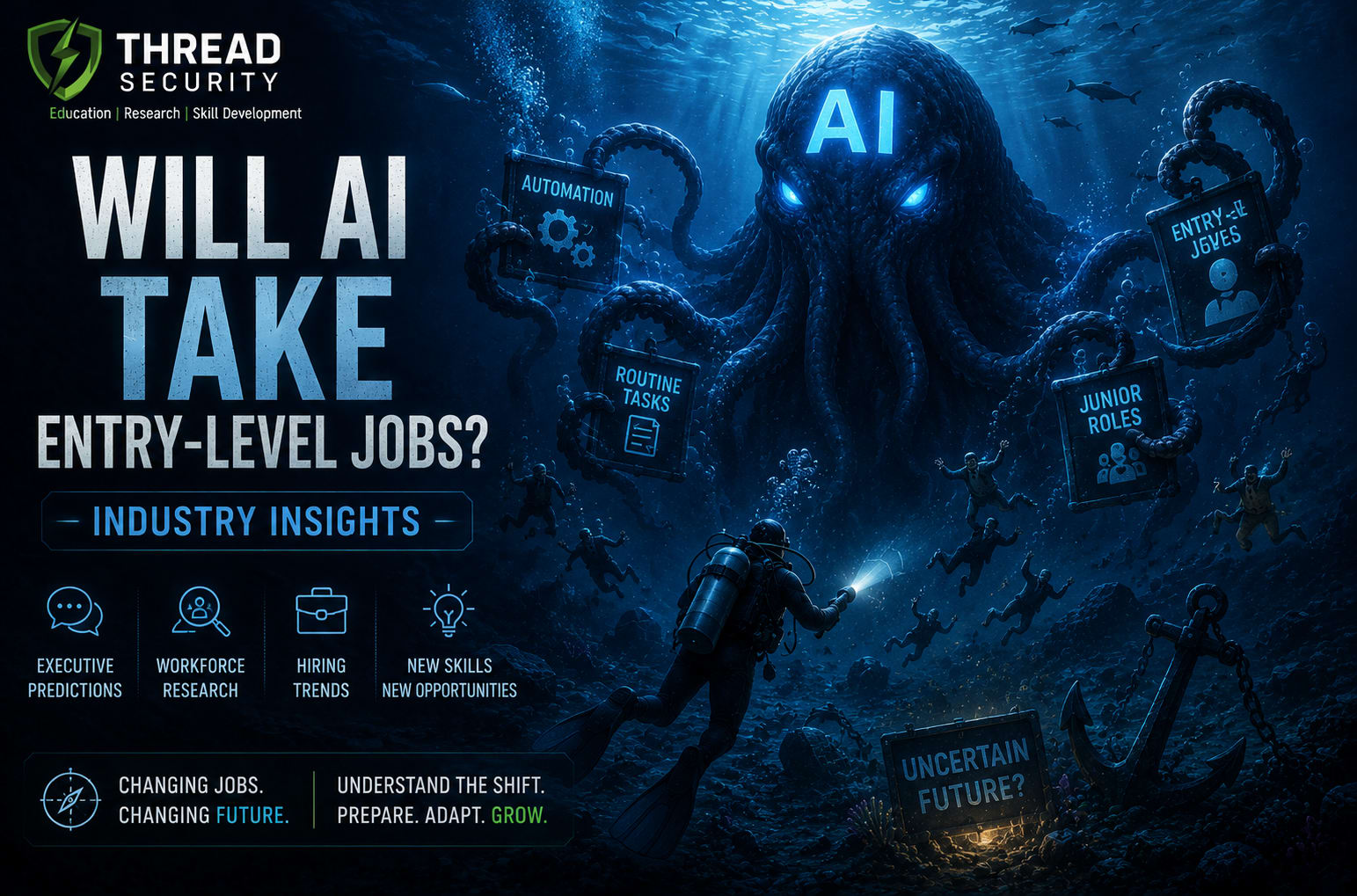
Will AI Take Entry-Level Jobs? The Industry Evidence
Will AI take entry-level jobs? This question is becoming increasingly important as businesses adopt artificial intelligence to automate tasks, improve productivity and redesign workflows. Technology leaders disagree about the scale of potential job losses, while workforce research suggests that traditional junior responsibilities and new opportunities may be changing simultaneously. The debate is no longer limited to what AI can do; it now concerns how businesses will organize work, recruit talent and develop the next generation of professionals.
Predictions from Anthropic CEO Dario Amodei, Google DeepMind CEO Demis Hassabis, Google CEO Sundar Pichai and NVIDIA CEO Jensen Huang reveal different views of the transition. Research from ISC2 adds evidence from the cybersecurity profession, where AI is already influencing daily workflows.
For the industry, the central question is not simply whether AI can perform a task previously assigned to a junior employee. It is whether businesses will eliminate that task, redesign the role around new responsibilities, expand their output or create entirely different services. These outcomes can occur simultaneously across different sectors.
1. Dario Amodei’s Warning: Entry-Level White-Collar Work Is Exposed
In a May 2025 interview with Axios, Dario Amodei warned that AI could eliminate up to half of entry-level white-collar jobs and potentially push unemployment to between 10% and 20% within one to five years. He highlighted technology, finance, law, consulting and other professions involving substantial amounts of digital knowledge work.
His warning centres on the improving ability of AI systems to perform tasks such as drafting documents, writing code, summarizing research and processing structured information. These activities frequently appear in junior positions because they help new employees learn professional workflows while contributing to a team's output.
From a business perspective, the incentive to automate is understandable. If a team can complete the same amount of work with fewer manual steps, management may reconsider recruitment plans. Companies could slow hiring, combine responsibilities or expect existing employees to supervise AI-assisted workflows.
However, Amodei's figures are a prediction, not evidence that half of entry-level jobs have already disappeared. Actual outcomes will depend on the speed of AI adoption, the reliability of available systems, economic conditions, customer demand and whether businesses develop new products and services.
Industry takeaway: organizations need to assess which tasks can be automated, which responsibilities still require human judgement and how junior employees will gain experience if traditional assignments become less common.
2. Demis Hassabis: The Junior Hiring Pipeline Could Change
At the World Economic Forum in Davos in January 2026, Google DeepMind CEO Demis Hassabis discussed the possibility that AI's effects would begin appearing in junior roles, entry-level positions and internships. He referred to signs of a slowdown in hiring at that level.
This raises a structural concern for employers. Entry-level jobs are not merely the least senior positions in an organization; they are part of the process through which industries develop experienced professionals. Junior developers learn debugging, analysts learn to interpret data, and cybersecurity trainees learn to recognize suspicious activity through repeated exposure to real situations.
If AI automates some of these early tasks, employers may expect new hires to contribute at a higher level from the beginning. That could improve productivity, but it may also create a mismatch between the experience companies expect and the opportunities candidates have had to acquire it.
The issue is therefore larger than the number of vacancies. It concerns how organizations train new workers, assess competence and create pathways from education into experienced professional roles.
Industry takeaway: businesses may need to redesign internships, graduate programmes and supervised project work rather than rely entirely on routine junior assignments to develop talent.
3. Sundar Pichai: AI Adoption Requires Adaptation
Google CEO Sundar Pichai has consistently discussed AI as a major technological shift with the potential to change how people work and how businesses operate. Google's expansion of AI capabilities, including increasingly integrated AI assistants, reflects an industry moving beyond isolated demonstrations towards tools embedded in everyday workflows.
For businesses, the potential benefits include faster software development, improved information retrieval, automated document processing and more efficient customer support. AI can also help employees explore ideas and complete tasks that previously required more specialized resources.
However, higher productivity does not automatically translate into more employment. A business may use efficiency gains to expand its services, improve quality, reduce costs or deliver the same output with fewer employees. The outcome depends on its strategy and the demand for its products.
AI adoption also creates new management responsibilities. Companies must decide which tasks can be delegated to automated systems, how outputs will be checked and who remains accountable when something goes wrong.
Industry takeaway: the success of AI adoption should be measured through business outcomes, workforce planning and service quality—not merely by how many tasks an AI tool can complete.
4. Jensen Huang’s Counterargument: Productivity Can Create Demand
NVIDIA CEO Jensen Huang has challenged highly pessimistic predictions about AI-driven job losses. In June 2025, he publicly disagreed with Amodei's prediction that AI could automate up to half of entry-level office jobs within five years. Huang has argued that productivity improvements can enable businesses to do more and may create additional demand for people and services.
The economic reasoning is worth considering. When technology reduces the cost of developing a product or delivering a service, businesses may find opportunities that were previously too expensive. Smaller teams might build software, more organizations might adopt analytics, and new services could emerge around integrating and maintaining AI systems.
For example, a company that previously lacked the resources to build an internal analytics tool might use AI-assisted development to create one. That project can still require people to define requirements, validate data, test the application, secure access and maintain the finished system.
Nevertheless, productivity-led job creation is not guaranteed. New opportunities may require different skills, arise in different sectors or appear in different locations from the jobs affected by automation. Some workers may also face a difficult transition before those opportunities become accessible.
Industry takeaway: leaders should examine both sides of AI adoption: which costs and tasks can be reduced, and which new products, services and markets may become possible as a result.
5. What ISC2’s 2026 Research Reveals About Cybersecurity
Executive predictions provide one view of the future. Workforce research can help reveal how professionals perceive changes occurring in their own fields.
In May 2026, ISC2 surveyed 856 cybersecurity professionals who use AI in their roles. Its findings, published in July 2026, show why the employment debate cannot be reduced to a simple claim that AI either destroys or creates entry-level jobs.
56% of participants said AI had somewhat or significantly reduced the need for entry-level positions over the previous year.
53% of participants believed AI was creating new types of entry-level roles.
62% of participants did not believe AI had reduced the need for foundational cybersecurity skills.
63% of participants reported spending more time reviewing or validating AI outputs.
65% of participants reported spending more time deciding when to trust or act on AI-generated recommendations.
These findings illustrate two developments occurring together. AI can accelerate repetitive activities such as alert triage, log analysis, report generation and vulnerability prioritisation. At the same time, professionals may need to devote more attention to interpreting results, validating recommendations and making decisions.
The figures must be interpreted carefully. They represent the views and experiences of surveyed cybersecurity professionals who use AI, not a count of all vacancies created or eliminated. They do not establish the net employment effect across cybersecurity or the wider economy.
Nevertheless, the findings raise an important question for the industry: if AI handles more of the routine work through which junior professionals gain experience, how will organizations develop the next generation of practitioners?
Industry takeaway: cybersecurity employers need to balance operational efficiency with talent development. Foundational knowledge, human oversight and the ability to investigate unfamiliar situations remain essential even when AI assists with routine analysis.
6. Which Parts of Entry-Level Work Are Changing?
The impact of AI is better understood at the task level than by labelling entire occupations as safe or doomed. Most jobs combine routine activities with communication, judgement, collaboration and accountability. AI may automate one part of a role while leaving other responsibilities dependent on people.
Industry area | Potential AI-driven change | Continuing business requirement |
|---|---|---|
Software development | Code generation, test creation and documentation | Debugging, architecture, security and code review |
Data and analytics | Data summaries, transformations and initial analysis | Data quality, interpretation and validation |
Customer operations | Automated responses and routine request handling | Complex cases, empathy and service accountability |
Finance and administration | Document processing and report preparation | Compliance, accuracy and exception handling |
Cybersecurity | Assisted alert triage and investigation | Threat assessment, validation and incident decisions |
AI engineering | Faster prototyping and code assistance | Evaluation, integration, monitoring and reliability |
This comparison describes plausible workflow changes rather than a measured ranking of job losses. The effect in each organization will depend on the technology adopted, the quality of implementation and the consequences of making an error.
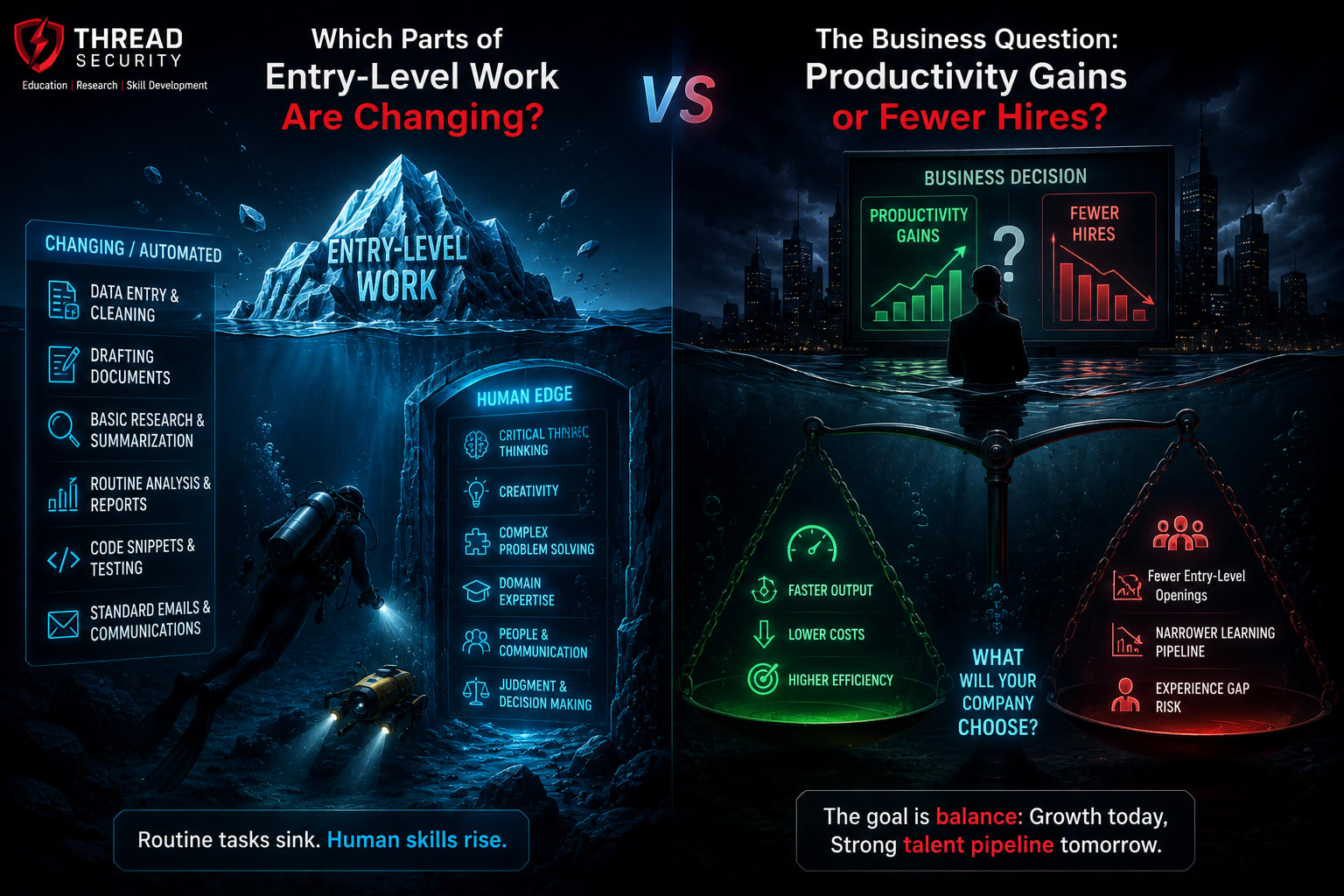
7. The Business Question: Productivity Gains or Fewer Hires?
One reason the AI employment debate remains unsettled is that productivity and employment are different measures. If an AI system allows an employee to complete a task in half the time, the organization has gained efficiency. What happens next is a business decision.
A company might reduce recruitment, increase output, improve customer service, lower prices or redirect employees towards more complex work. If lower costs create additional demand, the business may expand. If demand remains unchanged, it may need fewer people to maintain the same output.
Several factors influence the outcome:
Adoption costs: implementing AI requires infrastructure, integration, governance and ongoing maintenance.
Reliability: errors can create additional review work or significant business risks.
Market demand: productivity gains may enable growth when customers want more of a product or service.
Workforce strategy: employers decide whether efficiency gains lead to expansion, redeployment or reduced recruitment.
Training capacity: organizations need ways to develop people for responsibilities that remain or emerge.
For this reason, AI's employment impact cannot be measured through product demonstrations or executive forecasts alone. Researchers and businesses need to examine actual hiring patterns, role changes, workforce data and the longer-term demand for products and services.
8. The Emerging Challenge: Who Trains Tomorrow’s Workforce?
A less visible consequence of automation may be the weakening of traditional learning pathways. If junior employees are given fewer routine tasks, organizations must find other ways to teach them professional judgement, troubleshooting and accountability.
Businesses can respond through supervised projects, structured mentoring, realistic simulations and clear performance assessments. Instead of measuring a junior employee only by the number of tasks completed, employers can evaluate how effectively the employee identifies problems, validates AI-generated work and explains decisions.
Educational institutions and training providers also have a role. Technical education should connect foundational concepts with realistic projects and industry workflows. Learners need to understand how AI tools work, where they fail, how to verify outputs and how to handle information responsibly.
For cybersecurity in particular, AI adoption creates a strong reason to preserve hands-on learning. Professionals need to understand networks, operating systems, access controls and threat behaviour before they can reliably judge an automated security recommendation.
The objective should not be to compete with AI at every repetitive task. It should be to develop professionals who can use AI effectively while bringing technical understanding, judgement and accountability to their work.
Conclusion: Will AI Take Entry-Level Jobs?
The evidence does not support a simple yes-or-no answer. Amodei warns of substantial displacement, while Hassabis highlights possible pressure on junior hiring and internships. Pichai's broader outlook emphasis adaptation to increasingly capable AI systems, while Huang argues that productivity can expand economic opportunities. ISC2's research shows that cybersecurity professionals perceive both reduced demand for some traditional entry-level positions and the emergence of new types of roles.
These perspectives are not equivalent forms of evidence. Executive statements describe opinions or forecasts; ISC2's percentages describe the experiences and views of a specific survey population. Neither can establish the exact net effect of AI on all entry-level employment.
What is clear is that AI is changing the economics of digital work, the tasks assigned to junior employees and the skills businesses may seek. The outcome will depend on how organizations adopt the technology, whether new demand develops and how effectively workers are prepared for changing responsibilities.
For industry leaders, the challenge is to capture productivity benefits without overlooking workforce development. For educators, it is to provide practical and adaptable learning. For early-career professionals, it is to build technical foundations and learn to evaluate AI outputs rather than rely on them blindly.
Develop Practical AI Skills with Thread Security Education
Understanding industry change is an important starting point, but practical experience helps learners apply that understanding. Thread Security Education supports technical learning in areas including Python, data science, machine learning, artificial intelligence and cybersecurity.
For learners exploring AI courses, training programmes or internship opportunities in Jalandhar, connect with Thread Security to learn about current offerings and opportunities.
As AI reshapes the workplace, the objective is not simply to learn a collection of tools. It is to develop the technical foundations, judgement and practical ability needed to contribute as technologies and industry expectations evolve.
Call to Action
Select one sector, create one little documented project this month and compare against live job listings. For those who require their AI systems to be tested, check out Thread Security. Enhance AI and security capabilities in Jalandhar with Thread Security Education.
Simranjit Kaur
VERIFIEDAI Trainer · Thread Security
Faculty mentor & research guide at Thread Security Education.