AI replace ethical hackers? It is a question that matters to cybersecurity students, penetration testers, security researchers, and organizations trying to protect increasingly complex systems. AI tools can already help analyze code, summarize security findings, generate test ideas, and process large volumes of technical information. But that does not automatically mean an AI system can take responsibility for a complete security assessment.
The more useful question is not whether artificial intelligence will replace every ethical hacker. It is which tasks AI can automate, which tasks still need skilled human judgment, and how security professionals should adapt. Research from ISC2, the World Economic Forum, and the US National Institute of Standards and Technology (NIST) offers useful context. The evidence points to a changing profession rather than a simple, universal replacement story.
1. What Does an Ethical Hacker Actually Do?
An ethical hacker is authorized to examine systems, applications, networks, or other digital assets for security weaknesses. Depending on the engagement, the work may include reconnaissance, attack-surface mapping, vulnerability validation, controlled exploitation, privilege testing, business-logic analysis, and reporting. The objective is to identify and explain weaknesses so that the organization can fix them before they are abused.
Professional penetration testing is more than running a scanner and copying its output into a report. Testers must understand the agreed scope, respect authorization boundaries, consider operational risks, distinguish exploitable vulnerabilities from false positives, and communicate the potential impact in language that developers and decision-makers can act on.
For example, an automated tool might identify a potentially exposed endpoint. A skilled tester must determine whether the finding is real, whether access controls can be bypassed, what data or functions are actually exposed, and whether further testing is permitted. The technical result matters, but so do context, evidence, safety, and clear reporting.
2. Where AI Is Already Helping Ethical Hackers
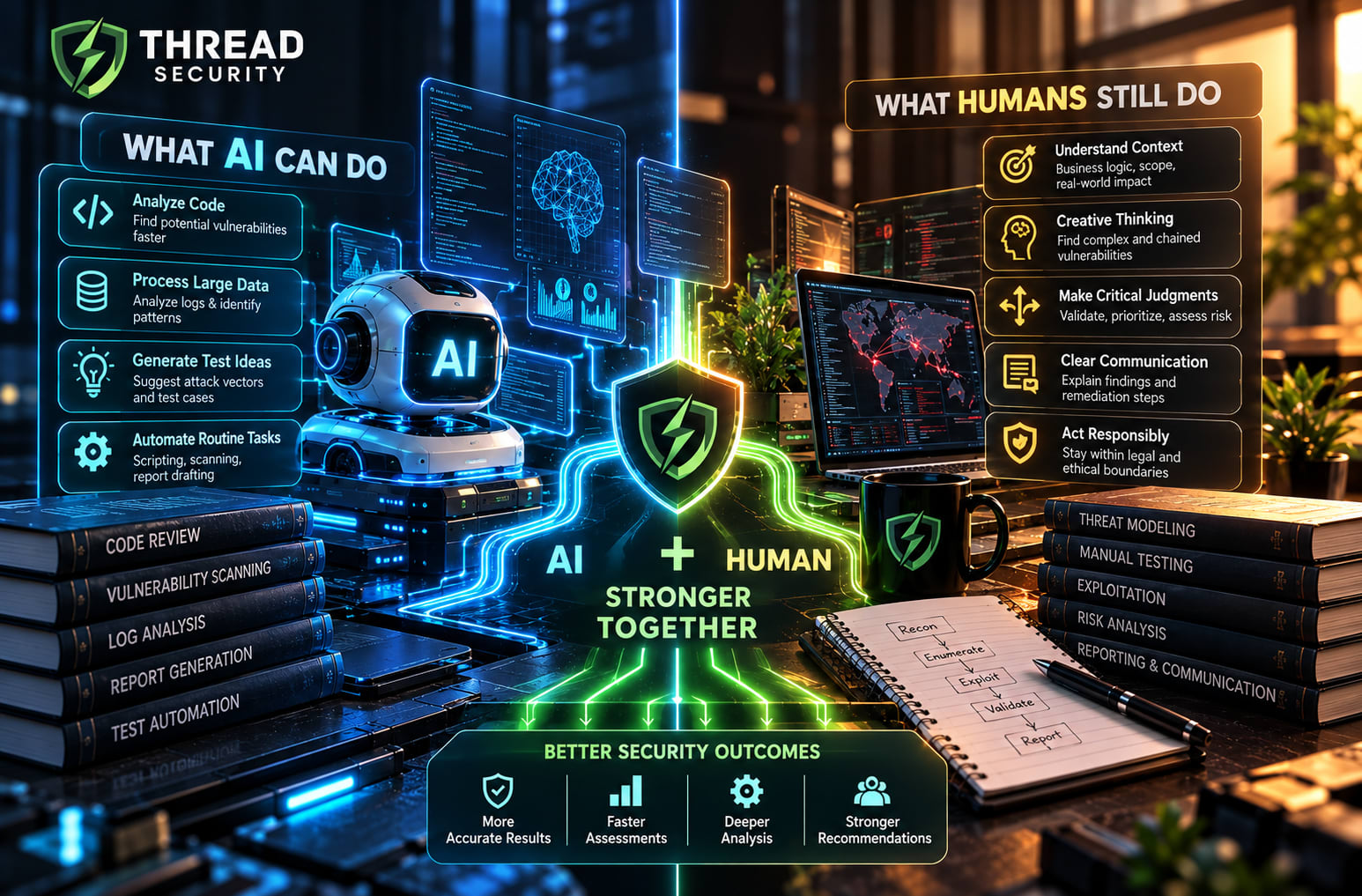
AI can make parts of security work faster, particularly when a task involves reviewing large amounts of text, code, logs, or structured information. Its usefulness depends on the quality of the input, the tool's capabilities, the environment being tested, and the human review process.
Code review and vulnerability discovery
AI-assisted development and security tools can help reviewers inspect code, explain suspicious patterns, suggest possible weaknesses, and generate ideas for further testing. These suggestions can help a tester investigate unfamiliar code more efficiently. They should not be treated as proof that a vulnerability exists or that an application is secure.
Test planning and scripting
AI assistants can help draft scripts, explain command output, create test cases, and adapt examples to a particular technical task. This can reduce time spent on routine preparation. However, generated code may contain errors, unsafe assumptions, or unsuitable commands. It should be reviewed and tested in an authorized environment before use.
Log analysis and vulnerability prioritization
Security teams often have more findings and events than they can investigate immediately. AI-assisted systems can help summarize information, group similar observations, and identify items that deserve closer review. Prioritization still requires reliable asset information, business context, threat intelligence, and validation of the underlying evidence.
Reporting and documentation
AI can help organize notes, explain technical concepts, and prepare an initial report structure. The tester remains responsible for ensuring that the report accurately reflects what was tested, what evidence was collected, what limitations applied, and which remediation steps are appropriate. An impressive-sounding report is not useful if its claims are inaccurate.
3. What Does the Evidence Say About AI and Cybersecurity Jobs?
It is important to separate research findings from predictions about the future. No single survey can establish exactly how many ethical hacking jobs AI will eliminate, and results from a broad cybersecurity workforce study should not be presented as a specific forecast for penetration testers.
ISC2: Cybersecurity work is changing
ISC2's 2025 Cybersecurity Workforce Study discusses how AI is affecting cybersecurity responsibilities, skills, and operational practices. The study describes professionals using AI to support work and adapting to new technical demands. It also highlights the importance of learning how to work with AI and address the security risks associated with its use.
The findings should not be interpreted as proof that every cybersecurity role is safe from automation. Nor do they establish that ethical hackers will disappear. They provide evidence that AI adoption is changing workflows and the skills professionals need to remain effective.
World Economic Forum: Cybersecurity skills remain important
The World Economic Forum's Future of Jobs Report 2025 identifies AI and big data, networks and cybersecurity, and technological literacy among the skills expected to grow in importance through 2030. These are employer expectations across the wider labor market, not a guarantee of hiring outcomes for any single job title.
The practical takeaway is that professionals should not treat AI knowledge and cybersecurity knowledge as competing choices. Understanding how systems work, how attackers exploit weaknesses, and how to validate security controls remains valuable when combined with the ability to evaluate AI-assisted findings.
NIST: AI introduces both opportunities and risks
The US National Institute of Standards and Technology explains that AI can support cybersecurity capabilities while also creating new risks and changing the defensive measures organizations need. Its Cybersecurity, Privacy, and AI program addresses both responsible use of AI for protection and the need to adapt to AI-enabled offensive techniques.
This matters for ethical hackers because AI systems themselves need security assessment. Organizations must consider how models, data, integrations, access controls, and connected applications could be misused or attacked. AI therefore creates additional areas of security work even as it changes existing tasks.
4. What AI Still Cannot Be Assumed to Do Reliably
AI capabilities vary significantly between tools and tasks. A model that explains a code snippet well may still misunderstand the architecture of a complete application. A tool that identifies a familiar vulnerability pattern may miss a business-logic flaw that depends on a specific sequence of actions.
Several challenges explain why human oversight remains important:
Business context: Security testing often depends on understanding user roles, workflows, data sensitivity, and the real-world consequences of a weakness.
False positives and missed issues: Automated suggestions need validation. A finding can be incorrect, incomplete, duplicated, or missing important context.
Novel attack paths: Unusual combinations of weaknesses may require creative reasoning, experimentation, and knowledge of the target system.
Scope and authorization: A tester must know what is permitted and avoid testing that could damage systems, expose data, or interrupt services.
Accountability: Organizations need people who can explain the evidence, document limitations, communicate risk, and make responsible decisions.
Confidentiality: Sensitive source code, credentials, customer data, and internal system details should not be pasted into an AI service without checking the organization's policies and the tool's data-handling terms.
These are not claims that AI will never improve at such tasks. They are reasons to assess a tool against the actual testing requirement rather than assuming that an AI-generated answer is correct simply because it sounds convincing.
5. Will AI Replace Entry-Level Ethical Hackers First?
This is a reasonable concern because some early-career tasks are repetitive and well-defined. Basic scan review, initial documentation, simple code explanations, and routine information gathering may be accelerated by automation. The degree of change depends on the employer, the type of engagement, the maturity of the tools, and the quality controls around their use.
That does not mean beginners should avoid ethical hacking. It means that learning only a few commands or relying on automated scanners is a weak long-term strategy. New professionals need to understand why a test works, how to verify its result, what the limitations are, and how to explain the security impact.
For someone entering the field, practical knowledge is especially important. Build a foundation in networking, Linux, Windows, HTTP, authentication, web application architecture, and scripting. Then practise in intentionally vulnerable labs or other environments where testing is explicitly authorized. Learn to reproduce findings, collect evidence, write remediation advice, and explain what you could not verify.
6. Skills Ethical Hackers Should Build in the AI Era
Rather than competing with AI at every repetitive task, security professionals can learn to use it carefully while developing skills that help them validate and interpret its output.
Strong technical foundations
Understand TCP/IP, DNS, HTTP, operating systems, identity and access management, databases, and web application security. Learn how common vulnerability classes work, including injection, broken access control, authentication weaknesses, security misconfiguration, and insecure handling of sensitive data. The OWASP Top 10 is a useful starting point for understanding prominent web application security risks.
Manual testing and verification
Practise validating scanner results, testing authorization boundaries, reviewing application logic, and documenting reproducible evidence. Learn when a result is inconclusive and when further testing would exceed the agreed scope. These habits help distinguish a credible security assessment from an unverified list of tool output.
Automation and AI literacy
Learn enough Python or another scripting language to automate repeatable tasks and inspect results. Experiment with AI-assisted code review, test-case generation, and report drafting using safe sample data. Check the output against documentation and independent tests. Understand that generated code can be insecure and that AI systems may produce plausible but incorrect explanations.
Communication and risk analysis
Technical findings need to lead to decisions. Practise explaining severity, likelihood, business impact, and remediation options to both technical and non-technical audiences. A useful report identifies the evidence, affected component, conditions required for exploitation, and a realistic path to fixing the issue.
Responsible and authorized practice
Ethical hacking requires explicit permission and a defined scope. Use training labs, personal systems, or environments where you have clear authorization. Do not scan, exploit, or access systems simply because a tool makes it easy. Responsible testing is a professional requirement, not an optional extra.
7. How to Use AI Without Depending on It Blindly
A practical workflow combines automation with human verification:
Define the scope: Confirm written authorization, targets, test limits, data-handling rules, and reporting requirements.
Plan the assessment: Identify assets, technologies, likely risks, and test cases. Use AI suggestions as ideas to review, not as the final plan.
Run approved tools: Use appropriate scanners and testing methods within the agreed boundaries.
Validate findings: Reproduce results safely, inspect supporting evidence, and rule out false positives where possible.
Assess impact: Consider the affected users, data, privileges, business process, and realistic exploitation conditions.
Write and review the report: Check every claim, remove unsupported conclusions, and provide actionable remediation guidance.
Retest after remediation: Where the engagement includes retesting, verify whether the reported weakness has been addressed and document any remaining limitations.
This workflow treats AI as an assistant within a controlled security process. It does not give an AI system unlimited permission to act, and it does not remove the tester's responsibility for the final assessment.
8. How Thread Security and Thread Security Education Fit In
For people preparing for a career in cybersecurity, the most useful response to AI-driven change is structured learning combined with practical work. Thread Security focuses on cybersecurity and security testing, while Thread Security Education supports learners who want to build technical understanding and develop job-relevant skills. As AI tools become more common, learning the fundamentals of ethical hacking, vulnerability assessment and penetration testing (VAPT), web application security, and responsible testing becomes even more important.
When exploring training opportunities, look for hands-on exercises, clearly defined lab environments, feedback on findings, report-writing practice, and guidance on ethical boundaries. AI can be part of that learning process, but it should not replace understanding the underlying technology or verifying what a tool reports. Learners should also assess any course against their own goals, syllabus, practical requirements, and available support before enrolling.
Conclusion: Will AI Replace Ethical Hackers?
Current evidence does not justify a confident claim that AI will completely replace ethical hackers. It does support a more careful conclusion: AI is changing cybersecurity workflows, helping automate some tasks, and increasing the importance of adapting technical skills. The effect on individual jobs will vary as tools, employers, and security requirements evolve.
Ethical hackers who understand systems deeply, validate findings, think critically, communicate risk, and use AI responsibly will be better prepared for this changing environment than those who rely only on tools or memorized commands. The goal is not to ignore AI or trust it blindly. It is to combine useful automation with sound security judgment.
Ready to Build Your Cybersecurity Skills?
If you want to move into ethical hacking or strengthen your existing skills, start with the fundamentals and practise in authorized labs. Explore the cybersecurity learning resources and training opportunities from Thread Security Education, and learn more about Thread Security and its cybersecurity focus. Review the available program details, choose a learning path that matches your goals, and take the next step toward becoming a security professional who can work effectively in an AI-enabled world.
References and Further Reading
Akshay Kumar
VERIFIEDAcademic Coordinator · Thread Security
Faculty mentor & research guide at Thread Security Education.