Cybersecurity, ethical hacking and information security are three terms frequently used in conversations about digital protection. They are closely related, but they do not mean the same thing. A company may hire a cybersecurity professional to protect its network, an information security manager to establish policies for protecting sensitive records, and an ethical hacker to test whether its applications can be compromised. Each role addresses a different part of the security challenge.
Understanding the difference matters whether you are choosing a cybersecurity career, building an organisation's security programme or simply trying to understand the industry. The terms overlap in practice, and organisations may use job titles differently, but their underlying purposes can be separated. This guide explains what each field covers, how they work together, and which skills are useful in each area.
What Is Cybersecurity?
Cybersecurity is the practice of protecting computers, networks, applications, digital services and the information they process from cyber threats. It includes the measures used to prevent attacks, detect suspicious activity, respond to incidents and restore systems after disruption.
The National Institute of Standards and Technology (NIST) describes cybersecurity in terms of protecting and restoring computers, electronic communications systems and the information they contain. This is broader than simply installing antivirus software or configuring a firewall. It involves people, processes, technology and risk management.
For example, when a business protects its cloud infrastructure, secures employee accounts with multi-factor authentication, monitors network activity and investigates suspicious logins, it is carrying out cybersecurity activities. The objective is to reduce the likelihood and impact of attacks while maintaining the availability and reliability of digital services.
What Is Information Security?
Information security, often shortened to InfoSec, focuses on protecting information and the systems used to store, process and transmit it. The information may be digital, printed on paper or communicated through other formats. Its protection is not limited to computers or internet-connected devices.
NIST's security terminology describes information security through three central principles: confidentiality, integrity and availability. These are commonly known as the CIA triad.
1. Confidentiality
Confidentiality means ensuring that information is accessible only to authorised people or systems. Access controls, encryption, identity management and data classification are examples of measures that support confidentiality.
2. Integrity
Integrity means protecting information against unauthorised or improper modification or destruction. For example, a financial record should not be altered by someone without permission. Access permissions, audit logs, checksums and controlled change processes can help protect integrity.
3. Availability
Availability means ensuring that authorised users can access information and systems when they need them. Backups, disaster recovery plans, redundancy and resilient infrastructure support availability.
Consider a hospital that stores patient records electronically and maintains printed medical files. Protecting its databases from ransomware is a cybersecurity concern. Restricting access to patient information, controlling printed records and ensuring that medical data is accurate are information security concerns. Both areas contribute to protecting the same valuable information.
What Is Ethical Hacking?
Ethical hacking is the authorised testing of systems, applications, networks or infrastructure to identify security weaknesses before malicious attackers can exploit them. Ethical hackers use techniques that may resemble those used by real attackers, but they operate with permission and within an agreed scope.
The important word is authorised. Testing a website, network or device without permission can be unlawful, even if the person performing the activity claims to be helping. Ethical hacking requires clear approval, defined targets, agreed testing methods and rules for handling any sensitive information discovered during the assessment.
Penetration testing is one recognised form of security testing. NIST describes penetration testing as a method in which assessors attempt to circumvent or defeat system security features under specified constraints. The UK National Cyber Security Centre also explains that penetration testing uses techniques similar to those an adversary might use to assess the security of an IT system.
An ethical hacker may test whether a web application has broken access controls, whether an exposed service can be abused, or whether a configuration weakness could allow unauthorised access. The purpose is not merely to demonstrate that a system can be compromised. A useful assessment documents the findings, explains their impact and provides practical remediation guidance.
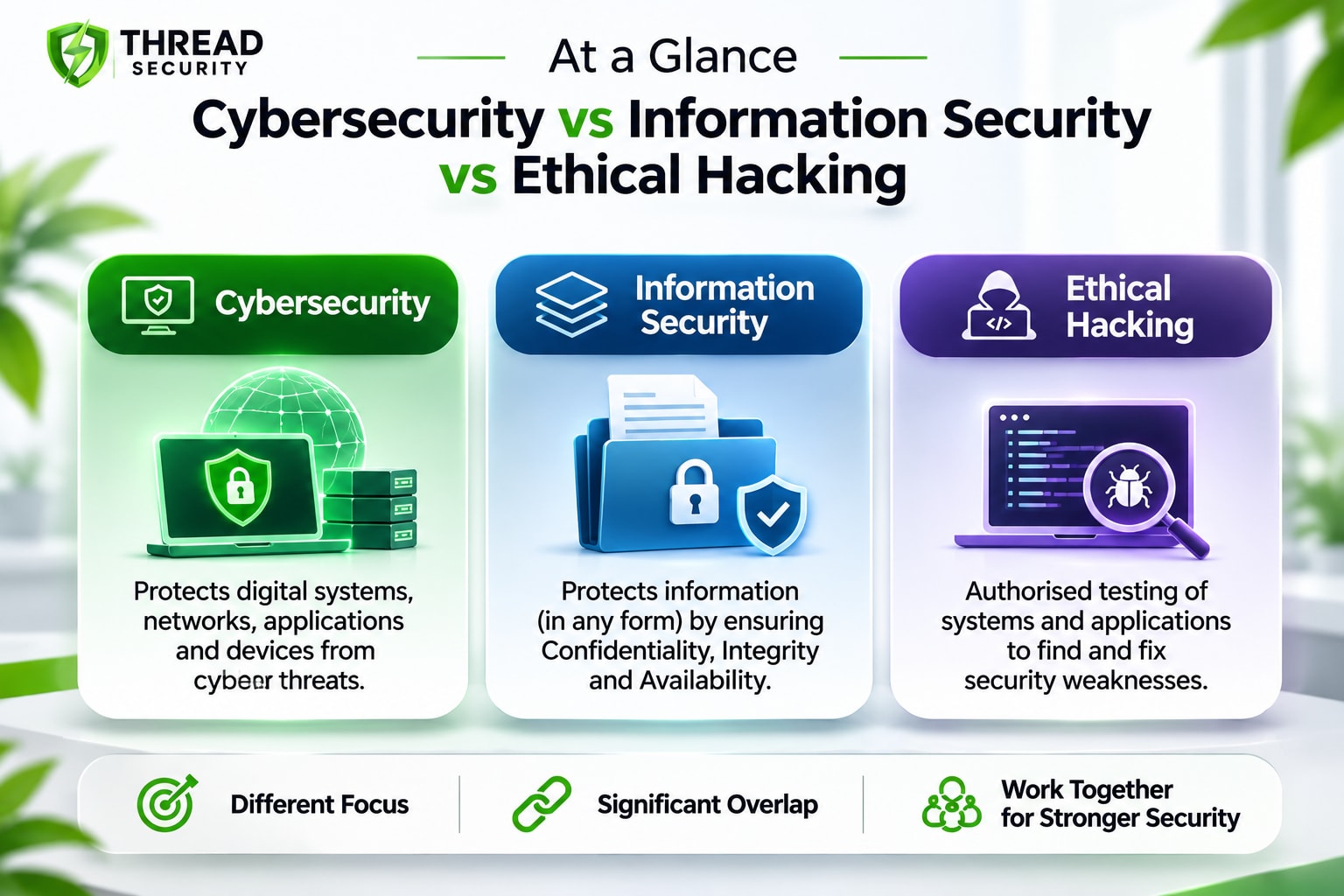
Cybersecurity vs Information Security vs Ethical Hacking
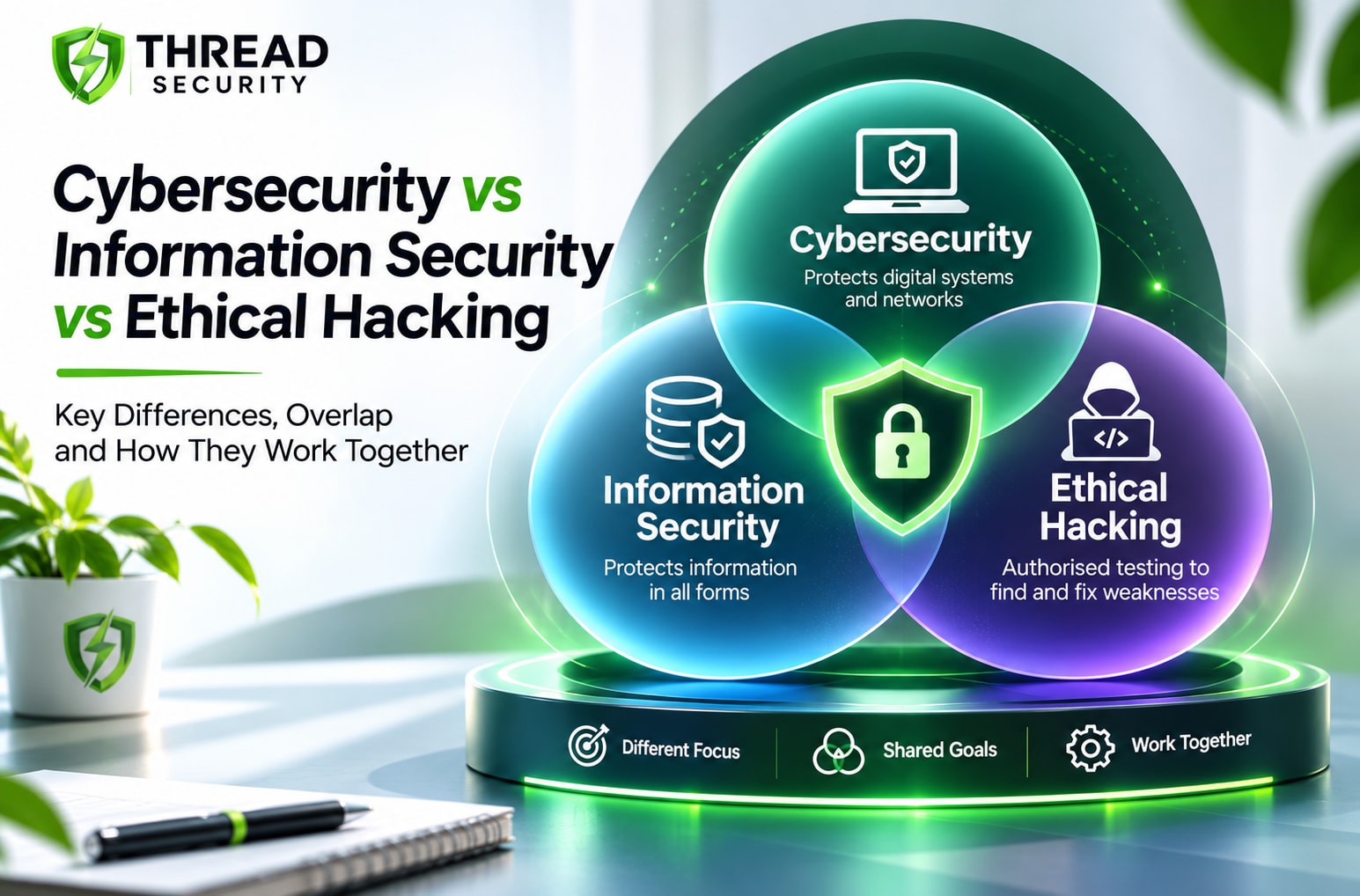
The easiest way to understand the difference is to compare their primary focus and purpose.
Cybersecurity: Protects digital systems, networks, applications, devices and the information they handle against cyber threats.
Information security: Protects information in any form by maintaining confidentiality, integrity and availability.
Ethical hacking: Tests security with authorisation to identify weaknesses and demonstrate how they could be exploited.
These are not three completely separate industries. Cybersecurity and information security have substantial overlap, and ethical hacking is one activity that can support a wider security programme. In many organisations, the teams responsible for these areas work together rather than operating independently.
How Do These Three Fields Work Together?
Imagine an online retail company that stores customer profiles, payment-related information and order histories. It needs to protect its website, cloud infrastructure, employee accounts and business data.
Its cybersecurity team may configure firewalls, monitor suspicious network activity, secure cloud resources and investigate incidents. Its information security function may define data classification rules, approve access policies, establish retention requirements and ensure that sensitive records are handled appropriately.
An ethical hacker may then be engaged to test the website and selected infrastructure within an agreed scope. The assessment might identify an access-control weakness or a vulnerable software component. The findings are documented and passed to the relevant technical teams for remediation.
After fixes are implemented, the organisation can validate whether the weaknesses have been addressed. The results may also lead to changes in security policies, monitoring rules and staff awareness. This is how testing, governance and technical defence support one another.
Common Tools and Skills Used in Each Field
The tools used depend on the job, organisation and technology environment. A tool does not define the profession by itself; understanding the problem and using the tool responsibly are more important.
Cybersecurity skills and tools
Cybersecurity professionals may work with network monitoring, endpoint protection, identity and access management, cloud security, vulnerability management and incident response. Tools and platforms can include Microsoft Defender, Wireshark, SIEM systems, cloud security services and security monitoring solutions. Useful foundations include networking, Linux, Windows, scripting, system administration and threat analysis.
Information security skills and tools
Information security roles often involve risk assessment, data classification, access governance, security policies, compliance processes, audit preparation and business continuity. Professionals need to understand how information is created, stored, shared and retained. Knowledge of security frameworks, privacy requirements, risk management and organisational controls is valuable.
Ethical hacking skills and tools
Ethical hackers commonly study networking, web technologies, operating systems, authentication, application security and common vulnerability classes. Depending on the authorised assessment, they may use tools such as Burp Suite, Nmap, Wireshark, Metasploit and specialised testing utilities. They also need to understand reporting, evidence handling, scope restrictions and responsible disclosure.
Learning a tool without understanding the underlying technology is not enough. For example, running a vulnerability scanner may produce a list of findings, but a skilled professional must validate the results, understand the risk and recommend an appropriate fix.
Career Paths: Which Field Should You Choose?
There is no single best option for everyone. The right direction depends on whether you prefer technical defence, governance and risk, or hands-on security testing.
Cybersecurity career paths: SOC analyst, security analyst, incident responder, cloud security engineer, security engineer and threat hunter.
Information security career paths: information security analyst, GRC analyst, risk analyst, security auditor, compliance specialist and information security manager.
Ethical hacking career paths: penetration tester, vulnerability assessor, application security tester, security researcher and red team operator.
These categories are not rigid. A security engineer may perform vulnerability assessments, an ethical hacker may work closely with application developers, and an information security professional may have strong technical responsibilities. Job descriptions and actual responsibilities matter more than titles alone.
How Should Beginners Start Learning?
If you are new to the field, avoid jumping directly into advanced hacking tools or collecting certifications without understanding the fundamentals. Start with computer networks, operating systems, basic programming, web technologies and security principles.
Next, learn how authentication, access control, encryption, vulnerabilities and secure configurations work. Build small projects in a controlled lab environment. For ethical hacking, practise only on systems designed for training or on assets for which you have explicit permission. Document what you test, what you discover and how you would fix the issue.
If you are more interested in information security, study risk assessment, data protection, security policies, access governance and the CIA triad. If cybersecurity operations interest you, practise log analysis, network monitoring, incident investigation and endpoint security.
Frameworks and official learning resources can help structure your progress. NIST publications provide security terminology and guidance, while the NIST NICE Workforce Framework describes cybersecurity work roles and the knowledge and skills associated with them. These resources are useful for understanding the breadth of the profession without assuming that every organisation uses identical job titles.
How Thread Security Connects These Areas
At Thread Security, cybersecurity is approached through practical security services and the identification of weaknesses that can affect digital systems and business operations. Its VAPT services align with the ethical hacking side of security by assessing systems within an authorised scope and helping organisations understand vulnerabilities that require attention. Thread Security Education complements this work by supporting learners who want to build knowledge in cybersecurity, ethical hacking and related technical areas. Understanding information security principles alongside hands-on technical skills helps learners see not only how systems can be tested, but also why data protection, access control and responsible security practices matter. The goal is to connect foundational knowledge with practical security awareness rather than treating tools as a substitute for understanding.
Conclusion: Understand the Difference Before Choosing Your Path
Cybersecurity, information security and ethical hacking are closely connected, but each has a distinct purpose. Cybersecurity focuses on defending digital environments, information security protects information wherever it exists, and ethical hacking uses authorised testing to discover weaknesses. Organisations need these capabilities to work together, while learners can use the differences to choose a direction that matches their interests and strengths.
There is no shortcut to becoming effective in any of these fields. Build strong fundamentals, practise in legal and controlled environments, learn how to communicate risk and understand how security decisions affect real organisations.
References and Further Reading
NIST FIPS 199 – Standards for Security Categorization of Federal Information and Information Systems
Ready to build your cybersecurity knowledge or strengthen your organisation's security practices? Explore Thread Security's cybersecurity and VAPT services, or discover learning opportunities through Thread Security Education. Whether you are a business looking to understand security weaknesses or a beginner preparing for a cybersecurity career, take the next step by connecting with Thread Security and developing a stronger foundation in digital security.
Akshay Kumar
VERIFIEDAcademic Coordinator · Thread Security
Faculty mentor & research guide at Thread Security Education.