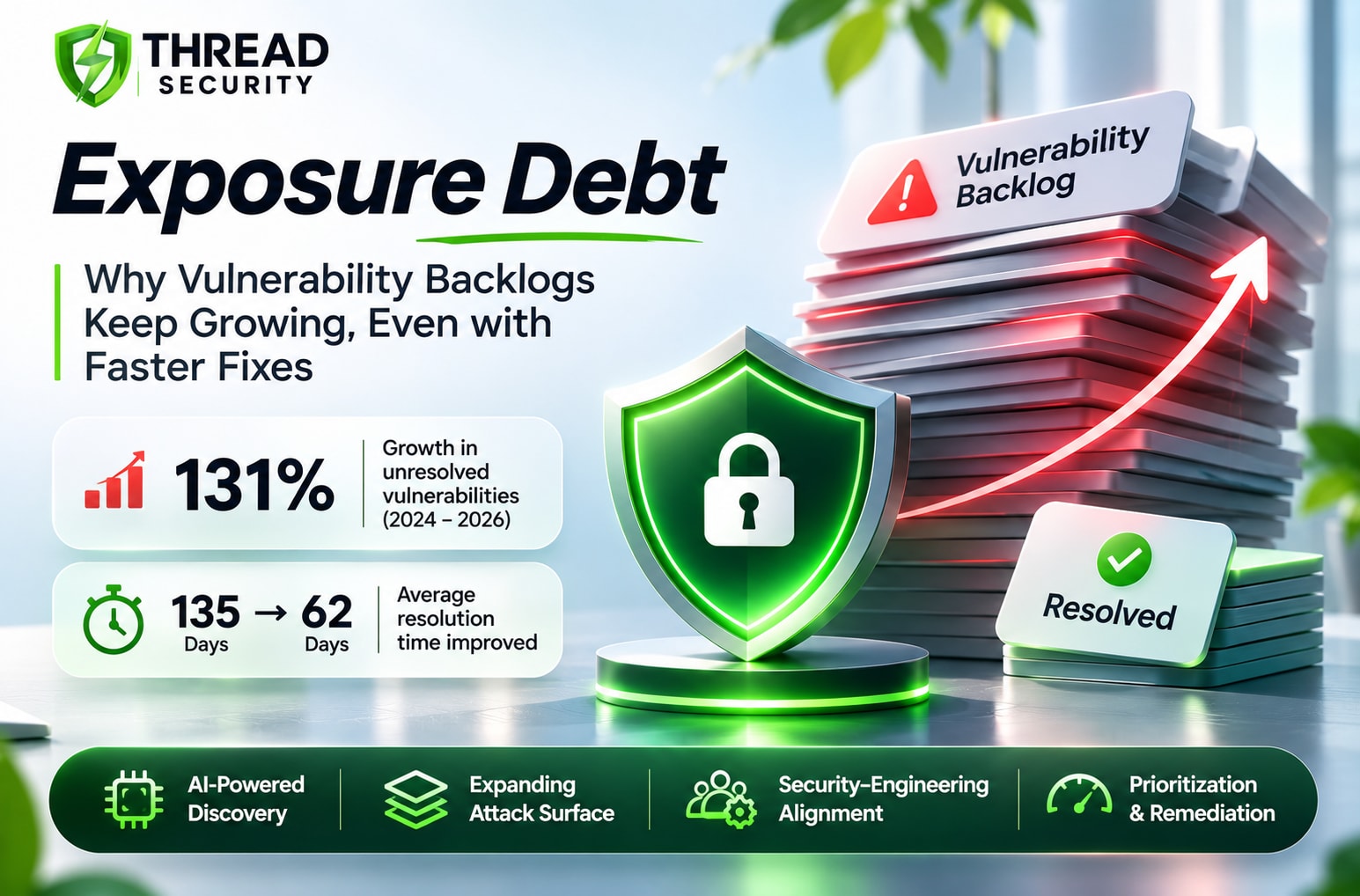
Exposure Debt is becoming a serious challenge for modern cybersecurity teams. Organisations are discovering vulnerabilities faster, security researchers are submitting more valid findings, and remediation processes are improving. Yet the number of known vulnerabilities waiting to be fixed continues to grow. How can companies fix bugs faster than before and still fall behind?
HackerOne's 2026 Security Research Report provides a useful explanation. According to its platform data, the backlog of validated, unresolved vulnerability reports grew 131% between 2024 and 2026, even as average resolution time improved from 135 days to 62 days. The report describes this growing gap between discovered vulnerabilities and resolved vulnerabilities as Exposure Debt.
These figures are specific to HackerOne's platform and research methodology, not a measurement of every organisation worldwide. However, they highlight a problem security leaders need to understand: finding vulnerabilities is only the beginning. If organisations cannot validate, prioritise, assign, and fix them effectively, their security exposure can continue to accumulate.
What Is Exposure Debt?
Exposure Debt is the accumulation of validated security vulnerabilities that an organisation knows about but has not yet resolved. These findings may come from penetration testing, vulnerability scanning, bug bounty researchers, internal security teams, or other security assessment activities.
Think of it as an unresolved security workload. A company may identify a weakness in an application, confirm that it is exploitable, and create a remediation ticket. But if the responsible engineering team cannot fix it promptly, the vulnerability remains an exposure.
The term is related to technical debt, but the two are not identical. Technical debt describes the future cost of choosing or retaining a less-than-ideal technical solution. Exposure Debt focuses specifically on known, unresolved security weaknesses and the risk they leave behind.
The important point is that a vulnerability does not stop being a security concern simply because it has been documented. Until the issue is fixed or effectively mitigated and verified, the organisation may still be exposed.
The Numbers Behind the Exposure Debt Problem
HackerOne's October 2026 Security Research Report, titled Exposure Debt: The Next Challenge in Cybersecurity, identifies a growing difference between vulnerability discovery and remediation.
Its key findings include:
131% growth: The platform's backlog of validated, unresolved vulnerability reports grew over two years, from 2024 to 2026.
135 to 62 days: Average resolution time across the platform improved over the same period.
Nearly 70%: Surveyed security leaders said validated findings were entering their systems faster than their teams could resolve them.
75%: Surveyed security leaders said their organisations formally track Exposure Debt.
The report draws on aggregated, de-identified HackerOne platform data from July 2025 to June 2026, a survey of 111 security leaders, and a survey of 408 active security researchers. The survey results should be understood within that research sample rather than treated as universal industry statistics.
Even with that qualification, the findings illustrate a clear operational problem: faster remediation does not automatically mean that the total number of unresolved vulnerabilities is falling.
Why Are Vulnerability Backlogs Growing Despite Faster Fixes?
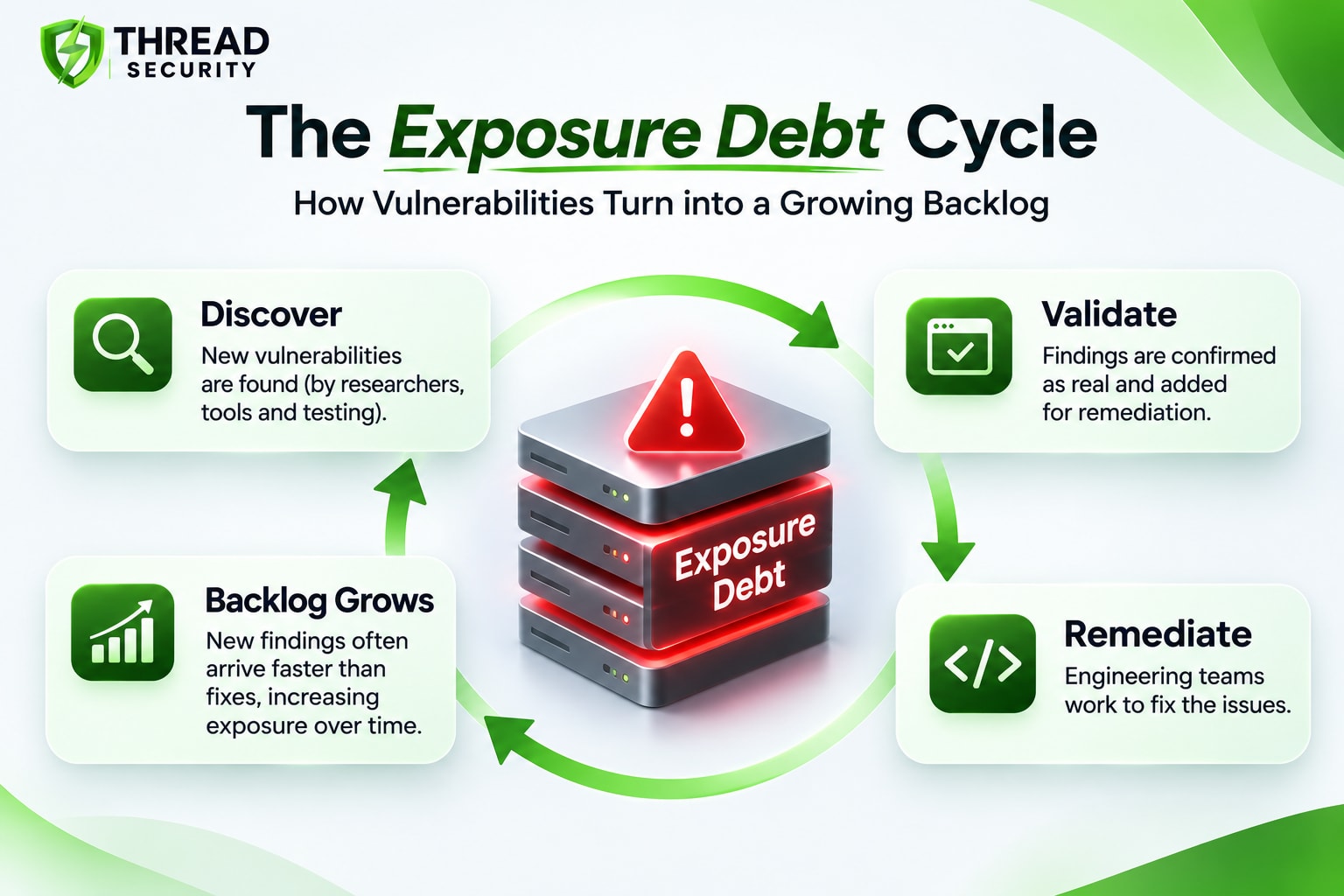
The apparent contradiction becomes easier to understand when discovery and remediation are viewed as two separate processes.
Imagine a company that receives 100 validated vulnerabilities in a period and resolves 80. Its backlog increases by 20. If the same company later resolves 120 vulnerabilities but receives 150 new findings, its backlog still increases by 30.
The organisation has become faster at fixing vulnerabilities, but incoming findings are growing even faster. That is the central challenge behind Exposure Debt.
1. AI Is Accelerating Vulnerability Discovery
AI-assisted security tools are helping researchers analyse code, investigate application behaviour, automate repetitive tasks, and identify weaknesses. This can increase the volume of potential findings that security teams must review.
HackerOne's 2026 report describes how AI is helping researchers uncover more complex issues, including authorisation weaknesses and multi-step attack chains that traditional scanners may not identify easily.
AI does not automatically produce valid vulnerabilities. Findings still require validation, technical context, and human judgement. But when more credible findings arrive, organisations need enough people and processes to handle them.
2. Attack Surfaces Keep Expanding
Modern organisations rely on cloud infrastructure, APIs, web applications, mobile applications, third-party services, and connected business systems. Each integration can introduce additional security considerations.
As digital environments expand, security teams must understand which assets exist, who owns them, how they are exposed, and whether they contain weaknesses. An incomplete asset inventory can make it difficult to identify and prioritise risk.
3. Security and Engineering Teams Have Different Priorities
A security team may classify a vulnerability as important, but the engineering team responsible for fixing it may already be handling product releases, reliability issues, customer requests, and technical maintenance.
Without clear ownership and agreed remediation timelines, security findings can remain in queues. A report may be technically valid, but the organisation still needs someone with the authority and capacity to resolve it.
4. Too Many Findings Compete for Limited Resources
Not every vulnerability carries the same level of risk. Teams that treat every finding as equally urgent can waste time and delay work on more serious exposures.
Effective prioritisation requires more than counting vulnerabilities or relying on a severity label. Teams need to consider exploitability, business impact, asset importance, exposure, and available mitigations.
Why Traditional Vulnerability Management Is Not Enough
Traditional vulnerability management often focuses on identifying weaknesses, assigning severity scores, and tracking whether patches have been applied. These activities remain important, but they may not provide enough context for modern environments.
A vulnerability scanner can identify a known software weakness. It may not establish whether the affected system is publicly accessible, whether the vulnerable component is reachable, whether compensating controls exist, or how much business impact a successful exploit could create.
That is why organisations need to connect vulnerability data with asset context, threat intelligence, ownership, and remediation workflows. The objective is not simply to create more tickets. It is to reduce the exposures that matter most.
What Is Continuous Threat Exposure Management?
Continuous Threat Exposure Management, commonly called CTEM, is an approach to continually identifying, evaluating, prioritising, and addressing an organisation's security exposures.
Gartner introduced CTEM as a strategic approach that helps organisations continuously assess the accessibility and exploitability of their digital assets. It is not a single product or vulnerability scanner. It is a programme that connects security discovery with business risk and remediation.
A practical CTEM approach includes five connected activities:
Scoping: Identify the systems, assets, and business areas that matter most.
Discovery: Find vulnerabilities, misconfigurations, exposed assets, and other security weaknesses.
Prioritisation: Evaluate which findings represent the greatest practical risk.
Validation: Confirm whether the exposure is real and understand its potential impact.
Mobilisation: Assign ownership, coordinate remediation, and verify that the risk has been reduced.
The value of this approach is the connection between finding a problem and ensuring that someone acts on it.
How Organisations Can Reduce Exposure Debt
Reducing Exposure Debt requires more than purchasing another security tool. Organisations need a repeatable process that connects discovery, validation, prioritisation, and remediation.
1. Maintain an Accurate Asset Inventory
Security teams cannot protect assets they do not know exist. Maintain an inventory of applications, cloud resources, APIs, endpoints, domains, and third-party connections. Assign owners to important systems and review the inventory as the environment changes.
2. Prioritise Based on Real Risk
Use severity as one input, not the only decision-making factor. Consider whether a vulnerability is remotely accessible, whether exploitation is practical, what data or systems are affected, and whether reliable mitigations are available.
3. Assign Clear Remediation Ownership
Every validated finding should have a responsible team, a defined priority, and an expected resolution path. Security teams should work with engineering teams to remove uncertainty about who is responsible and what needs to happen next.
4. Measure Backlog Age Alongside Fixing Speed
Mean Time to Remediation is useful, but it does not tell the complete story. Track the number of open validated vulnerabilities, their severity, how long they have remained unresolved, and whether critical findings are repeatedly delayed.
A falling average resolution time can hide a small group of serious vulnerabilities that remain open for a long period. Backlog age and severity help reveal that problem.
5. Verify That Remediation Actually Worked
Closing a ticket is not the same as eliminating a vulnerability. Teams should verify the fix through retesting, configuration checks, or other appropriate validation. They should also investigate whether the same weakness exists in other applications or environments.
6. Review AI Systems and Integrations
As organisations introduce AI applications and agents, their attack surfaces change. Security reviews should consider access permissions, sensitive data exposure, prompt injection risks, external integrations, and the actions that connected tools are permitted to perform.
AI adoption should not create a separate security process disconnected from the organisation's existing vulnerability management programme.
How Thread Security Connects to Exposure Management
At Thread Security, cybersecurity is approached through practical security assessment and an understanding of how vulnerabilities affect real business environments. Its VAPT services are relevant to identifying and evaluating weaknesses in applications, systems, and digital infrastructure. This supports the broader objective of helping organisations understand their security exposure rather than simply collecting vulnerability reports.
Thread Security Education focuses on developing practical cybersecurity knowledge and skills. For learners interested in ethical hacking, penetration testing, and vulnerability research, understanding how vulnerabilities are discovered, validated, prioritised, and responsibly reported is essential. These skills help build a stronger foundation for working in modern security teams, where identifying a weakness is only one part of reducing risk.
Conclusion: Finding Vulnerabilities Is Not the Same as Reducing Risk
Exposure Debt highlights a fundamental challenge in modern cybersecurity. Organisations are improving their ability to discover and fix vulnerabilities, but the volume of validated findings can grow faster than remediation capacity.
HackerOne's 2026 report demonstrates this pattern on its platform: a 131% increase in the unresolved vulnerability backlog alongside faster average resolution times. The figures are not contradictory. They show that discovery and remediation must be managed together.
Security leaders should therefore measure more than how quickly a ticket is closed. They need visibility into unresolved findings, their age, their severity, their business impact, and whether remediation has genuinely reduced exposure.
The goal is not to discover the largest number of vulnerabilities. It is to ensure that the most important risks are understood, assigned, and resolved before attackers can take advantage of them.
References and Further Reading
HackerOne Security Research Report 2026 — primary report covering Exposure Debt, vulnerability backlog growth, remediation speed, and AI-assisted security research.
HackerOne: Exposure Debt Report Announcement, October 7, 2026 — key findings and research methodology.
HackerOne: The Exposure Debt Benchmark, October 14, 2026 — explanation of the discovery-to-remediation gap.
HackerOne: Finding Fast, Fixing Slow — analysis of vulnerability submission and remediation trends.
Gartner: What Is Continuous Threat Exposure Management? — overview of the CTEM approach.
Is your organisation measuring vulnerabilities, or actually reducing its exposure? Explore Thread Security's cybersecurity services to understand how vulnerability assessment and penetration testing can help identify weaknesses in your digital environment. If you want to build a career in cybersecurity, explore Thread Security Education to develop practical foundations in ethical hacking, vulnerability assessment, and security research. Visit Thread Security to learn more and take a more informed approach to cybersecurity.
Akshay Kumar
VERIFIEDAcademic Coordinator · Thread Security
Faculty mentor & research guide at Thread Security Education.