A 40× Reduction That Deserves Attention
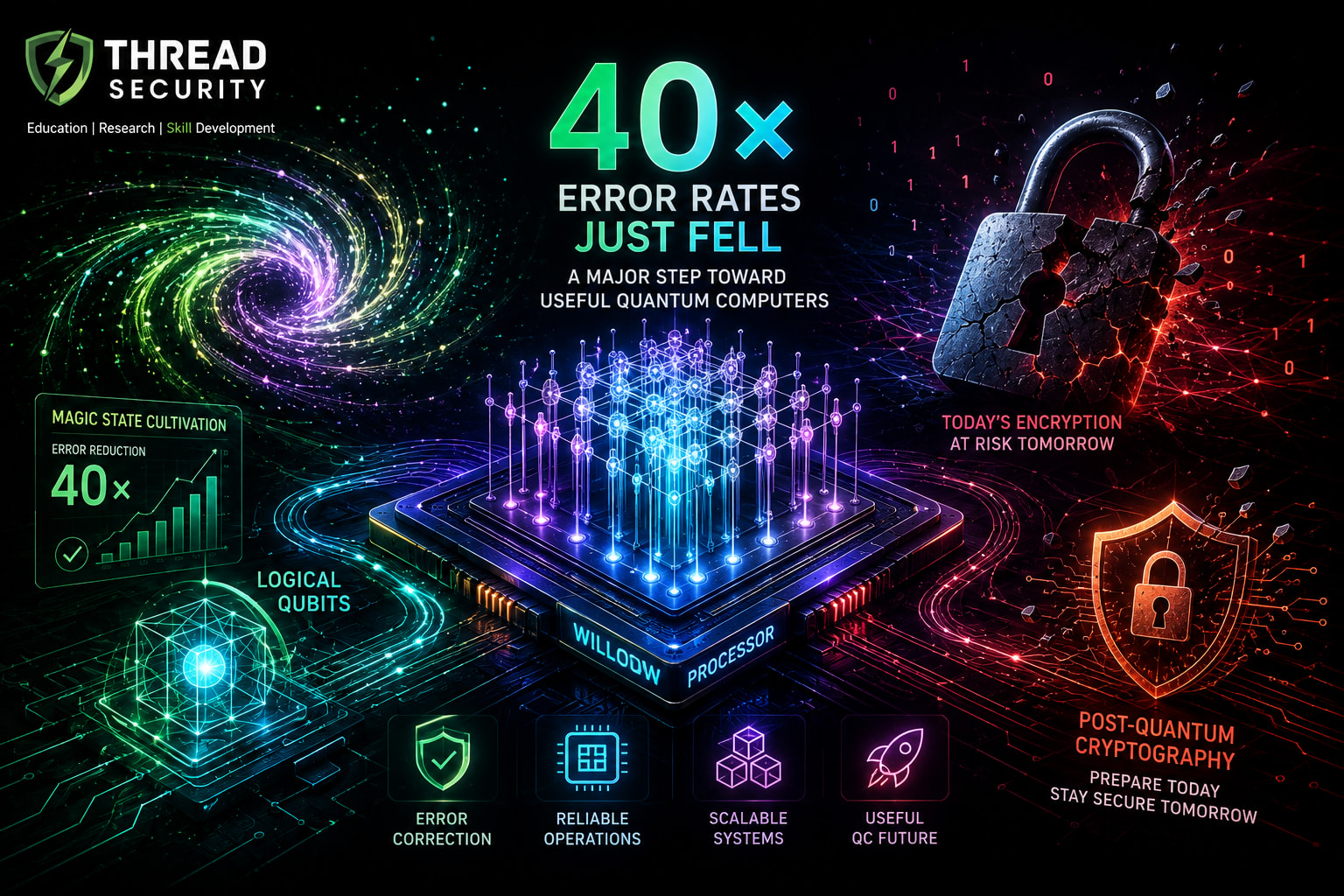
Quantum error correction is one of the biggest challenges standing between today's experimental quantum processors and useful, reliable quantum computers. On 15 October 2026, Google Quantum AI announced an important experimental result: its Willow processor demonstrated a technique called magic state cultivation, reducing errors in prepared magic states by approximately 40 times.
That number sounds dramatic, and the research is genuinely significant. But it does not mean quantum computers have suddenly become 40 times more powerful, that all quantum errors have disappeared or that today's encryption can now be broken.
Another result from researchers led by RIKEN demonstrated approximately 99.9% accuracy while controlling five silicon spin qubits simultaneously. Together, these developments highlight progress in two important areas: producing reliable quantum resources and controlling multiple qubits without losing accuracy.
To understand why these developments matter, we first need to understand what makes quantum computers so difficult to build and why the same progress deserves attention from cybersecurity professionals.
1. Why Do Quantum Computers Need Error Correction?
Traditional computers use bits that represent either 0 or 1. Quantum computers use quantum bits, or qubits, which can exist in combinations of quantum states. This allows quantum algorithms to use effects such as superposition and entanglement.
The problem is that qubits are extremely sensitive to their surroundings. Temperature fluctuations, electromagnetic interference, imperfect control signals and interactions with the environment can disturb their quantum states.
These disturbances introduce errors. Even a small error rate becomes a serious problem when a computation requires thousands or millions of operations. A calculation can become unreliable long before it reaches its final result.
This is why quantum error correction is essential. Instead of trusting one fragile physical qubit, researchers use multiple physical qubits to encode and protect information in a more reliable unit called a logical qubit.
Physical qubits versus logical qubits
A physical qubit is an actual quantum component in a processor. A logical qubit is an encoded quantum state protected by an error-correction scheme that uses multiple physical qubits and repeated checks.
Think of it as protecting important information through redundancy and error detection. However, quantum error correction is not simply copying quantum information several times. Quantum states cannot be copied arbitrarily, so specialized encoding and measurements are required to detect errors without destroying the information being protected.
A reliable logical qubit is important because useful quantum algorithms require many operations to succeed together. Improving individual physical qubits is valuable, but it does not automatically produce a large, fault-tolerant computer.
2. Google's 40× Breakthrough: What Is Magic State Cultivation?
Google Quantum AI published its research, Magic state cultivation on a superconducting quantum processor, in Science on 15 October 2026. The experiment was conducted using Google's Willow quantum processor.
The work addresses a particular bottleneck in fault-tolerant quantum computing: preparing high-quality magic states.
What are magic states?
Quantum computers need different types of quantum operations to run universal quantum algorithms. Some operations are relatively straightforward to implement within an error-corrected system. Others, particularly certain non-Clifford operations, require additional resources.
Magic states provide a way to implement these more advanced operations through a process called magic-state injection and related techniques. They are therefore an important resource for running a broad range of useful quantum algorithms.
Preparing sufficiently accurate magic states can be expensive. Traditional approaches use magic-state distillation, which combines multiple imperfect states and checks or processes them to produce higher-quality ones. This can consume substantial quantum computing resources.
What did Google demonstrate?
Google demonstrated magic state cultivation on real quantum hardware. The method prepares and protects a magic state using an error-corrected quantum code, with checks that help identify unsuccessful attempts.
The reported result was approximately a 40-fold reduction in the error of the cultivated states compared with the reference state-injection approach. Google reported a logical fidelity of approximately 99.99% for the retained T-states.
There is an important qualification: only approximately 8% of attempts were retained after the protocol's selection process. In other words, the high-quality result applies to the accepted attempts, not to every attempt made by the processor.
The team also demonstrated code switching between a distance-3 color code and a distance-5 surface code, showing that the cultivated states could be transferred within the processor architecture.
This is meaningful because it moves an important theoretical technique into an experimental demonstration on real hardware. However, Google itself acknowledges that the technique still needs to be demonstrated at larger scale.
3. RIKEN's Five-Qubit Result: Why Parallel Control Matters
Another important development came from researchers led by Japan's RIKEN Center for Emergent Matter Science, working with collaborators. Their research, published in Nature Physics, addressed a different problem: maintaining accurate control when multiple silicon spin qubits operate simultaneously.
Silicon is attractive for quantum computing because it is compatible with many of the manufacturing technologies used in conventional semiconductor chips. However, controlling several silicon qubits at once can introduce unwanted interactions and shifts that reduce operation accuracy.
The researchers used a five-qubit silicon array controlled through a shared microwave line. They developed a calibration approach based on pairwise phase adjustments to compensate for unwanted phase shifts during parallel operation.
The reported results were impressive:
Individual qubit operations achieved fidelities above 99.99%, with the best approaching 99.999%.
When up to three qubits operated simultaneously, fidelities remained above 99.99%.
When all five were controlled simultaneously, the reported operation fidelities were approximately 99.9%.
However, these figures describe the accuracy of basic single-qubit gate operations. They do not mean the researchers completed a large fault-tolerant computation or demonstrated equally accurate two-qubit operations under the same conditions.
The study also identified remaining limitations related to increased microwave power and loss of quantum coherence. It is a useful step towards scalable processors, not proof that the scaling problem has been solved.
4. Why These Two Results Matter Together
Google and RIKEN are addressing different engineering challenges, but both are relevant to building more capable quantum processors.
Google's work: Improves the quality of an important resource needed for universal, fault-tolerant quantum operations.
RIKEN's work: Demonstrates high-accuracy control of multiple silicon qubits operating in parallel.
Useful quantum computing needs more than one impressive metric. Researchers must improve physical qubit quality, logical error rates, gate operations, measurement, connectivity, error correction, resource requirements and system scale.
A processor that performs one operation accurately is not necessarily capable of running a long, complex algorithm reliably. The challenge is making the entire system work together.
5. What Does This Mean for Encryption?
This is where quantum computing moves from a research topic into a cybersecurity concern.
Today's digital security depends heavily on cryptographic algorithms. Public-key systems such as RSA and elliptic-curve cryptography (ECC) are used in areas including secure communication, digital signatures, identity verification and key exchange.
A sufficiently powerful, fault-tolerant quantum computer could use Shor's algorithm to solve the mathematical problems underlying widely used RSA and ECC systems much more efficiently than known classical methods.
That would create serious security consequences. However, today's quantum processors have not demonstrated the ability to run the large, fault-tolerant computations needed to break widely deployed public-key cryptography.
Does quantum computing break all encryption?
No. The impact depends on the cryptographic algorithm.
RSA: Vulnerable to a sufficiently capable quantum computer running Shor's algorithm.
ECC: Also vulnerable to the same broad class of quantum attack.
AES: Symmetric encryption is affected differently. Grover's algorithm can provide a theoretical quadratic search advantage, but this does not mean AES is simply broken in the same way as RSA.
It is therefore inaccurate to say that quantum computers will instantly destroy every encryption system. The more immediate concern is preparing systems that depend on quantum-vulnerable public-key cryptography.
6. Why Security Leaders Say We Are Already Late
On 21 October 2026, IBM CEO Arvind Krishna and Palo Alto Networks CEO Nikesh Arora discussed the quantum threat to encryption on the All-In podcast.
Krishna discussed the possibility of a cryptographically relevant quantum computer around 2030 as a planning concern. Arora argued that organizations should begin replacing vulnerable infrastructure now because the migration process could take years.
Their warning is not a scientific guarantee that a machine capable of breaking current encryption will arrive in 2030. It is a warning about the time required to identify, replace and validate cryptographic systems across large organizations.
The harvest-now, decrypt-later problem
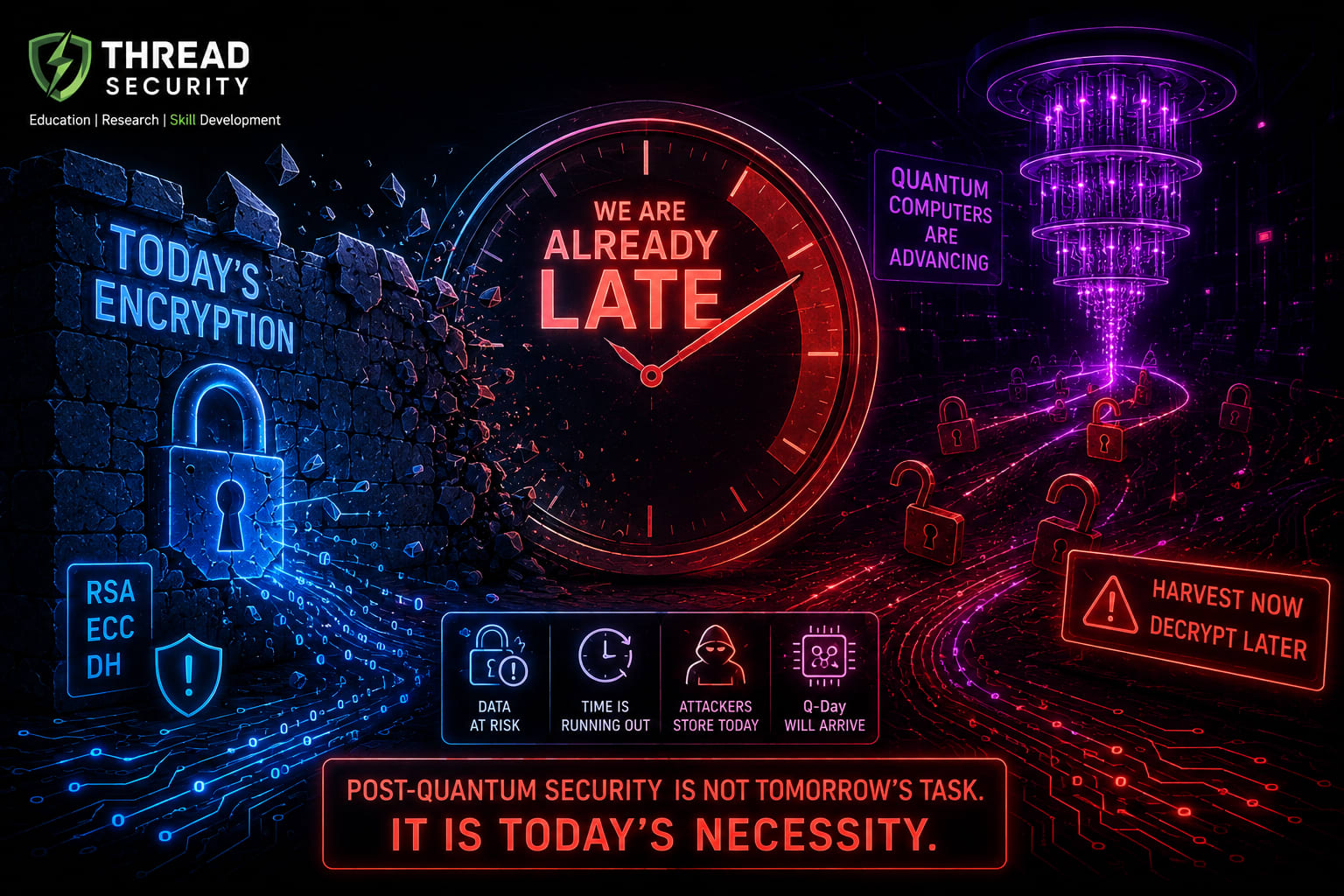
One reason the transition cannot simply wait is a threat known as harvest now, decrypt later.
An attacker may collect encrypted information today and store it for years. If a sufficiently capable quantum computer becomes available in the future, some of that stored information could become readable.
This is particularly important for information that must remain confidential for a long time, such as government records, sensitive business information, intellectual property and personal data.
Even if the quantum threat is years away, information stolen today may still have value to an attacker in the future.
7. What Is Post-Quantum Cryptography?
Post-quantum cryptography (PQC) refers to cryptographic algorithms designed to resist attacks from both classical and sufficiently capable quantum computers.
Unlike quantum cryptography, PQC does not require organizations to replace all their infrastructure with quantum hardware. It uses mathematical algorithms that can run on conventional computers and networks.
In August 2024, the US National Institute of Standards and Technology (NIST) finalized three important PQC standards:
FIPS 203 — ML-KEM: A key-encapsulation mechanism used to establish shared secret keys.
FIPS 204 — ML-DSA: A digital-signature standard.
FIPS 205 — SLH-DSA: A stateless hash-based digital-signature standard.
These standards give organizations a practical foundation for beginning their migration to quantum-resistant cryptography.
In October 2026, NIST also published transition guidance describing quantum-vulnerable standards, replacement standards and migration considerations. Its guidance highlights the importance of identifying where vulnerable cryptography is used across an organization and its technology supply chain.
8. What Should Organizations Do Now?
Organizations do not need to purchase a quantum computer to prepare for the quantum security transition. They need to understand where their current cryptographic protections are used and how difficult they will be to replace.
A practical starting checklist includes:
Inventory cryptography: Identify where RSA, ECC and other cryptographic algorithms are used across applications, networks, devices and services.
Identify sensitive data: Prioritize information that must remain confidential for many years.
Review vendors: Ask technology providers about their post-quantum cryptography roadmaps and standards support.
Plan migration: Identify systems that can be upgraded, replaced or redesigned and establish a realistic timeline.
Test compatibility: Evaluate performance, interoperability, certificate handling and key-management changes.
Monitor standards: Follow NIST guidance and relevant regulatory or sector-specific requirements.
Do not replace cryptographic systems by simply selecting an algorithm that claims to be quantum-proof. Migration requires careful engineering, testing, key management and long-term support.
9. The Bigger Picture: Are Useful Quantum Computers Close?
Google's magic state result and RIKEN's parallel-control work are meaningful progress, but neither proves that large-scale, fault-tolerant quantum computing has arrived.
Researchers still need to demonstrate reliable logical operations at larger scales, improve error correction, reduce the physical resources required per logical qubit and run increasingly complex computations with sufficiently low overall error rates.
There is also a difference between a machine that demonstrates a quantum advantage on a specialized task and one that can solve commercially valuable problems reliably. Useful quantum computing will require both engineering progress and algorithms that offer practical advantages over classical alternatives.
The correct response is neither to dismiss these developments nor to assume that every quantum security prediction is now inevitable. The evidence supports continued technical progress and sensible preparation.
Key Takeaways
Google demonstrated magic state cultivation on its Willow processor, reducing the relevant state-preparation error by approximately 40 times.
The reported 99.99% fidelity applied to retained attempts, with approximately 8% of attempts accepted.
RIKEN's five-qubit experiment demonstrated high-fidelity parallel control, not a complete fault-tolerant computation.
Quantum error correction is essential for building reliable logical qubits and running longer quantum algorithms.
A sufficiently powerful quantum computer could threaten RSA and ECC, but current quantum processors cannot break widely deployed public-key encryption.
Post-quantum cryptography is already being standardized, so organizations should begin planning migration rather than waiting for a future breakthrough.
Frequently Asked Questions
What is quantum error correction?
Quantum error correction uses encoded quantum information, multiple physical qubits and error-detection techniques to protect logical qubits from noise and operational errors.
What did Google achieve with magic state cultivation?
Google demonstrated magic state cultivation on its Willow processor and reported an approximately 40-fold reduction in the relevant error, with at least 99.99% fidelity for retained T-states.
Does Google's quantum breakthrough mean encryption is broken?
No. The experiment is a significant research milestone, but it does not demonstrate a quantum computer capable of breaking RSA or ECC encryption used in real-world systems.
What is the difference between quantum cryptography and post-quantum cryptography?
Quantum cryptography uses quantum-mechanical principles for security-related tasks. Post-quantum cryptography uses mathematical algorithms designed to resist quantum attacks while running on conventional computing hardware.
Why is harvest now, decrypt later dangerous?
Attackers may collect encrypted data today and retain it until future technology makes some of that information easier to decrypt. This creates a risk for sensitive information that needs long-term confidentiality.
Should organizations migrate to post-quantum cryptography now?
Organizations should begin assessing their cryptographic exposure, prioritizing sensitive long-lived data, reviewing vendor roadmaps and planning migration based on recognized standards and applicable requirements.
Explore Emerging Technology and Cybersecurity with Thread Security Education
Quantum computing is a reminder that technology and cybersecurity do not develop independently. Advances in computing can create new opportunities while also changing the assumptions behind existing security systems.
Thread Security Education, the education initiative of Thread Security, focuses on practical learning across artificial intelligence, Python, data science, machine learning and cybersecurity.
If you are exploring AI courses in Jalandhar, developing technical skills should involve more than learning individual tools. Understanding emerging technologies, their limitations and their security implications helps build a stronger foundation for future technology roles.
Whether your interest is AI, data science or cybersecurity, build the habit of understanding not only how a technology works, but also what changes when it becomes powerful enough to affect real-world systems.
Explore practical learning opportunities with Thread Security Education and develop skills for an evolving technology landscape.
Simranjit Kaur
VERIFIEDAI Trainer · Thread Security
Faculty mentor & research guide at Thread Security Education.