You Have Seen the Warnings But, why do smart people lose money anyway?
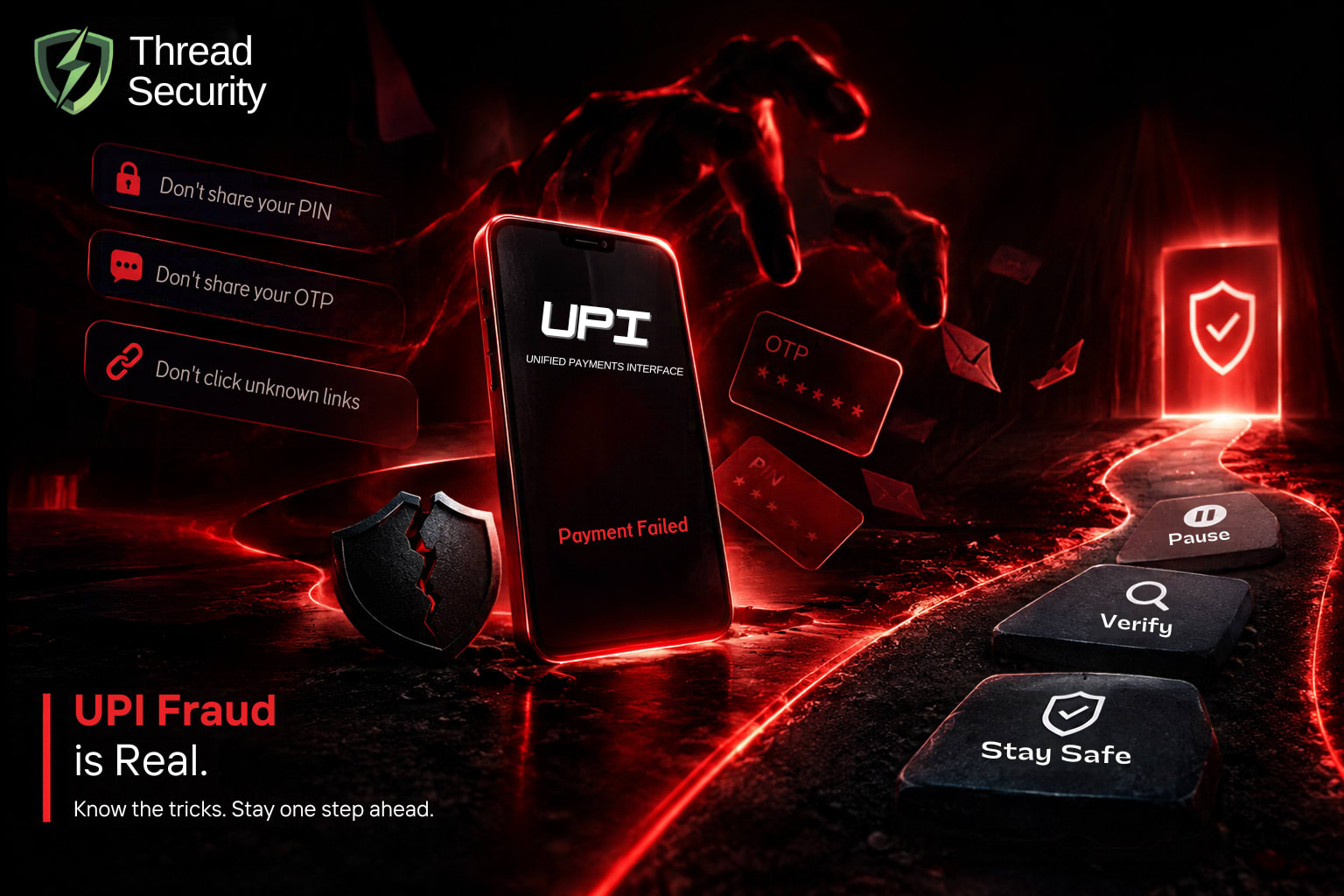
Any UPI user will have come across these messages: do not share your PIN with anyone, do not share your OTP with anyone, don't click on unknown links. However, UPI fraud continues to increase and the victim is not a carefree kind of person. They are teachers, shopkeepers, engineers and retirees who knew the rules and still lost money on a bad afternoon.
The primary issue of UPI scam prevention is the aforementioned. You can learn a rule but when it comes to real time, they're two different skills and scammers create scripts around the difference. This guide provides a simple explanation of why warnings are not necessarily effective, discusses four realistic scenarios, and shares five pause and verifying habits to work when rushed, scared or distracted. It is not part of this that the victim was at fault.
The Numbers: How Big is UPI Fraud?
India's Finance Ministry has informed the Lok Sabha in December 2025 that UPI-related frauds reached 13.42 lakh with a total loss of ₹1,087 crore from April 2024 to November, followed by 12.64 lakh with ₹981 crore loss during April 2025-November 2025 and 10.64 lakh with a loss of ₹805 crore during April 2025-November 2025. In the same response, UPI's transaction volume for November 2025 alone was 20.47 billion, and fraud becomes a minor proportion of the volume. There are still hundreds of thousands of homes.
The survey information is a reflection of the human side. According to the survey, published in November 2025, 51% of Indians surveyed experienced a financial loss due to a scam, for an average loss of ₹93,915, and that the average duration of a scam was 30 minutes or less. Indian adults reported almost four out of five cases of scams, with an average occurrence of scams occurring about once every three days, according to the Global Anti-Scam Alliance's survey of Indian adults.
Read these carefully
Government figures only include reported cases and FY26 is a partially completed year. The McAfee and the GASA report are both self-reported surveys and the McAfee survey is vendor-operated in seven countries. It's not just a matter of what you report: GASA's worldwide survey identified "do not know where to report" as the primary obstacle. Please use these as a guide rather than exact counts.
Why Do Scam Warnings Not Work?
The same GASA report revealed that 73 percent of the world's adults believed they could spot a scam with 23 percent losing money in the previous year. The confidence and protection are not synonymous. There are several design problems that accounts for the difference.
Urgency shrinks thinking time. You are being time-tempted to give in to a reactionary impulse, the “Your account will be blocked in 10 minutes” warning created to do just that. If a scam can be completed in 30 minutes, then there is little chance that a week-old warning will have any impact.
Be aware of the difference between warnings and scams. There's a warning sign that reads "beware of fraud. You know the caller's name, a recent transaction and your bank so it's not the thing you've been warned about, it's the actual thing.
Authority and trust take the place of rules. Saying "never share your PIN" doesn't work the same as saying "I am from your bank," which is why saying "I am from your bank" is often a better option.
Warnings are given at inappropriate times. They appear in SMS banners and ads and not as soon as the moment you are about to tap Pay.
Don't" rules do not provide any safe next step. If you give someone what not to do, and no easy alternative, then you have left them in a quandary when a stressful call requires an answer.
There is nothing wrong with them. Scam scripts are tailored and optimized for such responses. Also, GASA states that 69 per cent of victims said they were subjected to a great amount of stress and that many victims do not report due to fear of being embarrassed. A better way is to plan for simple habits that can be followed even if you're shaken up.
Four Realistic Scenarios
The examples listed below are composite and hypothetical, and not actual cases.
Scenario 1 : The Call is Urgent.
A caller calls schoolteacher Meera at 6 p.m. and tells her that her electricity will be disconnected tonight if she does not pay her a small amount she is due for right now via a link that will be sent to her by the caller. She is preparing food, her mom is on the other line and the amount is small. She pays. The trap: urgency + a little + a credible person. The pause: Call the official app or the number that was printed on the previous paper bill and verify the bill.
Scenario 2: The QR and Refund Confusion
Rohit is auctioning off a sofa on a classified website. A "buyer" tells him that he will pay and he gives Rohit a QR code to scan "to get money". Rohit reads it and enters his PIN. Instead money is deducted from his account. The trap: Accepting money is the opposite of paying. The rule: NPCI's UPI Safety Shield instructs users to only enter their PIN while paying money and never receiving money, and to only scan a QR code for payment.
Scenario 3: The Refund Link and the Collect Request
The recipient of the parcel is Anita, who receives a message later saying, "Your refund is ready, tap to claim. There is a payment request displayed and she's told that she needs to approve it and type in her pin to receive the money. Payment request or collect request may be "masked" as a refund and is known as the trap. The pause: approving a request and entering a PIN always involves money going out, so a real refund will never require a PIN or a request to be approved. Ask the seller via the app/website you purchased from.
Scenario 4: The Screen Sharing "Helper" is a Separate Computer.
Suresh makes a transaction, which fails and he looks for the helpline of his bank. The number he discovers, planted by a con man, leads him to a “support agent” who requests him to download an app to access the issue. The app will show him his screen, and the agent will look at him to see him input his PIN and OTP. The trap: helpfulness. The advice: “Stay away from apps that are downloaded on your phone on an unknown person's request, and avoid any app that allows you to share your screen or send SMS via your device,” suggests NPCI. Only get a bank number from its official card, app or web page.
Five Pause and Verify Habits that Work
The end result is a brief strategy you can use when you're feeling stressed out. Determine beforehand, do not come up with on the spot!
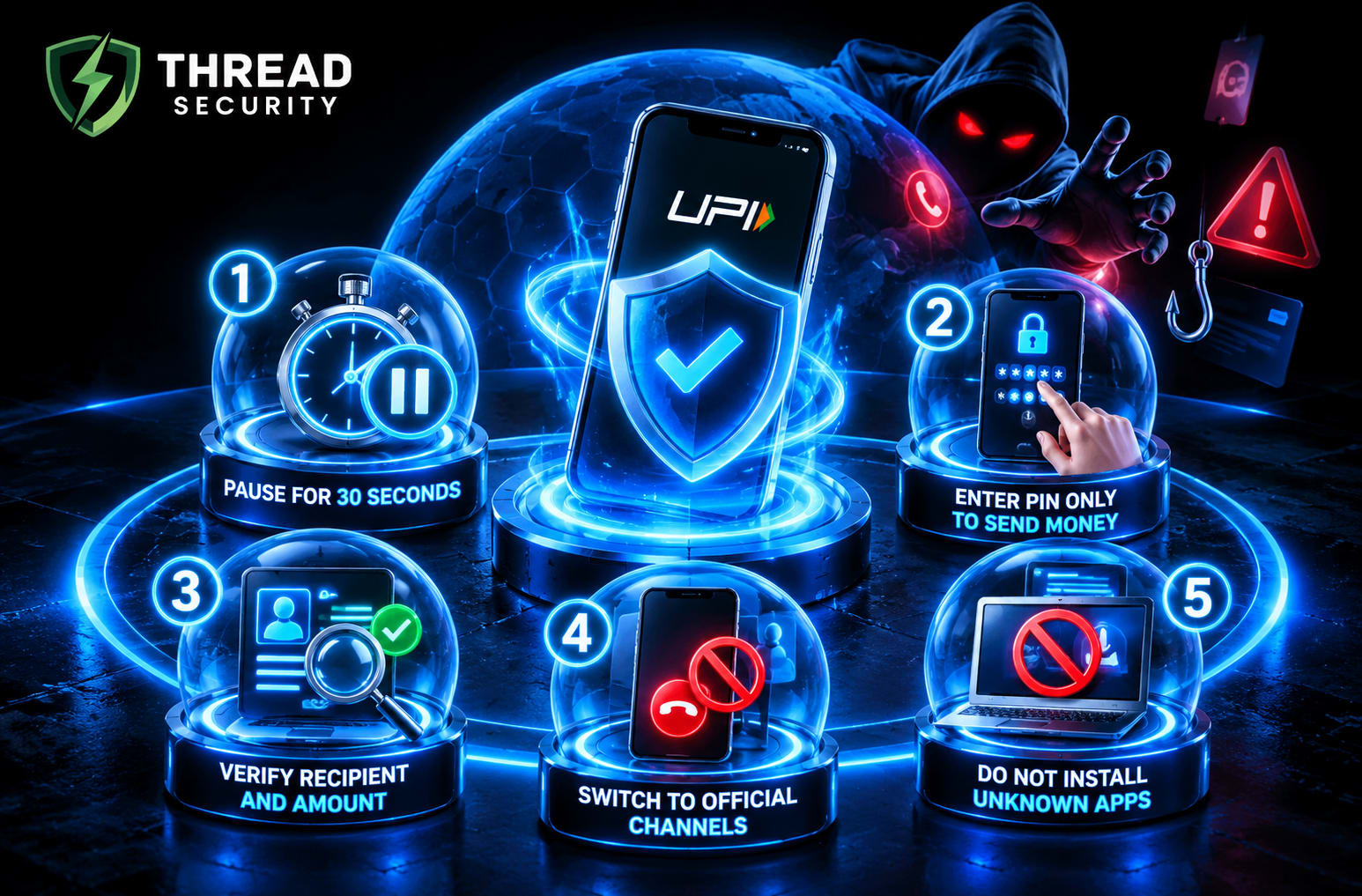
Take a 30-second time-out before making any money-and-time related request. Put the phone down, take a breath and ask yourself "who contacted whom, and why now?". It is not a rush of ideas that makes it urgent but the signal.
PIN stands for "out of pocket" money. If you are asked to enter your PIN, approve or scan a code to receive funds, STOP. The one thing that is the most helpful rule in UPI safety is that one shouldn't be there.
Check the name and amount prior to paying. Check the recipient's name on computer matches with your intended payee. In a shop, don't read the name off of the person's lips, ask the seller to confirm it.
Switch channels. Hang up, and then contact the organization on a number that you've found yourself, like its official app, website, or card. Don't use the number provided by the caller or message. A call to a family member before acting also will remove the sense of urgency.
Don't install screen sharing or SMS forwarding apps from someone who came to you first. No true bank or payment support requires this from you.
For families. Make a family agreement, for example, ‘We discuss something with someone before any payment that isn't planned. Look at the transaction amounts in the payment apps and perhaps reduce this for older family members. The government has mentioned that some of these protections are in place like the device binding, pin-based two-factor authentication and limits on daily transactions, which you have a hand in.
It Already Happened: Act Fast, Without Shame!
You don't blame the scammer for taking your money and the order of the business is more important than anything else.
Immediately contact the national cyber-fraud helpline (1930) with the transaction ID, amount and time.
Inform your bank / UPI app to flag it.
Report to cybercrime.gov.in by providing screenshots/Call Logs in the complaint.
Never pay anyone who claims to retrieve your money! This is a second scam.
Reporting works. I4C, the helpline's companion, says that the total saved worth stands at ₹8,189 crore for over 23.61 lakh complaints till 31 December 2025 and it urges that prompt complaints are the key to recovery.
Rethinking the design of bank teller desks, mobile apps and business spaces.
Individual habits are only half the answer. Warning messages are more effective when delivered when there is a risk, in simple terms, with a clear next step (e.g., when at the PIN screen, warning messages should say "you are sending money; real refunds never ask for your PIN"). NPCI already offers its banks AI and machine-learning fraud monitoring capabilities to alert and block suspicious transactions. To test their own payment flows, merchants and fintech teams should try to use them the way an attacker would.
Businesses and FinTechs: Where does Thread Security fit in?
Payment feature construction, APIs, web apps and cloud are all components of the fraud picture if you accept UPI payments. As per its description, Thread Security is a certified offensive security firm, penetration testing company, offering services like VAPT, web application penetration testing, cloud security reviews, smart contract auditing, etc. The 2026 IBM report on India revealed that the main method to gain access to a compromised organization was phishing, accounting for 19 percent of the incidents, and offensive security testing, which reduced costs by approximately ₹2.47 crore per incident.
Knowledge to Career: Cyber Security Courses in Jalandhar
For those seeking cyber security courses in Jalandhar, Thread Security Education provides both offline and live online cyber security courses. Its website lists a Cyber Security Course (CEH and industrial training) in both 45-day and 6-month versions, Defensive Cyber Security focused on Blue Team and SOC operations, Web Penetration Testing and Bug Bounty Hunting, and AI and AI-security courses. These skills are used in fraud monitoring, payment-app security and incident response.
Contact:
Vasal Mall, 3rd Floor, Opposite Hotel President, Police Line, Jalandhar, Punjab - 144001, Phone: 91-164-4032578. Phone: +91 7347398956. Operation Hours: Monday to Saturday 9 AM – 7 PM.
Frequently Asked Questions
To receive money, do I need to enter my UPI pin? No, says NPCI, that the PIN is just for the money-deduction. If someone requests that it be “received” in return for a payment or a refund, it is a scam.
But is a QR code safe to scan? People pay merchants by scanning a QR code that they stand in front of. Never scan one that someone sends you so that you can "receive" money, a refund or cashback.
A screen sharing scam is what? A fraudster tricks you into installing an app that will allow them to view your screen and then looks at you as you enter your PIN or OTP. Never allow it to be installed by anyone that has first contact with you.
If I lose money with UPI what do I do? Call 1930 immediately, inform bank, app and report at cybercrime.gov.in for speeding up the possibility of freezing funds.
Key Takeaways
UPI scams build a sense of urgency and trust, not carelessness, and its victims should not be blamed.
Not all adults feel confident enough to identify scams, and 73 percent of adults overall said they felt they could spot a scam, but 23 percent lost money.
There is one rule to remember: Your PIN is for sending money, it is not for receiving money.
PIN means money leaves, read the name, switch channels and never install remote-access apps for callers are five habits to use.
If it does occur, dial 1930 right away.
Call to Action
Talk to a parent or a family member about these 5 habits today and make a family rule for unexpected payments. For businesses requiring their payment flows to be tested, check threadsecurity.org. For a successful career in cyber security in Jalandhar, check out Thread Security Education.
Simranjit Kaur
VERIFIEDAI Trainer · Thread Security
Faculty mentor & research guide at Thread Security Education.