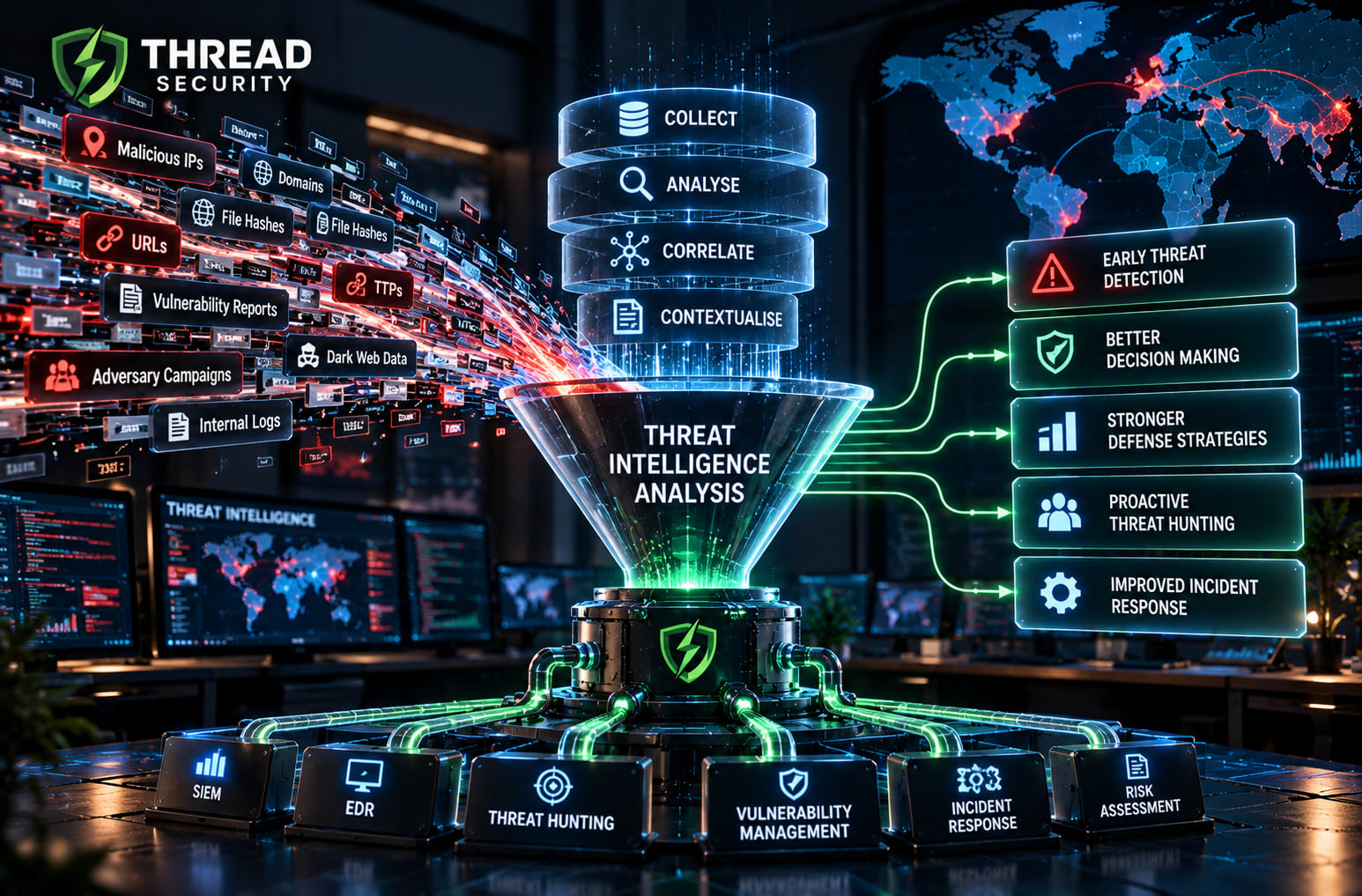
Threat intelligence is often misunderstood as a list of malicious IP addresses, suspicious domains, file hashes, and URLs. These indicators can be useful, but they represent only one part of cyber threat intelligence. Effective threat intelligence helps security teams understand who may be targeting them, what adversaries are trying to achieve, how attacks are carried out, and which defensive actions are most relevant to their environment. For a modern Security Operations Center (SOC), the real value lies not in collecting the largest feed, but in turning reliable information into decisions.
The National Institute of Standards and Technology (NIST), in Special Publication 800-150, describes cyber threat information as information that can help an organization identify, assess, monitor, and respond to cyber threats. It includes indicators, attacker tactics and techniques, recommended defensive actions, and findings from incident analysis. This broader view explains why threat intelligence should be connected to detection, investigation, vulnerability management, and incident response.
What Is Cyber Threat Intelligence?
Cyber threat intelligence (CTI) is the process of collecting, evaluating, analysing, and communicating information about cyber threats so that people responsible for security can make better decisions. It combines evidence from internal systems with relevant external information and places that evidence into context.
For example, a security tool may flag a connection to an unfamiliar IP address. The address alone does not explain whether the activity is malicious, whether the connection is related to a known campaign, which asset is involved, or what the organization should do next. Analysts need to examine supporting evidence such as DNS records, endpoint events, network logs, timestamps, reputation data, and the behaviour observed before and after the connection.
Threat intelligence is therefore not simply data collection. It is the analysis that helps answer practical questions: Is this activity relevant to our organization? What evidence supports that assessment? How confident are we? What action would reduce risk?
Indicators of Compromise Are Only the Starting Point
Indicators of compromise, commonly called IoCs, are observable artefacts or patterns that may indicate malicious activity. Examples include IP addresses, domain names, URLs, file hashes, email addresses, and certain network or host artefacts. Security products and threat intelligence platforms can use these indicators to enrich alerts, search historical logs, and identify potentially related activity.
However, an indicator is not a verdict. An IP address can be reassigned, a legitimate service can host content used by attackers, and a domain can change ownership or purpose. A hash can identify a particular file but will not detect every modified version of that file. Even a technically correct indicator can be irrelevant to an organization if the associated infrastructure or behaviour does not appear in its environment.
Teams should evaluate the source, observation time, confidence, context, and relevance of an indicator before using it to trigger a high-impact response. Automated blocking may be appropriate for well-supported indicators under established rules, but uncertain matches often need additional investigation. The aim is to reduce risk without creating unnecessary disruption.
How Security Teams Use Threat Intelligence in Practice
1. Enriching SIEM and EDR Alerts
A Security Information and Event Management (SIEM) platform brings together security events from sources such as identity systems, endpoints, applications, and network devices. Endpoint Detection and Response (EDR) tools provide visibility into activity on supported devices. Threat intelligence can add external context to alerts generated by these systems.
Imagine that an endpoint generates an alert for a suspicious script. An analyst may review the process tree, user account, parent process, network connections, file reputation, and related authentication events. If relevant threat reporting describes similar behaviour in a known intrusion pattern, the analyst can compare the evidence and decide whether the alert warrants escalation.
This enrichment helps analysts move beyond an isolated alert. It does not automatically prove that an attack is taking place; the internal evidence must still be evaluated.
2. Understanding Attacker Tactics and Techniques
Threat intelligence can describe more than infrastructure. It may explain how adversaries gain initial access, establish persistence, steal credentials, move between systems, or attempt to exfiltrate data. These methods are often described as tactics, techniques, and procedures (TTPs), although a specific report may not provide enough evidence to identify every element of an attacker’s activity.
The MITRE ATT&CK knowledge base provides a structured way to describe adversary tactics and techniques based on observed behaviour. Security teams can use it to compare reports, organise investigation findings, identify relevant detection opportunities, and assess whether their controls can identify activity associated with particular techniques.
Mapping activity to ATT&CK should be evidence-led. Analysts should not label an incident with a technique merely because a tool or alert resembles a documented example. They should record the observations that support the mapping and distinguish confirmed findings from hypotheses.
3. Improving Threat Hunting
Threat hunting is a proactive investigation for suspicious activity that may not have generated a clear security alert. Threat intelligence can help hunters develop a focused question instead of searching blindly across large volumes of telemetry.
For instance, a report may describe an attacker using a particular command-line pattern, an unusual authentication sequence, or a sequence of processes associated with a known technique. A hunting team can translate those observations into queries against available endpoint, identity, DNS, and network logs. It can then look for matching activity, related events, and variations that may indicate the same behaviour.
Not every hunt will find malicious activity. A documented negative result can still reveal gaps in logging, improve query quality, or help establish a baseline for normal behaviour. Teams should capture the scope of the hunt, data sources examined, assumptions, and any limitations that affect the conclusion.
4. Supporting Incident Response
When a security incident occurs, analysts need to determine its scope, likely entry point, affected assets, and potential impact. Relevant threat intelligence can provide leads, such as known infrastructure, observed attacker behaviour, or defensive recommendations from a trusted advisory.
Investigators should compare those leads with their own evidence. They may search for related domains in DNS logs, examine authentication events, review endpoint timelines, or check whether similar behaviour occurred on other systems. This can help determine whether an alert is isolated or part of a broader incident.
Threat intelligence can also inform containment and recovery decisions. Still, the response should account for business impact, evidence quality, and the organization’s incident-response procedures. Intelligence supports the decision; it does not replace investigation or authorization.
5. Prioritising Vulnerabilities and Defensive Work
Security teams face more vulnerabilities and potential weaknesses than they can remediate immediately. Threat intelligence can help put technical findings into context by identifying credible reports of exploitation, affected technologies, attacker interest, or relevant defensive guidance.
That context should be combined with internal factors such as internet exposure, asset criticality, existing controls, business dependency, and the availability of a fix or mitigation. A vulnerability affecting a critical internet-facing system may require urgent attention, especially when credible evidence indicates exploitation. A score or threat-feed entry by itself, however, should not be treated as a complete risk assessment.
Teams should document the evidence behind prioritisation decisions and revisit them as circumstances change. The objective is to direct limited security resources toward the risks that matter most to the organization.
Threat Intelligence Feeds, Platforms, and Frameworks
Threat intelligence feeds provide regularly updated information from external sources. They may include indicators, reports, malware details, vulnerability information, or descriptions of adversary activity. Feeds are useful when their data is relevant, timely, sufficiently documented, and compatible with the team’s workflow.
A Threat Intelligence Platform (TIP) can help aggregate, normalise, correlate, enrich, and distribute information from multiple sources. Some organizations also use formats and protocols such as Structured Threat Information Expression (STIX) and Trusted Automated Exchange of Intelligence Information (TAXII) to represent and exchange cyber threat information. Adoption should depend on operational needs, interoperability, governance, and the quality of available data.
Frameworks and standards serve different purposes. MITRE ATT&CK helps structure adversary behaviour. NIST SP 800-150 provides guidance for establishing and participating in cyber threat information-sharing relationships. Neither replaces the need to define what intelligence the organization needs, how it will validate information, and who is authorised to act on it.
Common Threat Intelligence Mistakes
Collecting without a clear purpose: Subscribing to many feeds can create noise if the team has not identified its intelligence requirements or the decisions the data should support.
Trusting indicators without validation: Indicators need source context, freshness, confidence, and relevance checks before high-impact actions are taken.
Ignoring internal telemetry: External reporting becomes more useful when compared with the organization’s own logs, alerts, assets, and incident history.
Confusing a match with confirmation: A matching domain or hash may justify investigation, but analysts must evaluate the surrounding evidence before concluding that a compromise occurred.
Failing to close the feedback loop: Teams should record whether intelligence led to a useful detection or response and use that learning to refine future collection and analysis.
Sharing information without governance: Organizations should define handling rules, permitted audiences, privacy safeguards, and sharing restrictions before distributing sensitive information.
How to Build a Practical Threat Intelligence Workflow
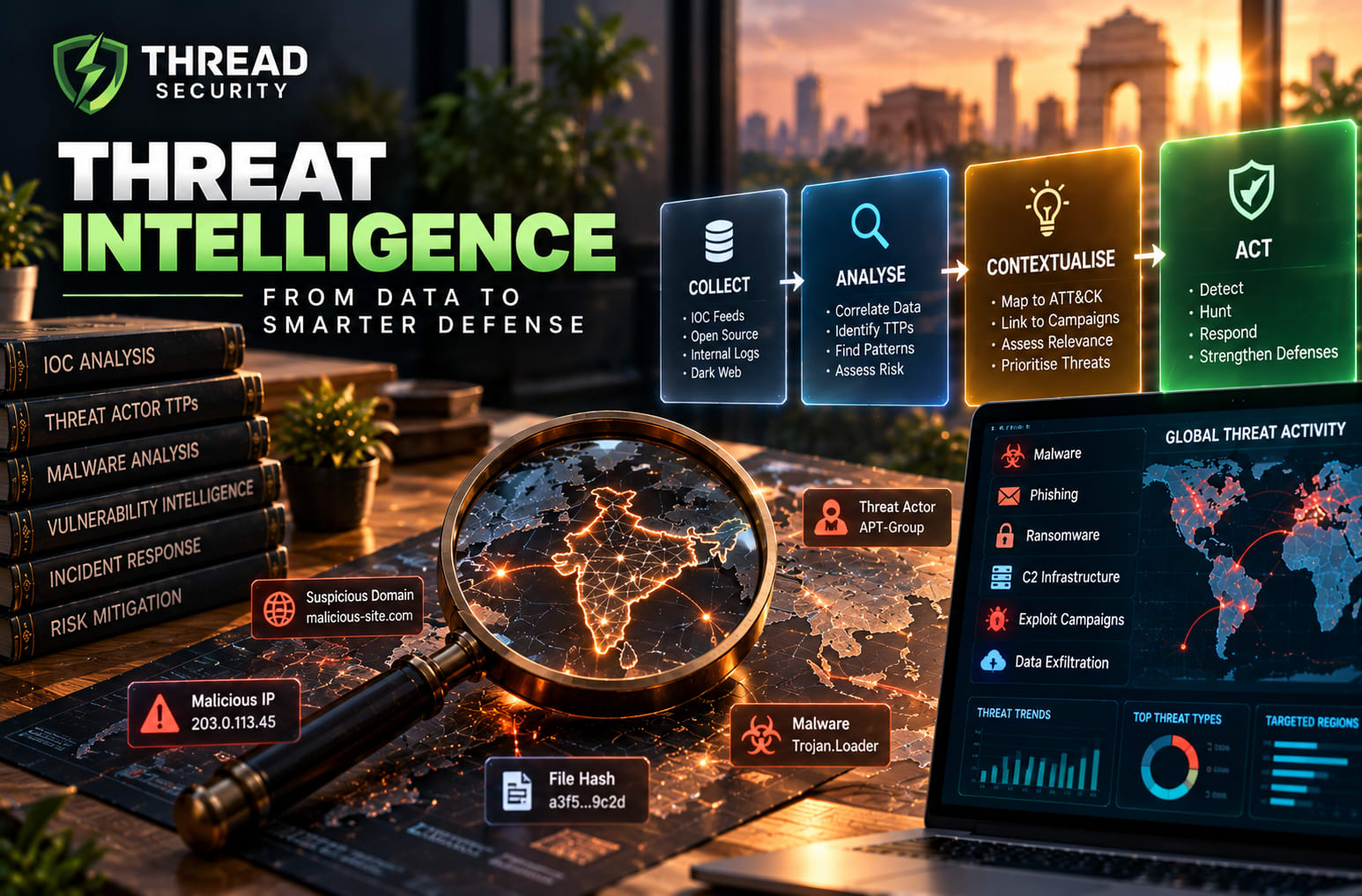
A useful starting point is to define intelligence requirements. Identify the assets, business services, threat scenarios, and decisions that matter most. Requirements might concern threats to a critical application, identity compromise, ransomware activity, or exploitation of technologies the organization uses.
Next, select sources that serve those requirements. Sources may include internal incident reports, security telemetry, trusted advisories, sector-sharing communities, and carefully evaluated commercial or open-source feeds. Record where each item originated, when it was observed, what evidence supports it, and how confident the assessment should be.
Then, enrich and validate the information against internal systems. Where appropriate, map observed behaviour to ATT&CK, create or improve detection logic, develop a hunting hypothesis, or provide context to incident responders. Any automated action should follow approved rules and account for the consequences of false positives.
Finally, measure operational usefulness. Teams can review whether intelligence improved triage, revealed previously unknown activity, supported a timely response, or helped prioritise a defensive action. There is no single metric that captures all intelligence value. Combine quantitative indicators with case reviews and feedback from analysts and incident responders.
How Thread Security Connects Threat Intelligence to Practical Defence
At Thread Security, threat intelligence is relevant because modern defence depends on more than recognising a suspicious IP address. Security teams need to connect external threat information with logs, attacker behaviour, detection logic, and incident-response decisions. Thread Security Education supports this learning journey by helping learners build a stronger foundation in cybersecurity concepts and understand how defensive workflows fit together. For students and aspiring security professionals, studying threat intelligence alongside SOC analysis, threat hunting, and incident response can help develop the analytical mindset required to investigate alerts rather than simply copy indicators into a tool. Training should be paired with authorised, hands-on practice and careful evaluation of evidence.
Conclusion: Turn Threat Data into Decisions
Threat intelligence is most valuable when it helps a security team answer a specific question and take a defensible action. Indicators of compromise remain useful, but they are only one layer of a broader discipline that includes context, adversary behaviour, internal evidence, risk prioritisation, information sharing, and continuous improvement.
For SOC analysts, incident responders, threat hunters, and security leaders, the goal is not to collect every available feed. It is to identify trustworthy information, understand its limits, connect it to the organization’s environment, and use it to improve detection and response. A disciplined workflow makes threat intelligence more relevant, measurable, and actionable.
References and Further Reading
Want to strengthen your cybersecurity knowledge? Explore more practical cybersecurity articles from Thread Security and learning opportunities from Thread Security Education to build your understanding of threat intelligence, SOC operations, threat hunting, and incident response. Keep learning, practise responsibly in authorised environments, and follow Thread Security for more research-based insights that help turn cybersecurity concepts into practical defensive skills.
Akshay Kumar
VERIFIEDAcademic Coordinator · Thread Security
Faculty mentor & research guide at Thread Security Education.