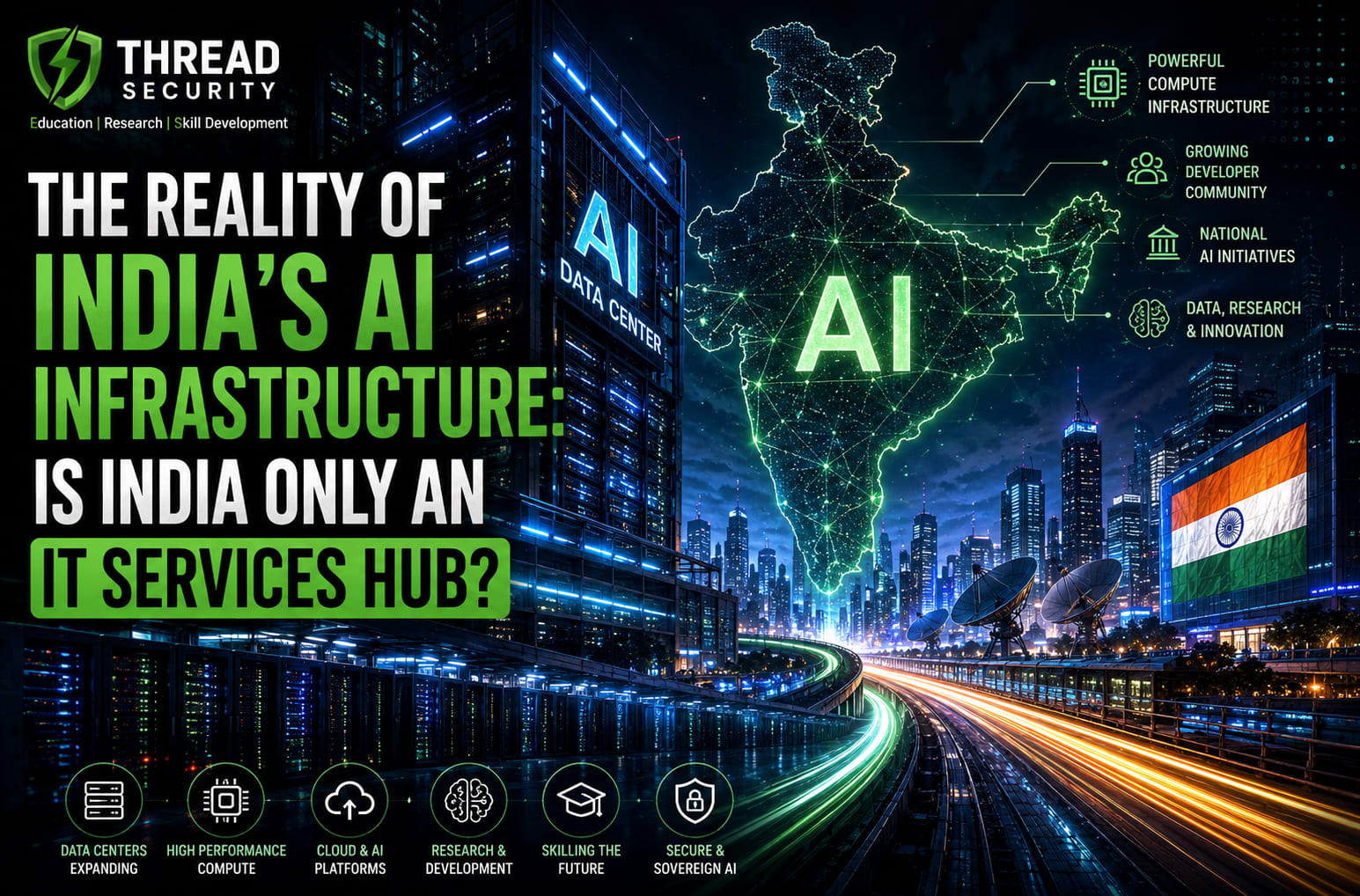
India AI infrastructure is becoming a bigger part of the country's technology story. India is often described as the world's back office: a country that provides software services, manages technology operations and supplies engineering talent to companies around the globe. That description captures an important part of India's technology economy but it does not tell the whole story anymore.
India is investing in artificial intelligence infrastructure, expanding access to computing resources, supporting domestic AI development and preparing a workforce for new AI-related roles. Major technology investments and national initiatives suggest that the ambition is no longer simply to use technology built elsewhere. It is also to develop the capability to build, evaluate, deploy and secure AI systems.
But ambition is not the same as leadership. Data centres, public funding and a large developer population do not automatically produce globally competitive AI research or dependable AI products. The more important question is whether India can connect its infrastructure investments with high-quality data, research institutions, skilled people and organizations capable of turning prototypes into useful systems.
Here is a closer look at what is changing, what the evidence tells us and what India still needs to do.
1. From IT Services to Building AI Capability
India's IT services industry has built considerable strengths in software engineering, business technology, systems integration and enterprise delivery. These capabilities are valuable in the AI economy, too. Organizations still need engineers who can connect models to existing systems, manage data pipelines, deploy applications, monitor performance and maintain software after launch.
However, building AI products involves additional challenges. Teams must select or train models, evaluate their behavior, handle imperfect data, manage computing costs and understand risks such as hallucinations, privacy exposure and security vulnerabilities. In research-heavy projects, they may also need expertise in optimization, distributed computing and experimental design.
This distinction matters because adopting an AI tool is not the same as developing an AI capability. A company can use an externally developed model to automate a business process without owning the underlying model, infrastructure or research. That can create real economic value, but it is different from developing a model, platform or specialized AI product that other organizations depend on.
India does not need to abandon its services advantage to progress. It can build on it: moving from implementing technology towards designing products, developing intellectual property, conducting research and creating secure AI systems for Indian and international users.
2. Microsoft's $17.5 Billion Commitment: What Does It Mean?
On 9 December 2025, Microsoft announced plans to invest US$17.5 billion in India over four years, from 2026 to 2029. The company described the investment as supporting cloud and AI infrastructure, skilling and ongoing operations. It presented the commitment as part of its effort to expand AI adoption in India.
The announcement is significant because AI depends on more than algorithms. Organizations need data-centre capacity, networking, storage, reliable electricity, cloud platforms and the engineering teams that operate them. Expanding these foundations can make it easier for businesses, researchers and developers to access the resources required to build and run AI applications.
Yet the headline number needs context. An announced investment is not the same as money already spent, and infrastructure investment does not guarantee that every startup, university or small business will receive affordable access. The eventual impact depends on how capacity is delivered, where it is available, what it costs and whether people can use it productively.
The important question is therefore not only how much capital enters India. It is whether that investment helps Indian organizations develop valuable products, improve productivity, conduct research and build capabilities that remain useful beyond a single cloud provider or technology cycle.
3. India's Developer Population: An Opportunity, Not a Guarantee
In September 2026, Microsoft CEO Satya Nadella highlighted the possibility that India could have the world's largest developer community by 2030. Such a prospect reflects the scale of India's technology workforce and the opportunity to involve more developers in building AI-enabled software.
A large developer community can accelerate experimentation. More people can create applications for local languages, adapt technology to Indian business conditions, contribute to open-source projects and solve problems in sectors such as agriculture, healthcare, education and financial services.
But developer numbers alone are not a measure of AI leadership. Writing an application that calls an existing model requires a different skill set from designing a reliable evaluation framework, optimizing inference, training models or conducting original research. Equally, a promising prototype is not necessarily ready for real-world deployment.
The opportunity lies in helping developers progress from using AI tools to understanding the systems behind them. That means stronger foundations in programming, mathematics, data engineering, model evaluation, cloud deployment and security. It also means giving learners access to meaningful projects, mentors and opportunities to work with real engineering constraints.
4. What Is the IndiaAI Mission Building?
The Government of India's IndiaAI Mission is a major part of the country's effort to expand AI capabilities. Its approved outlay is approximately ₹10,372 crore, intended to support areas including computing infrastructure, innovation, datasets, skills, startup development and responsible AI initiatives.
One important component is access to AI compute. Training and running advanced models can require specialized processors and substantial computing capacity. Without access to suitable resources, researchers and startups may struggle to experiment, evaluate models or scale applications.
Government updates in 2026 reported an expanding pool of GPUs available through the mission's compute initiative. Such capacity can reduce a barrier for eligible users, although access conditions, workloads, availability and costs still matter. A GPU count is a useful infrastructure indicator, not proof that the country has solved every compute problem.
Other parts of the mission focus on datasets, support for innovation and developing AI capabilities. These are connected challenges: compute without useful data has limited value, and data without skilled teams or a clear application does not automatically become a useful AI product.
The mission's impact should therefore be judged by outcomes as well as inputs. Are researchers completing meaningful experiments? Can startups access the resources they need? Are useful datasets available under appropriate conditions? Are more dependable Indian AI applications reaching users? Those are stronger measures of progress than a single headline figure.
5. Why Sovereign AI Matters
Sovereign AI broadly refers to a country's ability to develop, operate and govern AI capabilities in line with its needs, laws and strategic priorities. It does not necessarily mean building every component independently or refusing to use international technology.
For India, the issue can involve access to compute, domestic research capability, suitable datasets, local-language performance, data governance and the ability to make informed choices about providers. Different organizations may require different levels of control. A startup building a public-facing application may have different requirements from a public institution handling sensitive information.
Local infrastructure can contribute to sovereignty, but physical location alone does not guarantee independence. An organization may still rely on foreign hardware, specialized software, cloud services or externally developed models. These dependencies are not automatically harmful, but they should be understood and managed.
A practical sovereign-AI strategy is therefore about building options. India can develop domestic talent and research, support a competitive ecosystem, evaluate external technologies carefully and maintain appropriate control over sensitive data and critical systems. The objective is resilience and meaningful choice not simply a label attached to a product.
6. The Compute Gap: More Than Counting GPUs
AI compute is one of the most visible parts of the infrastructure conversation, but effective capacity depends on several factors. High-performance processors must be supported by fast networking, storage, cooling, electricity, software tools and people who know how to use them efficiently.
Access also differs by task. Fine-tuning a smaller model, running inference for a business application and training a large model from scratch have very different resource requirements. A university team may need affordable, predictable access for experiments, while a production service may need stable performance and capacity that can grow with demand.
For many teams, the challenge is not simply whether a GPU exists somewhere in the country. It is whether the right compute is available at the right price, with suitable software, enough time and support to complete the work.
There is also a reason to focus on efficiency. Better data preparation, model selection, quantization, caching and evaluation can sometimes reduce the resources required to achieve a useful result. Not every problem needs the largest model or the most expensive hardware.
7. Data and Deep Research: The Less Visible Challenges
AI systems depend on data that is relevant, sufficiently accurate, legally usable and representative of the people or environments in which a system will operate. India's linguistic, cultural and regional diversity creates both a major opportunity and a demanding engineering challenge.
Datasets may be incomplete, outdated, poorly labelled or concentrated around particular groups. Local-language applications can struggle when training and evaluation data do not reflect the language varieties, accents and contexts encountered by real users. In sensitive areas, data collection and sharing must also respect privacy, consent and applicable rules.
These issues cannot be solved simply by collecting more data. Teams need documentation, quality checks, suitable permissions, careful sampling and independent evaluation. They must also test whether a system works for different groups and conditions, rather than relying only on an impressive average score.
Research capacity is another important part of the picture. Strong AI research requires experienced researchers, advanced computing, reliable datasets, sustained funding, collaboration and time to investigate difficult questions. Developing such capability is a longer process than launching a product demonstration.
India can make progress by strengthening university-industry collaboration, supporting research careers, encouraging reproducible experiments and creating opportunities for engineers to work on challenging technical problems. It also needs to retain and attract people who can connect foundational research with real-world deployment.
8. The Talent Gap Is About Depth, Not Just Headcount
India has a large pool of technology learners and professionals, but the skills needed for AI development are varied. Building a chatbot, for example, may require application development and retrieval techniques. Operating it reliably can additionally require evaluation, monitoring, privacy controls, infrastructure management and security testing.
Some teams need machine learning engineers who understand training and model behaviour. Others need data engineers, AI application developers, research engineers, MLOps specialists, AI evaluators or security professionals who can assess how systems fail. Organizations also need people who can explain technical trade-offs to business leaders and users.
Certificates can help structure learning, but they are not substitutes for demonstrated ability. A stronger candidate can explain why a model was selected, how it was tested, which errors occurred, how the system handles unexpected input and what would need to change before deployment.
India's opportunity is to make practical learning more accessible: projects based on real constraints, code reviews, reproducible experiments, collaborative work and responsible deployment. The aim should not be to produce people who can only prompt a model, but people who can build, test, improve and maintain useful systems.
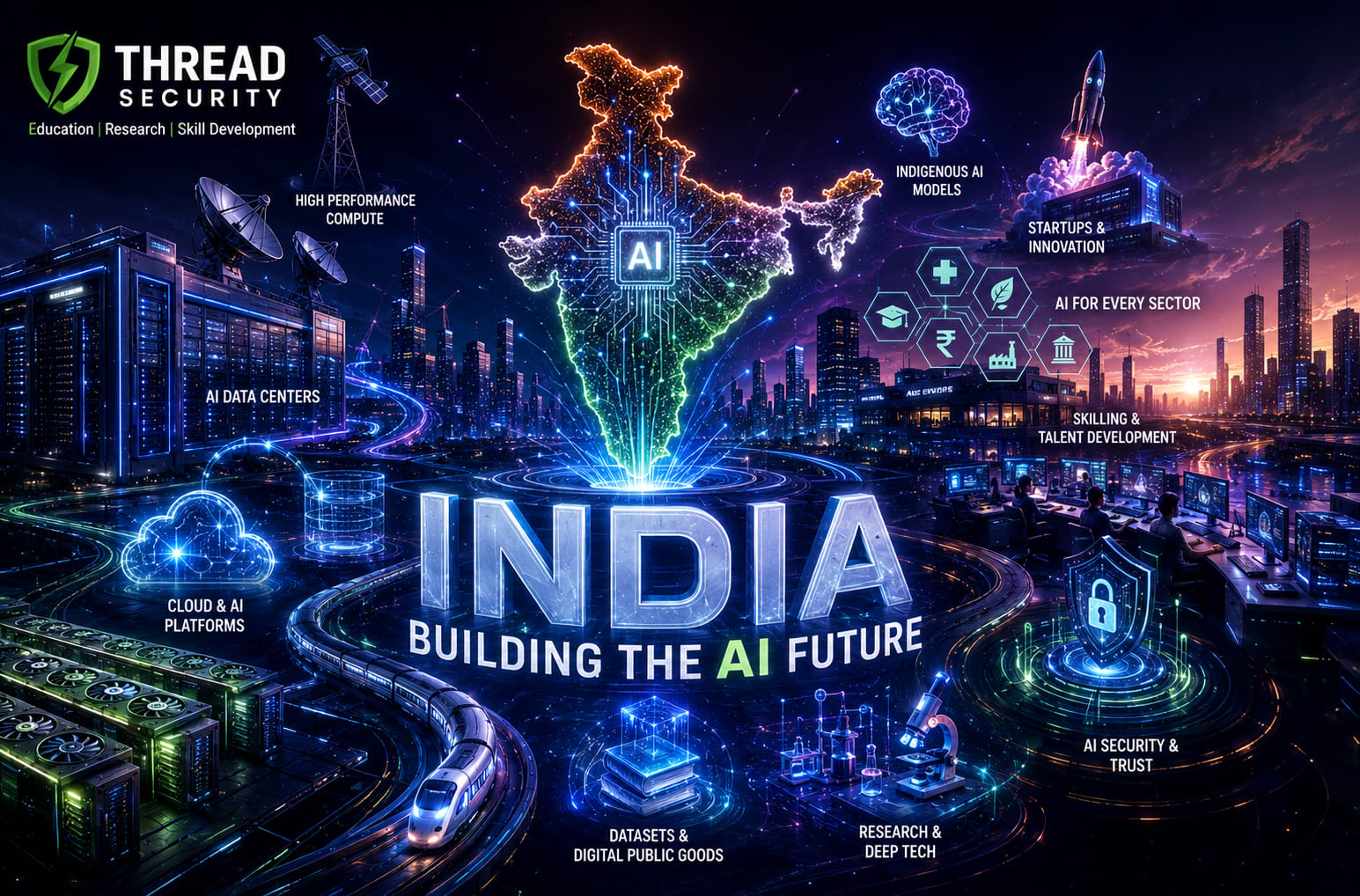
9. What Would Prove India Is Becoming an AI Builder?
Infrastructure announcements and funding are important inputs. To understand whether they are translating into durable capability, look for evidence across several dimensions:
Area | What meaningful progress looks like |
|---|---|
Compute | Researchers and startups can access suitable resources at predictable costs. |
Research | More reproducible work, strong research teams and useful technical contributions. |
Products | AI systems solving real problems beyond controlled demonstrations. |
Data | Documented, representative datasets used with appropriate permissions and safeguards. |
Talent | People who can evaluate, deploy, secure and maintain systems not just build prototypes. |
Economic value | Products, productivity improvements, skilled jobs and sustainable businesses. |
These indicators also help distinguish progress from hype. A country can have a large AI user base without leading in every area of AI research. It can build strong applications using global models while continuing to develop domestic models and infrastructure. Progress is not all-or-nothing, and different parts of the ecosystem may advance at different speeds.
10. Why AI Security Must Be Part of the Growth Story
As AI systems become part of business operations, security becomes an engineering requirement rather than an optional finishing step. AI applications can expose sensitive information, rely on unsafe integrations, accept manipulated inputs or inherit vulnerabilities from the applications and infrastructure around them.
Systems using retrieval-augmented generation (RAG), external tools or agents introduce additional considerations. Teams should examine access controls, data permissions, logging, secret handling, output validation and the actions an AI agent is allowed to perform. They should also test for prompt injection, data exposure and unintended tool use where relevant.
This is where organizations such as Thread Security can contribute through cybersecurity expertise and appropriate security assessments. As AI adoption grows, businesses should assess not only whether an application works, but also whether its web interfaces, cloud configuration, integrations and data-handling processes are adequately protected. The scope of an assessment should match the system being tested; conventional penetration testing alone does not automatically validate model quality or every AI-specific risk.
11. Thread Security Education: Build Practical AI Skills
India's AI opportunity creates a need for learners who can turn concepts into working projects. Students and early-career professionals can begin with Python, data handling and software fundamentals, then progress towards machine learning, deep learning, generative AI, retrieval-augmented generation and AI application development.
Practical work should include more than copying a tutorial. Build a small application, document the data and model choices, create a test set, measure performance, identify failure cases and explain what you would improve. Where relevant, include deployment, monitoring and basic security checks.
Thread Security Education focuses on practical technology learning across AI and cybersecurity. Learners exploring AI courses in Jalandhar can investigate relevant training options and look for programmes that emphasize hands-on projects, technical foundations and responsible engineering. Choose learning pathways based on your current level and goals, and evaluate them by the skills and portfolio evidence you can build—not by promises of guaranteed jobs or salaries.
Frequently Asked Questions
Is India only an IT services hub?
No. IT services remain an important strength, but investments in AI infrastructure, national initiatives, research and product development indicate a broader ambition. The scale and long-term impact of that transition will depend on measurable outcomes.
What is India's AI infrastructure?
It includes the computing capacity, data centres, cloud services, networks, datasets, software platforms and skilled teams required to develop and operate AI systems.
What is the IndiaAI Mission?
It is a Government of India initiative with an approved outlay of approximately ₹10,372 crore to support AI compute, innovation, datasets, skills and related ecosystem development.
What does sovereign AI mean for India?
It refers to developing the capability and control needed to build, operate and govern AI systems according to national and organizational needs. It does not require avoiding all international technology.
Will more GPUs automatically make India an AI leader?
No. Compute is important, but leadership also depends on research, quality data, skilled people, efficient engineering, useful products and sustained investment.
Which skills are useful for an AI career in India?
Python, data engineering, statistics, machine learning, model evaluation, deployment and security are useful foundations. The right combination depends on the role you want to pursue.
How can students gain practical AI experience?
Build documented projects, compare model performance, test failure cases, use version control and learn how to deploy and secure applications. Explain your decisions rather than relying on a project demo alone.
Where can learners explore AI courses in Jalandhar?
Learners can explore relevant programmes from Thread Security Education and compare their syllabus, practical work, mentoring and learning outcomes before enrolling.
Key Takeaways
India's technology story is expanding beyond traditional IT services, but the transition to AI leadership is still a work in progress.
Microsoft's announced US$17.5 billion commitment and the IndiaAI Mission can strengthen infrastructure, skills and access to compute.
A large developer population is an advantage only when it is supported by deep technical skills, research opportunities and practical experience.
Sovereign AI involves capability, resilience and informed choices—not simply hosting infrastructure within national borders.
Data quality, research depth, compute access and AI security remain important challenges.
Progress should be measured through useful products, credible research, reliable systems and sustainable economic value—not announcements alone.
Call to Action
India's next phase of technology growth will depend on people who can do more than use AI tools. It will need developers, researchers, data professionals and security practitioners who understand how systems are built, evaluated, deployed and protected.
If you are starting your journey, begin with strong fundamentals and build projects that demonstrate real problem-solving. If you are an organization adopting AI, invest in responsible deployment and security alongside innovation.
Explore Thread Security and Thread Security Education to learn more about technology training and cybersecurity expertise. If you are searching for AI courses in Jalandhar, explore relevant learning options and take the next step towards building practical, responsible AI skills
Simranjit Kaur
VERIFIEDAI Trainer · Thread Security
Faculty mentor & research guide at Thread Security Education.