SOC Analyst Roadmap 2027 is a practical starting point for anyone planning a career in cybersecurity, especially in security operations, threat detection and incident response. A Security Operations Center (SOC) analyst monitors security events, investigates suspicious activity and helps an organization respond to cyber incidents. The role combines technical knowledge, investigation skills and clear communication. You do not need to master every cybersecurity tool before applying for an entry-level role, but you do need to understand what alerts mean and how to investigate them.
This roadmap explains the skills to learn, SOC tools to practise, certifications to consider, career progression and common SOC analyst interview questions. It is a learning guide for 2027, not a promise of employment or a claim that every employer follows the same hiring process.
1. Understand What a SOC Analyst Does
A SOC analyst works with security telemetry generated by endpoints, servers, networks, cloud services, identity systems and security applications. The analyst reviews alerts, checks their context, determines whether activity is suspicious, documents findings and escalates incidents when required.
Typical responsibilities include monitoring SIEM dashboards, investigating endpoint alerts, analysing login activity, reviewing phishing reports, checking indicators of compromise, documenting incidents and supporting containment procedures. More experienced analysts may also conduct threat hunting, improve detection rules and coordinate incident response.
Many organizations describe SOC responsibilities using Tier 1, Tier 2 and Tier 3 structures. These labels are common, but the exact responsibilities differ between employers.
Tier 1 – Monitoring and triage: Review alerts, validate basic context, identify false positives and escalate suspicious events.
Tier 2 – Investigation and response: Investigate incidents in greater depth, correlate evidence, determine scope and support containment and remediation.
Tier 3 – Threat hunting and detection engineering: Develop detection logic, investigate advanced activity, hunt for threats and improve defensive coverage.
2. Build Your Technical Foundation First
Do not begin by collecting tool names or memorising commands. Start with the systems and protocols that generate the evidence SOC analysts investigate.
Networking fundamentals
Learn TCP/IP, the OSI model, IP addressing, ports, DNS, DHCP, HTTP and HTTPS. Understand the purpose of common ports such as 22, 53, 80, 443 and 3389. Practise reading basic packet captures in Wireshark. You should be able to explain what happens when a user visits a website, how DNS resolution works and why unusual outbound connections may deserve investigation.
Windows and Linux
Learn Windows users and groups, processes, services, scheduled tasks, Event Viewer and basic PowerShell. On Linux, practise file permissions, processes, services, authentication logs, SSH and commands such as grep, find, ps, ss and journalctl. SOC work frequently involves interpreting activity from both operating systems.
Security fundamentals
Understand the CIA triad: confidentiality, integrity and availability. Study authentication, authorisation, multi-factor authentication, access control, malware, phishing, ransomware, vulnerabilities, patching, encryption and security logging. Learn the difference between an event, an alert and a confirmed incident. This distinction is important because an alert is a signal to investigate, not automatic proof of a successful attack.
3. Learn the Core SOC Tools
Tools are important, but employers do not all use the same technology stack. Learn the purpose of each category and become comfortable investigating in at least one practical platform.
SIEM – Security Information and Event Management
A SIEM platform collects and analyses security data from different sources. Learn how logs are ingested, searched, correlated and used to generate alerts. Common platforms include Splunk, Microsoft Sentinel, Elastic Security and IBM QRadar. Practise searching authentication events, identifying repeated failed logins and comparing activity across multiple systems.
EDR and XDR
Endpoint Detection and Response tools provide visibility into endpoint activity, including processes, files, network connections and suspicious behaviour. Extended Detection and Response platforms correlate signals across multiple security layers. Explore Microsoft Defender for Endpoint and understand the investigation concepts used by other EDR products.
Packet and network analysis
Wireshark helps inspect packet captures, while tools such as Zeek and Suricata are used for network security monitoring and analysis. Learn to recognise DNS requests, HTTP traffic, connection patterns and potentially suspicious communication. These tools are not substitutes for understanding networking fundamentals.
Threat intelligence and investigation
Learn how to examine IP addresses, domains, file hashes and URLs using reputable intelligence sources. VirusTotal can help enrich an investigation, but a detection result should not be treated as conclusive proof by itself. Check context, timestamps, reputation, source reliability and corroborating evidence before drawing conclusions.
Querying and automation
Practise SPL for Splunk and Kusto Query Language (KQL) for Microsoft Sentinel. Learn basic Python or PowerShell to parse logs, automate repetitive tasks and transform data. You do not need advanced software engineering skills for every entry-level SOC position, but scripting and query skills make investigations more efficient.
4. Understand MITRE ATT&CK and Incident Response
MITRE ATT&CK is a knowledge base of adversary tactics and techniques based on real-world observations. It helps defenders describe attacker behaviour using a shared structure. Learn the difference between a tactic, which describes an adversary's goal, and a technique, which describes how that goal may be achieved.
For example, credential access describes an adversary objective, while specific techniques explain ways credentials may be obtained. During an investigation, mapping observed behaviour to ATT&CK can help analysts explain what happened and identify possible detection gaps. Do not force every alert into a technique when the evidence does not support it.
Also learn the common incident response lifecycle: preparation, detection and analysis, containment, eradication, recovery and lessons learned. NIST's Computer Security Incident Handling Guide, SP 800-61, is a useful reference for understanding incident handling. Follow your organization's approved procedures when taking response actions.
5. Build a Hands-On SOC Analyst Lab
A certificate alone cannot demonstrate that you can investigate an alert. Build a small, legal lab and document what you learn. You can use virtual machines, sample logs, training datasets and free learning environments. Keep experiments isolated from networks and systems you do not own or have permission to test.
Windows log investigation: Generate normal login activity in a test Windows environment. Review relevant Windows Event Logs and explain what each event indicates.
Failed login investigation: Use sample authentication logs to identify repeated failures, unusual timing and potentially suspicious source addresses. Explain what additional evidence you would need before escalating.
SIEM practice: In Splunk or Microsoft Sentinel, ingest sample data and write queries to find failed logins, unusual process activity and repeated events.
Phishing analysis: Inspect a safe training email sample. Review sender details, headers, links and attachments without opening suspicious files on a normal device.
Incident report: Write a short report containing the alert summary, timeline, evidence, assessment, actions taken and recommended next steps.
Publish sanitised lab notes, queries and detection examples in a GitHub portfolio. Never upload real customer logs, personal data, credentials or confidential company information.
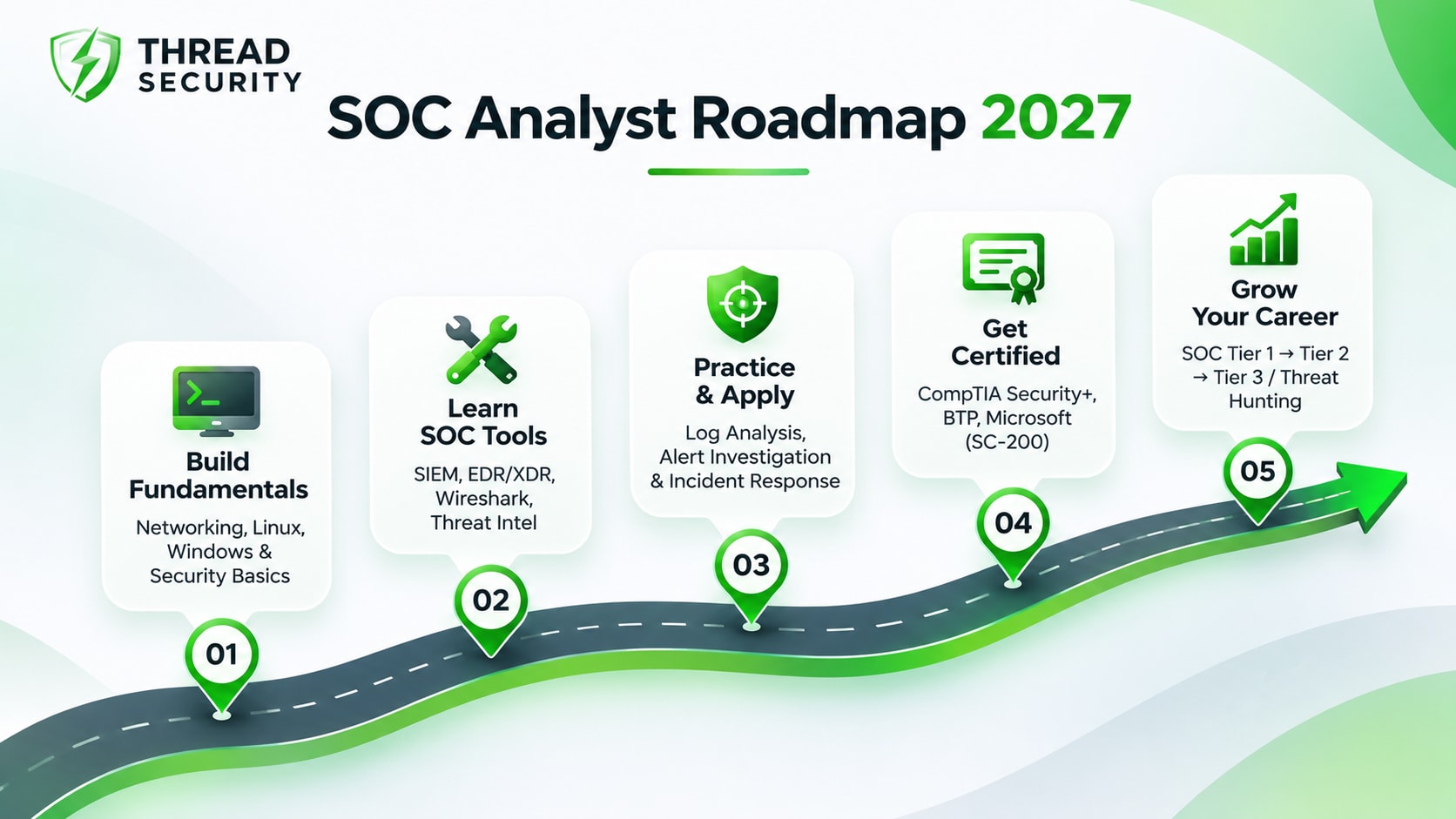
6. SOC Analyst Certifications to Consider
Certifications can provide structured learning and help demonstrate knowledge, but they do not replace practical investigation experience. Choose a certification based on your current level, budget and the technologies relevant to your target roles.
CompTIA Security+: A broad security foundation covering core cybersecurity concepts, threats, architecture and security operations.
CompTIA CySA+: More focused on defensive security analysis, vulnerability management, detection and incident response concepts.
Microsoft SC-200: The Microsoft Security Operations Analyst Associate certification focuses on security operations using Microsoft Sentinel and Microsoft Defender technologies. Review the current official exam objectives before preparing.
Vendor-specific SIEM training: Splunk and other platform providers offer learning resources that can help you practise searching, analysing and investigating security data.
Do not collect certifications randomly. A beginner may benefit more from networking, operating system and security fundamentals before attempting an intermediate analyst certification. Always verify exam names, prices, availability and objectives on the issuing organisation's official website because certification programmes can change.
7. SOC Analyst Career Path in India
A common entry route is to apply for SOC Analyst L1, Junior SOC Analyst, Security Operations Analyst, Cybersecurity Analyst or Security Monitoring Analyst positions. Job titles and requirements vary across companies. Some employers accept fresh graduates with strong fundamentals and lab experience, while others ask for prior IT support, networking or security experience.
After gaining experience, analysts may move towards incident response, threat hunting, detection engineering, digital forensics, security engineering or SOC leadership. These are possible career directions, not automatic promotions. Progress depends on practical ability, organisational needs and the depth of experience developed.
For your first role, prepare a focused resume that lists relevant technical skills, labs, projects, certifications and clear examples of investigations. Describe what you personally built or analysed. Avoid claiming professional SOC experience if your work was completed only in a training lab.
8. Common SOC Analyst Interview Questions
Interviewers may test fundamentals, investigation logic and communication. Practise explaining your reasoning rather than memorising one-line definitions.
What is a SIEM?
A SIEM collects and analyses security logs and events from multiple sources to support monitoring, correlation, alerting and investigation.What is the difference between an event, alert and incident?
An event is an observable activity. An alert is a notification that activity may require attention. An incident is a security event or series of events assessed as requiring a coordinated response.What would you do after receiving repeated failed-login alerts?
Validate the alert, identify the affected account and source, check timestamps and authentication patterns, review successful logins and related activity, assess risk and follow escalation procedures.What is the difference between IDS and IPS?
An Intrusion Detection System identifies and alerts on potentially malicious activity. An Intrusion Prevention System can also take action to block or prevent certain activity, depending on configuration.What is phishing?
Phishing is a social engineering technique that attempts to trick people into revealing information, opening malicious content or performing an unsafe action.What is MITRE ATT&CK?
It is a knowledge base that organises observed adversary tactics and techniques to support threat-informed defence and analysis.What is the purpose of EDR?
EDR provides endpoint telemetry and investigation capabilities to help detect, analyse and respond to suspicious activity on devices.How do you handle a false positive?
Validate the available evidence, identify why the detection triggered, document the reasoning and follow the approved process for tuning or escalation.
Expect scenario-based follow-ups. An interviewer may ask you to inspect a log, explain a suspicious PowerShell process or investigate an unfamiliar IP address. State what the evidence shows, what remains unknown and what you would check next. That is stronger than guessing.
9. A Practical 90-Day Learning Plan
Days 1–30: Study networking, Windows, Linux and security fundamentals. Practise reading system and authentication logs.
Days 31–60: Learn one SIEM platform, practise SPL or KQL, explore endpoint alerts and study MITRE ATT&CK.
Days 61–90: Complete three documented lab investigations, write incident reports, revise interview questions and prepare a focused resume and portfolio.
This is a suggested study structure, not a guaranteed job timeline. Adjust it according to your existing knowledge and the time you can consistently dedicate to practice.
10. How Thread Security Supports SOC Career Preparation
At Thread Security, cybersecurity is approached through practical security awareness, technical learning and an understanding of how defensive teams investigate threats. Thread Security Education aims to help learners build relevant foundations in cybersecurity and develop an understanding of security operations, threat detection and incident response. For aspiring SOC analysts, structured learning should be supported by hands-on exercises, tool familiarity, investigation practice and clear documentation. Explore Thread Security Education to learn about its cybersecurity training opportunities and choose a learning path that matches your current skill level and career goals.
Conclusion: Start With Fundamentals, Then Prove Your Skills
The SOC Analyst Roadmap 2027 is not about learning every cybersecurity tool at once. Build strong networking and operating system fundamentals, understand security concepts, practise with a SIEM, learn endpoint investigation, and become comfortable explaining evidence. Use certifications as structured learning milestones and create a portfolio that demonstrates what you can actually do. Consistent practice and honest documentation will make your preparation more credible than a long list of tools on a resume.
Ready to begin your SOC analyst journey? Explore the cybersecurity learning opportunities at Thread Security Education, strengthen your technical foundations and start building practical investigation skills. Visit Thread Security to learn more, explore available training opportunities and take the next step towards a career in cybersecurity.
References and Further Reading
Akshay Kumar
VERIFIEDAcademic Coordinator · Thread Security
Faculty mentor & research guide at Thread Security Education.