
How to become a vulnerability researcher is an increasingly relevant question as artificial intelligence changes how software weaknesses are discovered. AI bug-finding tools can analyse source code, identify suspicious patterns, generate test cases and help researchers investigate complex software. But finding a vulnerability is not simply a matter of asking an AI model to scan a repository. Effective vulnerability research still requires programming knowledge, security fundamentals, careful testing and the ability to prove that a suspected weakness is real.
The role of a vulnerability researcher is evolving. Traditional techniques such as manual code review, fuzzing and reverse engineering remain important, while AI-assisted security tools are becoming part of the research workflow. This guide explains the skills, tools, practical projects and responsible disclosure practices needed to build a career in vulnerability research in the age of AI.
1. What Does a Vulnerability Researcher Actually Do?
A vulnerability researcher investigates software, hardware, applications or systems to identify security weaknesses that could be exploited by an attacker. The objective is not merely to find unusual behaviour. A researcher must understand the underlying cause, determine the security impact, reproduce the issue and communicate the findings responsibly.
Typical vulnerability research activities include reviewing source code, analysing application behaviour, identifying insecure input handling, testing authentication and authorisation controls, examining memory-management issues, developing proof-of-concept demonstrations and helping developers understand how to fix the problem.
Vulnerability researchers may work in product security teams, application security, security consulting, vulnerability research laboratories, bug bounty programmes or independent security research. The exact responsibilities depend on the organisation and the systems being studied.
2. How AI Is Changing Vulnerability Research
Traditional vulnerability discovery often requires a researcher to understand a codebase, identify potentially dangerous functions, construct test cases and investigate unexpected behaviour. AI-assisted tools can help with several of these activities. They may summarise code, identify suspicious data flows, suggest test cases, explain complex functions and assist with reproducing a suspected bug.
However, AI-generated findings are not automatically valid vulnerabilities. A model may misunderstand program behaviour, overlook security controls, produce an incorrect explanation or report a weakness that cannot be reproduced. Researchers must validate every important finding with evidence.
Real-world evidence: Google's Big Sleep and Project Zero
Google has publicly described Big Sleep, an AI-powered vulnerability discovery agent developed with Google DeepMind and Project Zero. Google reported that the system found vulnerabilities in software including the V8 JavaScript engine and other parts of the Chrome ecosystem.
In an October 27, 2026 Project Zero comparison, researcher Samuel Groß reported that Big Sleep found 45 vulnerabilities in V8 over the preceding six months, compared with 37 found by the Fuzzilli fuzzer. The report also found that the tools discovered different sets of bugs, with only partial overlap. Project Zero's conclusion was that AI-based discovery and traditional fuzzing are complementary approaches.
This is an important development, but it should not be exaggerated. The comparison concerns a particular engine, tools and evaluation period. It does not establish that AI will outperform human researchers in every type of vulnerability research.
3. Build the Technical Foundations First
If you want to become a vulnerability researcher, start with programming and system fundamentals. Learning security tools without understanding the software being tested creates shallow knowledge.
Programming languages
Learn Python for scripting, automation, data processing and writing test utilities. Study C and C++ if you want to investigate memory-safety vulnerabilities, buffer overflows, use-after-free bugs and low-level software behaviour. JavaScript is valuable for browser and web application research, while Java, Go or Rust may be useful depending on the software you want to investigate.
Operating systems and networking
Understand Linux processes, memory, permissions, system calls, filesystems and debugging. Learn Windows internals if you plan to research Windows applications or drivers. Networking fundamentals should include TCP/IP, DNS, HTTP, TLS, sockets and common application protocols.
Web and application security
Study authentication, session management, access control, input validation, SQL injection, cross-site scripting, server-side request forgery, insecure deserialisation and security misconfiguration. The OWASP Web Security Testing Guide and OWASP Top 10 are useful starting references for web application security.
4. Essential Vulnerability Research Tools
There is no single tool that finds every vulnerability. A strong researcher understands different testing methods and chooses tools based on the target, programming language and suspected weakness.
Static analysis and code review
Static Application Security Testing (SAST) examines source code or compiled representations without requiring the application to run. Tools such as Semgrep and CodeQL can help identify insecure coding patterns and trace potentially dangerous data flows. Learn to review the findings manually rather than treating every warning as exploitable.
Dynamic testing and web security
Dynamic testing examines software while it is running. Burp Suite is widely used for web application testing, while OWASP ZAP provides an open-source option for examining web application security. Learn how to inspect requests, responses, authentication flows, input handling and access-control behaviour.
Fuzzing
Fuzzing automatically supplies many inputs to a program to identify crashes, unexpected behaviour and potential security issues. AFL++, libFuzzer and OSS-Fuzz are important tools and projects to study. Learn about coverage-guided fuzzing, input corpora, sanitizers, crash reproduction and minimisation.
Reverse engineering and debugging
Ghidra can help analyse compiled software through disassembly and decompilation. GDB and LLDB are useful debuggers for understanding program execution and memory behaviour. For browser research, learn the relevant developer tools and JavaScript engine debugging concepts.
AI-assisted research tools
AI systems can support code comprehension, vulnerability hypothesis generation, test-case development and patch review. Google has documented Big Sleep and its work with Project Zero. OpenAI introduced Aardvark in 2025 and announced its evolution into Codex Security in March 2026 as a research preview. These examples show how AI agents are being integrated into security workflows, but product availability and capabilities should always be checked against official documentation.
5. Learn the Main Vulnerability Classes
Do not try to research every vulnerability category simultaneously. Start with common classes and understand how they arise, how they can be reproduced and how developers can prevent them.
Injection vulnerabilities: Understand how untrusted input can alter database queries, operating-system commands or interpreter behaviour.
Broken access control: Learn how insecure authorisation checks can allow users to access data or actions they should not control.
Memory-safety issues: Study buffer overflows, out-of-bounds access, use-after-free and integer errors, especially in C and C++ software.
Authentication and session weaknesses: Investigate insecure password handling, session management and identity verification.
Cryptographic implementation flaws: Learn how incorrect use of cryptographic libraries, weak configurations or poor key management can expose systems.
Business logic vulnerabilities: Understand how an application can behave insecurely even when individual components appear technically correct.
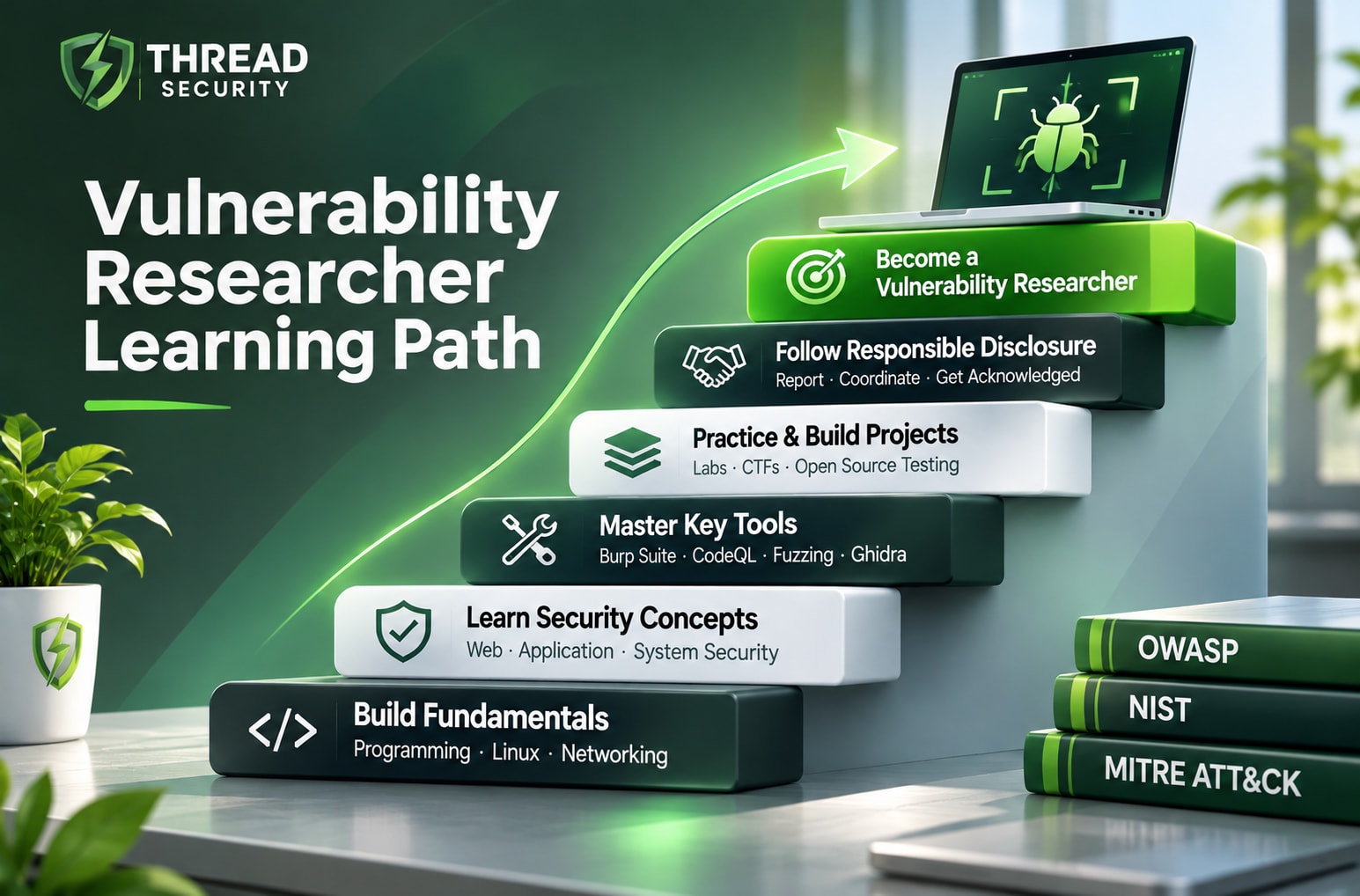
6. A Practical Roadmap to Become a Vulnerability Researcher
Phase 1: Learn programming and security fundamentals
Build confidence in Python, Linux, networking, HTTP, databases and basic application security. Practise reading source code rather than relying only on video tutorials. Learn to explain why a particular input or operation may create a security problem.
Phase 2: Practise in authorised environments
Use deliberately vulnerable applications, capture-the-flag exercises and legal training labs. OWASP Juice Shop and PortSwigger Web Security Academy provide structured opportunities to learn web vulnerabilities. Keep a record of the test conditions, evidence, root cause and remediation for every exercise.
Phase 3: Learn automated testing
Use a combination of SAST, DAST, fuzzing and dependency analysis. Begin with a small open-source project that explicitly permits security testing. Understand the target's licence, security policy and testing scope before conducting research.
Phase 4: Add AI to your workflow
Use AI to explain unfamiliar code, suggest possible edge cases, generate test inputs and help organise investigation notes. Then independently verify its suggestions. Compare AI-generated hypotheses with static analysis, fuzzing results and manual testing. Record false positives as well as confirmed findings.
Phase 5: Publish research responsibly
Build a portfolio containing technical write-ups, safe proof-of-concept demonstrations, root-cause analysis and remediation guidance. Do not publish sensitive data or weaponised exploit details that could expose users before a fix is available. Follow the target's vulnerability disclosure policy and coordinate with maintainers.
7. What Makes a Strong Vulnerability Researcher?
Tool knowledge is only one part of the job. Strong researchers are patient, analytical and comfortable investigating problems that do not have obvious answers. They understand how software is designed, how security controls work and how a weakness could affect real users.
Important professional skills include:
Reading and understanding unfamiliar source code.
Creating minimal, reproducible test cases.
Distinguishing theoretical weaknesses from demonstrable security impact.
Understanding exploitability without making unsupported claims.
Writing clear technical reports for developers and security teams.
Following legal authorisation and responsible disclosure processes.
Using AI critically instead of trusting generated findings blindly.
8. How to Build a Vulnerability Research Portfolio
A portfolio should demonstrate investigation quality, not just list tools. Start with three or four well-documented projects. For example, analyse a deliberately vulnerable web application, create a small fuzzing harness for a permitted test program, review a sample codebase using CodeQL or Semgrep, and document an AI-assisted code review where you independently verify the result.
For each project, explain the objective, environment, testing methodology, evidence, limitations and remediation. If you submit a real vulnerability report, follow the programme's rules and only publish details when disclosure is permitted. Never claim that a simulated lab finding is a real-world zero-day.
9. Responsible Disclosure Is Part of the Job
Finding a vulnerability is only one stage of professional security research. Researchers should report findings through the software vendor's security contact, vulnerability disclosure programme or authorised bug bounty platform. A good report includes affected versions, reproduction steps, impact, supporting evidence and possible remediation.
NIST SP 800-216 provides recommendations for establishing vulnerability disclosure guidelines. In July 2026, CISA, the NSA and international partners also published guidance on coordinated vulnerability disclosure programmes, including clear policies, triage, remediation and communication with researchers.
Never test systems without permission. A bug bounty programme's scope and rules define what is authorised; the fact that a website is publicly accessible does not give permission to probe it.
10. The Future: AI Will Change the Work, Not Remove the Need for Researchers
AI can reduce the time required for some repetitive analysis and help explore codebases at scale. Research from Google Project Zero and the results of DARPA's AI Cyber Challenge demonstrate that automated systems can identify and, in some cases, help patch meaningful software vulnerabilities.
However, vulnerability research involves more than finding suspicious code. It requires understanding the system's intended behaviour, validating security impact, handling complex dependencies, communicating with developers and making responsible disclosure decisions. These tasks demand technical judgement and accountability.
The most useful approach is not to compete with AI at tasks it can automate. It is to become a researcher who understands the underlying technology, uses AI as an additional analysis tool and can independently validate the results.
11. How Thread Security Supports Practical Cybersecurity Learning
At Thread Security, application security, vulnerability assessment and penetration testing are closely connected to the practical skills discussed in this article. Thread Security Education aims to help learners build cybersecurity foundations and understand how security weaknesses are identified, assessed and addressed. For aspiring vulnerability researchers, structured learning should go beyond tool demonstrations: it should include programming fundamentals, secure coding, authorised testing environments, vulnerability analysis and responsible reporting. The objective is to help learners develop a methodical security mindset and understand the difference between identifying a possible issue and proving a genuine vulnerability.
Conclusion: Become a Researcher Who Can Prove the Finding
AI bug-finding tools are making vulnerability discovery more accessible and changing how security teams analyse software. But they do not remove the need for programming knowledge, manual investigation, reproducible evidence or responsible disclosure. Build strong technical fundamentals, practise with authorised labs, learn fuzzing and code analysis, and use AI as an assistant rather than an unquestioned authority. A credible vulnerability researcher is not someone who produces the most alerts; it is someone who can explain, reproduce and responsibly report a real security weakness.
Ready to build your cybersecurity and vulnerability research skills? Explore the learning opportunities at Thread Security Education and strengthen your foundations in application security, ethical hacking and vulnerability assessment. Visit Thread Security to learn more about its cybersecurity initiatives and take a practical next step towards understanding how modern software security works.
References and Further Reading
Akshay Kumar
VERIFIEDAcademic Coordinator · Thread Security
Faculty mentor & research guide at Thread Security Education.