Why Students Need an AI Learning Plan
AI learning plan development is becoming important for students who want to manage college studies, additional courses and practical projects without allowing one responsibility to affect the others. Learning artificial intelligence involves more than watching tutorials or completing online certificates. Students need time to understand concepts, practice technical skills, work on projects, prepare for examinations and review what they have learned.
The problem is that these activities often compete for the same limited hours. A student may attend college, enroll in an online machine learning course, start building a chatbot, prepare for internal assessments and still try to follow new AI developments. Without a clear plan, everything starts feeling urgent. Projects remain unfinished, course lessons pile up and academic preparation gets delayed.
The solution is not necessarily to study for longer hours. It is to decide what deserves attention, allocate realistic time blocks and follow a system that can be maintained throughout the semester.
This guide explains how to create a weekly schedule, choose one project at a time, review progress and recognize the signs of burnout. The aim is to make learning consistent without turning every day into an exhausting productivity challenge.
1. Understand Your Three Main Learning Responsibilities
Before creating a timetable, identify the responsibilities that need space in your week. For most students balancing academics and AI skill development, these can be divided into three areas.
A. College Academics
College responsibilities should include lectures, assignments, practical work, internal assessments, examination preparation and revision. These activities are linked to your formal academic progress and usually have fixed deadlines.
Do not assume that college subjects can be handled at the last minute because you are also learning industry-oriented technologies. A strong practical portfolio cannot compensate for repeatedly neglecting academic requirements.
B. Additional Courses and Skill Development
Online courses, certifications and structured training programmes help students explore topics beyond their university curriculum. These may include Python, machine learning, deep learning, generative AI, data science, cloud technologies or cybersecurity.
However, enrolling in several courses does not mean that you are learning several skills effectively. Course consumption can become a form of procrastination when students keep collecting lessons without practicing or completing anything.
C. Practical AI Projects
Projects help students apply concepts to actual problems. Examples include building a document question-answering application, developing a recommendation system, experimenting with computer vision or creating an AI-powered automation workflow.
Projects require more than coding time. You also need time for problem definition, research, testing, debugging, documentation and improvement.
All three areas matter, but they do not need equal time every week. Your allocation should change according to examination dates, course deadlines and project milestones.
2. Decide Your Priorities Before Filling the Calendar
A common planning mistake is to create a timetable first and decide what to study later. This produces a busy-looking schedule without a clear purpose.
Instead, start by identifying your priorities for the current week.
Use the following order as a practical starting point:
Fixed academic deadlines: Complete assignments, practical submissions and examination preparation that cannot be postponed.
One main skill-development goal: Select the most relevant course or topic to focus on.
One active project: Define a small milestone that can realistically be completed.
Revision and review: Reserve time to revisit concepts and identify knowledge gaps.
Optional exploration: Read about new AI tools or technologies only after essential work is covered.
This does not mean that optional exploration is useless. It means that it should not repeatedly displace important work.
Use a Weekly Priority Test
Before adding a task to your schedule, ask three questions:
Does this task support an academic requirement, a current learning goal or an active project?
Does it need to be completed this week?
What will happen if I postpone it?
If a task has no clear connection to your current priorities and no immediate deadline, it may not deserve space in this week's schedule.
3. Build a Weekly Time-Blocking System
Time-blocking means assigning a specific period to a particular activity instead of relying on a general promise to study whenever free time appears.
For example, writing "learn machine learning this week" is too vague. A more useful block would be "Tuesday, 7:00 PM to 7:40 PM: revise decision trees and solve two practice questions."
A time block should define:
Activity: What exactly will you work on?
Duration: How much time is available?
Expected outcome: What should be completed by the end?
Priority: Is it essential, important or optional?
4. Follow the One-Project-at-a-Time Rule
One of the biggest productivity traps in AI learning is starting too many projects simultaneously.
A student may begin a chatbot, a computer vision model, an AI agent, a recommendation system and a voice assistant within the same month. Each project seems interesting, but switching between them creates fragmented progress. Eventually, several projects remain partially completed and none becomes a strong portfolio piece.
A better approach is to maintain a project backlog while working on only one primary project at a time.
How to Select Your Next AI Project
Evaluate possible projects using these questions:
Learning relevance: Does the project help you practice a skill you currently need?
Feasibility: Can you build a basic version with your available time and hardware?
Scope: Can the project be divided into small, manageable milestones?
Practical value: Does it solve a clearly defined problem or demonstrate a useful capability?
Completion potential: Can you realistically finish and document it?
Example: Building an AI Document Assistant
Instead of trying to build a complete application immediately, divide the work into smaller stages:
Week 1 : Problem definition: Decide who will use the assistant and what problem it should solve.
Week 2 : Data preparation: Collect permitted sample documents and understand their structure.
Week 3 : Basic implementation: Build a simple document question-answering workflow.
Week 4 : Testing: Check response quality, unsupported questions and retrieval errors.
Week 5 : Improvement: Improve the workflow and address the most important issues.
Week 6 : Documentation: Prepare a README, screenshots, architecture explanation and limitations.
The duration will vary with your experience and project complexity. The point is to work towards a finished outcome instead of repeatedly switching to a new idea.
Keep other project ideas in a backlog. You are not rejecting them; you are deciding when they deserve your attention.
5. Connect Your AI Course with Your Project
Courses and projects should support each other rather than operate as completely separate activities.
For example, if you are studying machine learning, you can use your project time to apply the concepts covered in the course. If you are learning about retrieval-augmented generation, you can explore how document retrieval works in a small application.
Try following this learning cycle:
Learn one concept through a course or structured resource.
Write a short explanation in your own words.
Practice the concept with a small exercise.
Apply it to your active project where relevant.
Record what worked, what failed and what needs more revision.
This approach helps convert passive learning into practical understanding.
A Simple Example
Suppose you complete a lesson on classification algorithms. Instead of immediately starting another lesson, spend some time comparing classification and regression, run a small experiment and note which evaluation metrics are suitable for your problem.
You do not need to turn every lesson into a large project. Small exercises are useful because they help you identify whether you actually understand a concept.
6. Review Your Progress Every Week
A timetable is not useful if you never check whether it is working. Weekly reviews help you identify unfinished tasks, unrealistic time estimates and areas where your learning is not progressing.
Set aside approximately 20–30 minutes once a week to answer the following questions:
Which academic tasks did I complete?
Which course lessons or concepts did I finish?
What measurable progress did I make on my active project?
Which tasks were postponed, and why?
What distracted me most during study sessions?
Did I allocate too much work for the time available?
What are the three most important outcomes for next week?
Measure Outcomes, Not Just Study Hours
Spending three hours watching tutorials does not automatically mean that you have understood the topic. Similarly, spending an entire weekend on a project does not guarantee that you have completed a meaningful milestone.
Track outcomes such as:
Number of concepts understood and revised.
Assignments completed before their deadlines.
Course exercises successfully attempted.
Project milestones completed.
Errors identified and resolved.
Documentation or portfolio updates completed.
Study hours can help you understand where your time goes, but completed learning outcomes are a better indicator of progress.
7. How to Avoid Burnout While Learning AI
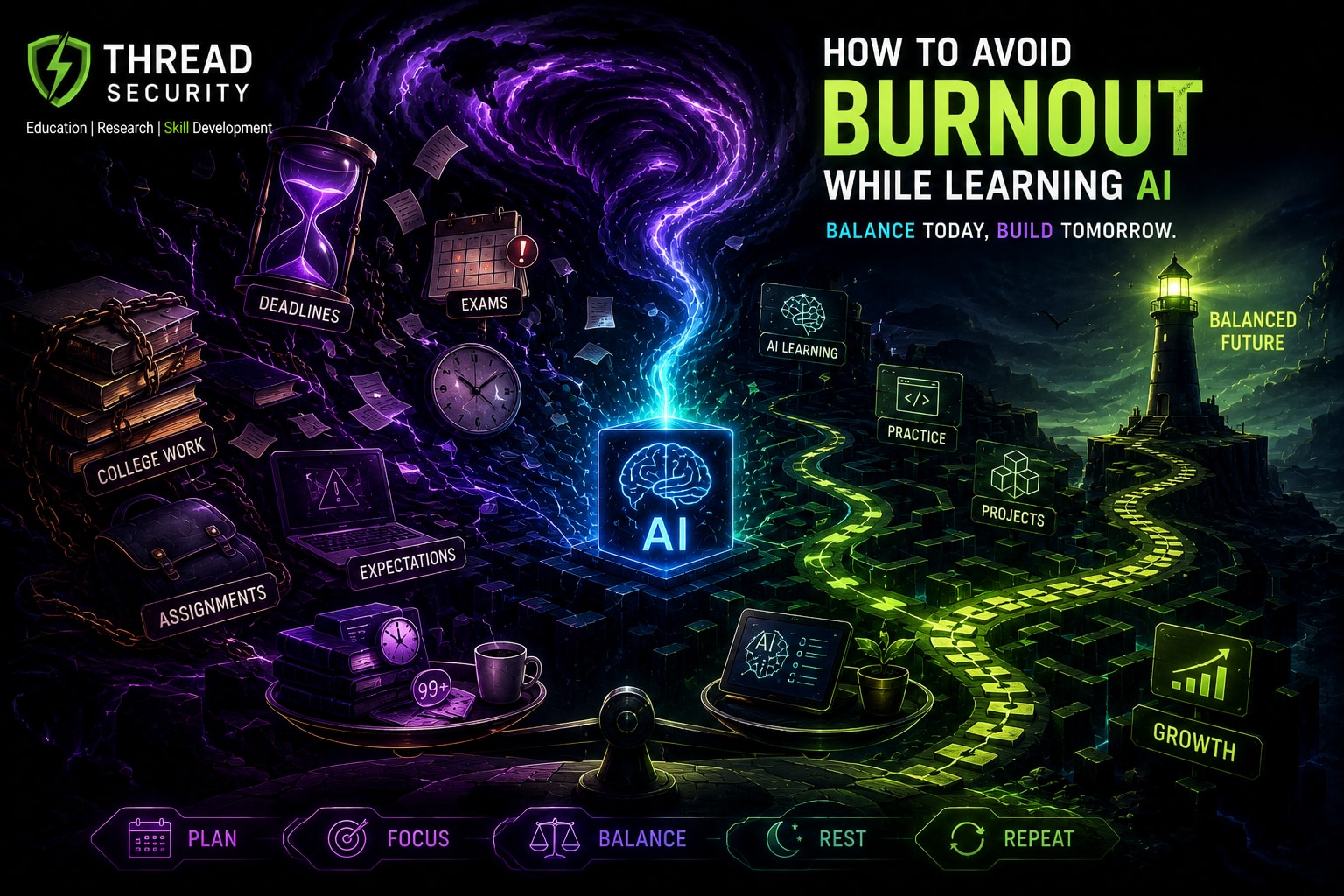
Trying to manage college, online courses, projects, certifications and personal responsibilities can become exhausting. The problem is not always a lack of discipline. Sometimes the schedule itself is unrealistic.
Watch out for these common warning signs:
Constantly postponing tasks because the workload feels overwhelming.
Feeling guilty whenever you are not studying.
Repeatedly starting new courses without completing previous ones.
Reducing sleep to create more study time.
Finding it difficult to concentrate even during short sessions.
Losing interest in activities because every free hour is reserved for learning.
Practical Ways to Reduce Overload
1. Set a realistic daily limit. Do not assume that you can maintain intense study sessions every day alongside college and other responsibilities.
2. Protect your sleep. Cutting sleep to complete optional course lessons is a poor long-term trade-off. It can affect concentration, memory and performance.
3. Keep one flexible block. Leave some time each week for unexpected assignments, technical problems or personal responsibilities.
4. Schedule genuine breaks. Breaks should allow you to recover rather than become another opportunity to consume tutorials or scroll through technology updates.
5. Reduce scope when necessary. If your semester examinations are approaching, temporarily reduce project development. You can resume the project after the academic workload decreases.
6. Stop collecting unnecessary courses. Complete and apply one relevant course before enrolling in another. More certificates do not automatically create stronger technical skills.
A sustainable learning routine should still leave room for rest, relationships and activities outside academics. If your schedule only works when everything goes perfectly, it is not a realistic schedule.
8. Tools That Can Help You Organize Your Learning
You do not need a complicated productivity system or several paid applications to manage your week. Start with tools that are simple enough to maintain.
Google Calendar: Useful for time-blocking classes, assignments, course sessions and project milestones.
Notion: Can organize subject notes, course progress, project backlogs and weekly reviews.
Trello: Useful for moving tasks through stages such as To Do, In Progress, Testing and Completed.
Google Sheets: A simple way to track weekly goals, deadlines and completed outcomes.
GitHub: Useful for maintaining project code, documentation and a record of development progress.
Choose one primary planning tool. Using multiple applications to track the same tasks can create more administration than actual learning.
9. Build Your Own Weekly AI Learning Plan
Now put the ideas into practice. Use the following exercise to create a weekly plan that reflects your actual commitments rather than an idealized timetable.
Step 1: List Your Fixed Commitments
Write down your college hours, commute, assignments, examination dates, family responsibilities and other activities that cannot easily be moved.
Step 2: Select One Main Learning Goal
Choose one AI topic to focus on for the week. For example, Python for machine learning, neural networks, generative AI or RAG fundamentals.
Step 3: Choose One Project Milestone
Do not write "work on AI project". Define a measurable result, such as preparing a dataset, completing an API integration, testing five sample inputs or writing the project documentation.
Step 4: Assign Time Blocks
Allocate realistic sessions for academics, course learning and project work. Include breaks and leave some flexible time for unexpected tasks.
Step 5: Review at the End of the Week
Compare your planned outcomes with what you actually completed. Adjust the next week's workload based on evidence rather than simply adding more tasks.
Starter Weekly Planning Template
Planning Area | Your Weekly Target |
|---|---|
College academics | One important subject or assignment target |
AI course | One topic or module to understand and practice |
Active project | One measurable development milestone |
Revision | One session to revisit earlier concepts |
Progress review | One weekly review of completed outcomes |
Rest | Protected time for recovery and personal activities |
The template is deliberately simple. Its purpose is to make your priorities visible and prevent you from turning every interesting activity into an urgent commitment.
Frequently Asked Questions
1. How many hours should a college student spend learning AI every day?
There is no universal number. The available time depends on college workload, commute, academic deadlines and personal responsibilities. A consistent, focused session is often more useful than an unrealistic daily target that cannot be maintained.
2. Should I focus on college studies or AI projects first?
Both matter, but priorities should change according to deadlines. Academic examinations and compulsory submissions may need more attention during busy periods, while project work can receive more time when the academic workload is lighter.
3. Can I learn two AI courses at the same time?
You can, but it may not be efficient if the courses require significant practical work. Beginners generally benefit from completing one main course or learning path before adding another. A short supplementary resource can be useful when it supports the same topic.
4. How many AI projects should I work on simultaneously?
For most students, one primary project at a time is a practical starting point. You can maintain a list of future ideas, but focus your active development time on completing and documenting one project properly.
5. What should I do if I fall behind my weekly study plan?
Identify why the tasks were missed. If the workload was unrealistic, reduce it. If an unexpected assignment appeared, rearrange lower-priority work. Avoid carrying every unfinished task into the next week without reconsidering its importance.
6. Which tools are best for planning AI learning?
Google Calendar, Notion, Trello and Google Sheets can all help. The best choice is the one you will consistently update. A simple calendar and checklist are enough for many students.
Key Takeaways
Separate college academics, additional courses and practical projects before planning your week.
Prioritize fixed academic deadlines and choose one main learning goal.
Use time blocks with clear tasks and measurable outcomes.
Work on one primary AI project at a time to avoid fragmented progress.
Connect course concepts with small practical exercises and project work.
Review completed outcomes weekly and adjust your schedule realistically.
Protect sleep, breaks and personal time instead of treating every free hour as study time.
Conclusion: Consistency Matters More Than an Overloaded Timetable
Balancing college, courses and AI projects is not about doing everything every day. It is about making deliberate choices and giving important activities enough attention to produce meaningful results.
A practical AI learning plan should reflect your actual schedule, academic responsibilities and current skill level. It should also change when examinations approach, project requirements increase or personal responsibilities demand more time.
Start with one academic priority, one learning goal and one project milestone. Review your progress at the end of the week, remove unnecessary commitments and build from there. A completed project, a properly understood concept and consistent academic progress are more valuable than a timetable filled with unfinished tasks.
Explore practical AI learning with Thread Security Education. Develop your understanding of artificial intelligence through structured learning, hands-on exercises and applied projects that connect technical concepts with real-world problem-solving.
Learn more: Thread Security
Simranjit Kaur
VERIFIEDAI Trainer · Thread Security
Faculty mentor & research guide at Thread Security Education.