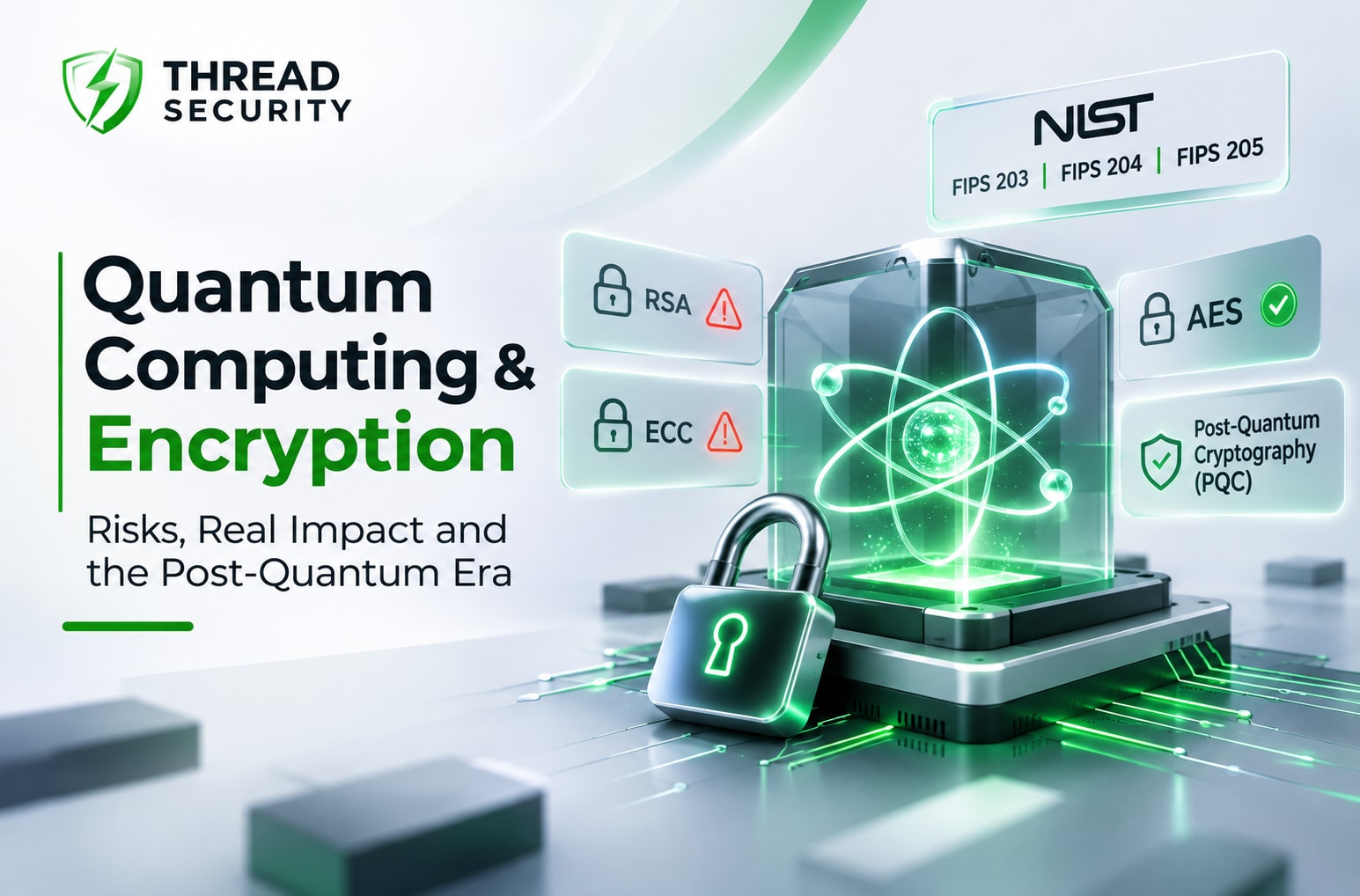
Quantum computing and encryption have become closely connected topics in cybersecurity because sufficiently powerful quantum computers could undermine some of the cryptographic systems that protect today's digital world. RSA and elliptic curve cryptography (ECC), for example, are widely used in public-key cryptography. A future cryptographically relevant quantum computer could use algorithms that make solving the mathematical problems behind these systems much more practical. But does that mean all encryption will suddenly stop working? No. The real situation is more specific, and the timeline is uncertain.
In this article, we separate the science from the headlines. We explain which encryption methods are at risk, what quantum researchers and technology companies have announced, what NIST has standardised, and what organisations should do to prepare for the post-quantum era.
1. Why Is Quantum Computing a Concern for Encryption?
Traditional computers process information using bits, represented as zero or one. Quantum computers use quantum bits, or qubits, which can be prepared in quantum states that allow quantum algorithms to exploit effects such as superposition and entanglement. This does not mean a quantum computer simply tries every possible answer simultaneously or is faster at every task. Its advantage depends on the problem and the algorithm being used.
The cybersecurity concern comes from the mathematical foundations of public-key cryptography. RSA relies on the difficulty of factoring large integers, while widely used elliptic curve systems rely on the difficulty of solving discrete logarithm problems. These problems are considered computationally difficult for classical computers at the key sizes used in modern systems.
In 1994, mathematician Peter Shor published a quantum algorithm for factoring integers and computing discrete logarithms. A sufficiently capable, fault-tolerant quantum computer running this algorithm could threaten RSA and elliptic curve cryptography. This is the technical foundation behind concerns about quantum computing and encryption.
2. Will Quantum Computers Break All Encryption?
No. The statement that quantum computers will break all encryption is an oversimplification. The impact depends on the cryptographic algorithm being used.
Public-key cryptography: A major concern
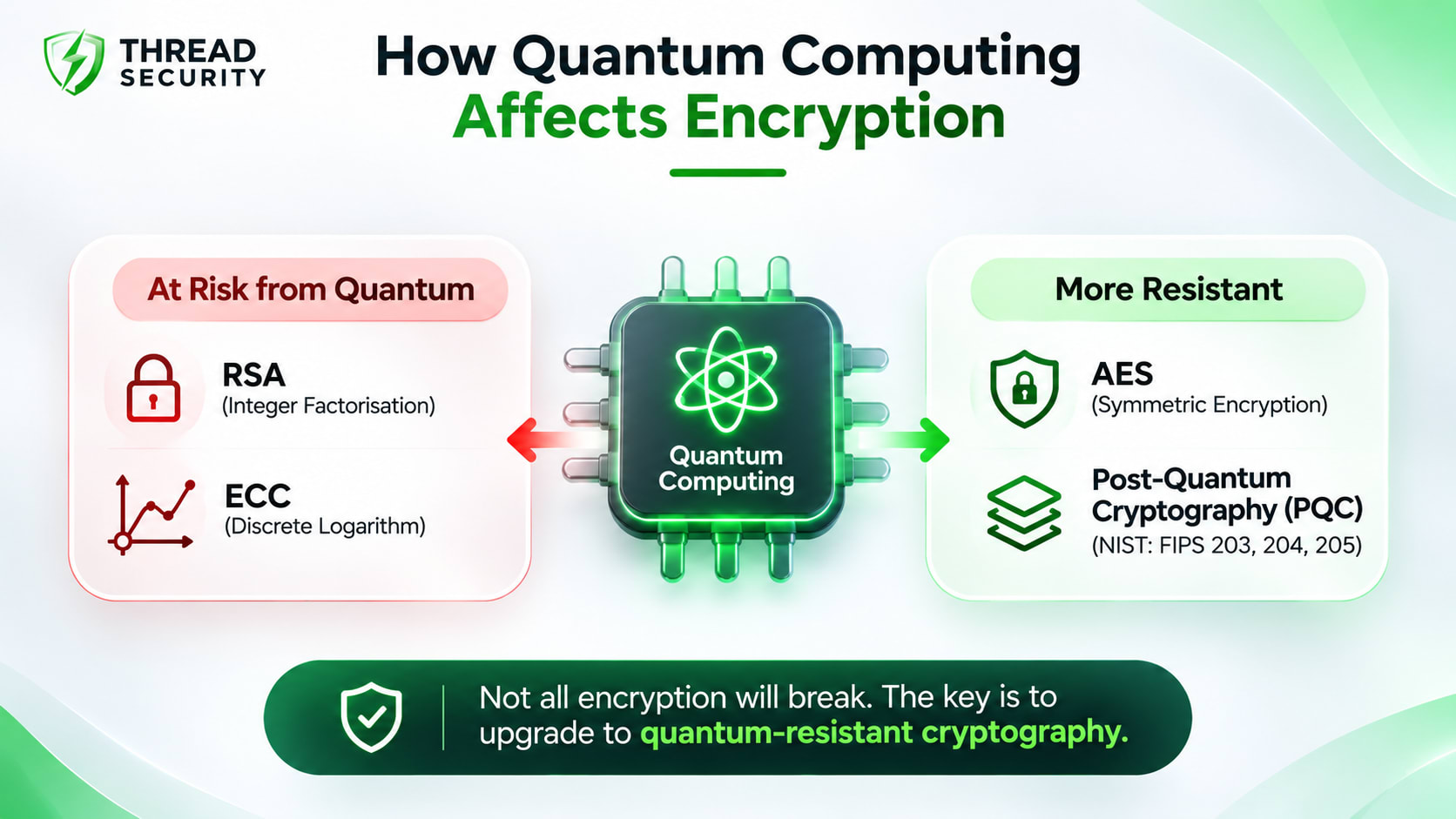
RSA and elliptic curve cryptography are examples of public-key systems that could be vulnerable to a sufficiently powerful quantum computer running Shor's algorithm. Public-key cryptography supports key establishment, authentication and digital signatures across many internet services, software systems and enterprise environments.
This is why the quantum threat is not limited to encrypted messages. It also affects the trust mechanisms used to verify identities, establish secure connections and confirm that software or documents have not been tampered with.
Symmetric encryption: A different impact
Symmetric encryption algorithms, such as AES, are affected differently. Grover's algorithm provides a theoretical quadratic speed-up for certain unstructured search problems. In simplified terms, this can reduce the effective security margin of a symmetric key, but it does not have the same effect as Shor's algorithm on RSA or ECC.
AES-256 is generally considered to retain a substantial security margin against this type of quantum search advantage. The practical impact depends on the attack model, implementation and available resources. Therefore, it is inaccurate to claim that a quantum computer will automatically decrypt every AES-encrypted file.
3. The Real Risk: Harvest Now, Decrypt Later
One of the most important reasons to prepare now is the threat commonly called Harvest Now, Decrypt Later (HNDL), sometimes described as store now, decrypt later.
In this scenario, an attacker collects encrypted information today and stores it. If a sufficiently capable quantum computer becomes available in the future, the attacker may attempt to decrypt data that was captured earlier using vulnerable public-key cryptography.
This creates a problem for information that must remain confidential for many years. Examples may include sensitive government records, long-term business plans, intellectual property, financial information and personal data. The risk is not that every intercepted message can currently be decrypted. The concern is that information with a long confidentiality lifetime may remain valuable when the technology changes.
Organisations should therefore consider how long their data needs protection, which cryptographic systems protect it and how long a migration will take. Waiting until a quantum computer can break current public-key systems could leave too little time to update complex infrastructure.
4. What Is Post-Quantum Cryptography?
Post-Quantum Cryptography (PQC) refers to cryptographic algorithms designed to resist attacks from both classical and quantum computers. These algorithms generally run on conventional computing hardware. Organisations do not need to buy a quantum computer to use post-quantum cryptography.
In August 2024, the US National Institute of Standards and Technology (NIST) published its first three final post-quantum cryptography standards:
FIPS 203 – ML-KEM: A key-encapsulation mechanism based on the CRYSTALS-Kyber algorithm. It is designed to establish shared secret keys over public channels.
FIPS 204 – ML-DSA: A digital signature standard based on CRYSTALS-Dilithium. It supports authentication and integrity verification.
FIPS 205 – SLH-DSA: A stateless hash-based digital signature standard based on SPHINCS+.
These standards are important because they provide implementable cryptographic building blocks rather than leaving organisations to design their own quantum-resistant algorithms. NIST continues to evaluate additional algorithms and migration guidance.
5. What Are Industry Leaders Saying About the Timeline?
There is no universally agreed date for when a cryptographically relevant quantum computer will be available. Technology companies publish research milestones and internal migration targets, but these should not be mistaken for a guaranteed date when current encryption will become breakable.
NIST: Begin the transition rather than wait
NIST has made it clear that organisations should begin migrating to post-quantum cryptography standards. Its October 27, 2026 report, NIST IR 8547, provides guidance for transitioning away from quantum-vulnerable cryptographic standards. The report explains that migration requires planning across systems, use cases and cryptographic dependencies. NIST's transition framework includes the eventual deprecation and removal of quantum-vulnerable algorithms from its standards by 2035, with higher-risk systems transitioning earlier.
NIST mathematician Dustin Moody has emphasised that migration strategies will differ according to use cases and organisational requirements. This is a practical point: a certificate infrastructure, a long-lived encrypted archive and an embedded device do not necessarily have the same migration complexity.
Google: A 2029 migration target
In March 2026, Google announced a 2029 timeline for its post-quantum cryptography migration. Google representatives Heather Adkins and Sophie Schmieg explained that progress in quantum hardware, error correction and resource estimates informed the company's updated timeline. Google has also highlighted the need to protect against both future decryption risks and digital signature forgery.
This is Google's migration target, not a scientific guarantee that quantum computers will break RSA in 2029. It demonstrates how a major technology provider is planning its own transition in response to the evolving risk.
IBM: Fault-tolerant quantum computing roadmap
IBM's published quantum roadmap identifies IBM Quantum Starling as a planned fault-tolerant quantum system for 2029. IBM describes a system designed to run 100 million quantum gates on 200 logical qubits. These are company development goals and depend on technical progress. They should not be interpreted as proof that the system will be able to break real-world RSA keys or that the broader quantum threat will arrive on a fixed date.
The important takeaway from these announcements is not a single countdown. It is that major standards bodies and technology companies are treating post-quantum migration as work that must begin before a cryptographically relevant quantum computer exists.
6. What Should Organisations Do Right Now?
Organisations do not need to replace every encryption system overnight. They do need a structured migration plan. A practical starting point includes the following activities:
Create a cryptographic inventory: Identify where RSA, ECC, certificates, key exchange, digital signatures and other cryptographic mechanisms are used across applications, networks, cloud services and devices.
Identify sensitive long-lived data: Prioritise information that must remain confidential for many years. Consider whether it could be collected today and decrypted in the future.
Assess suppliers and dependencies: Ask technology providers about their PQC support, product roadmaps, certificate plans and migration responsibilities.
Plan cryptographic agility: Design systems so cryptographic algorithms and keys can be updated without rebuilding entire applications or infrastructure.
Evaluate hybrid approaches: Where appropriate and supported by standards and vendor guidance, organisations may use hybrid key-establishment approaches that combine classical and post-quantum mechanisms during transition.
Test before deployment: Assess interoperability, performance, certificate sizes, network compatibility, hardware limitations and operational impact in controlled environments.
NIST's migration guidance is useful for building this plan. The right sequence depends on the organisation's risk exposure, regulatory environment, technology stack and data-retention requirements.
7. What Does This Mean for Cybersecurity Professionals?
Quantum-safe security will create work across cryptography engineering, cloud security, application security, infrastructure, identity management, risk management and compliance. Cybersecurity professionals do not all need to become quantum physicists. However, they should understand how cryptographic systems are used and how a migration can affect real infrastructure.
Security analysts and engineers can begin by learning public-key cryptography, TLS, certificates, key management, digital signatures and the difference between symmetric and asymmetric encryption. They should also understand the NIST PQC standards and how to identify cryptographic dependencies in applications and services.
For security teams, the practical task is to turn a high-level quantum risk into an asset inventory, risk assessment, supplier discussion and migration plan. This requires collaboration between security, infrastructure, application development, procurement and compliance teams.
8. Hype vs Reality: What Should You Believe?
Claim: Quantum computers have already broken modern internet encryption.
Reality: There is no established evidence that a cryptographically relevant quantum computer has broken widely deployed RSA or ECC systems in real-world use.Claim: All encryption will become useless.
Reality: The threat differs by algorithm. Public-key systems such as RSA and ECC face a major theoretical risk, while symmetric encryption is affected differently.Claim: We can wait until quantum computers arrive.
Reality: Long migration timelines and harvest-now-decrypt-later risks make early preparation sensible.Claim: Post-quantum cryptography requires quantum hardware.
Reality: NIST's standardised PQC algorithms are designed to run on conventional computing systems.Claim: A company's 2029 roadmap proves encryption will fail in 2029.
Reality: A roadmap is a stated development or migration target, not a guaranteed cryptographic breaking date.
9. How Thread Security Approaches Emerging Cybersecurity Risks
At Thread Security, understanding emerging technologies is part of building a stronger cybersecurity mindset. The quantum transition is a useful example of why security cannot be limited to responding to today's threats; organisations also need to assess how future technology may affect their existing systems. Through Thread Security Education, learners can build foundations in cybersecurity, cryptography, network security and practical security concepts that help them understand changes such as post-quantum cryptography. For organisations and aspiring professionals alike, the objective is to move beyond headlines and develop the technical understanding needed to assess risk, evaluate controls and plan security improvements responsibly.
Conclusion: The Quantum Threat Is a Migration Challenge Today
Quantum computing could fundamentally change the security assumptions behind widely used public-key cryptography. However, claims that all encryption will suddenly fail or that a specific year marks the end of digital security are not supported by the current evidence. NIST's standards, Google's migration target and IBM's hardware roadmap show that the industry is preparing for a future risk whose exact arrival date remains uncertain.
The sensible response is preparation, not panic. Organisations should identify vulnerable cryptographic systems, assess long-term data exposure, work with suppliers and develop a tested transition plan. The quantum era is not simply a future technology story; it is already influencing how responsible organisations plan digital security.
Want to understand the technologies shaping the future of cybersecurity? Explore the learning opportunities at Thread Security Education and strengthen your foundations in cryptography, network security and modern cyber defence. Follow Thread Security for practical cybersecurity insights and guidance that help you prepare for an evolving threat landscape.
References and Further Reading
Akshay Kumar
VERIFIEDAcademic Coordinator · Thread Security
Faculty mentor & research guide at Thread Security Education.