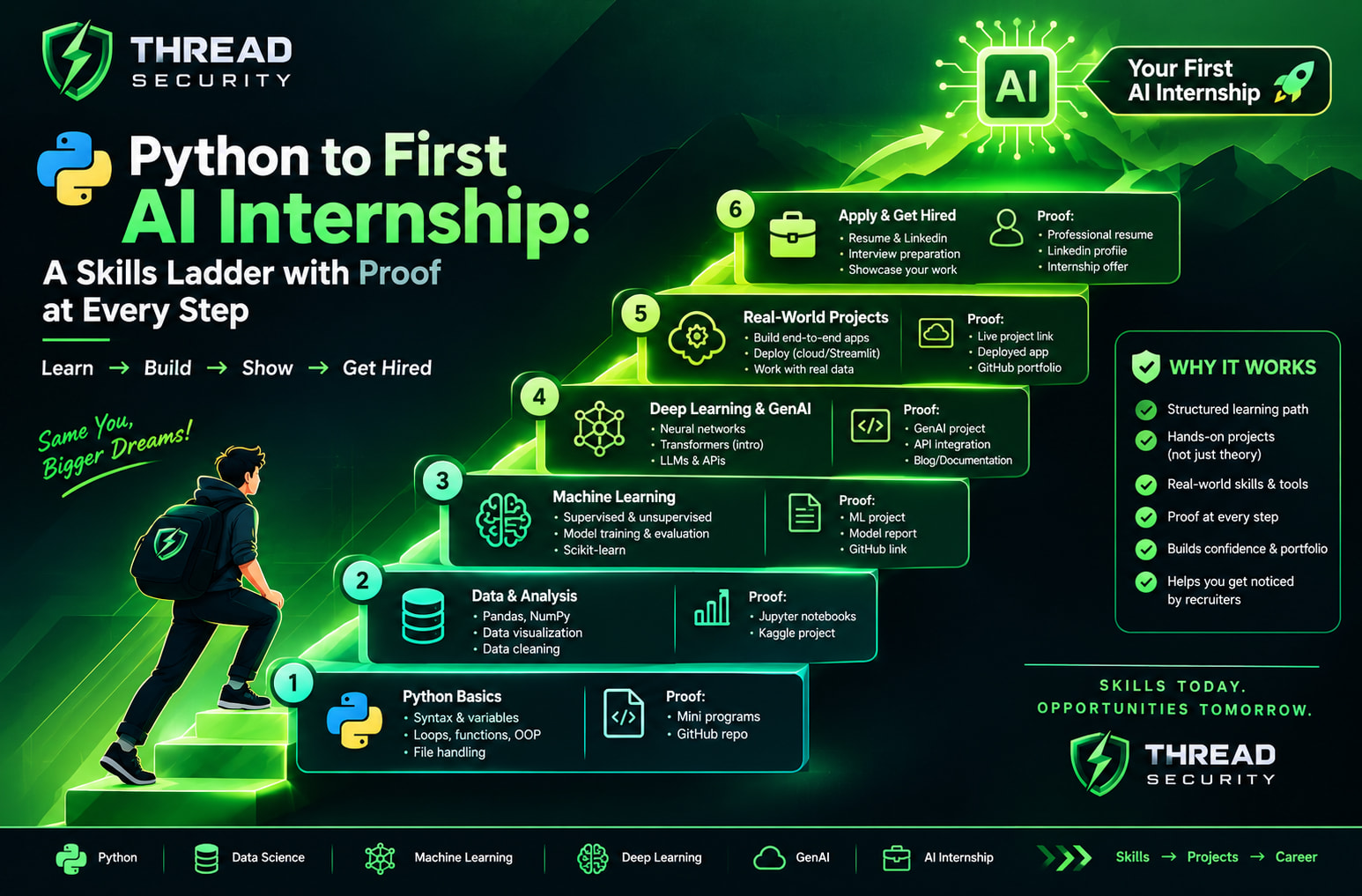
Landing a first AI internship is less about having a perfect resume and more about showing credible proof that you can build, evaluate, and explain machine learning work. The path from Python fundamentals to a first AI internship is best treated as a skills ladder: each rung builds on the last, and each rung produces a tangible artifact — a notebook, a model, a deployed demo, or a written explanation — that demonstrates real capability. This guide lays out that ladder step by step, with the proof you should produce at each stage.
Why Proof Beats Credentials for a First AI Internship
Hiring managers for AI internships are looking for evidence that a candidate can learn quickly, write clean code, and reason about data. A certificate alone rarely convinces them. What does convince them is a GitHub repository with a clear README, a notebook that walks through a real dataset, a small deployed model, and a concise write-up explaining trade-offs. Proof lowers the perceived risk of hiring someone without industry experience, and it gives interviewers concrete things to discuss.
Rung 1: Python Fundamentals
Start with core Python — variables, control flow, functions, modules, file handling, and error handling. Then move to the libraries that AI work depends on: NumPy for numerical arrays, pandas for tabular data, and matplotlib for visualization. Focus on writing readable code, using virtual environments, and structuring small scripts as reusable modules. The proof at this rung is a small data-processing project: a script that loads a public CSV, cleans it, computes summary statistics, and produces a chart, committed to GitHub with a README explaining the goal and how to run it.
Rung 2: Data Handling and Exploration
AI is built on data, so the next rung is exploratory data analysis. Learn to load messy datasets, handle missing values, encode categorical variables, and produce clear summaries and visualizations. Practice on real, imperfect public data — not just tidy toy datasets. The proof at this rung is an exploratory data analysis notebook on a dataset of your choice, with a short written summary of findings, data-quality issues, and decisions you made.
Rung 3: Math and Statistics Foundations
You do not need a graduate degree, but you do need working intuition for linear algebra, probability, and statistics. Understand vectors and matrices, distributions, mean and variance, correlation versus causation, and the basics of hypothesis testing. Learn what a gradient is and why it matters for optimization. The proof at this rung is a short technical note or notebook that explains a statistical concept using code — for example, simulating a distribution or demonstrating why correlation does not imply causation.
Rung 4: Classical Machine Learning
Move to supervised and unsupervised learning with scikit-learn. Cover train/test splits, cross-validation, linear and logistic regression, decision trees, random forests, and k-means clustering. Learn evaluation metrics — accuracy, precision, recall, F1, and ROC-AUC — and why metric choice matters. The proof at this rung is an end-to-end machine learning project: a cleaned dataset, a train/validation split, at least two models compared, evaluation with appropriate metrics, and a written interpretation of results, all in a reproducible notebook or repository.
Rung 5: Deep Learning Basics
Introduce neural networks with PyTorch or TensorFlow. Understand tensors, forward and backward passes, loss functions, optimizers, and training loops. Start with a simple feed-forward network, then move to a convolutional network for images or a recurrent or transformer model for text. The proof at this rung is a small training project — such as image classification on a public dataset — with training curves, a validation metric, and a short discussion of overfitting and how you addressed it.
Rung 6: An End-to-End Capstone Project
Combine everything into one capstone that resembles real internship work. Pick a problem you care about, gather or source a dataset, build a baseline, train a model, evaluate it honestly, and deploy a simple demo with Streamlit, Gradio, or a small Flask app. Document the project with a clear README, architecture diagram, results, and limitations. The proof at this rung is the capstone repository plus a short demo video or deployed link — the single strongest artifact in your internship application.
Rung 7: Communication and Professional Presence
Technical skill is necessary but not sufficient. Learn to write a concise project summary, explain a model to a non-technical audience, and present trade-offs clearly. Maintain a clean GitHub profile, a focused LinkedIn, and a short portfolio page listing your projects with links. The proof at this rung is a portfolio page and a one-page resume that maps each project to the skills it demonstrates.
How to Structure Weekly Practice
A sustainable pace matters more than bursts of effort. A practical weekly structure is to spend a few hours on tutorials or reading, several hours building or extending a project, and at least one hour writing up what you learned. Keep a learning log so you can see progress and so interviewers can see consistency. Treat each rung as complete only when you have produced its proof artifact, not merely watched a course.
Common Mistakes to Avoid
Common pitfalls include endlessly consuming courses without building anything, copying tutorial code without understanding it, skipping evaluation and reporting only accuracy, ignoring data cleaning, and building a portfolio of near-identical toy projects. Another frequent mistake is applying to internships before having a single end-to-end project to discuss. Depth on one honest project beats breadth across many shallow ones.
Turning Proof into an Internship Offer
With the ladder climbed, the application becomes straightforward. Tailor your resume to highlight the capstone and one or two supporting projects, link directly to repositories and demos, and prepare to walk an interviewer through your decisions: why you chose a model, how you evaluated it, what failed, and what you would do next. Internship interviews reward clear reasoning and honest limitations far more than perfect results.
Conclusion
The path from Python to a first AI internship is not a single leap but a ladder of small, provable steps. By mastering Python and data handling, building math intuition, learning classical machine learning and deep learning, completing an end-to-end capstone, and presenting your work clearly, you accumulate proof at every rung. That proof is what turns an aspiring learner into a credible intern candidate — one artifact at a time.
Atish Chand
VERIFIEDFaculty Mentor · Thread Security
Faculty mentor & research guide at Thread Security Education.