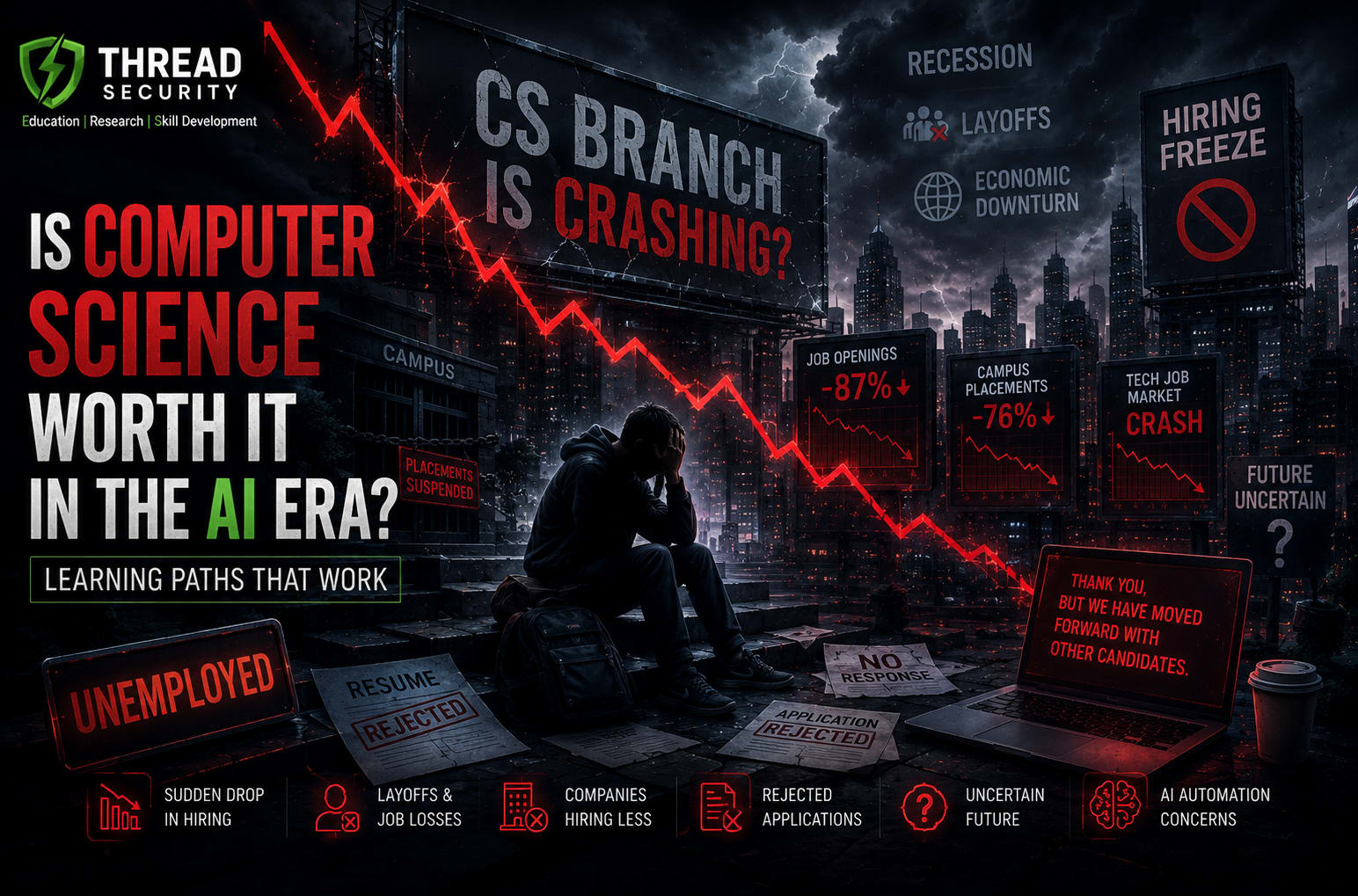
Is Computer Science Worth it in the AI era?
Artificial intelligence is changing how people learn programming, build applications and prepare for technology careers. With AI assistants explaining code, generating functions and helping beginners debug errors, learners are questioning whether a traditional computer science degree remains a worthwhile investment.
Some learners believe a degree is no longer necessary because online courses, coding bootcamps and AI tools can teach practical skills faster. Others argue that a university education provides foundations, recognized qualifications, internships and access to campus recruitment that independent learning may not easily replace.
Both perspectives contain part of the truth. A degree is not a guarantee of employment, and not every technology role requires one. However, a strong portfolio or certificate does not automatically replace a formal qualification when an employer makes a degree mandatory.
The more useful question is not simply whether a degree is worth it. It is: which learning route gives you the strongest combination of knowledge, practical ability, credibility and access to the jobs you want?
This guide compares three routes university degrees, bootcamps and self-study explains how to evaluate employer expectations, and outlines three learning paths you can adapt to your circumstances.
1. What Has AI Actually Changed About Learning Computer Science?
AI coding assistants have made several activities easier. Learners can ask for code explanations, generate starter examples, explore unfamiliar libraries and receive suggestions when debugging. Someone learning Python can now experiment with a concept and obtain immediate feedback instead of searching through multiple resources for every small problem.
However, easier access to code does not mean that understanding code has become unnecessary.
Developers still need to identify the right problem, choose an appropriate solution, test the result, understand performance limitations and recognize security risks. AI-generated code may contain logical errors, insecure assumptions, outdated methods or dependencies that do not fit the application.
For example, generating a machine learning model is only one part of an AI project. A capable practitioner must also understand data quality, train-test separation, evaluation metrics, overfitting and the practical limitations of the model.
AI therefore changes the way people can learn and work, but it does not eliminate the value of computing fundamentals. In many situations, those fundamentals help people use AI tools more effectively because they can evaluate the output rather than accepting it blindly.
The practical takeaway: learn to use AI as an assistant, not as a substitute for your own understanding.
2. The Computer Science Degree Route: What Are You Paying For?
A computer science degree typically offers a structured sequence of subjects, assessment, access to faculty, peer collaboration and opportunities to participate in internships, research or campus recruitment. The exact experience depends on the institution, curriculum and how actively a student uses the opportunities available.
Where a degree can be valuable
Structured foundations: programming, data structures, algorithms, databases, operating systems, computer networks and software engineering.
Formal eligibility: some employers and recruitment programmes specify a bachelor's degree or a particular academic qualification as a requirement.
Campus recruitment: eligible students may access placement drives, internships, employer presentations and university career services.
Long-term flexibility: a broad computing foundation can help learners move between software engineering, data science, AI, cybersecurity and related specializations.
Academic progression: formal qualifications may be required for certain postgraduate programmes, research opportunities or teaching positions.
A degree can be especially useful when you are beginning your career and do not yet have professional experience. It provides a recognized educational record while giving you time to explore different areas of computing.
What a degree cannot guarantee
Completing a degree does not automatically mean you can build production-ready software, solve unfamiliar problems independently or perform well in a technical interview. Students can graduate with strong theoretical knowledge but limited practical experience if they have not worked on substantial projects.
Another consideration is time and cost. A full degree generally requires a multi-year commitment, and the financial value depends on tuition fees, available alternatives, institutional quality and the opportunities it creates.
Best suited for: students seeking a broad educational foundation, candidates targeting graduate hiring programmes, and learners whose intended employers or future academic plans require formal qualifications.
3. The Bootcamp Route: Can Intensive Training Get You Job-Ready?
A coding or AI bootcamp concentrates on a narrower set of practical skills over a shorter period. Depending on the programme, it may cover programming, web development, data analytics, machine learning or application development through guided exercises and projects.
The main attraction is focus. Instead of spending several semesters studying a broad curriculum, learners concentrate on skills associated with a particular job direction.
Potential advantages
A focused curriculum can make it easier to follow a defined learning plan.
Guided assignments and projects can provide practice with real tools.
Instructor feedback and peer learning may help learners identify gaps.
A shorter programme may complement an existing degree or professional background.
What learners should check before enrolling
Not all bootcamps offer the same value. Examine the actual syllabus, instructor experience, project depth, assessment methods and the amount of individual feedback provided. Ask whether students build projects independently or mainly follow demonstrations.
Be careful with employment promises. A certificate of completion is not the same as a recognized academic qualification, and a bootcamp does not automatically satisfy an employer's degree requirement. Placement statistics should also be interpreted carefully: ask how outcomes are measured, which learners are included and whether figures are independently verified.
A bootcamp works best when it provides a starting structure and the learner continues practicing beyond the scheduled classes.
Best suited for: graduates, working professionals and career changers who already have an appropriate educational background or relevant experience and want to develop a specific technical skill set.
4. The Self-Study Route: Can You Learn AI Without a Degree?
Yes, it is possible to learn programming, data analysis and many AI concepts independently. Free documentation, online tutorials, open-source repositories, public datasets and AI-assisted learning tools have made technical education more accessible.
However, learning independently requires more than collecting course certificates. You need a sequence, consistent practice, feedback and a way to demonstrate that you can apply what you have learned.
What makes self-study effective?
A defined target: choose a role such as Python developer, data analyst, machine learning practitioner or AI application developer.
A learning sequence: build prerequisites before moving to advanced libraries and frameworks.
Practical projects: use your knowledge to solve problems instead of only reproducing tutorial examples.
External feedback: ask experienced developers to review your code, participate in communities and improve projects based on criticism.
Evidence of progress: maintain repositories, document decisions, test your work and explain what you learned.
The biggest challenge is not necessarily access to learning materials. It is knowing what to learn next and recognizing when your work meets a reasonable standard.
Self-study also does not remove hiring constraints. If a job requires a bachelor's degree, an impressive portfolio may not overcome an eligibility filter. That is why independent learners should check real job descriptions before committing to a particular career strategy.
Best suited for: disciplined learners who need a low-cost, flexible route, already have relevant qualifications or experience, or want to explore technology before investing in a longer programme.
5. What Do Employers Actually Accept as Proof of Skill?
There is no single proof of skill that every employer accepts. Expectations vary by role, company, seniority, location and recruitment process. The most useful approach is to examine the requirements for the jobs you genuinely want rather than relying on general claims about what the technology industry prefers.
Start by collecting 15–20 recent job descriptions for your target role. Include a mix of employers and distinguish between entry-level positions, internships and roles that ask for professional experience.
Record the following information:
Whether a degree is mandatory, preferred or not mentioned.
Which programming languages, frameworks and tools appear repeatedly.
Whether the role requires projects, internships or previous employment.
Which technical assessments, certifications or domain skills are mentioned.
Whether the employer offers campus recruitment or graduate-specific hiring.
This small research exercise gives you a more useful picture of your target market than a generic claim that degrees are either essential or irrelevant.
Evidence that can strengthen an application
1. Projects you can explain. A project should demonstrate a real problem, your implementation decisions, testing and limitations. A polished interface alone does not show how well you understand the underlying system.
2. Readable, maintainable code. Clear naming, sensible structure, error handling, useful documentation and tests provide evidence that you understand software beyond getting a single result.
3. Technical problem-solving. Coding assessments, debugging exercises and technical interviews can show how you reason through unfamiliar situations.
4. Internships and practical experience. Internships, supervised projects, open-source contributions and relevant work experience can demonstrate collaboration, communication and the ability to deliver against requirements.
5. Relevant credentials. Certifications can help demonstrate familiarity with a tool or platform, especially when the credential is recognized in the target field. They are strongest when supported by practical work.
6. Clear project explanations. Be prepared to explain why you selected a method, what alternatives you considered, how you evaluated the result, which errors you encountered and what you would improve.
For AI-related work, a portfolio might include a data analysis project with a clear evaluation, a machine learning model compared against a baseline, or an AI application with documented testing and failure cases. The complexity should match your experience; a small, well-understood project can be more convincing than a large project you cannot explain.
Remember that these are ways to strengthen an application, not a guarantee of acceptance. Employers may still require formal qualifications, relevant experience or specific eligibility criteria.
6. Degree vs Bootcamp vs Self-Study: A Practical Comparison
Factor | Degree | Bootcamp | Self-study |
|---|---|---|---|
Typical timeline | Multi-year | Weeks to months | Flexible; often months or longer |
Learning structure | Formal curriculum | Focused curriculum | Designed by the learner |
Formal qualification | Yes, on completion | Usually a course certificate | Not by itself |
Learning cost | Varies; may be substantial | Varies by provider | Can be low, depending on resources |
Practical evidence | Depends on projects and experience | Depends on project quality | Depends on work completed |
Campus hiring access | May be available to eligible students | Depends on provider and employer | Usually requires other application routes |
Best advantage | Structure and recognized qualification | Focused skill development | Flexibility and control |
Main challenge | Time and financial commitment | Variable quality and limited breadth | Consistency, feedback and direction |
These comparisons are general rather than universal. A strong university programme can offer excellent practical training, a bootcamp can provide poor instruction, and a self-taught learner can develop impressive skills. Evaluate the actual programme and outcomes instead of judging only by the category.
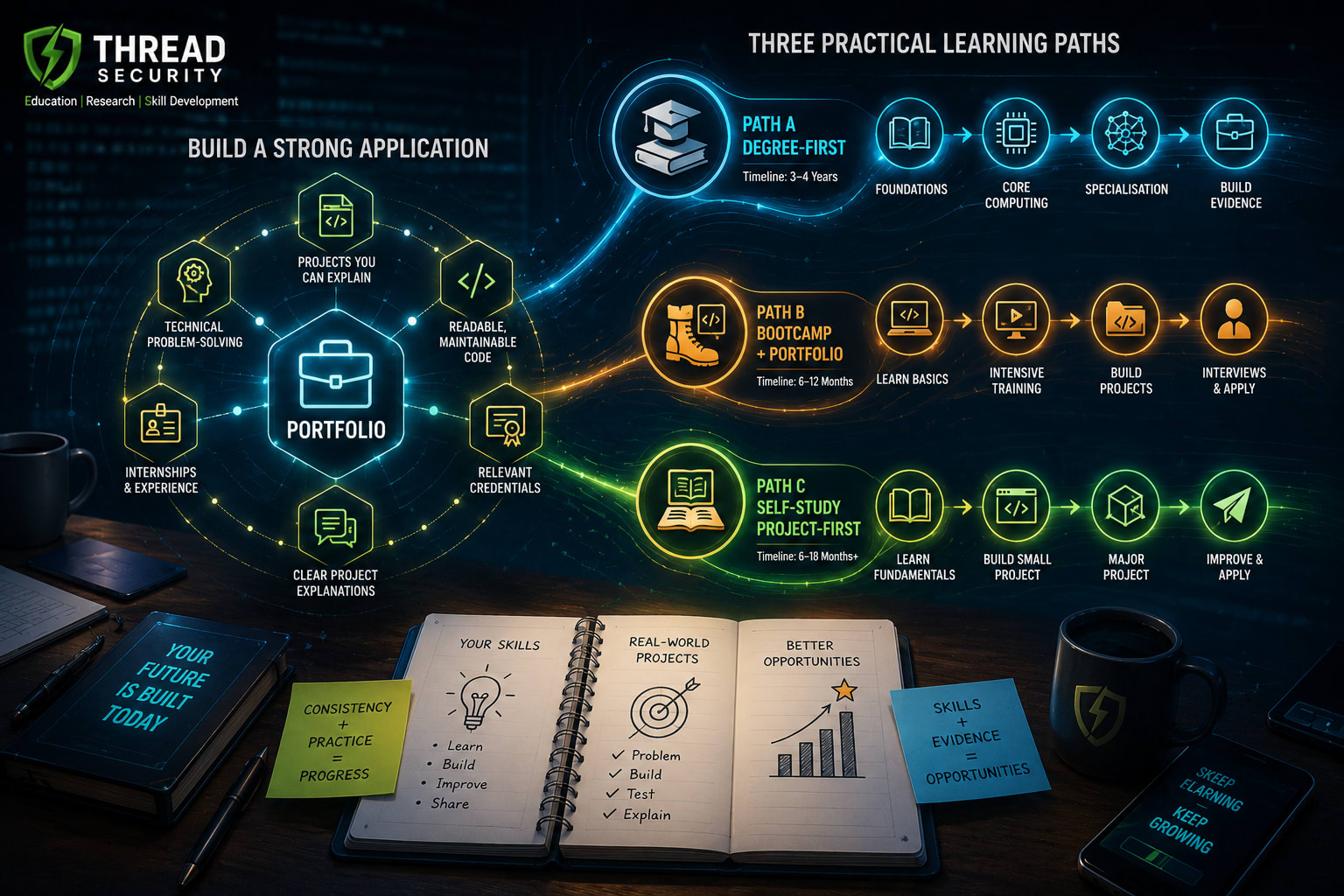
7. Three Learning Paths With Practical Timelines
The timelines below are planning estimates, not promises of employment. Your starting knowledge, weekly study hours, project quality and target role will affect your progress.
Path A: Degree-First, With Projects Alongside
Suggested timeline: the duration of your degree, commonly three to four years for many undergraduate programmes.
Stage 1 : Foundations: learn programming, problem-solving, basic mathematics and computer science fundamentals. Practice regularly instead of postponing coding until examinations.
Stage 2 : Core computing: strengthen data structures, algorithms, databases, operating systems, networking and software engineering. Build small applications that apply these concepts.
Stage 3 : Choose a specialization: explore AI/ML, cybersecurity, software development, cloud computing or data engineering. Learn the tools and concepts that appear in relevant job descriptions.
Stage : Build evidence: complete two or three substantial projects, seek internships, participate in technical activities and practice interviews. Document your contribution and the results.
Who should choose it? Students who are beginning their higher education, want broad computing knowledge or need a formal qualification for their intended career.
Important principle: do not wait until graduation to build your portfolio. Combine academic learning with practical work from the beginning.
Path B: Focused Bootcamp Plus Portfolio
Suggested timeline: 6–12 months, depending on your starting point and available study time.
Months 1–2: establish programming fundamentals, Git, command-line basics and problem-solving skills. If you already know these topics, spend this time identifying and closing gaps.
Months 3–4: complete a focused programme in your chosen area. For example, a learner targeting data analysis could study Python, SQL, data cleaning and visualization.
Months 5–6: develop two independent projects. Add documentation, tests where appropriate, explain design choices and improve the work using feedback.
Months 7–9: strengthen weak areas, practice technical interviews and apply for suitable internships or junior roles. Continue improving projects based on feedback.
Months 10–12: expand the portfolio, contribute to a team project or pursue further training if the job descriptions reveal a genuine skill gap.
Who should choose it? Graduates or career changers who want a structured, focused learning experience and can demonstrate the required eligibility for their target jobs.
Important principle: treat the bootcamp as one part of your learning plan, not as a guaranteed shortcut to employment.
Path C: Independent Learning With a Project-First Approach
Suggested timeline: 6–18 months or longer, depending on your starting knowledge and weekly commitment.
Months 1–3: learn one programming language, basic data structures, debugging, Git and fundamental problem-solving. Complete small exercises without copying every solution.
Months 4–6: select a career direction. Learn the relevant tools and build a small project that uses them together. For AI, this might include data preparation, a baseline model and evaluation.
Months 7–9: develop one substantial project based on a real problem. Include a clear README, setup instructions, testing, limitations and a description of your individual contribution.
Months 10–12: seek code reviews, improve the project, practice interviews and apply to suitable opportunities. Compare your current skills with actual job descriptions.
Months 13–18: deepen your specialization, contribute to collaborative work, improve communication and build additional evidence where your target roles demand it.
Who should choose it? Learners who need flexibility, want to minimize training costs or prefer to control their own pace.
Important principle: self-study works best when it produces verifiable skills and when you have a realistic plan for meeting formal hiring requirements.
8. How to Choose the Right Path for Your Situation
Before enrolling in a programme or deciding that a degree is unnecessary, answer these questions.
What job do you want? Software development, data analytics, AI engineering and research have different expectations.
What qualifications do employers require? Check whether the degree is mandatory, preferred or irrelevant in the actual listings you collected.
What do you already know? A learner with a relevant degree may need focused upskilling, while a beginner may benefit from a more structured foundation.
How much time and money can you invest? Include the cost of training, equipment, assessments and the time needed for independent practice.
How will you demonstrate your ability? Decide which projects, assessments, internships or contributions will provide evidence of the skills you need.
If you are already pursuing a CS degree, you generally do not need to abandon it because AI tools are becoming more capable. Instead, strengthen your practical experience and learn to use AI responsibly.
If you have a degree in another field, a focused programme and relevant projects may help you transition into some technology roles, depending on employer requirements.
If you do not have a degree, begin by identifying positions that genuinely consider alternative backgrounds. Build relevant skills and evidence while being realistic about employers that use degree requirements as a screening condition.
9. Can You Build an AI Career Without a Computer Science Degree?
It is possible to enter some AI-adjacent and technical roles without a computer science degree, but the route depends on the job. Data analysis, automation, AI application development and certain technical support or implementation roles may have different entry requirements from research-heavy machine learning positions.
For an AI application development path, you might learn Python, APIs, data handling, Git, application development, model evaluation and responsible use of AI tools. You could then build an application that solves a clearly defined problem and document its limitations.
For a data-focused path, you might prioritize SQL, Python, data cleaning, statistics, visualization and communicating findings. For machine learning, you would need to progress into model evaluation, suitable mathematics, data preparation and the practical limitations of different algorithms.
In all three cases, a project should show more than a successful demonstration. Explain the problem, the data or inputs, your technical choices, how you tested the output and what happens when the system fails.
Do not assume that learning a few AI frameworks makes you ready for every AI engineering role. Advanced positions may require stronger mathematics, software engineering, systems knowledge, research experience or a formal qualification.
The goal is to choose a realistic entry point and progressively build the skills needed for your next step.
10. Learn With a Practical, Career-Focused Approach
At Thread Security Education, learners can explore technical learning opportunities connected with AI, programming and practical technology skills. If you are searching for AI courses in Jalandhar, compare programmes based on their syllabus, hands-on work, instructor support and the projects you will be able to explain after completing them.
Before choosing any course, ask:
Does the curriculum match the role I want to pursue?
Will I build projects independently, rather than only follow demonstrations?
Will I receive feedback and learn to test my work?
Will the course help me understand what employers expect?
Are the learning outcomes and any placement claims clearly explained?
A course should support your career plan, not replace it. Keep checking job descriptions, strengthening your fundamentals and building evidence of your ability.
Explore Thread Security Education's learning opportunities to find a practical starting point for your technology journey. Choose your direction, build your skills step by step, and make your learning visible through meaningful projects.
Frequently Asked Questions
1. Is a computer science degree worth it in the AI era?
It can be. A degree provides structured computing education and may be required for specific graduate programmes, employers or further study. Its value depends on cost, programme quality, career goals and the practical experience you build alongside it.
2. Can I learn AI without a degree?
Yes. You can learn programming, data analysis and many AI techniques through independent study and practical projects. However, some AI roles require formal qualifications, and learning independently does not guarantee eligibility for every job.
3. Is a bootcamp better than a degree?
Neither is universally better. A degree offers broader structured education and a formal qualification, while a bootcamp focuses on selected skills over a shorter period. Compare their cost, curriculum, practical outcomes and relevance to your target role.
4. What do employers look for besides a degree?
Depending on the role, employers may assess programming ability, problem-solving, projects, internships, communication, technical interviews and relevant experience. Some employers also require a degree, so review the actual eligibility criteria.
5. How long does it take to become job-ready through self-study?
There is no universal timeline. A focused learner may develop a useful foundation over several months, but reaching the standard expected for a particular role can take considerably longer. Your starting point, study hours, feedback and project quality all matter.
6. Will AI make computer science fundamentals unnecessary?
No. AI tools can help generate and explain code, but understanding algorithms, data, software design, testing, security and system behaviour helps you evaluate the output and build more reliable solutions.
7. Should I pursue a degree if I want an AI career?
A degree can be valuable, particularly for research-oriented, graduate-entry or qualification-sensitive roles. Other paths may suit some AI application and adjacent roles. Research the requirements for the specific career you want before making a decision.
Final Takeaway: Build Skills, Evidence and Options
The AI era has expanded the ways people can learn computer science, but it has not made every learning route interchangeable.
A degree can provide structure, a recognized qualification and access to certain recruitment opportunities. A bootcamp can offer focused training. Self-study can provide flexibility and affordability. Each route has limitations, and the best choice depends on your starting point and career objectives.
Instead of asking only whether a degree is worth it, ask what your target employers require, which skills you need to develop and how you will prove that you can apply them.
Build your foundations. Complete projects you understand. Seek feedback. Use AI tools thoughtfully. Check real job descriptions and make informed decisions about your education.
Your career path does not need to look exactly like someone else's. It needs to prepare you for the opportunities you intend to pursue.
For practical learning guidance and technology training opportunities, connect with Thread Security Education and take the next step towards building skills that you can demonstrate.
Simranjit Kaur
VERIFIEDAI Trainer · Thread Security
Faculty mentor & research guide at Thread Security Education.