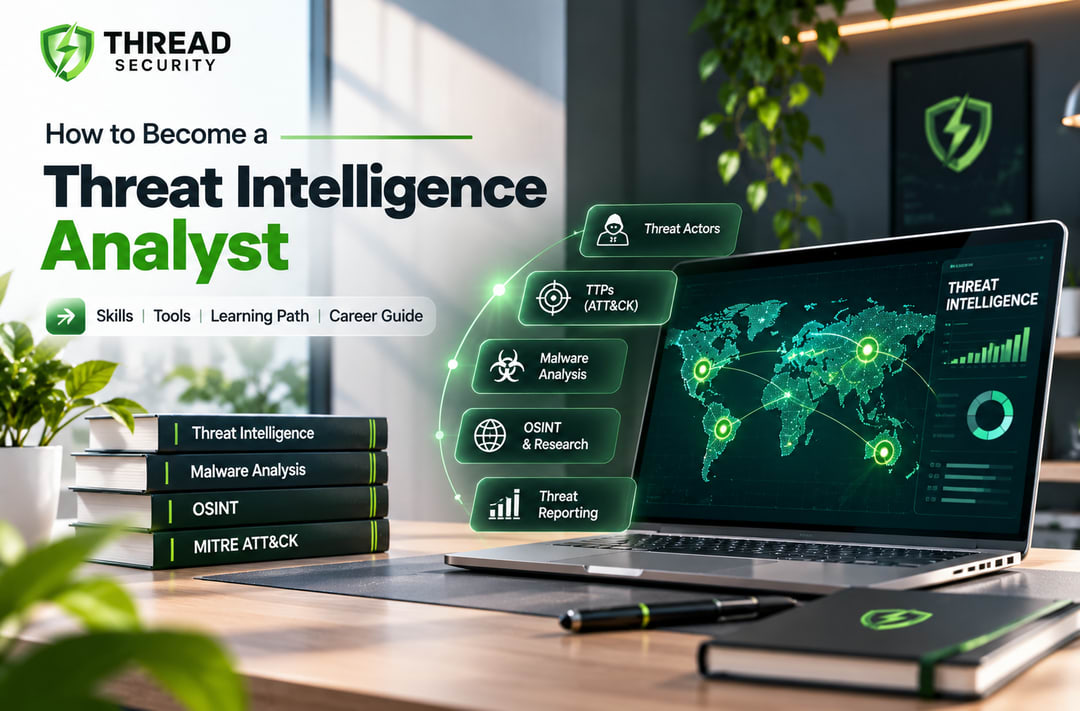
A Threat Intelligence Analyst helps organisations understand the cyber threats that could affect their systems, data, employees and business operations. Instead of simply collecting malicious IP addresses or reading security news, analysts research threat actors, examine attack techniques, evaluate evidence and turn findings into information that security teams can act on. If you are exploring a cybersecurity career, threat intelligence combines technical investigation, analytical thinking, research and communication.
There is no single mandatory degree or certification that guarantees entry into this profession. The work varies between organisations: some roles focus on technical analysis and indicators of compromise, while others concentrate on threat actor research, strategic assessments and intelligence reporting. This guide explains the skills, tools, learning path and practical experience that can help you prepare for a threat intelligence analyst role.
What Does a Threat Intelligence Analyst Do?
A threat intelligence analyst collects, processes, analyses and communicates information about cyber threats. The objective is to help an organisation understand relevant adversaries, their methods, potential targets and the defensive actions that may reduce risk.
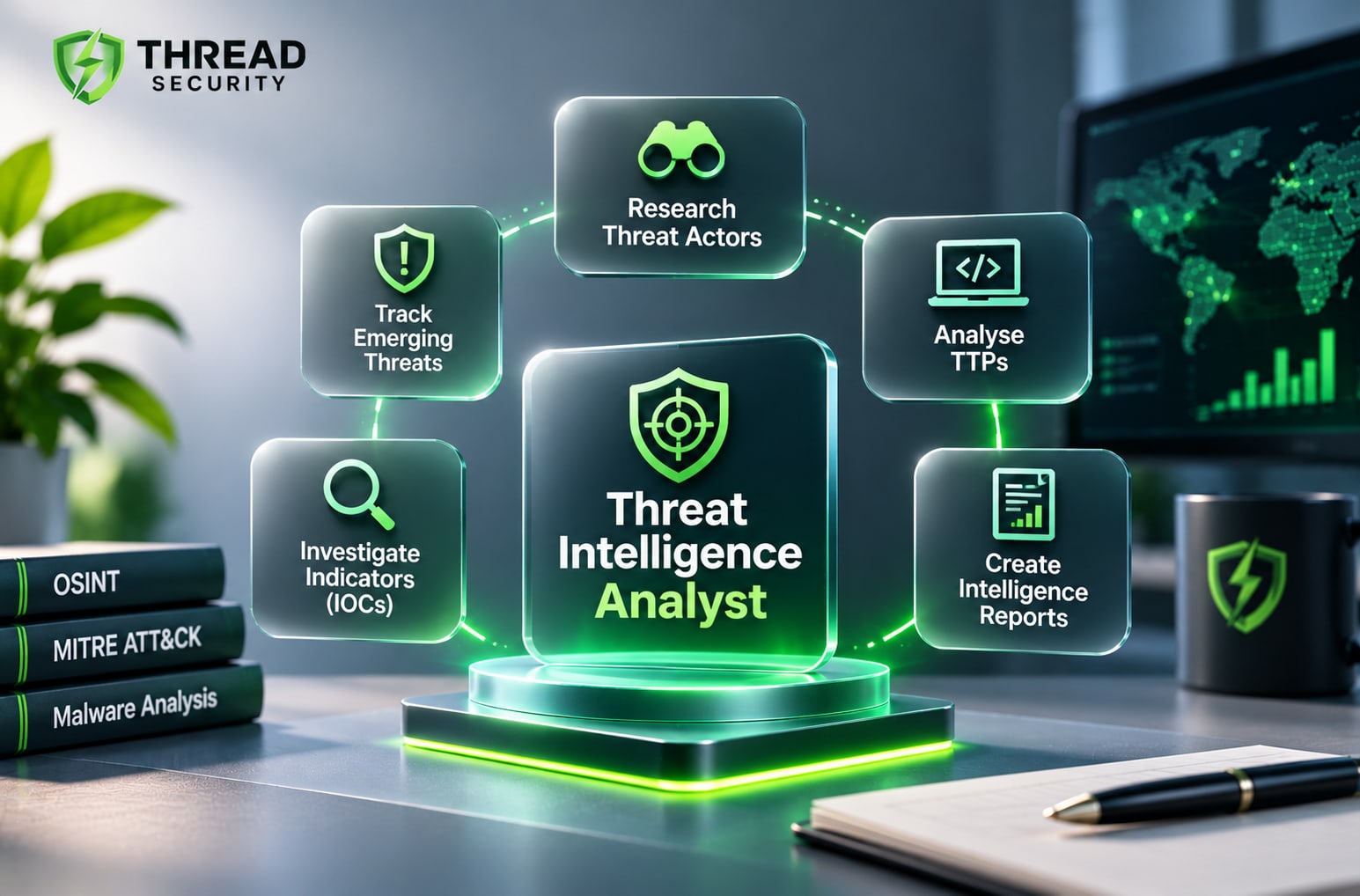
Typical responsibilities can include researching threat actors, reviewing security advisories, analysing suspicious domains and IP addresses, investigating malware reports, identifying attacker tactics and techniques, monitoring emerging vulnerabilities, and producing intelligence reports for technical or business teams.
The NIST NICE Workforce Framework provides a common way to describe cybersecurity work through tasks, knowledge and skills. Its Threat Analysis work role includes collecting, processing, analysing and disseminating cybersecurity threat assessments. This is a useful reference when comparing job descriptions and identifying the capabilities employers may expect.
Different Types of Threat Intelligence Analyst Roles
1. Technical Threat Intelligence Analyst
Technical analysts examine indicators of compromise, malicious files, network activity, domains, infrastructure and technical reports. They may work with malware analysis, digital forensics, detection engineering and security operations teams. A strong understanding of operating systems, networking and attacker behaviour is valuable in this path.
2. Strategic Threat Intelligence Analyst
Strategic analysts focus on the wider threat environment. They research threat trends, sectors, motivations, business risks and the potential implications of cyber activity. Their reports are often written for security leaders, risk teams and business decision-makers. Clear writing, source evaluation and the ability to explain uncertainty are particularly important.
3. Operational Threat Intelligence Analyst
Operational analysts investigate specific campaigns, threat actors and attack patterns. They connect reporting with observable activity and help security teams understand how an intrusion may develop. This work can overlap with incident response, threat hunting and detection engineering.
These are useful descriptions of common areas of work, not universal job titles. One position may combine technical, operational and strategic responsibilities depending on the employer.
Essential Skills Required for a Threat Intelligence Analyst
1. Networking Fundamentals
Understand TCP/IP, DNS, HTTP and HTTPS, ports, protocols, routing, proxies and common network services. Analysts frequently examine domains, IP addresses, DNS records and network connections. Without networking fundamentals, it becomes difficult to interpret whether an observation is suspicious or simply normal infrastructure behaviour.
2. Linux and Windows Knowledge
Learn how processes, services, users, permissions, logs and scheduled tasks work in Windows and Linux. Familiarity with Windows Event Logs, PowerShell, Linux command-line tools and basic system administration helps when investigating suspicious activity and reviewing technical reports.
3. OSINT and Research Skills
Open Source Intelligence (OSINT) involves collecting and analysing information from publicly available sources. Threat intelligence analysts use it to research domains, IP addresses, organisations, exposed services, threat actors and reported campaigns. Good OSINT is not simply searching the internet. Analysts must evaluate source credibility, corroborate findings and distinguish verified evidence from speculation.
4. Python and Basic Scripting
Python can help automate repetitive tasks such as parsing indicators, processing JSON or CSV files, querying APIs, comparing datasets and extracting information from reports. You do not need to become a software engineer before starting, but you should be comfortable writing scripts, handling data and understanding how APIs work.
5. Analytical Thinking and Report Writing
Technical findings have limited value if nobody understands their implications. Analysts must explain what they observed, where the information came from, how confident they are, what remains unknown and what action may be appropriate. Strong writing and presentation skills are therefore part of the job, not optional extras.
Important Tools Used in Threat Intelligence
Tools vary by employer and workflow. The following platforms and resources are useful learning examples, but knowing their names is not the same as being proficient in them.
MITRE ATT&CK: A knowledge base of adversary tactics and techniques based on real-world observations. It helps analysts structure threat reporting and connect observed behaviour with defensive detections.
VirusTotal: Helps examine files, URLs, domains and IP addresses using multiple security analysis sources. Results require interpretation and should not be treated as proof of malicious activity.
AbuseIPDB: Provides information and community reports about IP addresses associated with abusive activity. Treat reputation results as context, not a definitive verdict.
Shodan: A search engine for internet-connected devices and services. It can support authorised exposure research and investigation of publicly visible infrastructure.
theHarvester: An OSINT tool used to collect information such as publicly available email addresses, subdomains and related infrastructure data.
MISP: An open-source threat intelligence platform designed to collect, store, correlate and share indicators and threat information.
Splunk and Microsoft Sentinel: SIEM platforms that help teams search and analyse security telemetry. Analysts may use them to investigate whether threat intelligence is relevant to their organisation.
Wireshark: A network protocol analyser useful for examining packet captures and understanding network communication.
Start with a small set of tools and learn what each one can and cannot tell you. For example, a reputation lookup may provide useful context about an IP address, but it cannot independently establish that a particular organisation has been compromised.
How to Use MITRE ATT&CK in Threat Intelligence
MITRE ATT&CK is particularly useful because it provides a structured vocabulary for describing adversary behaviour. It organises observed activity into tactics, techniques and sub-techniques. Tactics describe an adversary's objective, while techniques describe how that objective may be achieved.
For example, when analysing a report about credential theft, an analyst can identify the behaviours described in the report and map supported observations to relevant ATT&CK techniques. This can help a SOC team consider detection opportunities, review logging coverage and communicate the threat in a consistent format.
Do not force every report into an ATT&CK technique. A mapping should be supported by evidence, and analysts should clearly identify assumptions or gaps. MITRE itself cautions users against treating one identified technique as proof that an entire adversary behaviour profile is understood.
Certifications and Learning Resources
Certifications can provide structure to your learning and help demonstrate knowledge, but there is no universally required certification for every threat intelligence analyst role. Choose training based on the skills you need and the job descriptions you are targeting.
CompTIA Security+: A broad entry-level security certification covering core security concepts, risk, threats and defensive practices.
GIAC Cyber Threat Intelligence (GCTI): A specialist certification focused on cyber threat intelligence concepts and analysis. Review its current syllabus, prerequisites and cost before deciding whether it fits your goals.
Google Cybersecurity Certificate: A structured introductory learning option covering foundational cybersecurity knowledge and practical concepts.
MITRE ATT&CK resources: Free reference material for learning adversary tactics, techniques and defensive use cases.
NIST NICE Framework: A useful reference for understanding cybersecurity work roles and the tasks, knowledge and skills associated with them.
Before paying for any certification, check current exam requirements, course content, fees and whether the qualification appears in the job descriptions relevant to your target market.
A Practical 6-Month Learning Roadmap
Month 1: Build Your Foundations
Study networking, DNS, HTTP, TCP/IP, Windows and Linux fundamentals. Practise reading system logs and using command-line tools. Your objective is to understand the technical environment in which threats operate.
Month 2: Learn Security Fundamentals
Study common attack types, phishing, malware, vulnerabilities, authentication attacks, indicators of compromise and incident response basics. Understand the difference between a vulnerability, an exploit, an indicator and an observed attacker technique.
Month 3: Practise OSINT and Intelligence Research
Use publicly available sources and tools in a controlled, lawful manner. Research a known threat campaign using vendor reports, official advisories and reputable research publications. Record sources, dates, confidence and unanswered questions.
Month 4: Learn Threat Intelligence Frameworks and Tools
Explore MITRE ATT&CK, MISP, VirusTotal, AbuseIPDB and a SIEM platform. Practise analysing sample indicators and mapping documented behaviours to ATT&CK. Do not perform unauthorised scanning or access systems without permission.
Month 5: Build Portfolio Projects
Create a threat intelligence report based on a publicly documented campaign. Include an executive summary, affected technologies, observed indicators, supported ATT&CK mappings, source references, confidence levels and defensive recommendations. You can also build a Python script that parses a sample indicator dataset and produces a structured report.
Month 6: Prepare for Jobs and Internships
Review entry-level job descriptions and identify recurring requirements. Update your resume with specific projects, tools and demonstrated skills. Practise explaining your investigation process, the sources you trusted, the limitations you identified and the recommendations you made. Apply for relevant internships and junior roles while continuing to improve your portfolio.
Portfolio Projects That Can Strengthen Your Resume
Threat Intelligence Report: Analyse a publicly documented threat campaign and produce a referenced report with evidence, limitations and defensive recommendations.
IOC Enrichment Script: Write a Python script that reads sample IP addresses, domains or file hashes and organises enrichment results from permitted sources or APIs.
MITRE ATT&CK Mapping: Take a published incident report and map only the techniques supported by its evidence.
OSINT Investigation: Research a fictional organisation or an authorised lab environment and document publicly visible information without accessing systems unlawfully.
Threat Feed Analysis: Compare sample indicators from different sources, identify duplicates and stale entries, and explain why source quality and context matter.
Publish your work on GitHub where appropriate, remove confidential information, respect source licensing and avoid uploading live malicious files. A well-documented project that explains your reasoning is more useful than a repository containing copied tool output.
Career Opportunities and Progression
Threat intelligence is connected to several cybersecurity disciplines. Depending on your interests and experience, possible adjacent roles include SOC Analyst, Cyber Threat Analyst, Threat Hunter, Incident Responder, Malware Analyst, Security Researcher and Intelligence Analyst.
A common development route is to begin in a junior security operations, research or analysis role, build experience with security telemetry and intelligence reporting, and then move towards a specialist technical, operational or strategic position. This is not a mandatory sequence: career paths differ across organisations, and some employers recruit directly into intelligence teams.
When evaluating vacancies, search for multiple related titles rather than relying only on the phrase Threat Intelligence Analyst. Read the actual responsibilities and required skills because job titles are not standardised across the industry.
How Thread Security and Thread Security Education Connect to This Career
At Thread Security, the threat intelligence discipline connects directly with the practical work of understanding attacker behaviour, analysing security events and strengthening organisational defence. Thread Security Education aims to help learners build the cybersecurity foundations needed to explore areas such as threat intelligence, SOC operations, OSINT, incident response and defensive security. For aspiring analysts, learning should go beyond watching demonstrations: practise researching credible reports, validating evidence, using tools responsibly and writing clear intelligence assessments. A structured learning path combined with hands-on projects can help students understand how these skills fit into real security workflows.
Conclusion
Becoming a threat intelligence analyst requires a combination of technical knowledge, research ability, analytical judgement and communication skills. Networking, operating systems, OSINT, Python, threat frameworks and intelligence reporting provide a practical foundation. Tools and certifications can support your development, but they cannot replace the ability to investigate evidence and explain what it means.
Start with the fundamentals, practise using public research and authorised lab environments, and build a portfolio that demonstrates your reasoning. Focus on producing useful analysis rather than collecting tool names or certificates. That is how you begin developing the capabilities expected in a threat intelligence role.
References and Further Reading
Ready to explore a career in cybersecurity? Continue reading the practical cybersecurity guides on Thread Security and explore the learning opportunities offered by Thread Security Education. Build your foundations, work on authorised hands-on projects and develop the skills needed to understand real-world cyber threats. Follow Thread Security for more research-based insights into threat intelligence, cybersecurity careers, SOC operations and defensive security.
Akshay Kumar
VERIFIEDAcademic Coordinator · Thread Security
Faculty mentor & research guide at Thread Security Education.