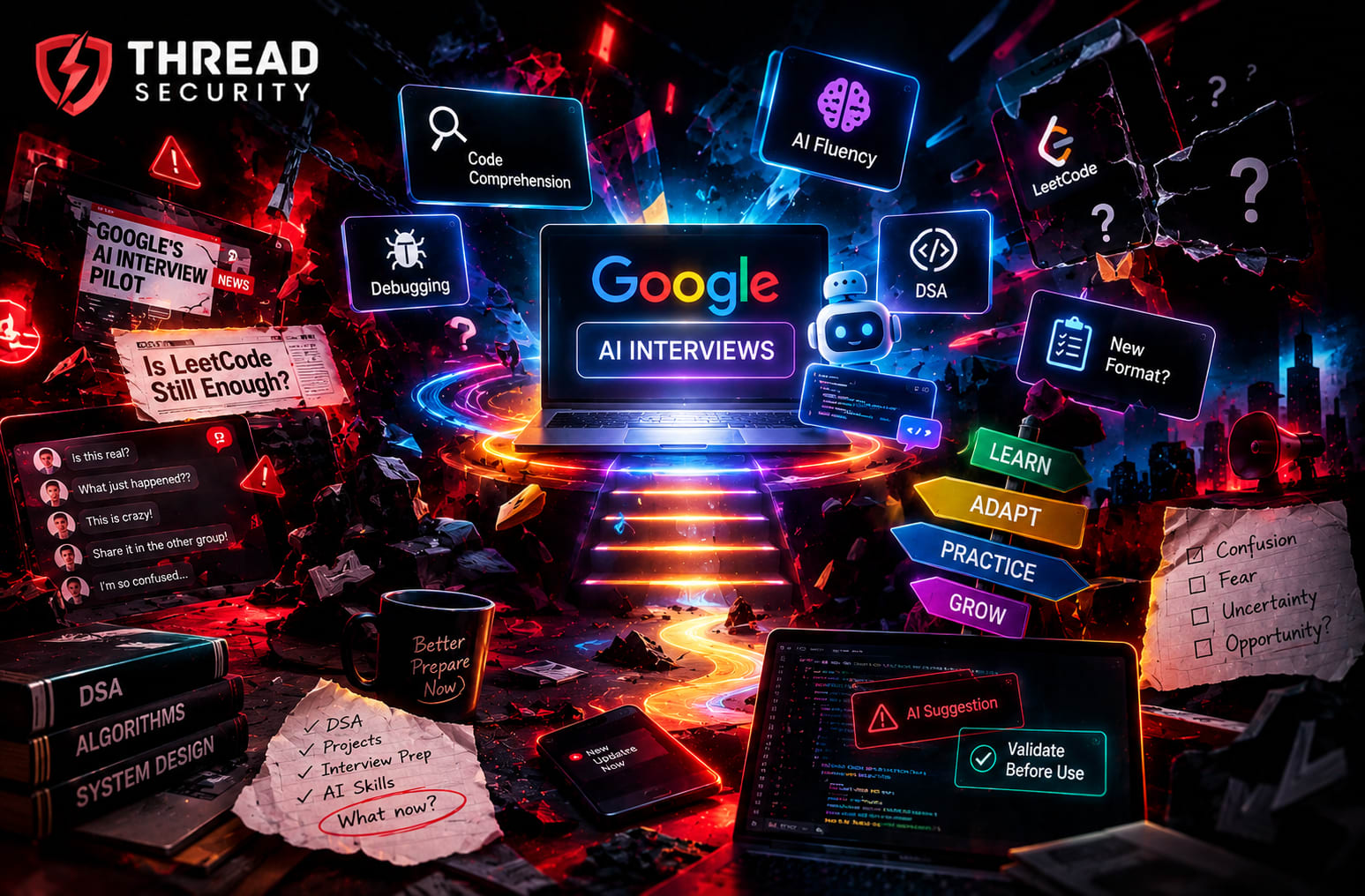
Google AI interviews are changing but that does not mean LeetCode is dead. Reports published in 2026 describe Google piloting a software-engineering interview format in which selected candidates can use an approved AI assistant while reading, debugging and improving existing code. The shift has sparked a bigger question for students and developers: if AI can generate code, what exactly should a coding interview measure?
The answer is not simply “prompt engineering instead of programming.” Software engineers still need to reason about algorithms, data structures, correctness and performance. What is changing is the possibility that some interviews will also assess how well a candidate understands code they did not write, checks an AI assistant's suggestions and takes responsibility for the final result.
There is an important qualification: the reported format is a pilot, not evidence that Google has removed traditional algorithm interviews from every role or region. Candidates should follow the instructions for their specific interview. With that context in mind, let's look at what has reportedly changed, what has not, and how aspiring developers can prepare.
1. What Is Google Changing in Its Coding Interviews?
In October 2026, reporting based on internal documents described Google expanding AI-related changes in its software-engineering hiring process. These include a “code comprehension” interview format in which candidates can use Google's Gemini assistant for the designated round. Google has described its updates as a pilot intended to make interviews more reflective of how its engineering teams work.
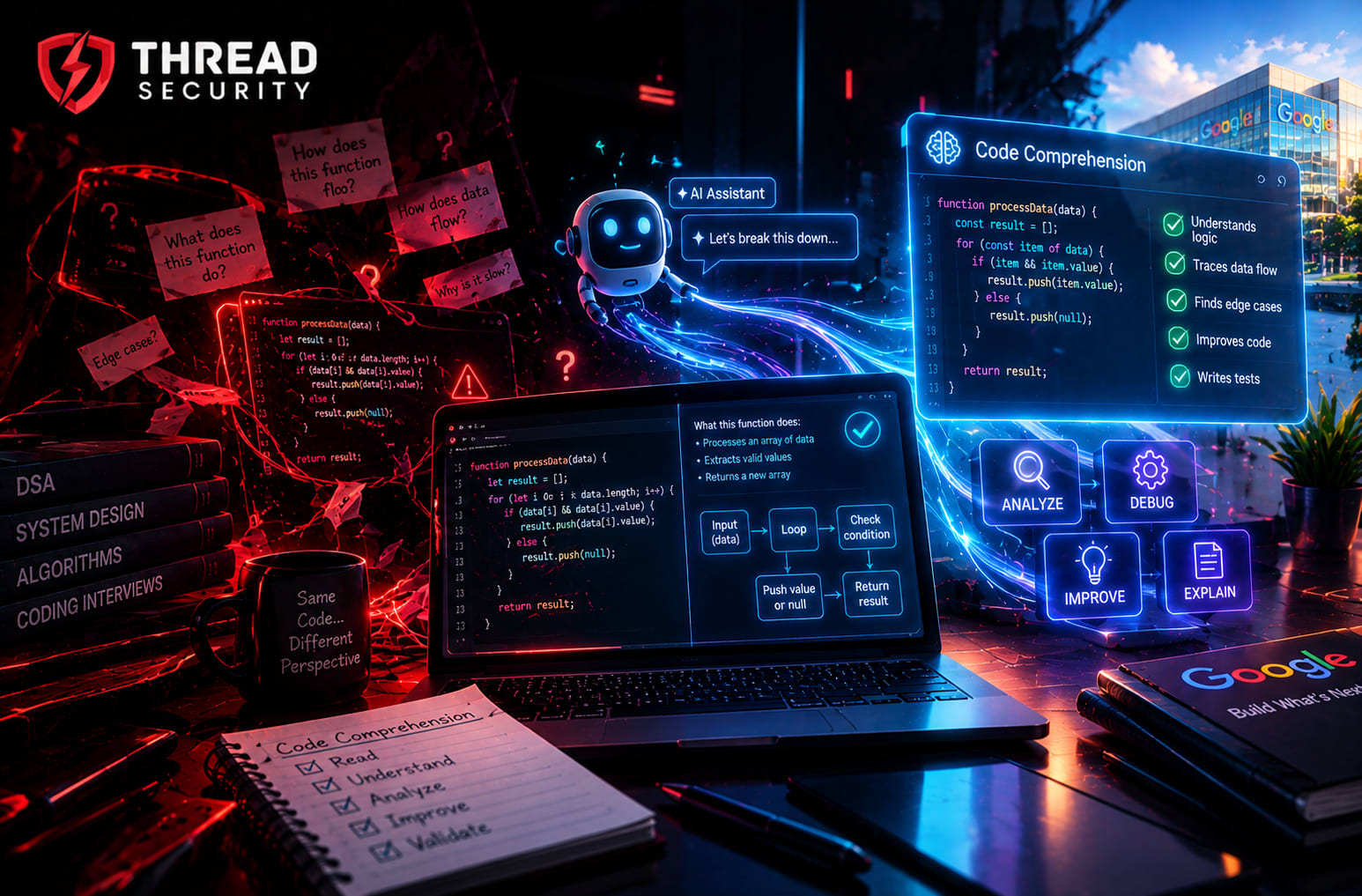
In this reported format, the candidate is not simply handed a blank editor and asked to produce an algorithm from scratch. Instead, the task centres on understanding an existing codebase, finding issues, debugging behaviour and improving the implementation. AI may help the candidate investigate the code or explore possible fixes, but the candidate is still expected to understand and validate the work.
Reported evaluation areas include AI fluency, prompt engineering, output validation and debugging. In plain language, interviewers want to see whether a person can use an assistant productively without accepting its answers blindly.
What this does not mean: it does not establish that every Google interview permits AI, that all DSA rounds have disappeared, or that the same format applies to every country and role. A pilot can vary by team and hiring cycle. If you have an interview scheduled, confirm the allowed tools and format with your recruiter. Never use an AI tool in an interview unless the instructions explicitly permit it.
2. What Is a Code Comprehension Interview?
Code comprehension means being able to read and understand code that already exists. In real engineering teams, developers spend a substantial amount of time working inside existing projects rather than starting every task from an empty file. They read code written by colleagues, investigate bugs, review pull requests, understand unfamiliar functions and make changes without breaking other parts of a system.
A code-comprehension task might ask you to:
Explain what a function or module is intended to do.
Trace how data moves through the program.
Identify a bug, edge case or incorrect assumption.
Find why the program becomes slow as the input grows.
Improve the implementation while preserving its intended behaviour.
Write or update tests that demonstrate the fix.
Explain the trade-offs behind your changes.
These tasks test more than whether code can be made to run once. A good engineer must understand why it works, what could cause it to fail, and whether the change is safe in the context of the larger system.
For example, imagine a function that removes duplicate values from a list. It works on a small example but becomes very slow for a large input. A candidate might first identify the repeated nested search, explain its time complexity, replace it with a set-based approach where appropriate, and test that the output still matches the required behaviour. That process demonstrates comprehension, algorithmic reasoning and verification together.
3. Why Would an Interview Allow AI?
AI coding assistants are increasingly part of software-development workflows. They can explain unfamiliar code, propose a function, suggest tests, identify likely causes of an error and help developers compare possible implementations. Employers therefore have a reason to assess whether candidates can work effectively with these tools.
Google has publicly discussed the growing role of AI in its software development. In April 2026, the company said AI generated a large share of its new code, which engineers then reviewed. The broader lesson is not that engineers no longer need to code. It is that code generation and code ownership are different responsibilities.
An AI assistant can produce a plausible-looking answer that contains a logic error, misses an edge case, uses an inefficient approach or misunderstands the requirements. In some cases, it may confidently recommend a change that solves the visible symptom but creates another problem. The developer must decide whether the answer is correct, relevant and safe to use.
This is why an AI-assisted interview can still be demanding. If a candidate can generate code but cannot explain it, test it or identify when it is wrong, the tool has not demonstrated engineering competence. A strong candidate uses AI to accelerate investigation while remaining responsible for the reasoning and final solution.
4. Does LeetCode Still Matter in 2026?
Yes, LeetCode and DSA practice still have value. The reported Google pilot should not be interpreted as a reason to abandon algorithm preparation. Data structures and algorithms help developers reason about time complexity, memory use, search, sorting, graphs, recursion and the trade-offs between different approaches.
These fundamentals are useful when writing code from scratch and when reviewing AI-generated code. If an assistant proposes a solution that repeatedly scans a large list, a candidate who understands complexity can recognize the performance issue. If a graph problem is incorrectly treated as a tree, knowledge of graph traversal can help expose the mistake.
LeetCode also develops structured problem-solving: clarify the input, identify constraints, choose an approach, test edge cases and explain complexity. Those habits remain useful even if a particular interview asks you to modify an existing codebase.
What may need to change is the balance of your preparation. Solving hundreds of problems by memorizing familiar patterns is less complete preparation than being able to explain a solution, inspect another person's implementation, find a defect and prove that your correction works.
Think of LeetCode as one part of your preparation not the entire preparation plan. Continue practicing DSA, but pair it with code reading, debugging, testing and responsible AI-assisted development.
5. The Skills Candidates Should Practice
Skill 1: Reading unfamiliar code
Choose a small open-source project or a function you have never seen before. Before editing anything, write down what you think it does, what inputs it expects and what it returns. Trace the execution with a sample input. Look for dependencies, assumptions and places where data may change. This trains you to build a mental model before making changes.
Skill 2: Debugging systematically
Do not change random lines until the error disappears. Reproduce the issue, reduce it to a small test case, inspect relevant variables and identify the likely cause. After fixing it, rerun the failing test and the existing tests. Explain why the bug occurred and why your change addresses the underlying cause.
Skill 3: Understanding complexity
Be able to discuss time and space complexity in practical terms. You do not need to optimize every line prematurely, but you should recognize when an approach scales poorly. Compare alternatives and explain the conditions under which each one makes sense.
Skill 4: Testing edge cases
AI-generated code can appear correct on a typical example and still fail on empty input, duplicate values, very large values, unexpected types or boundary conditions. Build a habit of testing normal cases, edge cases and invalid inputs where relevant. Tests are evidence; a confident explanation from an AI tool is not.
Skill 5: Using AI with clear prompts
A useful prompt provides context, constraints and a specific request. Instead of saying “fix this code,” explain the observed behaviour, expected behaviour, relevant input and restrictions. You might ask an assistant to identify likely failure points without changing the code first, or to propose two possible fixes and compare their complexity.
Skill 6: Validating AI output
Read every proposed change. Check assumptions against the requirements, run tests where possible and ask what could still fail. If you cannot explain a line or justify a change, investigate it before accepting it. The goal is not to make the AI look capable; it is to deliver a correct solution.
6. A Practical Example: Debugging AI-Generated Code
Consider this Python function, which is intended to return the average of a list of numbers:
def average(numbers):
    total = 0
    for number in numbers:
        total += number
    return total / len(numbers)
For a non-empty list of numbers, the function works. But what happens when the list is empty? The function attempts to divide by zero. Whether the right fix is to return None, raise a clear exception or handle the case another way depends on the application's requirements.
A weak AI-assisted workflow would ask an assistant for a fix, paste the first answer and move on without checking what behaviour the caller expects. A stronger workflow would look like this:
Clarify the requirement: Should an empty list be rejected, return a special value or produce a default?
Ask a focused question: Ask the assistant to explain the failure and propose options without assuming which behaviour is desired.
Evaluate the options: Check whether the suggested behaviour matches the function's contract and how callers will use the result.
Implement and test: Test a normal list, negative values, a single item and an empty list.
Explain the decision: Be ready to justify the chosen behaviour and describe its limitations.
The important skill here is not writing a perfect prompt in isolation. It is using the assistant as a tool while maintaining control over requirements, correctness and testing. In an interview, narrating your reasoning helps the interviewer see that you understand the change rather than simply accepting generated output.
7. A Four-Week Preparation Roadmap
If you are preparing for software engineering interviews, you do not need to discard your current plan. Add structured code-comprehension practice alongside your existing DSA routine.
Week 1: Strengthen the fundamentals
Review arrays, strings, hash maps, stacks, queues, trees and graphs.
Practice explaining time and space complexity.
Solve a manageable number of problems and explain your approach aloud.
Week 2: Read and debug code
Read functions from projects you did not write yourself.
Predict outputs and trace execution before running the code.
Introduce or identify small bugs, then write tests that expose them.
Week 3: Practice AI-assisted development
Use an AI coding assistant on practice projects, not in restricted assessments.
Ask for explanations, alternative approaches and possible edge cases.
Review every suggestion, run tests and record at least one limitation or correction you found.
Week 4: Simulate an interview
Take an unfamiliar small codebase and give yourself a fixed time to understand it.
Identify one defect, implement a fix and add tests.
Explain complexity, trade-offs and remaining risks.
Complete a separate DSA problem without AI so that your independent problem-solving remains sharp.
This is a flexible plan, not a prediction of Google's exact interview questions. The goal is to broaden your preparation so you can handle both traditional algorithm rounds and practical engineering tasks.
8. What This Means for Students and Early-Career Developers in India
For students in India, the practical takeaway is to build a portfolio that demonstrates how you think not just how quickly you can produce a demo. A useful project should include a clear problem statement, readable code, setup instructions, tests, known limitations and an explanation of the decisions you made.
For an AI-enabled project, go one step further. Record which parts were generated or assisted by AI, how you checked the output, what failed during testing and what you changed. This demonstrates that you can use modern tools without outsourcing your judgement to them.
Employers and interview formats differ, so do not assume every company will assess AI fluency in the same way. Some interviews may still prohibit AI entirely; others may include a permitted AI-assisted task. Prepare for both modes: solve problems independently and practice using tools transparently when they are allowed.
Learning programmes should follow the same principle. Programming fundamentals, DSA, code review, testing and debugging should sit alongside AI tools not be replaced by them. Learners exploring practical technical training should look for opportunities to build, test and explain real projects rather than relying on certificates or tool demonstrations alone.
9. The Bigger Shift: From Code Production to Engineering Judgement
The debate is often framed as “humans versus AI,” but that misses the more useful question. As AI tools become capable of generating more code, which human skills become more important to the quality of the final software?
Requirements still need to be understood. Architecture still involves trade-offs. Data and user permissions still matter. Software still fails in unexpected conditions. Performance and security still need to be tested. AI can assist with these tasks, but assistance is not the same as accountability.
Code comprehension is one way to assess these abilities. It rewards a candidate who can orient themselves in an unfamiliar system, ask focused questions, test assumptions, recognize flawed suggestions and make a justified change. These are useful skills whether or not a particular employer adopts an AI-assisted interview.
It is too early to conclude that every company will follow the same path or that traditional coding interviews will disappear. Hiring processes will continue to vary by role, team and organization. But the broader direction is worth watching: developers may increasingly be expected to combine independent technical fundamentals with the judgement to work effectively alongside AI.
Frequently Asked Questions
Has Google removed LeetCode from its coding interviews?
No. Reports describe a pilot involving an AI-assisted code-comprehension format. They do not establish that Google has removed traditional DSA interviews across all roles, teams and regions.
What is Google's code-comprehension interview?
It is a reported interview format in which candidates work with existing code, focusing on understanding, debugging and improving it. In the pilot, an approved AI assistant may be available, and AI fluency is part of the assessment.
Can candidates use Gemini in every Google interview?
No such general permission has been established. AI use is tied to the designated pilot format and interview instructions. Candidates should confirm the rules for their own interview and must not use AI unless explicitly allowed.
Should I stop practicing data structures and algorithms?
No. DSA builds the reasoning needed to analyze and improve code. Continue practicing it while adding code reading, debugging, testing and AI-output validation to your preparation.
What does AI fluency mean in a coding interview?
It can include asking clear questions, providing relevant context, assessing suggestions, validating output and debugging mistakes. It does not mean accepting AI-generated code without understanding it.
How can beginners practice code comprehension?
Read small projects, trace execution, predict outputs, investigate bugs, write tests and explain your fixes. Start with code at your current level and gradually move to larger projects.
Will AI make software engineering skills less important?
AI may change how developers perform parts of their work, but sound reasoning, system understanding, testing and accountability remain essential to building reliable software.
Key Takeaways
Google is reportedly piloting AI-assisted code-comprehension interviews; the change should not be described as the end of LeetCode.
The reported format emphasises reading, debugging and improving existing code, alongside AI fluency.
DSA fundamentals remain valuable for understanding performance, correctness and algorithmic trade-offs.
AI suggestions must be checked against requirements, tests and edge cases.
Prepare for both AI-free interviews and AI-assisted tasks where the use of tools is explicitly permitted.
A strong portfolio demonstrates decisions, tests, limitations and problem-solving not just a working demo.
Build Skills That Go Beyond Writing Code
The most prepared developers will be able to solve problems independently, understand unfamiliar code and use AI tools responsibly when permitted. Start by strengthening your programming foundations, then practice debugging, testing, code review and AI-assisted development with clear evidence of what you learned.
Explore Thread Security and Thread security Education for practical technology learning and cybersecurity insights. Focus on building real projects, explaining your technical decisions and developing the judgement needed to create dependable software.
Simranjit Kaur
VERIFIEDAI Trainer · Thread Security
Faculty mentor & research guide at Thread Security Education.