
Is Generative AI Actually Paying Off for Businesses?
Generative AI has moved rapidly from experimentation to boardroom discussions. Businesses are using AI assistants to draft content, summarize documents, support customer service, analyze information and help developers write code. The promise sounds straightforward: automate repetitive work, improve productivity and reduce costs.
But there is an important distinction between an AI tool that impresses during a demonstration and a business system that consistently delivers measurable value. A successful demo does not automatically translate into higher revenue, lower operating costs or improved profitability.
That is the central question behind the debate about generative AI ROI: are organizations getting meaningful returns from their investments, or are they confusing experimentation and individual productivity with enterprise-wide transformation?
Research from MIT Project NANDA and McKinsey offers useful, but different, perspectives on this question. Meanwhile, Microsoft's Satya Nadella used the World Economic Forum in Davos in January 2026 to emphasize skills, broad adoption and redesigning work around technology.
The evidence suggests neither that generative AI is universally failing nor that every business will quickly benefit. The outcome depends on the use case, implementation, costs, people and the way success is measured.
1. MIT NANDA's 2025 Report: Why the 95% Figure Needs Context
In July 2025, MIT Project NANDA published The GenAI Divide: State of AI in Business 2025. The report became widely discussed because of its headline finding that 95% of organizations in its analysis were getting zero return from their generative AI investment.
The research examined more than 300 publicly disclosed AI initiatives, included structured interviews with representatives from 52 organizations, and collected survey responses from 153 senior leaders at four industry conferences. The research period ran from January to June 2025.
The report's central concern was the gap between trying AI and integrating it into business operations in a way that produces measurable results. Many organizations were experimenting with generative AI, but far fewer appeared to be converting those experiments into sustained business impact.
What the report is warning businesses about
Pilots are not production systems. A prototype can work in a controlled demonstration but struggle with real customer requests, incomplete data or complex business processes.
Access is not adoption. Providing employees with an AI tool does not guarantee that it becomes a reliable part of everyday work.
Integration matters. AI must fit the organization's existing systems, data, permissions, review processes and business objectives.
Value needs to be measured. Time saved by an individual is useful, but the organization must determine whether that time translates into improved output, lower costs, better service or another measurable result.
Does this mean 95% of all AI pilots fail?
No. That is too broad a conclusion to draw from the report.
The report is labelled as preliminary research. Its findings draw on interviews, conference-based survey responses and publicly disclosed initiatives rather than a representative census of all businesses. The authors themselves describe the figures as directionally accurate based on individual interviews rather than official company reporting.
There are additional limitations to consider. Publicly disclosed projects may not represent the full range of AI deployments, the organizations willing to participate may differ from those that do not, and the observation period may not capture benefits that emerge after longer implementation cycles.
Critics have also questioned how the headline statistic is communicated, particularly when the distinction between organizations receiving no measurable return, pilots failing to scale and projects being abandoned is lost. These are different outcomes and should not be treated as interchangeable.
The useful takeaway is not that generative AI cannot deliver value. It is that businesses should be cautious about assuming that experimentation automatically leads to financial returns.
2. McKinsey's State of AI Survey: Adoption Is Growing, but Value Is Uneven
McKinsey's November 2025 State of AI survey provides another perspective. It describes a business landscape in which AI use is becoming common, while many organizations are still working out how to scale it and capture enterprise-level benefits.
In the survey, nearly nine in ten respondents said their organizations regularly used AI in at least one business function. However, most respondents said their organizations had not yet begun scaling AI across the enterprise.
The survey reported several findings that help explain the difference between AI adoption and AI ROI:
88% reported regular AI use: AI was being used in at least one business function.
About one-third reported scaling AI: broad experimentation had not yet become enterprise-wide deployment for most organizations.
39% reported enterprise-level EBIT impact: this was the share attributing some level of earnings-before-interest-and-taxes impact to AI use.
64% said AI was enabling innovation: respondents identified benefits beyond immediate cost savings.
62% reported at least experimenting with AI agents: interest in systems that can carry out multi-step tasks was growing.
These findings should be read carefully. They represent survey respondents' reports and perceptions, not audited financial statements covering every company. The percentages also measure different things: regular use, scaling, perceived innovation and reported financial impact are not equivalent metrics.
Why adoption does not automatically equal ROI
Imagine a customer support team that introduces an AI assistant. The assistant drafts responses in half the time, and employees report that their work is easier. That is a meaningful productivity signal.
However, the organization may still need employees to check every response, correct mistakes, manage escalations and maintain the AI system. If the team handles the same number of cases, costs remain unchanged and customer satisfaction does not improve, the financial return may be limited.
Now imagine that the same business redesigns its support workflow. AI handles routine queries, difficult cases are routed to trained staff, response quality is monitored, and the team uses the recovered time to resolve more customer issues. The business could then see improvements in service capacity, response times and cost per resolved case.
The difference is not simply whether the AI model is capable. It is whether the organization has redesigned the work around it.
3. Satya Nadella at Davos 2026: Skills and Diffusion Matter
At the World Economic Forum in Davos in January 2026, Microsoft chairman and CEO Satya Nadella highlighted the importance of AI skills, wider access and changes to the way organizations work.
As reported by Business Today, Nadella drew a comparison with the early adoption of personal computing. Just as workers once needed to learn tools such as spreadsheets and word processors, people increasingly need the skills to use AI effectively in their work.
His message extended beyond learning to operate a chatbot. He emphasized the need for businesses and governments to make AI skills more widely available and argued that organizations must rethink how work is structured around the technology.
What does this mean for enterprise AI ROI?
First, an organization cannot expect strong returns if its employees do not know when to use AI, how to evaluate its output or when human judgement is necessary.
Second, access must spread beyond a small innovation team. The people who understand the real workflow customer service staff, analysts, developers, operations teams and managers need opportunities to identify and test appropriate uses.
Third, workflows may need to change. Adding AI to an inefficient process can make the same process faster without solving its underlying problems. Better outcomes may require changing task ownership, review procedures, escalation paths and performance measures.
This also makes practical training important. AI literacy, data handling, prompt design, evaluation, automation, privacy and security are not just technical topics. They help employees use AI responsibly and help businesses turn promising tools into dependable processes.
4. AI Hype vs Reality: What Businesses Often Overlook
Generative AI can produce impressive results, but a business case needs more than an impressive output. Organizations should examine the complete system surrounding the model.
Hidden costs can change the calculation
Licensing and API usage are only part of the expense. Businesses may also need to budget for data preparation, integration, cloud infrastructure, monitoring, security reviews, staff training, human verification and ongoing maintenance.
A pilot may appear inexpensive because employees and existing infrastructure absorb much of the work. Those costs can become more visible when the project expands to hundreds or thousands of users.
Accuracy and reliability matter
An AI system that produces a convincing but incorrect answer can create rework, customer complaints, compliance problems or security exposure. A project should be evaluated on the quality of its results in realistic conditions, not just on how fluent its responses appear.
Time saved is not always money saved
If AI saves an employee thirty minutes each day, that is a potential productivity gain. It does not automatically mean that the company has reduced payroll expenses or increased revenue. The organization needs to decide how the saved time will be used and measure the resulting outcome.
Not every problem needs generative AI
For a stable, rule-based task, a conventional automation script may be cheaper and more predictable. For numerical forecasting, traditional analytics or machine learning may be more suitable. Generative AI is most useful when its capabilities match the task and its limitations can be managed.
The goal should not be to use AI everywhere. The goal should be to choose the right approach for a clearly defined problem.
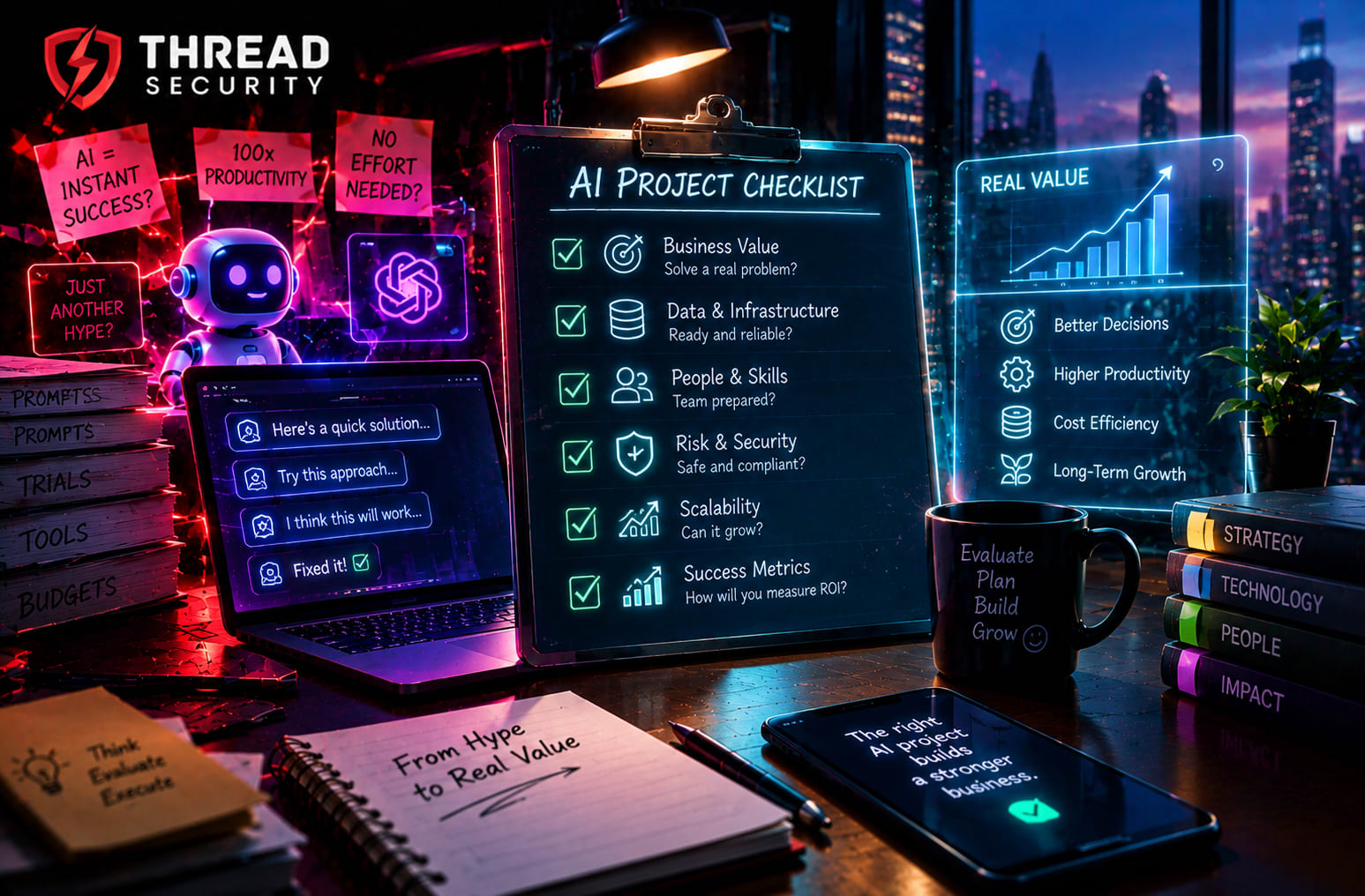
5. A Simple Checklist for Evaluating an AI Project
Before approving an AI pilot or expanding an existing deployment, use the following checklist. It can help business leaders, project managers and technical teams assess whether a project has a credible path to value.
Business problem
Have we identified a specific, recurring business problem?
Do we know how the process performs today, before introducing AI?
Is the problem important enough to justify the cost and implementation effort?
Measurement
Have we selected measurable success criteria, such as cost per task, turnaround time, error rate, revenue or customer satisfaction?
Have we established a baseline and a target before starting the pilot?
Will we compare results against the existing process or another reasonable alternative?
Total cost
Have we included licenses, usage, infrastructure, integration, training, monitoring and maintenance?
Have we accounted for the time employees spend checking and correcting AI output?
Do the expected benefits still exceed the costs when the system operates at realistic scale?
Quality, privacy and security
Does the system meet a defined accuracy and reliability threshold on representative tasks?
Are sensitive data, access permissions and retention rules properly controlled?
Are there human review and escalation procedures for high-impact or uncertain outputs?
Can we monitor errors, misuse, unexpected costs and performance changes after deployment?
Adoption and scaling
Have the employees who will use the system tested it in their actual workflow?
Is training available so that users understand the tool's capabilities and limitations?
Have we redesigned the process where necessary, rather than simply adding another application?
Have we defined clear criteria to continue, improve, pause or stop the project?
Calculate ROI using the full picture
A simple starting point is:
ROI (%) = (Net Benefits ÷ Total Project Costs) × 100
For this calculation, net benefits should reflect the value attributable to the project after relevant costs and other effects are accounted for. Define the measurement period and assumptions clearly, and avoid counting the same benefit twice.
For example, suppose an AI project costs ₹2,00,000 over a defined period and generates ₹3,00,000 in verified net benefits during that same period. Its ROI would be 150% under this simplified calculation. The example is illustrative, not a claim about typical AI returns.
For projects whose benefits are uncertain or take time to emerge, track intermediate indicators such as adoption, accuracy, cycle time and rework alongside financial outcomes. These indicators can explain progress, but they should not be presented as proof of financial ROI on their own.
6. What Should Businesses Do Next?
The most sensible response to the debate is neither to rush into every AI trend nor to abandon AI because some pilots have disappointed. Businesses should make decisions based on the value of individual use cases and the quality of the evidence they collect.
Start with one meaningful problem. Choose a workflow with a clear pain point, identifiable users and a measurable baseline.
Run a controlled pilot. Test with representative data and real users while keeping appropriate human oversight.
Measure the full cost. Include the people, systems and controls needed to operate the solution reliably.
Improve the workflow. Remove unnecessary steps and establish clear responsibilities for AI output, review and escalation.
Build employee capability. Train users to select suitable tasks, assess output quality and handle data responsibly.
Scale only when the evidence supports it. Expand when the system meets predefined performance, safety and business thresholds.
This approach treats enterprise AI adoption as a business transformation effort rather than a software purchase alone. It also recognizes that not every experiment needs to become a permanent product. A well-designed pilot can create value by showing that a proposed solution is not suitable before the organization invests more heavily.
7. Why AI Skills and Practical Training Matter
As AI tools become more accessible, the ability to use them thoughtfully is becoming important across technical and non-technical roles. Businesses need people who can identify suitable use cases, work with data, automate processes, evaluate outputs and recognize security and privacy risks.
For learners, this means moving beyond simply trying popular AI tools. A stronger learning path includes Python fundamentals, data handling, generative AI concepts, prompt design, workflow automation, model evaluation and responsible AI practices. The right sequence depends on a learner's starting point and career goals.
For organizations, training should be connected to actual work. Employees can practice with realistic tasks, learn how to check AI-generated results and understand when to involve a human expert. Technical teams can go further by building small prototypes, measuring performance and testing security controls.
Thread Security Education focuses on practical technology learning that connects concepts with applied skills. Learners interested in AI, machine learning, automation and cybersecurity can explore relevant learning opportunities and build projects that demonstrate how they approach real problems.
Explore Thread Security to learn more about its technology training and education offerings. If you are searching for AI courses in Jalandhar, prioritize programmes that combine hands-on projects, responsible AI practices and measurable learning outcomes not just a list of tools.
Conclusion: Measure the Value, Not the Hype
Generative AI is creating real opportunities, but the return is neither automatic nor uniform. The MIT NANDA report highlights the difficulty of converting enterprise experiments into measurable outcomes, while McKinsey's survey shows that widespread AI use can coexist with limited enterprise-level financial impact. Nadella's Davos remarks add another important dimension: skills, broad adoption and workflow redesign are essential to spreading the benefits.
These sources use different methods and measures, so their findings should not be treated as directly interchangeable. Together, however, they point towards a practical lesson: successful AI adoption requires a clear problem, suitable technology, capable people, responsible implementation and credible measurement.
The better question is not whether generative AI is worth the hype in general. It is whether a particular AI project solves a meaningful problem, performs reliably, earns users' trust and delivers enough measurable value to justify its full cost.
For businesses, that is the path from experimentation to ROI. For learners, it is a reminder that the most valuable AI skills combine technical knowledge with problem-solving, evaluation and an understanding of how technology works in real organizations.
Simranjit Kaur
VERIFIEDAI Trainer · Thread Security
Faculty mentor & research guide at Thread Security Education.