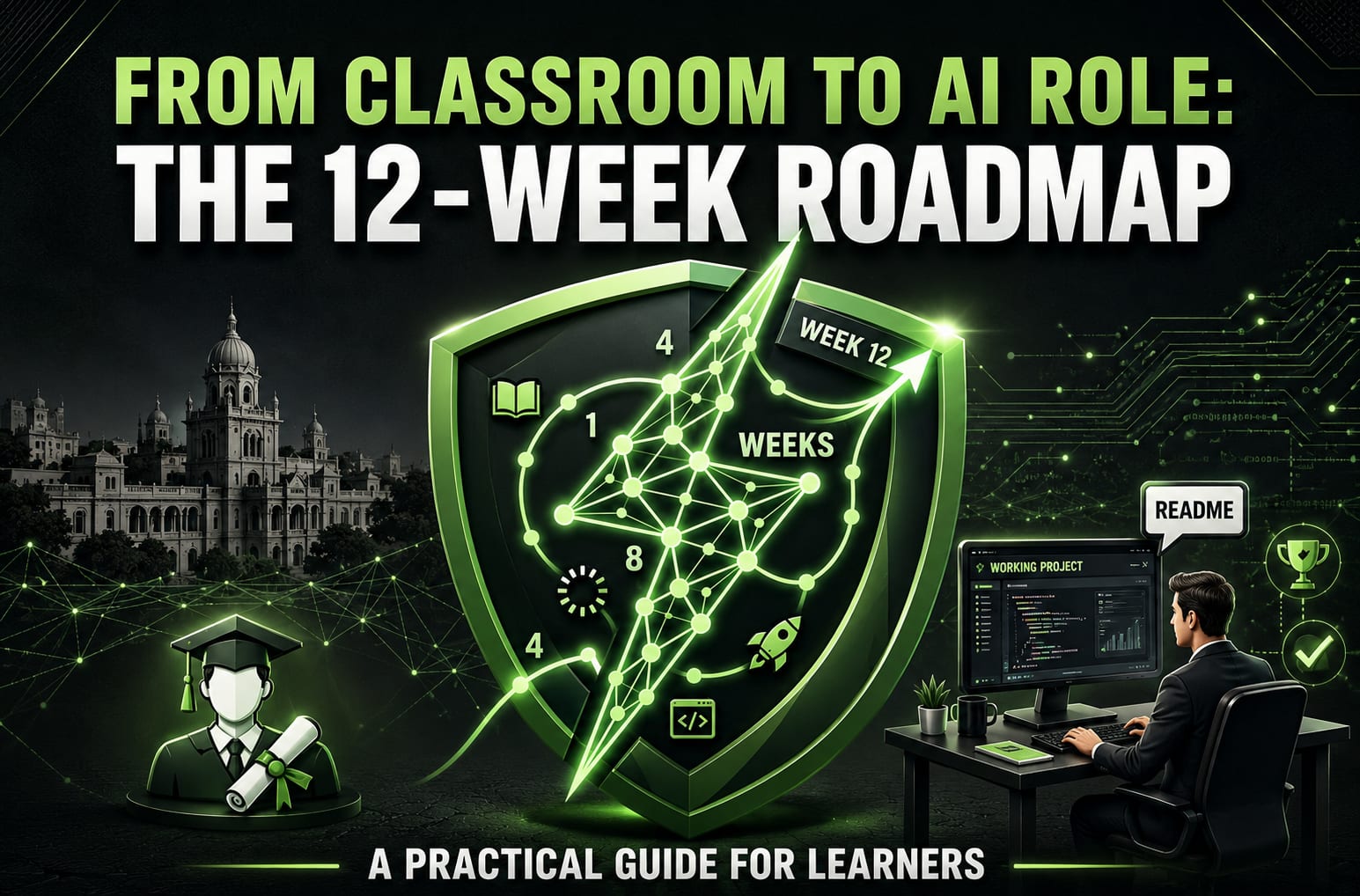
The common problem that most students face when it comes to pursuing an AI career is picking up certificates and completing tutorials but then going into the job market without anything the recruiter can confirm. A certificate is issued when you attend. It is said to be a working project with a clear README and a short demo video that you can do the work.
There's one goal in mind here: By Week 12, you should notice tangible results, not just a sense of progress. It is meant for college-going students and early career learners who are juggling between a job and learning, even in Jalandhar and other parts of the country.
Who this Roadmap is for (and not for)
It's for you if you are able to allocate about 8 to 10 hours per week, you don't mind some basic school level math, and you don't mind making things that may be a little bit messy.
Do not use it if you are looking for a job that you know you will have in 12 weeks. No straight path, school or college will guarantee that. Any 12 weeks can really provide you with a solid base, with one credible project and a set of applications with proof attached. Hiring is based on the market and your background as well as the consistency of your application.
The Realistic Workload
Overall, 12 weeks of 8-10 hours per week is approximately 100-120 hours. This is sufficient to learn the basics and create one project. You don't need to be an expert, otherwise you are selling something.
Making a sustainable split every week:
4 hours: using computers (for research and writing)
4 hours: building (code, notebooks, experiments)
3 to 4 hours: code review (including writing notes and README, reviewing commits)
If you are only able to commit 5 hours per week, do it for 20 weeks not skipping weeks. Consistency beats intensity.
The 12-week plan
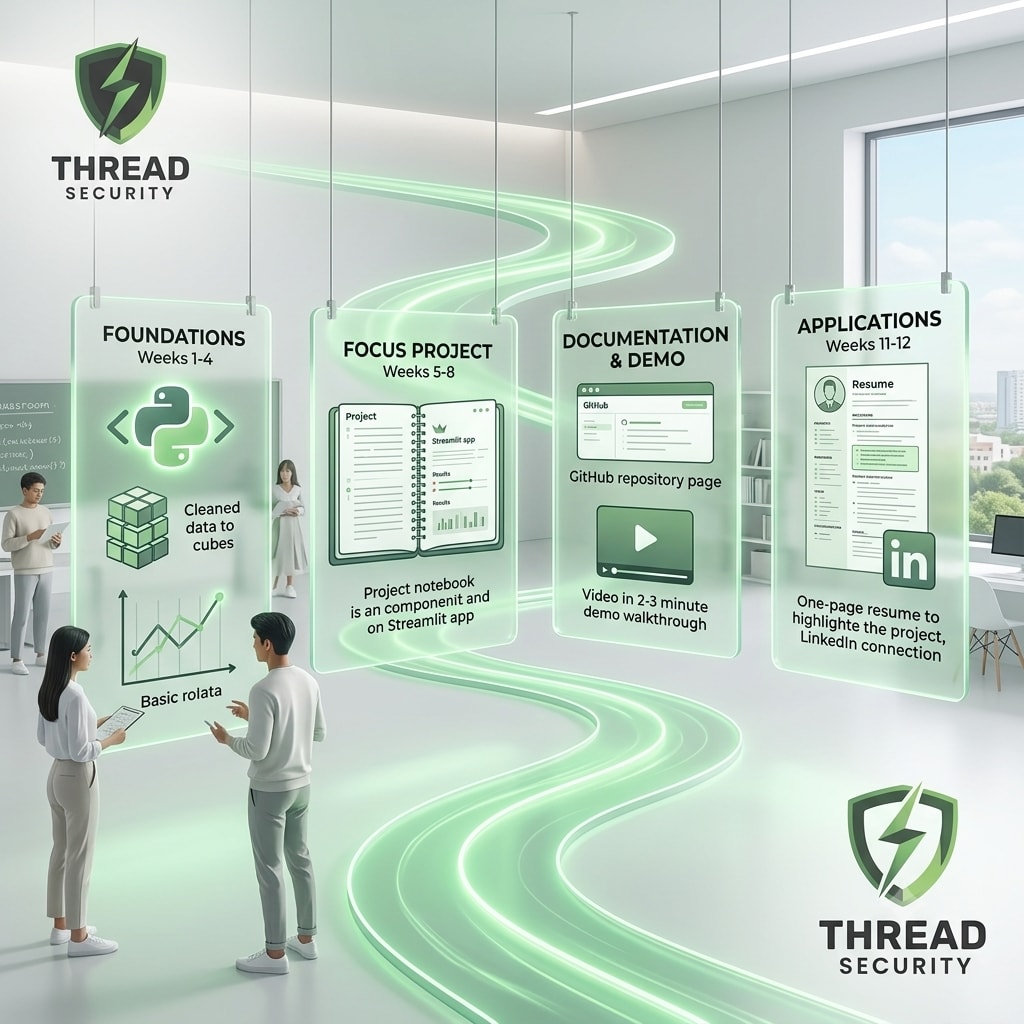
Phase 1: Foundations (Weeks 1 to 4)
Week 1: Introduction to Python and Environment setup
Benefit: A Python environment is now available with 15-20 small practice programs pushed to a GitHub account.
Focus: variables, loops, functions, lists and dictionaries, reading and writing files.
Week 2:Use Python for data, part 1
Outcome: You can load a CSV, clean it and summarise it using pandas.
Outline: Filtering, grouping, dealing with missing values, and focus on DataFrames.
Week 3: Python for data, part 2 and visualisation
Criteria: At least four clear charts and written observations in an exploratory data analysis notebook on a public dataset.
Focus: NumPy basics, Matplotlib or Seaborn, ask questions of data.
Week 4: Core machine learning concepts
Outcome: A first working model (e.g. classifier) created using scikit-learn with a simple explanation of its purpose.
Focus: train/test split and overfitting, basic metrics (accuracy, precision and recall).
Phase 2: One Focus Project (Weeks 5-8)
The worst thing that can happen is to create five shallow projects. One project that you can explain in great detail is more valuable to recruiters and interviewers than a list of the many tutorials that are available.
Week 5: Choose and scope your project
Outcome: One page project brief (problem statement, dataset, measurement of success, and what is out of scope).
Tips: Choose a problem that you can describe to a non-technical individual in two sentences. Predicting loan defaults from publicly available information, classing customer support information, identifying unusual log-in activity or summarising agricultural price data.
Week 6: Data preparation / Baseline
Outcome: Clean data and simple baseline model. The reason a baseline is important is that there's no way to know if your final model is any good if you don't have a baseline.
Week 7: Honestly enhance and assess
Outcome: 2 Model Improvements Tried, Results Recorded (including what doesn't work)
The reason it is important: Interviewers care more about how you think and what experiments you tried unsuccessfully than about your score.
Week 8: Make it Useable
The outcome is something that is simple to interface with or someone else can run - a Streamlit app, a notebook with clear instructions, or a small API.
Phase 3: Documentation and Demo (Weeks 9 and 10)
Week 9: Documentation
Outcome: A professional README covering the problem, data source, approach, results, limitations and how to run the project, plus a clean repository with meaningful commit messages.
The reality is: Many candidates don't do this, and that's why it's important to do it right.
Week 10: Demo and write-up
This is meant to be a 2-3 minute screencast of your work, and a blog post or LinkedIn article that explains your creation and what you learned.
Phase 4: Applications (Weeks 11 & 12)
Week 11:Building and Assembling your application kit
Outcome: At the end of this course, students will be able to design and build a one-page resume with a project at the top, update LinkedIn profile, and pin a GitHub repository.
Also: A shortlist of 30-40 roles that you are interested in, such as AI internships, data analyst junior positions and machine learning trainee positions.
Week 12: Apply, Connect and Network
Goal: Send 15 – 25 customized applications, make 5 – 10 direct messages to individuals in relevant positions, and have completed two mock interviews.
Tip: Each application should link to your project. Please don't submit a standard resume without any documentation.
What is considered as "visible proof"?
By the end of Week 12 you should be able to share a single link or a brief handful of links that demonstrate:
A public, open-source GitHub repository (with a good README)
A working demo or recorded walkthrough of the work.
A brief report of your procedure and outcomes
A resume that serves as a direct reference to these items.
If you can be convinced in 5 minutes, you have done it right.
Internships and Opportunities
Expand your job search to include more than just the title AI Engineer for AI career opportunities. Common initial positions for early in Career are Data Analyst, Junior Data Scientist, Data Intern, AI Trainee, or Analytics positions. Recruitment sites like LinkedIn, Internshala, company career pages, college placement cells and industry networks are good places to look. Use internships as opportunities to get supervised, real-world experience, carefully review each listing, including the stipend, duration and scope of learning, before applying.
Learn with support of Thread Security
Some learners will do well with self-study. Many learners will find a structured approach, mentoring and feedback in the project, documentation and application stages most beneficial, where most people get stuck.
Moreover, if you're interested in AI courses in Jalandhar, you can reach out to Thread Security and get all the verified details of the courses, such as course name, duration, classroom/online option, batch time, fees range, and any internship or placement policy.If you are looking to compare any AI course in Jalandhar, even ours, have a look at these questions:
Is there a practical project as well as theory?
Will you receive some type of feedback on your code and documentation?
Are trainers professionals and can you see what they've done?
Do internship or placement claims make sense and do not make any assumptions?
Are there some of the past students available for your questions or to check out their work?
The Most Frequent Errors to Prevent
Tutorial hopping. Completed 10 courses without creating any structures.
Beginning with deep learning. Learn Python programming, data handling and simple machine learning first.
Skipping documentation. An undocumented project is very difficult to assess and very easy to forget about.
Over-scoping. It's better to have a small, completed project than a large, abandoned one.
Waiting until you are ready. If the project is not perfect, start to apply in Week 11.
Frequently asked Questions
Is it essential to have a computer science degree to pursue an AI career? Not necessarily. Numerous jobs require a list of skills, but there are some jobs that do prefer degrees, so look it up for the jobs you are interested in.
Can you get a job in AI in 12 Weeks? It's enough to create a foundation and a proof-of-work undertaking. Employment is dependent upon the market, and upon your own background and longevity following Week 12.
How much Math is required? Alongside the roadmap, comfortable basics in statistics, probability and linear algebra help.
So, where are the AI courses in Jalandhar? Research local institutes regarding curriculum, project work, training experience, and what to expect from the training. If possible, visit in person and request a class demo. Just like how you can Visit or contact the Thread security Team for any type of Guidance.
Your Next Step
Choose when to start Week 1, nail down what you want to accomplish each week and document it in an open source repository. To avail of structured guidance, mentorship and project feedback, reach out to Thread Security, Jalandhar at 3rd Floor, Vasal Mall, Opposite Hotel President, Police Line, Jalandhar, Punjab 144001 or call at +91 7347398956 or visit Thread Security Website to enquire about their available batches.
Simranjit Kaur
VERIFIEDAI Trainer · Thread Security
Faculty mentor & research guide at Thread Security Education.