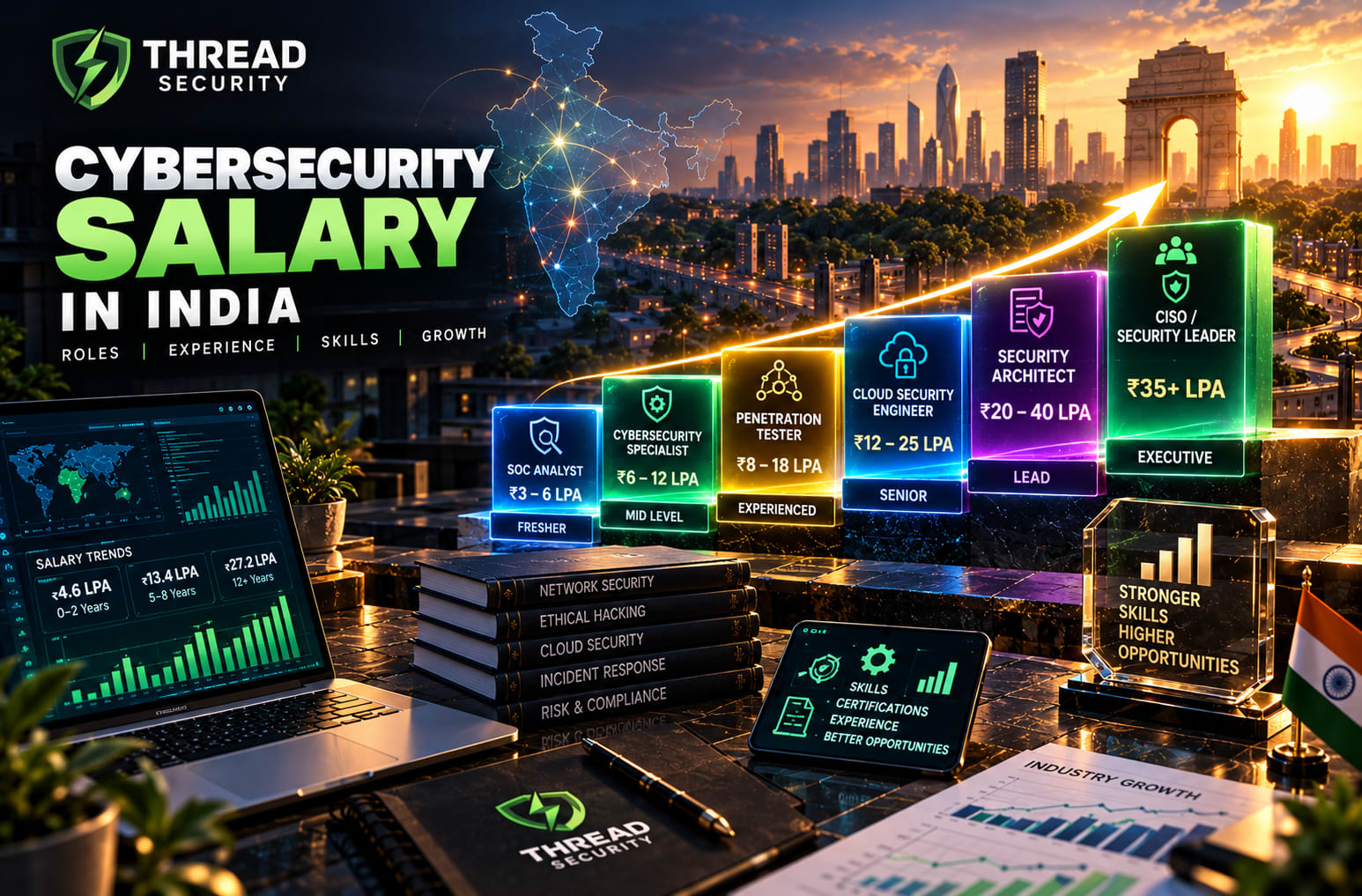
Cybersecurity salary in India depends on several factors, including job role, experience, technical skills, location, employer, and the complexity of the systems a professional protects. A fresher joining a security operations centre may earn a different salary from a penetration tester, cloud security engineer, application security specialist, or experienced security architect. This guide compares published salary benchmarks, explains the difference between fresher, mid-level, and senior compensation, and outlines the skills that can support career progression. All figures are indicative—not guaranteed offers—and should be interpreted according to the source, year, and experience category.
1. Cybersecurity Salary in India: An Overview
Cybersecurity is not a single occupation. It includes security monitoring, vulnerability assessment, incident response, application security, cloud security, governance, risk and compliance, and security architecture. Each role has different responsibilities, and salaries can vary even among people with similar job titles.
Flexiple's cybersecurity salary page, updated in August 2026, reports an overall median annual compensation of approximately ₹7 lakh across all experience levels, based on 5,908 verified compensation records. It reports a median of ₹4.6 lakh for professionals with 0–2 years of experience, ₹13.4 lakh for the 5–8-year group, and ₹27.2 lakh for professionals with 12 or more years of experience. These are experience-group medians, not guaranteed salary bands for every cybersecurity job.
Source: Flexiple — Cybersecurity Specialist Salary in India.
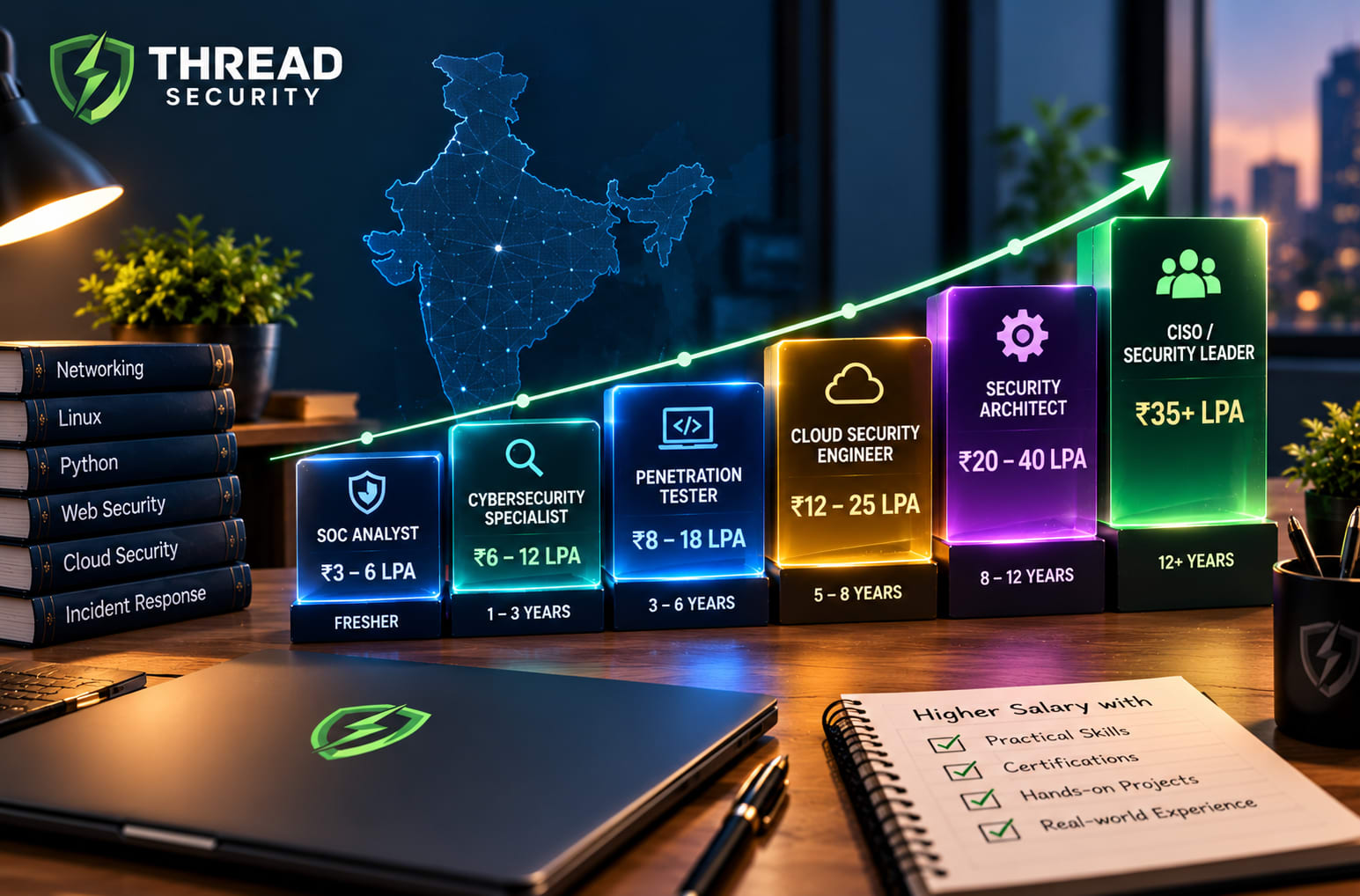
2. Cybersecurity Salary by Experience Level
Freshers and entry-level professionals
Entry-level candidates commonly explore roles such as junior cybersecurity analyst, SOC analyst, security operations trainee, vulnerability assessment trainee, and security support associate. Their responsibilities may include reviewing alerts, analysing logs, following incident-response procedures, checking basic security configurations, and escalating suspicious activity.
Flexiple reports a median of ₹4.6 lakh per year for the 0–2-year cybersecurity experience group, with a typical middle range of ₹3.1 lakh to ₹6.6 lakh. This is an overall cybersecurity benchmark rather than a salary promise for a particular fresher role. Some candidates may receive lower or higher offers depending on the employer, location, technical assessment, and job responsibilities.
For freshers, a practical portfolio, networking fundamentals, Linux knowledge, basic scripting, and the ability to explain security findings can help demonstrate readiness. A certificate may support an application, but it does not guarantee selection or a particular package.
Mid-level professionals
Mid-level professionals usually handle more independent investigations, complex security testing, incident coordination, automation, or implementation of security controls. They may be expected to improve detection rules, investigate suspicious activity, assess application weaknesses, or help secure cloud infrastructure.
Flexiple reports an annual median of ₹13.4 lakh for the 5–8-year experience group. Its published data also shows ₹7.6 lakh for the 2–5-year group and ₹17.3 lakh for the 8–12-year group. These categories are based on experience, not identical job descriptions, so they should not be interpreted as fixed salary grades.
At this stage, practical depth matters. Experience with SIEM platforms, endpoint detection, penetration testing, incident response, cloud identity and access management, secure development, or compliance can be relevant depending on the chosen career path.
Senior professionals and security leaders
Senior specialists may lead penetration tests, design security architecture, coordinate incident response, manage security engineering teams, or advise business leaders on risk. Roles can include senior security engineer, security architect, security consultant, security manager, and chief information security officer (CISO).
Flexiple reports a median of ₹27.2 lakh annually for its 12-plus-year cybersecurity experience group. Senior compensation varies widely, however, and years of experience alone do not determine pay. Leadership scope, business impact, specialist expertise, employer size, and the responsibility attached to the role all matter.
Do not treat an experienced professional's salary as a realistic starting point for a fresher. Career progression takes time and depends on demonstrated capability, opportunities, and performance.
3. Salary by Cybersecurity Job Role
Role-specific salary comparisons need care because datasets may use different definitions, employer samples, and experience bands. TeamLease Digital's Digital Skills & Salary Primer FY 2024–25 presents estimated annual salary figures for selected technology roles across employer segments. The figures below are taken from that report and should be read as estimates for the stated sector—not as current universal salaries for all Indian employers.
Penetration tester in Global Capability Centres (GCCs): TeamLease listed estimates of ₹11.8 lakh for entry-level professionals, ₹17.1 lakh at mid-level, and ₹30.8 lakh at senior level.
Cybersecurity specialist in GCCs: The report listed estimated annual pay of ₹8.5 lakh at entry level, ₹13.4 lakh at mid-level, and ₹26.9 lakh at senior level.
Information security analyst in IT products and services: The report listed estimates of ₹5.4 lakh at entry level, ₹11.7 lakh at mid-level, and ₹23.2 lakh at senior level.
Security consultant in IT products and services: The report listed estimates of ₹7.1 lakh at entry level, ₹13.5 lakh at mid-level, and ₹18.9 lakh at senior level.
Source: TeamLease Digital — Digital Skills & Salary Primer FY 2024–25.
These figures should not be directly merged with Flexiple's experience-based medians. The reports use different methodologies, and the TeamLease figures are sector-specific estimates from an earlier period. Check recent job listings and the employer's actual requirements when evaluating an offer.
4. Which Cybersecurity Roles Can You Choose?
SOC analyst
A security operations centre analyst monitors alerts, examines logs, investigates suspicious activity, and escalates incidents. Entry-level SOC roles can be a route into security operations. Knowledge of networking, Windows and Linux logs, SIEM queries, and incident handling is useful.
Penetration tester
Penetration testers assess systems within an approved scope to identify and validate vulnerabilities. Relevant skills include web application security, networking, operating systems, testing methodology, and report writing. All testing must be authorised and follow the agreed rules of engagement.
Cloud security engineer
Cloud security professionals help protect cloud identities, workloads, networks, storage, and configurations. Skills may include AWS or Azure security, IAM, logging, network segmentation, infrastructure as code, and secure deployment practices.
Application security engineer
Application security specialists help teams identify software weaknesses and build safer applications. Secure coding, code review, API security, threat modelling, and integration of security checks into CI/CD pipelines are relevant areas of knowledge.
GRC and security architecture
Governance, risk and compliance professionals work with policies, controls, audits, risk assessments, and regulatory requirements. Security architects focus on designing security controls across systems and services. These roles may require substantial experience and domain knowledge; they are not necessarily immediate entry-level destinations.
5. What Influences Cybersecurity Salaries?
Technical depth: Employers may value candidates who can investigate a problem, interpret evidence, explain the risk, and recommend a practical fix—not merely list tools on a resume.
Specialisation: Cloud security, application security, incident response, security engineering, and architecture involve different skill sets. Compensation depends on the actual role and demand for the relevant capabilities.
Location and employer: Compensation can differ across cities, service companies, product companies, consultancies, startups, and Global Capability Centres. Remote or hybrid arrangements also depend on employer policy and role requirements.
Communication and business understanding: Professionals must document findings, explain risks to non-technical stakeholders, and work with engineering, IT, compliance, or leadership teams. These skills become especially important in consulting and senior positions.
Experience and evidence of impact: Projects, practical investigations, automation, successful remediation, and ownership of security outcomes can help demonstrate capability. Experience is valuable when it shows what a professional can reliably deliver.
6. Skills and Certifications That Can Support Salary Growth
Begin with networking, Linux and Windows fundamentals, security principles, and basic Python or PowerShell. Then choose a path that matches your interests: SOC operations, penetration testing, cloud security, application security, or GRC.
Certifications can structure learning and help demonstrate knowledge. Depending on your goals, you might review entry-level options such as ISC2 Certified in Cybersecurity, broader security certifications such as CompTIA Security+, or specialist credentials relevant to penetration testing and cloud platforms. Check the official provider's current syllabus, eligibility, examination fees, and renewal requirements before enrolling.
Certifications should be paired with practical work. Build a home lab, analyse sample logs, complete authorised web security exercises, write vulnerability reports, or demonstrate secure cloud configurations. Explain what you did, why it mattered, and how you would improve security. Never test systems without permission or publish sensitive information from real environments.
7. How Freshers Can Improve Their Career Prospects
Start by choosing one realistic target role rather than trying to learn every cybersecurity discipline at once. Review several job descriptions and note the repeated requirements. Create a learning plan around those skills, then build two or three projects that demonstrate them.
Prepare a concise resume with technical skills, projects, internships, certifications, and measurable contributions where you can substantiate them. Practise explaining your troubleshooting process and the reasoning behind your security recommendations. Apply for internships and junior roles that match your current level, and use interview feedback to identify gaps.
Be cautious of advertisements promising guaranteed high salaries after a short course. Salary figures are market indicators, not promises. A responsible training provider should explain the syllabus, practical work, fees, assessment method, and limitations of its placement or career-support claims.
8. How Thread Security and Thread Security Education Fit Into Your Career Plan
Building a cybersecurity career requires more than memorising tools: learners need a foundation in security principles, hands-on practice, and the ability to apply knowledge to real problems responsibly. Thread Security operates in the cybersecurity space, while Thread Security Education focuses on cybersecurity learning and skill development. For students exploring security operations, penetration testing, cloud security, or related paths, structured learning can help connect technical concepts with practical exercises and career preparation. If you are considering a programme, review the current syllabus, practical lab work, trainer support, fees, and learning outcomes directly before enrolling. Training can support your development, but no course or certification can guarantee a specific salary or job offer.
Conclusion: Understand the Market, Then Build Your Skills
Cybersecurity salary in India varies by experience, specialisation, employer, and location. Published data provides useful benchmarks, but every report has a defined methodology and time period. Freshers should focus on strong fundamentals, practical projects, and entry-level opportunities; experienced professionals can build deeper specialisation, ownership, and leadership skills. Use salary reports as a starting point, compare them with current job descriptions, and evaluate opportunities based on the responsibilities and learning they offer—not just the headline package.
Official and Industry Sources
Flexiple — Cybersecurity Specialist Salary in India, updated August 2026
TeamLease Digital — Digital Skills & Salary Primer FY 2024–25
Data Security Council of India — Indian Cyber Security Skilling Landscape 2025–2026
Want to take the next step in your cybersecurity career? Explore the learning opportunities offered by Thread Security Education and learn more about Thread Security. Continue reading our cybersecurity resources, identify the skills needed for your target role, and build practical experience through structured learning and responsible projects. Make your next career decision with reliable information, realistic expectations, and a clear plan for developing your skills.
Akshay Kumar
VERIFIEDAcademic Coordinator · Thread Security
Faculty mentor & research guide at Thread Security Education.