One Fraud Number, Two Opposite Headlines
One Fraud Number, Two Opposite Headlines
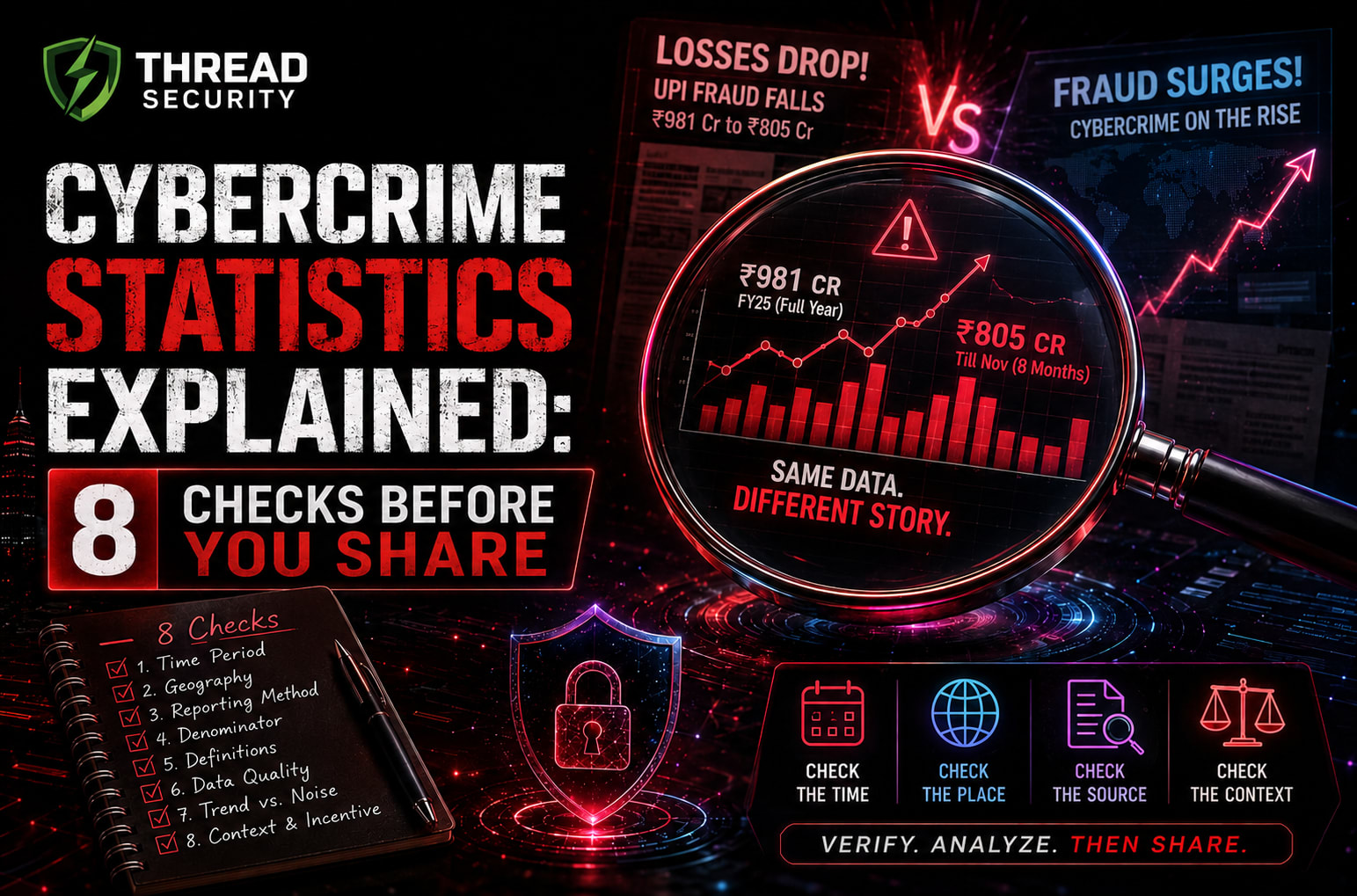
Suppose two headlines concerning the same year UPI fraud. One states that its losses dropped from ₹981 crore to ₹805 crore. The other says fraud is surging. Both can be constructed on the same official data and both can be misleading. The first one is a comparison of a full year of financial activity against a partial year. The second does not account for the increase in usage of UPI.
This is the essence of being able to explain cybercrime statistics correctly – the number is only useful when you have the answer to the question: “what did it count, over what time, where, and how?” The numbers of cybercrime can be particularly misunderstood, as much of the crime goes unreported, definitions of the crime vary from agency to agency, and the numbers that come out of loudest organizations tend to be those that are looking for a sale. Take a look at the following eight checks to perform in a minute on any headline, a worked example, and a checklist to keep.
In the World of Computer Crime, Statistics can be Difficult to Read.
The vast majority of crime statistics are flawed. There are three reasons why cybercrime is worse. Victims may not come forward as they feel embarrassed, not know where to turn or they think nothing can be done. Crimes are not limited to one category or one border; one type of scam may be included in both fraud and cybercrime. Figures are sourced from a wide range of sources and are measuring different things, such as police records, government portals and company surveys.
There can be extensive underreporting. The statistics regulator says in its report on fraud statistics that the Office for National Statistics estimated that there is a 14.3% proportion of successful frauds reported to Action Fraud or police in 2023/24, equating to one in seven, and a 15.7% proportion of successful computer misuse offences. It's the UK data, not India's, but it's a good example of how the number of cases reported can be very low compared to what is true.
The 8 Checks
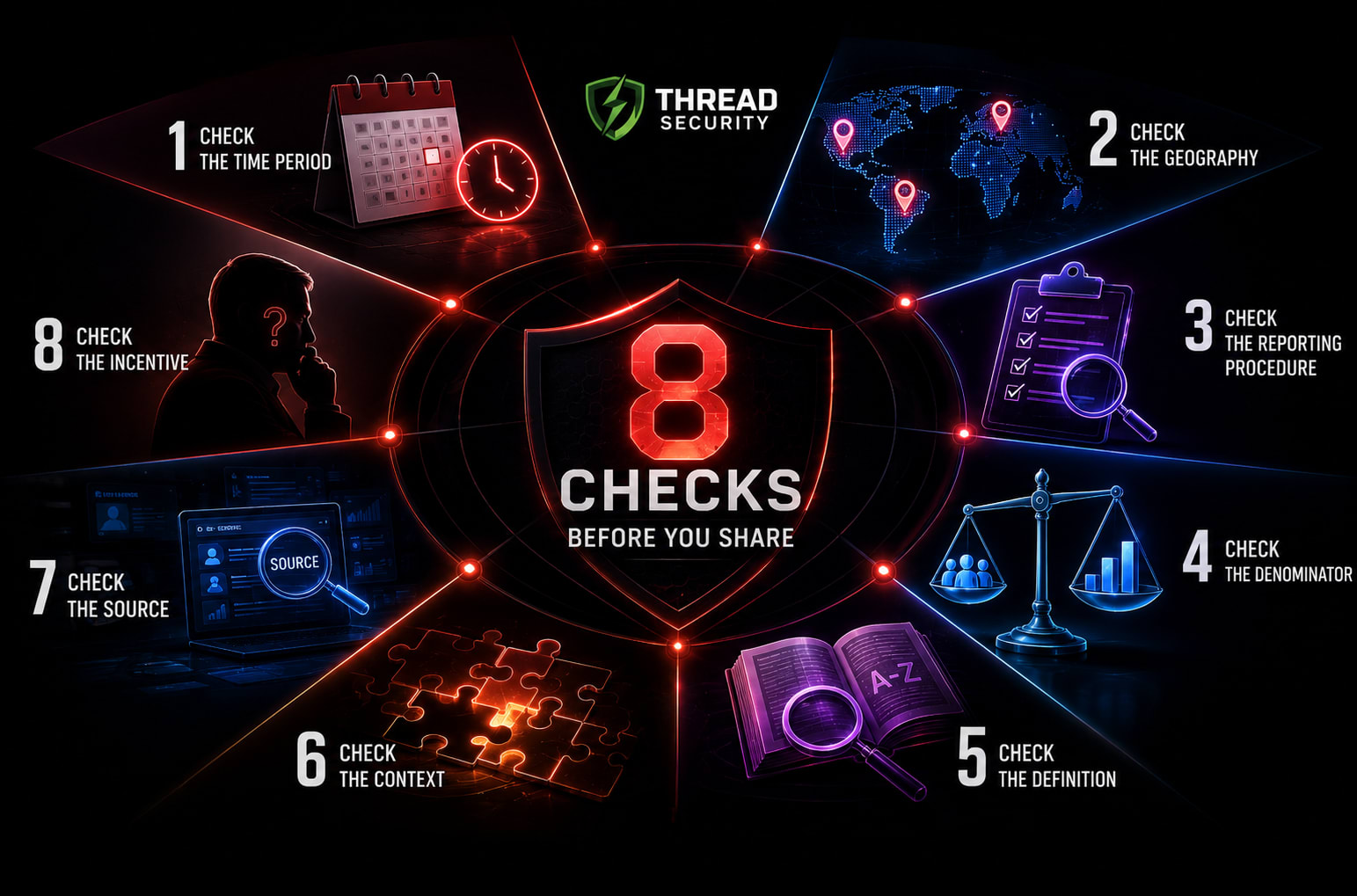
1. Find Out how many minutes, hours, or days have passed
Please give exactly what period the number refers to. The financial year (April to March), a calendar year, a rolling 12 months and a partial year are not synonymous. UPI-related frauds had 12.64 lakh incidents for a sum of ₹981 crore in FY25 and 10.64 lakh incidents for a sum of ₹805 crore till November this year, the Finance Ministry told Parliament today. The way you're doing it, it would be comparing twelve months against eight, "fraud fell". Keep an eye on the starting point: If you are starting from a really low base, your gain can look dramatic; if you are coming down from a peak, it looks like you are making progress.
2. Check the Geography
A statistic is a measure that is attributed to a place. Indeed, the FBI's 2025 Internet Crime Report claimed approximately $20.9 billion in losses, representing a 26 percent increase from 2024 in dollars and in this instance within the United States. According to data from the I4C, in 2025, there were approximately ₹19,813 crore in losses and 2,177,524 cheating related complaints in India, using another reporting system. A third scope is added to global surveys. These should NOT be compared head-to-head, and watch for the headlines getting mixed.
3. Review the Reporting Procedure
Question the number and method of counting. You can't equate a police-recorded case with a complaint filed on a government site with the bank's internal record, or a survey response. The figures from the FBI are based on complaints reported to the FBI's reporting centre. Global Anti-Scam Alliance and McAfee numbers are based on self-reported experience. So the main difficulty in reporting was the uncertainty about where to report, as reported counts are dependent not only on crime levels, but also on the ease with which it can be reported, according to GASA's global survey.
4. Check the Denominator
A raw count without a base can mislead. Digital payments continue to increase and even more fraud may be a declining rate. In response, the Finance Ministry stated that the UPI has facilitated 20.47 billion transactions just in November 2025, whereas the incidents mentioned here were in lakhs over 8 months. If payments were doubled and the amount of fraud increased by 20 percent, the fraud rate dropped approximately 40 percent – here's a hypothetical example using fictional numbers. Before agreeing to "surge" request a rate, whether it's on a per million transaction basis or per 1,000 user basis.
5. Ensure that there are no Duplicates and that it is a Unit of Counting.
A “case” could be a complaint, a case, a victim, a police FIR or a transaction. A victim can make multiple complaints and one scam can be a lot of transactions. Even if two agencies are telling the truth, the numbers and counts will not correspond if they count different units. This is why there are sometimes discrepancies in totals for the same year from different outlets. Search for a definition of the unit, and be wary of a number without one.
6. Identify if figures are reported cases or estimates of prevalence
This is the most crucial check. An authority is someone who has been in contact with a victim or an institution or some other party who reports the case. Estimated prevalence: An estimate that a statistician makes, typically based on a survey, about how much happens in the entire population. They respond to a different set of questions and the number of reported cases is a minimum, not a maximum.
The gap is shown in the UK. Fraud and computer misuse were estimated in the Crime Survey for England and Wales to have risen to 3.8 million and 2.0 million respectively, but all offences have been recorded by police to be 4.5 million. The ONS says that a survey can be used to give an indication of crimes that have not been reported to the police. The other side of the coin: Increases in reported cases may not be increases in crime. There is a caveat when it comes to the number of victims recorded, as the statistics regulator explains, because of modifications in the way victims are seen and reported by police. There are restrictions associated with the survey as well: sample size, who responded and memory.
7. Check the definition and scope
What is considered cybercrime? Does it contain online fraud, hacking, harassment, or all of the above? A claim that the overall number of crime was halved since 2010 was checked by the UK Fact Check and was reported to be "based on survey data which excludes fraud and computer misuse, which the survey estimated make up about 4.4 million of 9 million offences in 2022. The statement was true to the extent that it measured, and false as a blanket statement about crime. There are also differences in terms of words like saved, recovered, blocked and lost. As of 31 December 2025, the CFCFRMS, a part of I4C, has saved ₹8,189 crore on 23.61 lakh complaints, I4C reported. Have to ask if “saved” means “blocked” or “held” or “returned” to victims as the headline won't say.
8. Determine the source, the sample and the average.
Who is the author, and what is the author's motive? Research done by vendors may be sound research but it carries a business motive, so check for some of the elements of research: methodology, number of samples, and date. Watch averages too. According to the IBM study on Data Breaches for India, the average cost of a data breach is ₹25.5 crore in the country. That's a mean from organizations that were breached, and a few very expensive incidents drag up a mean. If a median is provided, it provides more information about a typical case. Lastly, pay attention to "up 26 percent" claims: ask "26 percent of what?
A Worked Example: Reading a Headline in 60 Seconds.
If a newspaper publishes the headline: "UPI fraud losses decrease 18 percent," what does it imply? What does the headline "UPI fraud losses decrease 18 percent" mean? Run the checks.
Time: The drop is from ₹981 crore (full FY25) to ₹805 crore (FY26, till November eight months). That's not a like-for-like.
The rate of change: ₹805 crore in eight months works out to approximately ₹100 crore per month. My simple annualization suggests a total of about ₹1,200 crore for a complete year, which is more than what was observed in FY25 but again does not constitute a forecast, because it does not consider the seasonality.
Incidents: 10.64 lakh in eight months have also been higher than the monthly average of 12.64 lakh incidents during FY25.
Denominator: Transaction volume increased, review rate per transaction.
Reporting: Changes to reporting awareness will move these ones, as these are reported incidents.
The verdict is not in any way wrong, but not backed by numbers mentioned in it. A reasonable version would read, "Reported losses thus far this year are less than last year's total, but the year is not over yet.
Your Quick Checklist
Before using or quoting a statistic about cyber crime, ask:
What time frame does it span and is the comparison “like for like”?
Which country (or region), which currency?
Who counted it - police, a portal, a bank or a survey?
So, how many more, at what rate, than what?
What is the denominator? (complaints, incidents, victims, transactions?
Is it reported cases or an estimate of prevalence?
What is meant by the terms, what is not included?
So, who has published it, how large was the sample and is it a mean or a median?
If the headline does not answer these, look for the original report, that is only a click away. Use primary sources: Parliament replies and PIB releases, FBI IC3 annual report, and the report pages of the ONS and IBM.
For Organizations: Honestly Assess Your Own Risk
The same approach is used within a company. A dashboard which includes "incidents" without a definition and/or compares quarters of different lengths results in poor decision making. A test provides evidence that isn't based on the public's headlines. As per their description, Thread Security is a certified pen testing company and an offensive security firm that offers services such as VAPT, web application penetration testing and cloud security reviews, as well as smart contract auditing. It also revealed that offensive security testing was the number one cost-reduction factor, saving approximately ₹2.47 crore per breach (on an average basis and sample).
Jalandhar Cyber Security Courses: How to work with the Data?
Security analysts have a lot of time to spend reading logs, counting events and determining if the number is meaningful or not. For cyber security courses in Jalandhar, Thread Security Education provides offline classes and live online batches. According to its website, they include a Cyber Security Course (CEH and industrial training), Defensive Cyber Security with Blue Team and SOC operations, Web Penetration Testing and Bug Bounty Hunting, and Foundational AI, which starts from Python and data analysis.
Contact: Thread Security Pvt Ltd 3rd Floor, Vasal Mall, Opposite Hotel President, Police Line, Jalandhar, Punjab 144001. Phone: +91 7347398956. Open: Monday-Saturday 9AM-7PM.
Frequently Asked Questions
Why are there so many variations in the cybercrime figures? They record different time periods, locations, units and definitions, and employ various techniques, including complaints, police reports or surveys. Differences are normal. The warning sign is that there are unexplained differences.
Is it possible to trust cybercrime figures? They are useful but incomplete. The reported crime figures underestimate actual levels of crime and survey estimates involve sampling error. Use them to guide and compare like with like.
What is the difference between the number of reported cases and the estimated prevalence? The numbers of cases reported are what authorities were told. Estimated prevalence is a statistical estimate that includes incidents that did not get reported, and also how much it occurs.
What are the trusted cybercrime data for India? Use official sources like responses to Parliament by the Finance Ministry/Home Ministry, PIB releases, I4C and NC RPN data. Next read the definitions of each figure.
Key Takeaways
Only after you know the period, place, method, unit and definition of a cybercrime number does it mean anything.
Reported cases are a bottom line and an increase in the number of cases reported may not necessarily mean that more crime is being committed.
Request rates not just counts and medians not just averages.
Use primary sources and not vendor surveys as a census.
Call to Action
Before you post your next cybercrime news story, follow the eight questions checklist, and pass it to another data writer or presenter. To find out more about penetration testing and VAPT check threadsecurity.org. To build analyst skills in Jalandhar, see Thread Security Education.
Simranjit Kaur
VERIFIEDAI Trainer · Thread Security
Faculty mentor & research guide at Thread Security Education.