Imagine a recruiter. Let's call her Meera. It's late, her chai has gone cold, and she has 80 applications open. Yours says "Certified in 7 AI courses" and links to a GitHub profile with fifteen repositories.
She clicks one. The README says "Machine learning project." That's it. No problem, no data, no result. She closes the tab.
Not because you're bad. Because she can't tell what you can actually do.
That's the challenge with AI portfolio projects: having projects isn't enough if recruiters cannot evaluate your work. You need to make your skills, methodology, and results easy to understand. Here's how to do it with just three projects and a README that does the talking.
Why a pile of certificates doesn't do the job
Certificates aren't useless. They show you finished something. But they answer "did you sit through a course?" and a hiring team wants to know "can you work on a real problem?"
Look at what junior roles actually ask for. A UK listing for a junior machine learning engineer, posted in June 2026, asks for Python and PyTorch, plus "demonstrable" university, research or personal projects. Its duties include evaluating and testing models. A HP junior ML listing I read expects experience with Git and continuous integration on GitHub. Another asks for solid knowledge of data modelling and evaluation.
Read that again. Projects. Evaluation. GitHub. Those are things a portfolio can show and a certificate can't.
One more honest point. Several hiring guides I read say reviewers see the same starter projects constantly, like the Titanic survival model or a basic sentiment notebook, so they rarely help you stand out. That's a guide's opinion, not a law. But it matches common sense: if everyone's project looks the same, nobody's looks special.
What "evaluable" means
A project is evaluable when a stranger can answer five questions in a few minutes:
What problem did you try to solve, and for whom?
What data did you use, and where did it come from?
What did "dumb but reasonable" achieve? (That's your baseline.)
How much better is your solution, and how did you measure it?
Where does it fail?
If your README answers those, you're ahead of most people. Let's make each answer concrete.
The anatomy of a README that works
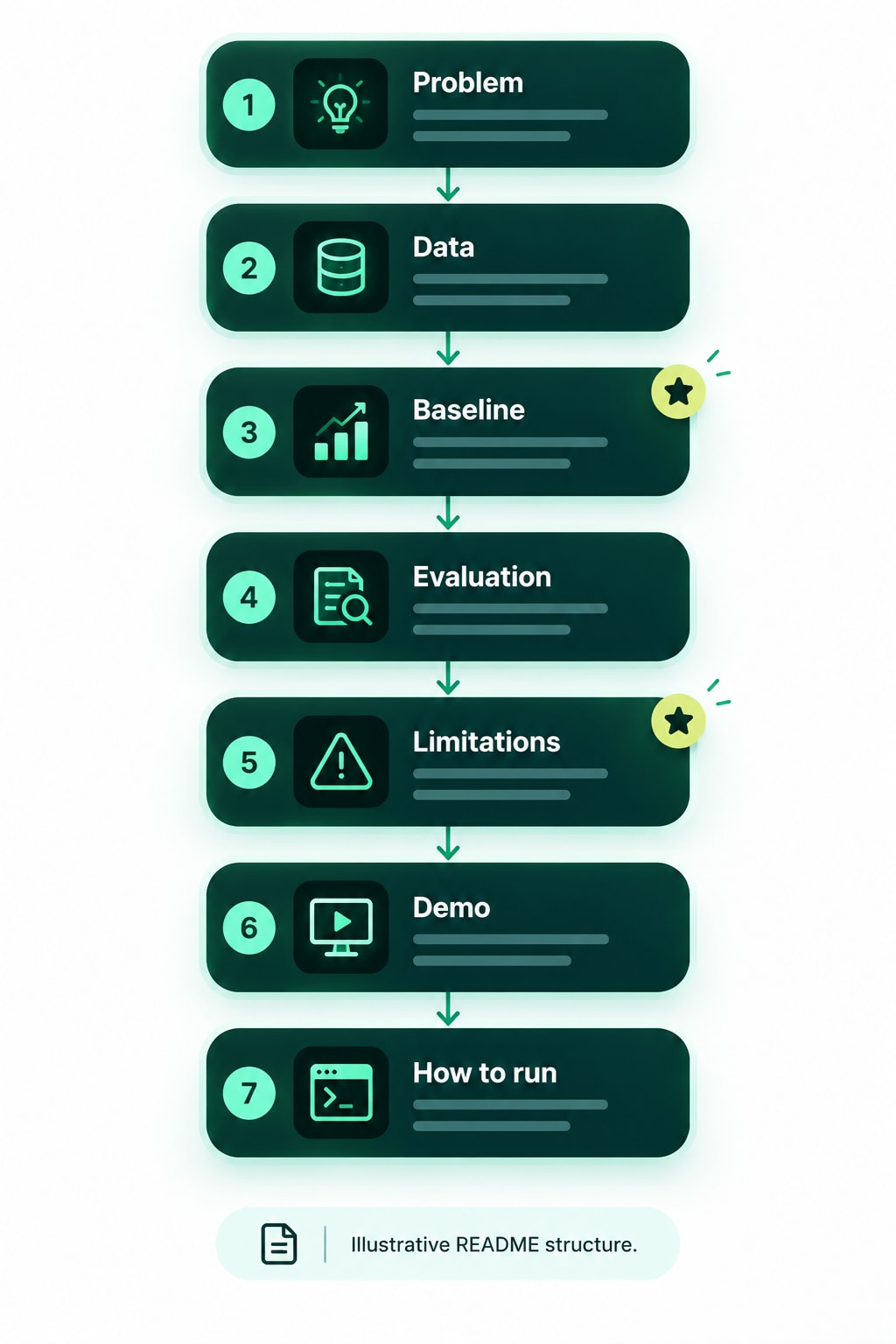
GitHub shows your README on the repository's front page, and it'll pick one up from the root, the .github folder or docs. Treat it like the first page of a short report. Here's the order that works, in plain words:
Problem. Two or three sentences. Who has this problem and why does it matter? Skip the buzzwords.
Data. Where it came from, the licence, how many rows, and anything messy about it. Hugging Face's guidance on dataset and model cards pushes the same habit: say where the data came from and what its limits are. Never use data you aren't allowed to use, and never upload anyone's personal information.
Baseline. The simplest thing that could work. For classification, scikit-learn even ships a dummy model for this exact purpose; its own description calls it a simple baseline to compare more complex models against. A classic baseline is "always predict the most common answer". If your fancy model barely beats that, you've learned something important, and saying so makes you look honest, not weak.
Evaluation. Which metric, on which data split, and why that metric. Compare your model and the baseline on the same folds so the comparison is fair. Show one honest number, not ten flattering ones.
Limitations. The most underrated section. Where does the model fail? What data is missing? What shouldn't anyone use it for? Hugging Face's model card guidance puts "intended uses and limitations" near the top for a reason.
Demo. A short screen recording, a hosted app or a notebook someone can run in a few clicks. A reviewer who can see it work believes it more.
How to run it. Exact commands, a requirements file and a fixed random seed so results can be reproduced.
Put your best line, the result, in the first screen. Something like: "Beats the baseline by 9 points on F1, but struggles on short messages." Specific beats shiny.
Three projects, three different strengths
Three finished projects beat fifteen half-done ones. One guide I read says the same thing, and the advice is blunt: skip unfinished projects. Pick three that show different muscles.
Project 1: A boringly honest prediction model
Problem: Pick something with real stakes that's small enough to finish, such as predicting whether a delivery will be late, or whether a customer will cancel, using an open dataset.
What it proves: You can clean data, set a baseline, evaluate properly and explain results in plain language.
The move that impresses: Show the dummy baseline first. Then show your model. Then show five examples it got wrong, with your guess as to why.
Project 2: A small language-model app with its own test set
Problem: A question-answering helper over a document you're allowed to use, like a public college handbook or open documentation.
What it proves: You can work with modern tooling and, crucially, you can judge it. Write 30 realistic questions with correct answers before you build. Then measure how often the app gets them right and note when it makes things up.
The move that impresses: An evaluation file in the repo that anyone can rerun. A lot of people can build a chatbot. Few can show it works.
Project 3: An AI project with a security angle
Problem: Something like a phishing-message classifier trained on a public dataset, or a script that flags unusual login patterns in sample logs.
What it proves: You think about misuse and failure, which is the heart of threat security. Add a short "how could someone fool this?" section. Maybe an attacker rewrites a message to dodge your keywords, or a bad input flips your model's guess.
The move that impresses: An honest limitations section that names real weaknesses. Security teams love people who find their own holes first.

A realistic way to build all three
You don't need a month off. A pace that works for a lot of students and working learners:
Weekend 1: Choose Project 1, find the data, write the problem and baseline
Weekend 2: Model, evaluation, limitations, README
Weekend 3: Start Project 2 and write the test questions first
Weekend 4: Build, measure, record a demo
Weekend 5: Project 3, start with the "how could this fail?" list
Weekend 6: Finish, tidy all three READMEs, ask a friend to read them cold
The friend test is the best review you can get. If they can't say what your project does after a quick skim, rewrite the top.
Things that quietly hurt
Notebook-only repos with no explanation. The code might be great, but nobody will read it.
One giant accuracy number. Accuracy can look great on lopsided data. Say what the baseline got.
Hidden failures. If everything in your README is rosy, a reviewer assumes you didn't look.
Copied tutorials with a new title. Fine for learning, risky for a portfolio. If you start from a tutorial, say so and show what you changed.
Secrets in the repo. Check for API keys and passwords before you push. This is basic security hygiene, and an easy way to lose trust.
Make the front door tidy
Create a short profile README that introduces you in three lines and pins your three projects. Give each project a clear name, a one-line description and a result in the repo summary. A recruiter shouldn't have to dig.
If you want mentor feedback and a structured path, look for a programme where you ship projects and get your READMEs reviewed. Whether you're comparing AI courses in Jalandhar or learning online, ask whether you'll finish with portfolio work you can show, not just a certificate. At Thread Security, we think of that as the difference between knowing about AI and being trusted with it.
The takeaway
Recruiters don't need more evidence that you've studied. They need a way to evaluate what you can do.
So build three AI portfolio projects. Give each a problem, data, a baseline, an honest evaluation, a limitations section, a demo and a README a stranger can follow. Fewer projects, clearer proof.
Ready to build projects that stand up to scrutiny? Explore Thread Security's programmes.
Explore AI courses in Jalandhar: https://www.threadsecurity.in/courses
Visit Thread Security: Vasal Mall, 3rd Floor, Jalandhar
Akshay Kumar
VERIFIEDAcademic Coordinator · Thread Security
Faculty mentor & research guide at Thread Security Education.