AI security engineer roles are becoming increasingly relevant as organizations integrate large language models (LLMs), AI assistants, retrieval-augmented generation (RAG) systems and autonomous agents into their products and internal workflows. These applications introduce security questions that traditional application testing alone may not fully address. Can a chatbot be manipulated by malicious instructions? Can it expose sensitive information retrieved from internal documents? Can an AI agent misuse a connected tool? Can untrusted input influence an action that should require human approval?
An AI security engineer helps identify, test and reduce these risks. The role combines application security, machine learning fundamentals, adversarial testing, identity and access controls, and secure deployment practices. It is not simply about learning to write prompts or running an AI model. It is about understanding how an AI-enabled system works, where it can fail, how an attacker might exploit those failures, and how to verify that the protections actually work.
This roadmap explains the core skills, relevant security frameworks, practical labs and portfolio evidence that can help learners prepare for work in LLM and AI application security.
1. What Does an AI Security Engineer Actually Do?
An AI security engineer assesses the security of systems that incorporate AI models. Depending on the organization, the work may involve reviewing an AI product before release, testing a customer-support chatbot, evaluating an internal RAG assistant, assessing an AI agent's tool permissions, or helping development teams implement appropriate security controls.
The job often sits between application security, product security, machine learning engineering and security testing. Responsibilities can include:
Threat modelling: identifying assets, trust boundaries, attackers, entry points and potential abuse cases in an AI application.
LLM security testing: examining whether user input or retrieved content can manipulate model behaviour or cause unsafe output.
AI red teaming: deliberately testing a system with adversarial inputs to uncover weaknesses before attackers exploit them.
Application security: checking authentication, authorization, API security, input handling, secrets management and data access.
Defense design: helping implement guardrails, permission boundaries, output validation, monitoring and human approval where needed.
Security reporting: documenting reproducible findings, their impact, evidence, limitations and recommended fixes.
The exact job title varies. Related roles may include AI security engineer, LLM security engineer, product security engineer for AI, AI red teamer, application security engineer or security researcher focused on AI systems. Employers may expect different levels of programming, infrastructure and security experience, so learners should compare job descriptions rather than assume every role has the same requirements.
2. Build the Foundations Before Specializing
Effective AI security testing depends on understanding the application surrounding the model. A learner who knows prompt injection but cannot recognize a broken access-control flaw may overlook one of the most important risks in a real deployment.
Python and basic machine learning
Start with Python, HTTP requests, JSON, API calls, exception handling and basic testing. You should be able to inspect a request, modify an input, call an API, record a response and reproduce a result. Learn how to use virtual environments and manage configuration without placing secrets directly in source code.
Next, learn the machine learning concepts needed to reason about model behaviour: training versus inference, datasets, embeddings, tokens, model inputs and outputs, evaluation, classification and the limitations of generative models. You do not need to train a large language model from scratch to begin studying LLM security.
Web and application security
Understand HTTP, REST APIs, cookies, sessions, authentication, authorization, database access, file uploads, server-side request forgery, injection flaws and sensitive-data exposure. Learn the difference between proving that a user is authenticated and verifying that the user is authorized to access a particular record.
Practice reading application logs and API responses. Learn to distinguish a genuine security vulnerability from an unexpected response that has no meaningful security impact. These fundamentals help you determine whether an AI-related weakness can actually expose data, bypass a control or trigger an unauthorized action.
Cloud, containers and deployment basics
Learn environment variables, secret storage, container basics, API gateways, network boundaries, role-based access control and logging. AI systems often depend on external services, vector databases, document stores, model endpoints and tools. Security must cover those dependencies as well as the model itself.
3. Understand OWASP Top 10 for LLM Applications
The OWASP Top 10 for LLM Applications is a useful starting point for organizing LLM security learning. It describes recurring risk areas in applications built around large language models. Consult the current official OWASP project because categories, terminology and guidance can evolve between versions.
Important areas to understand include:
Prompt injection: malicious or manipulative instructions in user input or external content may influence the model in unintended ways.
Sensitive information disclosure: a system may reveal confidential information through its responses, retrieval pipeline, logs or connected tools.
Improper output handling: an application may trust model-generated content without appropriate validation or safe handling.
Excessive agency: an AI agent may have more tool access or authority than its task requires.
System prompt leakage: an application may expose internal instructions, although disclosure of a prompt is not automatically equivalent to access to a secret or a security breach.
Vector and embedding weaknesses: retrieval systems may expose or use content in unexpected ways if access controls and data boundaries are poorly designed.
Unbounded consumption: poorly controlled usage can create unexpected costs, resource exhaustion or service disruption.
Do not learn these categories as definitions alone. For each one, identify the affected asset, the possible attacker action, the conditions required for exploitation, the likely impact and the control that could reduce the risk.
Practical exercise: choose a chatbot that you own or are explicitly authorized to test. Map its input, model, retrieval source, connected tools and output handling. Select three relevant OWASP risk areas and create one controlled test for each. Record what happened, what the result demonstrates and what it does not demonstrate.
4. Learn Prompt Injection and LLM Red Teaming
Prompt injection is one of the best-known LLM security problems because natural-language instructions and untrusted content can influence how an AI application behaves. Unlike a traditional SQL injection flaw, prompt injection is not necessarily solved by escaping a special character or filtering a fixed string. The risk depends on how the application combines instructions, data, tools and permissions.
Direct and indirect prompt injection
Direct prompt injection occurs when a user submits input designed to override or manipulate the application's intended behaviour. Indirect prompt injection involves instructions embedded in content that the system processes, such as a retrieved document, web page, email or uploaded file.
For example, imagine a company assistant that retrieves answers from an internal knowledge base. A document could contain instructions attempting to persuade the model to ignore its normal task or reveal information. The important security question is not merely whether the model follows the text. It is whether the overall application allows that influence to cross a security boundary, expose data or initiate an unauthorized action.
What AI red teaming involves
AI red teaming is a structured process for challenging a system's safety and security assumptions. A useful test plan defines the target, scope, allowed techniques, expected behaviour, success criteria and stop conditions before testing begins.
Depending on the system and authorization, test categories can include:
Instruction-conflict and direct prompt-injection tests.
Indirect injection through approved test documents or other controlled content.
Attempts to retrieve data belonging to another user or role.
Testing whether tool calls respect permissions and task boundaries.
Output-handling tests using harmless, controlled test strings.
Repeated tests to check whether a fix works across different phrasings and contexts.
Keep testing within an explicitly authorized environment. Do not probe production systems, access private data, bypass another organization's controls or run disruptive tests without permission.
Also remember that a single successful or unsuccessful prompt is not enough to judge an entire AI application. Model behaviour can vary, and a model's refusal is not proof that the application is secure. Strong testing combines multiple cases with checks of application permissions, data access and tool execution.
5. Use MITRE ATLAS to Structure AI Threat Analysis
MITRE ATLAS is a knowledge base focused on adversary tactics and techniques involving AI-enabled systems. It complements general cybersecurity knowledge by helping security teams reason about how AI systems may be attacked and how adversary behaviour can be described systematically.
Use ATLAS to investigate relevant threat scenarios, understand the techniques an attacker may attempt and improve your threat model. For example, when assessing an AI-enabled application, you could document how untrusted content might influence a model, how an attacker might seek sensitive information, or how an exposed integration could increase the consequences of a successful attack.
OWASP and MITRE ATLAS serve related but different purposes. OWASP's LLM guidance is useful for organizing application risks and considering mitigations. ATLAS helps structure adversarial threat analysis and techniques. Neither framework replaces testing of the specific system you are assessing.
Practical exercise: write a one-page threat model for a RAG chatbot. Identify its data sources, users, trust boundaries, model endpoint and tools. Describe three plausible attack scenarios, map them to relevant framework guidance where appropriate, and list controls that could prevent or limit each scenario.
6. Guardrails, Least Privilege and Secure Deployment
Finding a weakness is only part of the job. An AI security engineer also needs to help teams reduce risk through appropriate design and deployment controls.
Use layered controls rather than relying on prompts
System instructions and model-level guardrails can help guide expected behaviour, but they should not be the only security boundary. A robust design places critical checks in the application and infrastructure layers, where access and actions can be enforced independently of the model's generated response.
Least privilege: give the model or agent only the tools, permissions and data access necessary for its task.
Server-side authorization: verify user and resource permissions in the application, not only in the model's instructions.
Input and output validation: validate structured data and safely handle generated content before using it in downstream operations.
Retrieval access controls: apply user permissions when searching documents and returning retrieved content.
Human approval: require appropriate confirmation for high-impact actions, such as sensitive account changes or external transactions.
Secrets management: keep API keys and credentials outside prompts, public repositories and unnecessary logs.
Monitoring and audit trails: record relevant security events while protecting sensitive information in logs.
Abuse and cost controls: apply sensible rate limits, quotas and resource limits to reduce misuse.
Before release, test the application under realistic conditions. Confirm that the correct users can access the correct information, tool permissions are enforced, failures are handled safely, logs do not expose unnecessary sensitive data and the team has a process for investigating reported vulnerabilities.
Secure deployment also includes dependency management, environment separation, patching, configuration review and incident response. The model is only one component in a larger system, so a security review should cover the entire application lifecycle.
7. Build Practical Labs for Your AI Security Portfolio
For learners entering this field, practical evidence is more valuable than a list of unfamiliar tools. You can begin with a small, deliberately vulnerable demonstration application or a chatbot that you build yourself. Use synthetic data, test accounts and harmless sample documents so that your experiments do not expose real information.
Lab 1: Direct prompt-injection evaluation
Build or select an authorized demo chatbot with a clearly defined system instruction. Create a small set of benign test prompts that challenge its expected behaviour. Record the intended behaviour, actual response and whether any security boundary was crossed. Separate ordinary instruction-following differences from demonstrable security issues.
Lab 2: RAG document-boundary testing
Create a small knowledge base with synthetic documents assigned to different test users or roles. Test whether the retrieval layer respects those access boundaries. Include controlled documents containing untrusted instructions and observe how the application handles them. The goal is to verify data isolation and safe retrieval, not simply to make the model produce an unusual response.
Lab 3: AI agent tool-permission review
Use a local demo agent with harmless tools, such as searching a sample knowledge base or returning mock records. Check whether each tool is restricted to the actions and data it needs. Test invalid inputs, missing permissions and attempts to trigger actions that should require approval.
Lab 4: Re-test after mitigation
Implement a control, such as server-side authorization, restricted tool access or improved retrieval filtering. Run the original tests again and document the results. Include unsuccessful cases as well as successful ones, and state the limits of the evaluation.
8. Portfolio Project: AI Chatbot Security Assessment Report
A strong beginner portfolio project is a security assessment of a sample chatbot. It demonstrates that you can move from a theoretical framework to a repeatable testing process and communicate findings to a development team.
Your report should contain:
Executive summary: describe the application, the assessment purpose and the most important findings.
Scope and methodology: identify the test environment, authorized targets, tools, test categories and limitations.
System architecture: show the user interface, application API, model, retrieval store and any connected tools.
Threat model: identify important assets, trust boundaries and plausible attack scenarios.
Test cases: include a test ID, objective, controlled input, expected behaviour, observed result and pass/fail status.
Evidence: add redacted screenshots, logs or response snippets that demonstrate the result without exposing secrets.
Risk assessment: explain the realistic impact and the conditions needed to reproduce each finding.
Recommendations: suggest specific fixes and explain how each one addresses the identified risk.
Retesting: show which tests were repeated after the fix and whether the expected behaviour was restored.
Limitations: describe what was not tested and why the report should not be interpreted as a guarantee of security.
Publish the report with a simple architecture diagram, a sanitized test dataset and, if appropriate, code for the demo application. Keep the repository free of API keys, private documents and personal data. A clear, honest report with reproducible evidence is more convincing than unsupported claims that a chatbot is completely secure.
9. How to Follow the AI Security Engineer Roadmap
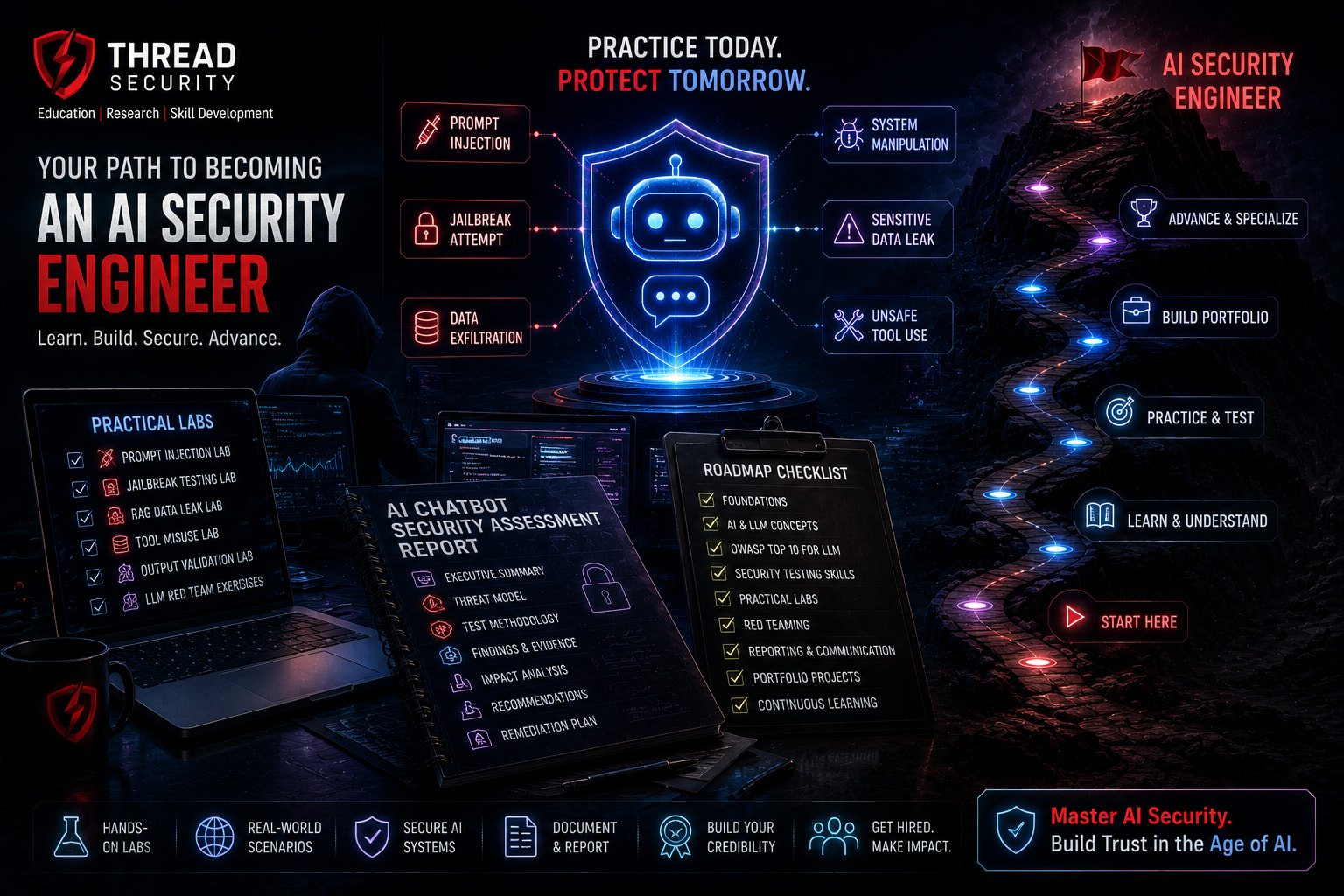
The following is an illustrative 12-week learning plan for someone who already has basic programming familiarity. Beginners may need additional time, particularly for web security, networking and Python. The schedule is a guide rather than a hiring guarantee.
Weeks | Learning focus | Practical outcome |
|---|---|---|
1–2 | Python, HTTP, APIs and basic ML concepts | A small API client that records and evaluates chatbot responses |
3–4 | Web security, authentication, authorization and common application vulnerabilities | A basic threat model and secure API checklist |
5–6 | LLM architecture, RAG, OWASP LLM risks and prompt injection | A documented set of controlled LLM security tests |
7–8 | AI red teaming, MITRE ATLAS and adversarial test planning | A structured threat model with mapped scenarios |
9–10 | Guardrails, least privilege, retrieval controls and secure tool use | A mitigated demo with repeatable regression tests |
11–12 | Reporting, remediation, retesting and portfolio development | A complete chatbot security assessment report and project repository |
Use primary documentation wherever possible. Start with the official OWASP GenAI Security Project, the MITRE ATLAS knowledge base and the OWASP Top 10 project. Supplement them with secure coding guidance, application security labs and documentation for the specific model or framework you use.
When choosing a role, read job descriptions carefully. Some positions focus on product and application security; others emphasize machine learning infrastructure, model evaluation, research or enterprise risk. Tailor your projects to the skills requested in the roles you want to pursue.
10. Why AI Security Matters to Security Teams
Organizations are introducing AI into customer support, software development, knowledge management, data analysis and internal operations. These systems can connect language models to private data, business APIs and actions that affect real users. As adoption expands, security teams need ways to assess those integrations and establish controls appropriate to their risk.
This does not mean every organization has an AI security engineer position open, or that every AI project requires a dedicated specialist. In some teams, application security engineers, product security teams, cloud security specialists and AI engineers share these responsibilities. In others, AI security may become a more distinct function as systems and risks grow more complex.
The practical opportunity is to combine existing security expertise with a working understanding of AI systems. Professionals who can explain the architecture, demonstrate a reproducible weakness, assess its real-world impact and validate a fix can contribute to safer AI adoption. That combination is a stronger professional foundation than relying on a single certification or a collection of tool names.
11. How Thread Security Connects to AI Security
AI application security sits at the intersection of secure software development, threat analysis and the protection of systems that use machine learning. For teams building or adopting AI-enabled applications, the key questions are practical: What data can the model access? Which tools can it call? How are permissions enforced? How is untrusted content handled? What evidence shows that the controls work?
Thread Security works in the broader cybersecurity and technology space, where secure development, threat awareness and disciplined security testing are relevant to the responsible adoption of AI. These areas connect directly to the skills explored in this roadmap: application security fundamentals, structured threat modelling, controlled testing, clear reporting and security-minded implementation.
For an organization assessing an AI-enabled workflow, a sensible starting point is to inventory the system's data sources and integrations, identify trust boundaries, review access permissions, define authorized tests and document the results. The depth of an assessment should depend on the application's architecture, data sensitivity, potential impact and applicable requirements.
AI security should not be reduced to testing whether a chatbot can be tricked into giving an unexpected answer. A useful assessment examines whether that behaviour creates a meaningful security impact and whether appropriate controls prevent it from becoming a real-world problem.
12. Learn Through Thread Security Education
Developing AI security skills requires more than reading about vulnerabilities. Learners need opportunities to write code, examine application behaviour, test controlled scenarios, interpret results and communicate findings clearly. A structured training pathway can help connect programming and AI concepts with the security practices used to assess real systems.
Thread Security Education focuses on technical learning and practical skill development across relevant technology and cybersecurity areas. Learners interested in AI security can use a foundation in Python, AI and machine learning as a starting point, then build toward application security, LLM risk assessment, prompt-injection testing, threat modelling and secure AI deployment.
When evaluating any training programme, look for hands-on assignments, guided labs, project reviews, clear learning outcomes and opportunities to build a portfolio. For this particular career direction, a useful outcome is a documented chatbot security assessment that shows your methodology, findings, remediation suggestions and retest evidence.
Those exploring AI training opportunities in Jalandhar can also review the relevant offerings from Thread Security Education and check the current course scope, schedule, prerequisites and practical components before enrolling. Course availability and coverage should be confirmed directly with the provider.
Frequently Asked Questions
1. What is an AI security engineer?
An AI security engineer helps identify and reduce security risks in applications that use AI models. The work can include threat modelling, LLM security testing, red teaming, application security reviews, access-control validation, secure deployment and remediation guidance.
2. Do I need machine learning expertise to start learning LLM security?
You need a working understanding of how models, tokens, prompts, embeddings and RAG systems operate, but you do not necessarily need to train large models. Python, web security, APIs and application architecture are important foundations.
3. What is prompt injection?
Prompt injection is an attempt to influence an AI system through instructions in user input or untrusted content processed by the system. Its security impact depends on the application's design, data access, tool permissions and other controls.
4. What is the difference between OWASP LLM guidance and MITRE ATLAS?
OWASP's LLM guidance helps organize common risks and mitigation considerations for LLM applications. MITRE ATLAS provides a knowledge base of adversary tactics and techniques relevant to AI-enabled systems. They can be used together during threat modelling and security assessments.
5. What tools should an aspiring AI security engineer learn?
Start with Python, HTTP/API testing, version control and basic application security tooling. Then learn how to inspect LLM requests and responses, test retrieval and tool boundaries, document findings and use relevant OWASP and MITRE resources. Choose additional tools based on the target system rather than collecting tools without a clear purpose.
6. Can beginners build an AI security portfolio?
Yes. A beginner can build a small chatbot or use an authorized demo environment, design controlled tests, document observed behaviour and recommend mitigations. A good portfolio explains the test conditions, evidence, impact, limitations and retest results without exposing real secrets or private data.
7. How long does it take to prepare for an AI security role?
It depends on your starting point, study time and target role. The 12-week roadmap in this article is an illustrative plan for someone with basic programming familiarity, not a guarantee of job readiness. Learners without web security or programming foundations may need considerably longer.
8. Are AI security engineer jobs guaranteed to grow?
No specific job title or growth rate is guaranteed. Demand depends on AI adoption, security budgets, regulation, business risk and how organizations divide responsibilities across existing teams. Building transferable application security skills alongside AI-specific knowledge helps prepare you for a wider range of relevant roles.
Key Takeaways
Start with the fundamentals: Python, APIs, web security, authentication, authorization and basic machine learning.
Study the right frameworks: use OWASP LLM guidance to understand common application risks and MITRE ATLAS to structure AI-focused threat analysis.
Practice prompt-injection testing: assess direct and indirect injection in authorized environments and examine the impact on the application, not just the model's response.
Design layered defenses: combine guardrails with server-side access control, least privilege, safe output handling, monitoring and human approval where appropriate.
Build a demonstrable portfolio: create a chatbot security report with reproducible test cases, evidence, recommendations and retesting results.
Keep learning from primary sources: security frameworks and AI systems evolve, so verify current guidance rather than relying on outdated checklists.
Develop transferable skills: application security, threat modelling and clear technical reporting remain valuable across many security roles.
Call to Action: Build Your AI Security Skills with Thread Security Education
Interested in moving from AI concepts to practical security work? Explore the relevant learning and training opportunities offered by Thread Security Education. Build your foundation in Python, AI and application security, then progress toward controlled LLM testing, prompt injection assessment, threat modelling and secure AI deployment.
If you are exploring AI courses in Jalandhar, review the available programmes, practical projects, course coverage and current schedules to find an option that matches your starting point and goals. Focus on learning to test responsibly, explain findings clearly and demonstrate how security controls work.
Take the next step: Connect with Thread Security Education to enquire about relevant AI and cybersecurity training opportunities and begin building practical skills for the evolving AI security landscape.
Simranjit Kaur
VERIFIEDAI Trainer · Thread Security
Faculty mentor & research guide at Thread Security Education.