
Introduction: Why AI Systems Need Security Testing
AI red teaming is a structured way to test artificial intelligence systems for weaknesses, unsafe behaviour and unintended outcomes before and after deployment. As organisations adopt chatbots, large language models (LLMs), AI assistants and automated decision-support tools, ordinary software testing alone may not reveal every risk.
An AI system can produce inaccurate answers, expose information it should protect, follow malicious instructions embedded in untrusted content or respond inappropriately to certain requests. These risks depend on the model, its training, the surrounding application, connected tools and the environment in which it operates.
AI red teaming helps teams investigate these possibilities under an agreed scope. The goal is not to make a model fail for entertainment or to bypass safeguards without permission. It is to discover meaningful weaknesses, collect reproducible evidence, assess potential impact and help the responsible team improve the system.
What Is AI Red Teaming?
AI red teaming is an adversarial evaluation process in which authorized testers deliberately examine an AI system from the perspective of someone attempting to misuse it or trigger an unsafe result. Findings are then assessed and communicated to the people responsible for the system.
Traditional security testing often focuses on infrastructure, application logic, authentication and data access. AI red teaming may examine those areas too, while also considering model-specific behaviour such as prompt injection, unsafe responses, hallucinations, sensitive information exposure and misuse of connected tools.
It is important to distinguish red teaming from routine quality assurance. Quality assurance checks whether expected behaviour works. Red teaming intentionally explores unusual, adversarial or high-risk situations to discover how the system behaves outside its normal path.
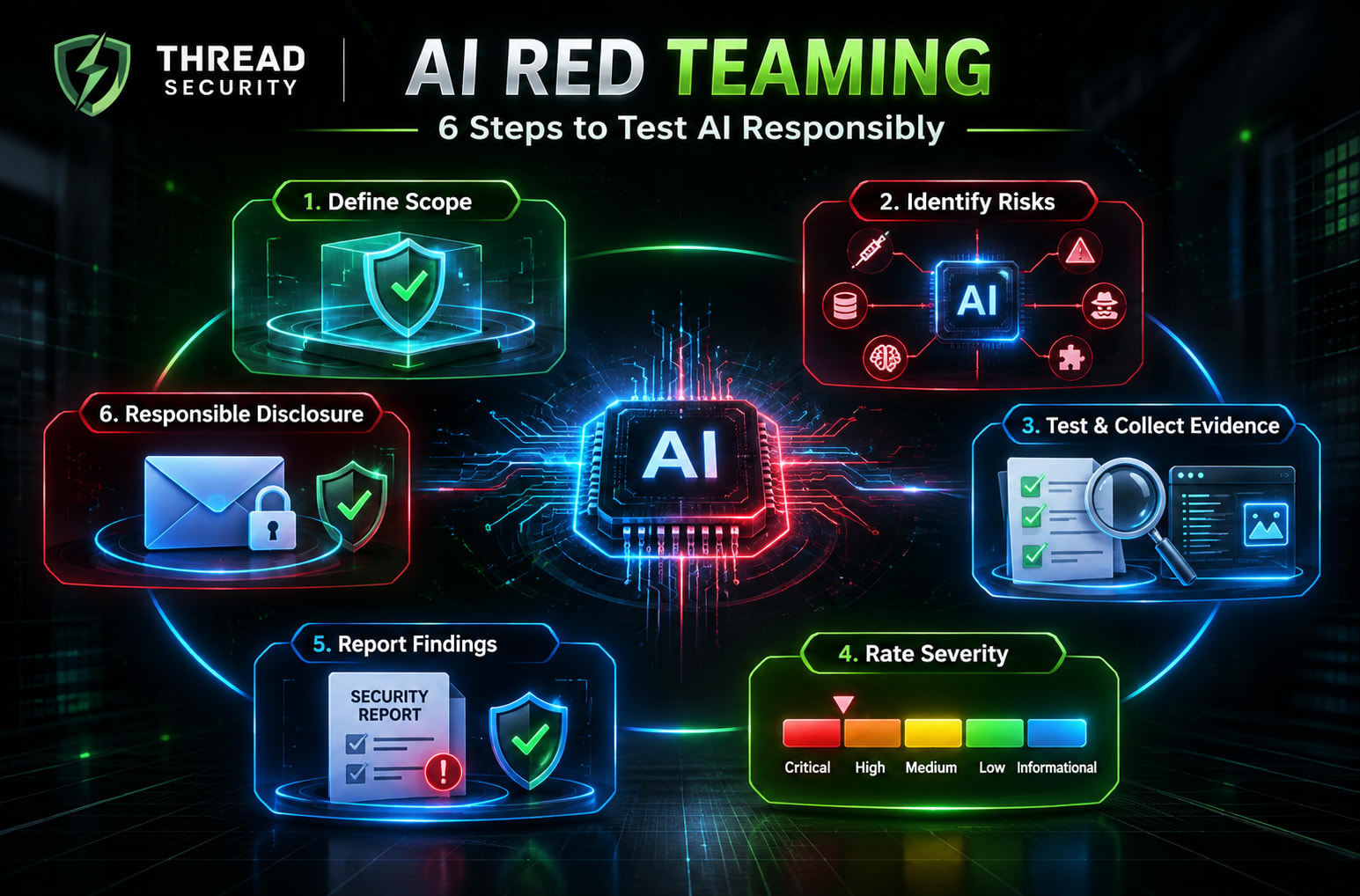
Step 1: Define the Scope Before Testing
Every responsible assessment begins with clear written authorization and a defined scope. A tester should know exactly which system they may examine, which techniques are permitted and how to report a problem.
Target: Identify the specific model, application, API, chatbot or test environment included in the assessment.
Permission: Confirm written authorization from the system owner or an approved testing programme.
Objectives: Define the risks being evaluated, such as data leakage, prompt injection or unsafe tool use.
Boundaries: Record prohibited actions, rate limits, restricted data and systems that must not be touched.
Test accounts and data: Prefer approved test accounts and synthetic data rather than real customer records.
Stop conditions: Establish when to stop, such as unexpected access to sensitive data, service instability or evidence of real-world harm.
Reporting route: Identify the designated contact, reporting channel and expected response process.
Do not assume that public availability means permission to test. A public chatbot, website or model endpoint is not automatically an authorized target. Never probe third-party systems outside the approved scope.
Step 2: Understand the Main AI Red Teaming Categories
1. Prompt Injection and Instruction Conflicts
Prompt injection occurs when untrusted input attempts to influence how an AI system follows instructions. For example, a document supplied to a summarization assistant might contain instructions that conflict with the application's intended task.
In an authorized test environment, assess whether the system reliably separates trusted instructions from untrusted content, follows its intended task and avoids disclosing restricted information. Record the test setup and observable outcome without accessing data beyond the approved test boundary.
2. Harmful or Unsafe Outputs
Test whether the system produces content that violates its defined safety requirements. Depending on the application's purpose, relevant categories may include dangerous guidance, targeted harassment, self-harm encouragement or other disallowed assistance.
Use controlled test cases and predefined expected behaviours. A single unexpected answer does not automatically establish a serious vulnerability; context, repeatability, safeguards and potential impact matter.
3. Sensitive Information Exposure
Evaluate whether the model reveals information it should not disclose, such as confidential test records, private prompts, secrets deliberately placed in a sandbox or personal information included in approved test data.
Use synthetic canary values and test datasets wherever possible. Do not try to obtain real users' private information or copy exposed secrets into reports unnecessarily.
4. Hallucination and Reliability Risks
AI models can produce confident but incorrect statements, invented references or unsupported claims. These failures can be particularly serious in systems used for education, finance, healthcare, legal information or business decisions.
Compare responses with trusted reference material, note uncertainty and check whether the application communicates limitations appropriately. Distinguish a factual error from a security vulnerability, while documenting both when they fall within the assessment scope.
5. Tool Use and Agent Permissions
AI agents may connect to search tools, databases, file systems, email systems or business applications. A model's ability to call a tool creates additional security considerations beyond the model's text response.
In an approved sandbox, verify that tool permissions follow least-privilege principles, sensitive actions require appropriate confirmation and untrusted instructions cannot independently authorize restricted operations. Do not execute destructive actions or send real messages during testing unless explicitly approved.
6. Retrieval-Augmented Generation (RAG) Risks
RAG systems retrieve documents and use them to generate answers. Their security depends on access controls, retrieval logic, document handling and how the model interprets retrieved content.
Test with approved documents and synthetic user roles to check whether users receive only the information they are permitted to access. Also examine whether malicious or misleading instructions embedded in a test document affect the system's behaviour.
7. Robustness, Bias and Misuse
Evaluate whether small changes in wording, context or input format cause inconsistent behaviour. Depending on the system's intended use, assess whether responses differ unfairly across relevant groups or whether safeguards fail under predictable variations.
Define the evaluation criteria before testing. Fairness findings should be supported by suitable comparison data and a clearly explained methodology rather than assumptions based on a few isolated outputs.
Step 3: Design Test Cases and Collect Evidence
A useful red-team test is repeatable, controlled and connected to a specific risk. Before running a test, write down what you are checking, what the expected safe behaviour looks like and what evidence would count as a failure.
A practical test-case record can include:
Test ID: A unique identifier, such as AI-RT-001.
Risk category: Prompt injection, data exposure, unsafe output or another defined category.
Objective: The security property being evaluated.
Environment: Model or application version, test account and relevant configuration.
Input: The exact test prompt or a redacted reference to it.
Expected behaviour: The safe response or control that should occur.
Observed behaviour: What the system actually did.
Reproducibility: Whether the result occurred again under comparable conditions.
Impact: The plausible consequence if the behaviour occurred in the intended deployment.
Evidence: Relevant timestamps, screenshots, request IDs and sanitized logs.
Evidence should be sufficient for another authorized reviewer to understand and reproduce the finding. Preserve relevant context, but redact credentials, personal information and unrelated confidential content. Store records only in approved locations with appropriate access restrictions and retention periods.
Step 4: Rate Severity Based on Risk
Not every unexpected output deserves the same priority. Severity rating helps teams decide which findings need immediate attention and which can be handled through planned improvements.
A practical rating model may use the following levels. Organisations should adapt the definitions to their own risk framework rather than treating these labels as a universal standard.
Severity | Typical interpretation | Example |
|---|---|---|
Critical | Potential for severe, direct impact across an important system or sensitive assets. | A reproducible failure in an approved test environment that enables a highly privileged action without required controls. |
High | Substantial impact on confidentiality, integrity, safety or important operations. | A confirmed access-control weakness that exposes restricted test records to an unauthorized test role. |
Medium | Meaningful but limited impact, or a weakness requiring additional conditions. | A prompt-injection weakness that changes a response but remains contained by downstream permissions. |
Low | Limited impact or a minor control weakness with narrow consequences. | An inconsistent refusal or warning message that does not bypass other safeguards. |
Informational | An observation or improvement opportunity without a demonstrated security impact. | A documentation gap or a non-reproducible behaviour that merits further monitoring. |
When assigning severity, consider likelihood, impact, exploitability, required privileges, affected users, exposure of sensitive assets and the strength of existing safeguards. Record uncertainty explicitly. Do not label a finding critical merely because the output looks alarming.
Step 5: Prepare a Clear Red Team Report
A useful report helps developers, security teams and product owners understand the issue and decide what to do next. It should be factual, reproducible and focused on remediation rather than dramatic claims.
Recommended Report Structure
Executive summary: Explain the overall risk in plain language.
Scope and authorization: State the approved target, testing period and limitations.
Methodology: Describe the categories, test environment and evaluation criteria.
Findings: Give each issue a unique ID, title, severity and concise description.
Evidence: Include sanitized inputs, outputs, timestamps, screenshots or relevant logs.
Impact analysis: Explain the plausible consequences and any assumptions.
Reproduction steps: Provide the minimum safe steps required to verify the issue.
Recommendations: Suggest practical mitigations and identify the relevant control owner.
Retest results: Record whether the fix worked and whether the issue remains reproducible.
A finding should separate observed facts from potential impact. For example, report that a test assistant disclosed a synthetic restricted marker under a defined condition, then explain what equivalent control failure could mean in production. Do not claim that real customer data was exposed unless the evidence actually supports that statement.
Step 6: Follow Responsible Disclosure
Finding a weakness is only part of the work. Responsible disclosure ensures that the right people receive enough information to address it without unnecessarily increasing risk.
Use the reporting channel specified by the organisation or authorized testing programme.
Share the minimum evidence needed to validate the issue.
Keep sensitive details private and avoid public exploit demonstrations before coordinated resolution.
Follow the programme's rules for acknowledgement, timelines and communication.
Do not demand payment, threaten publication or access unrelated systems to strengthen a report.
Retest only when permitted, and document the outcome of the remediation.
If no reporting channel is documented, seek guidance through an appropriate official security contact. Avoid further probing until you have clear permission. Disclosure expectations and legal requirements vary by programme and jurisdiction, so read the applicable rules carefully.
A Beginner-Friendly AI Red Teaming Exercise
You can practise the workflow without targeting a live third-party service. Create a small demonstration chatbot that uses synthetic documents and has no real credentials, customer data or external action tools.
Write a short scope document identifying the sandbox and prohibited actions.
Create a harmless reference document containing a synthetic marker such as TEST-ONLY-4821.
Prepare normal questions, misleading-context examples and benign instruction-conflict tests.
Define the expected safe behaviour for each case before testing.
Record the exact inputs, outputs, timestamps and model configuration.
Classify each result according to its demonstrated impact and repeatability.
Write a short report with evidence, limitations and a proposed mitigation.
Change the relevant safeguard and rerun the same test cases to check whether behaviour improves.
The exercise teaches a crucial lesson: a good red-team result is not simply a surprising response. It is a well-scoped, documented observation that can be evaluated and used to improve a system.
Common Mistakes Beginners Should Avoid
Testing without permission: Always confirm the target and scope before beginning.
Using real sensitive data unnecessarily: Prefer synthetic records and controlled environments.
Confusing odd behaviour with a confirmed vulnerability: Validate repeatability and demonstrate the relevant impact.
Keeping incomplete evidence: Record model versions, settings, inputs and expected behaviour.
Overrating severity: Base priority on realistic impact and supporting evidence.
Ignoring application controls: A model response alone may not represent what the complete application permits.
Publishing sensitive findings too early: Follow the agreed disclosure process and protect affected users.
Skills That Help You Get Started
Beginners can build relevant skills gradually. Start with Python, HTTP and API fundamentals, basic web application security, structured testing and clear technical writing. Next, learn how LLM prompts, retrieval systems, model evaluations and agent tool permissions work.
Practice documenting observations in a consistent format and explaining risk to both technical and non-technical audiences. Familiarity with threat modelling, access control, logging and secure software development is valuable because AI security often overlaps with conventional application security.
Build a portfolio around authorized sandbox exercises, transparent methodologies and responsible reporting. A concise report demonstrating a reproducible test, a sensible severity rating and a validated mitigation is more meaningful than a collection of unverified claims about breaking AI safeguards.
Learn AI and Cybersecurity with Thread Security Education
AI security is an evolving field at the intersection of artificial intelligence, software engineering and cybersecurity. Understanding how systems fail and how to evaluate those failures responsibly can help learners develop practical skills relevant to modern AI applications.
Thread Security Education focuses on practical, industry-oriented technical learning across AI and cybersecurity. Learners interested in AI, machine learning, application security and emerging security challenges can explore learning opportunities and build their knowledge through structured study and hands-on practice.
Explore Thread Security to learn more about its training and technical learning opportunities.
Final Takeaway
AI red teaming is a disciplined security process, not an unrestricted attempt to trick a chatbot. Define the scope, obtain permission, test meaningful risk categories, preserve sanitised evidence, assess severity consistently and report findings through the correct channel. Most importantly, verify that remediation works. These practices help teams build AI systems that are more reliable, secure and accountable.
Simranjit Kaur
VERIFIEDAI Trainer · Thread Security
Faculty mentor & research guide at Thread Security Education.