If you picture an AI career, you probably picture someone in a hoodie training a giant neural network. That picture is accurate for a small slice of the field. It is badly misleading for everyone else.
The truth behind today's AI career opportunities is that every model that reaches real users depends on a much larger crew: people who prepare data, test outputs, build applications, write the rules, and help customers actually use the technology. Many of these roles don't require a PhD, and some don't require advanced coding.
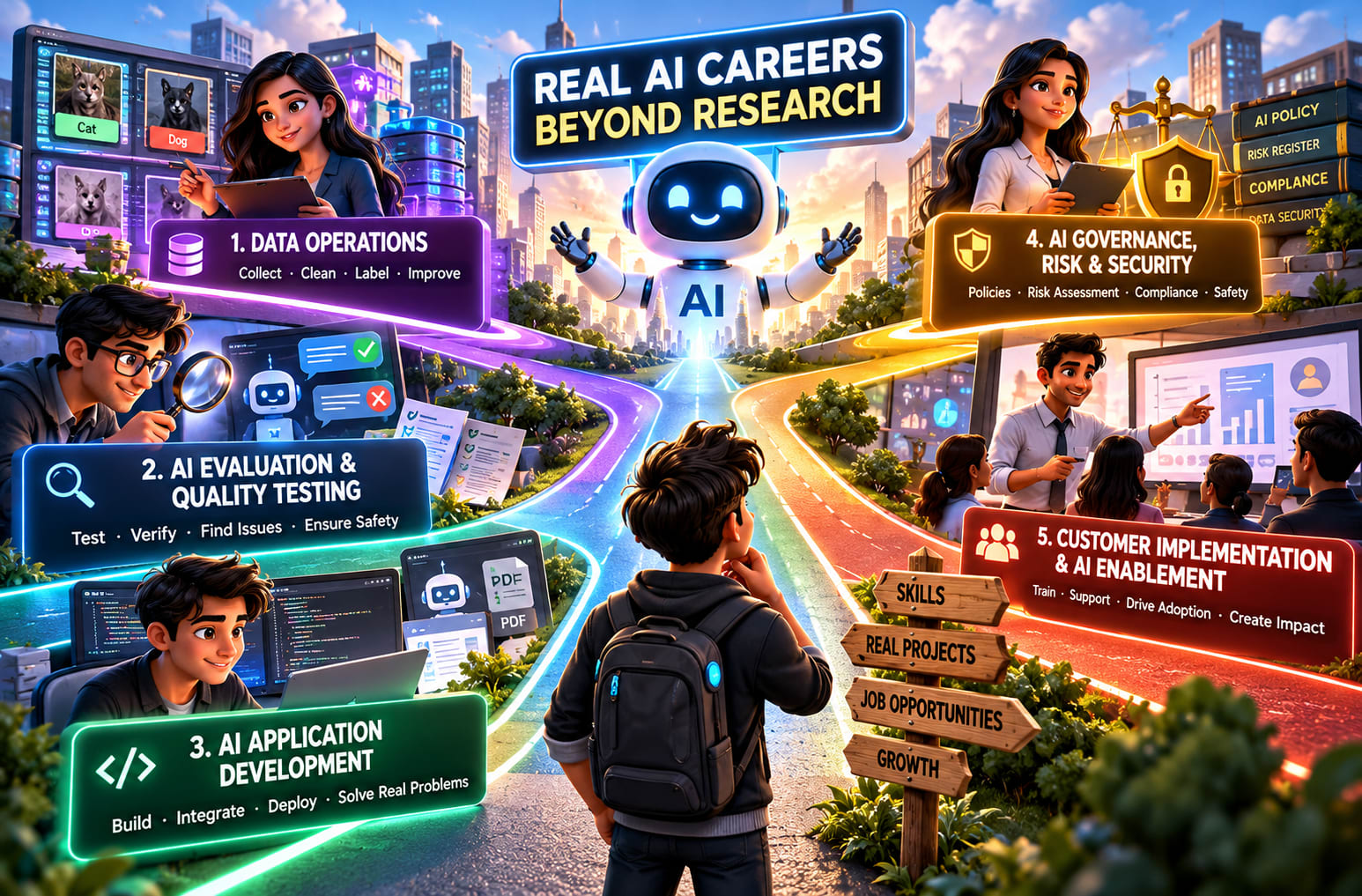
This guide maps five career paths and gives you a starter artifact for each: a small piece of work you can build this month and show to an employer.
Why AI careers are widening beyond research
Stanford's 2026 AI Index reports that generative AI reached majority-level population adoption faster than the PC or the internet did, and coverage of the report notes business use of AI climbing sharply from 2024 levels. When a technology spreads that fast, the bottleneck moves. It stops being "can we build a model?" and becomes "can we feed it good data, check its answers, wire it into our product, govern it safely, and get our customers using it?"
Job-market commentary points the same way. Career guides in 2026 describe hiring that favors judgment, evaluation and communication alongside technical skill. One Indian hiring analysis reported that only roughly 16 to 20 percent of AI job postings explicitly asked for advanced skills such as prompt engineering, model evaluation or RLHF, which suggests most openings sit in the broader ecosystem.
A caution before we go further: the labour-market picture is mixed. Stanford's report and related coverage also flag pressure on some early-career roles, and researchers say the long-run employment effects are still unclear. The goal of this article is not to promise an easy path. It is to show where to aim your effort.
Lane 1: Data operations
What it is: Collecting, cleaning, labelling and quality-checking the data that AI systems learn from and run on. Titles include data annotator, data quality analyst, data operations associate and dataset curator.
Why it's growing: Upwork's 2026 skills reporting described annotation expertise as the fastest-growing skill category in data science, and a Gartner survey cited alongside it found most organisations unsure they have the data management practices AI requires. Bad data is expensive, so careful people are valuable.
Who fits: Detail-oriented people, and domain experts (a nurse, an accountant, a teacher) whose specialist knowledge makes labels more accurate.
Starter artifact: A labelled mini-dataset of 100 examples plus a one-page annotation guideline. Pick a topic you know, define clear label rules, label the data twice a week apart, and report how often your two passes disagreed. That disagreement analysis is exactly what data-ops teams care about.
Lane 2: AI evaluation and quality testing
What it is: Testing whether an AI system is accurate, safe and useful. You design test questions, score the answers, and document failures such as hallucinations, bias or unsafe replies. Titles include AI evaluator, AI quality analyst, red-team tester and prompt tester.
Why it matters: One 2026 career guide calls evaluation one of the most important generative AI roles, and another points out that a former nurse or paralegal will catch errors in a medical or legal AI tool that a computer science graduate might miss.
Who fits: Sceptical, structured thinkers who enjoy finding what breaks.
Starter artifact: An evaluation pack: 30 test prompts for a chatbot in a domain you know, a simple scoring rubric (correct, partly correct, wrong, unsafe), results from running two different AI tools, and a short failure log explaining the worst three mistakes.
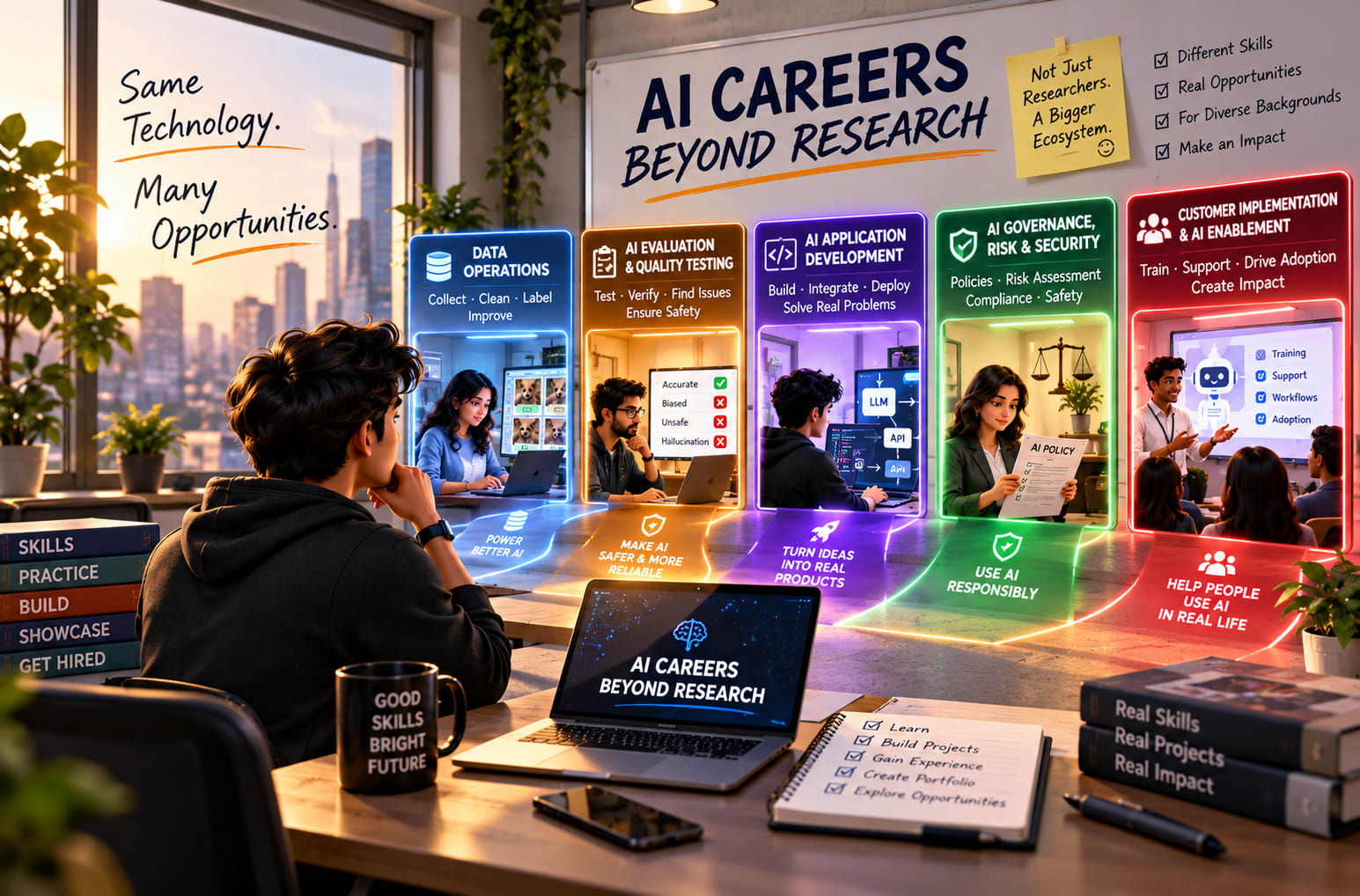
Lane 3: AI application development
What it is: Building products and workflows on top of existing models, using APIs, retrieval (RAG), automation tools and light coding. This is the lane for developers, DevOps engineers and technically curious builders who want to ship, not research.
Why it's growing: Industry trend pieces describe rising demand for people who can connect large models to a company's own data and build reliable evaluation and deployment workflows around them. That is engineering, not research.
Who fits: Developers, DevOps and cloud learners, and no-code builders ready to learn some Python.
Starter artifact: A small question-answering app over a document set (for example, a college FAQ or a policy PDF) with a README covering how it works, how you tested it, what it gets wrong, and how you would secure it. Putting security notes in the README sets you apart.
Lane 4: AI governance, risk and security
What it is: Making sure AI is used lawfully, safely and responsibly. Work includes writing AI use policies, running risk assessments, checking vendors, protecting data and reviewing systems for vulnerabilities. Titles include AI governance analyst, AI risk and compliance associate and AI security specialist.
Why it's growing: Coverage of the 2026 AI Index describes capability advancing faster than the guardrails around it. Some hiring trackers put growth in governance and ethics roles at roughly 150 percent year over year, though a single-source figure like that is indicative, not exact. The direction is what matters: organisations need people who can say "yes, with controls."
Who fits: Lawyers, auditors, finance and compliance professionals, and cybersecurity learners.
Starter artifact: A one-page AI acceptable-use policy for a fictional small business plus a short risk register listing five realistic risks (for example, staff pasting confidential data into public chatbots), each with a likelihood, an impact and a control.
Lane 5: Customer implementation and AI enablement
What it is: Helping real organisations adopt AI tools: scoping use cases, running pilots, training teams, collecting feedback and measuring results. Titles include AI solutions consultant, implementation specialist, customer success manager for AI products and AI trainer.
Why it's growing: Enterprise AI vendors need people who can guide non-technical clients through adoption. Career guides consistently list customer success and coordination roles among the entry points that don't demand a CS degree.
Who fits: Strong communicators, teachers, project coordinators and anyone who enjoys turning confusion into a clear plan.
Starter artifact: A pilot rollout playbook. Pick one business task (say, drafting quotations), define success metrics, write a two-week pilot plan, a staff training outline and a feedback form, then run it with a friend's small business and record the before-and-after result.
How to choose your lane in one evening
Ask yourself three questions:
Do I prefer details, judgment, or people? Details point to data operations. Judgment points to evaluation and governance. People point to implementation.
Do I enjoy building? If yes, start with application development.
What do I already know? Your existing field (healthcare, law, education, finance, agriculture) is a hiring advantage in every lane above, not a handicap.
Then build one starter artifact in 30 days. A published artifact beats a long list of course certificates, because it shows the exact skill the employer is hiring for.
How to research real openings before you commit
Before investing months in any lane, spend an hour checking what employers actually ask for:
Read recent job listings on LinkedIn, Naukri and company career pages, and note the repeated skills.
Search the exact titles used above, not just "AI jobs."
Skim the Stanford AI Index (free online) for the broad picture of where demand and adoption are heading.
Note which listings value domain knowledge, and adjust your starter artifact to match.
Learning AI in Punjab: courses and where to start
If you're searching for AI courses in Jalandhar or nearby cities like Ludhiana, look for programmes that end in a portfolio, not just a certificate. A good course should have you build artifacts like the five above, teach you to test and secure what you build, and connect you with people already working in the field.
Thread Security , a Jalandhar-based cybersecurity company working in VAPT, security training and DevSecOps consulting, sees this combination daily: AI systems are only as trustworthy as the data, testing, security and governance around them. That is why AI skills and security skills increasingly belong together, and why learners who pair them are well placed for roles in governance, evaluation and secure AI development.
Want guidance on building your first AI starter artifact or choosing a learning path? Reach out to the Thread Security team and tell us which lane interests you.
Frequently asked questions
Can I get an AI job without coding? Yes. Data operations, evaluation, governance and implementation roles often rely more on judgment, domain knowledge and communication than programming, though basic familiarity with AI tools and data workflows helps.
What is the best entry-level AI job in India? There is no single best one. Data operations and evaluation are common starting points, application development suits coders, and governance suits people with legal, audit or security backgrounds.
Do I need a certificate to get hired? Certificates can help, but a small, well-documented project usually says more about your ability than a certificate alone.
How long does it take to build a starter artifact? Most can be built in two to four weeks alongside study or work.
Are AI jobs safe from automation? No career is guaranteed. The more durable positions combine AI fluency with human strengths: judgment, domain expertise, accountability and communication.
Key takeaway
The AI economy is not just model builders. It is also the people who prepare the data, test the output, build the product, set the rules and bring customers along. Pick one lane, build one artifact, and let your work do the talking.
Akshay Kumar
VERIFIEDAcademic Coordinator · Thread Security
Faculty mentor & research guide at Thread Security Education.