Why Your First Email to an AI Recruiter Matters
Looking for an AI internship for freshers can feel confusing when you have skills to offer but little professional experience. You may have completed a machine learning course, built a chatbot or experimented with a Python project, yet still wonder how to approach a recruiter who has never met you.
A cold email is a professional message sent to someone with whom you have no existing conversation, usually to introduce yourself, express interest in an opportunity and ask about a possible next step. It does not guarantee an internship, but it gives you a way to communicate your interests and demonstrate that you have made a thoughtful effort to understand the organisation.
The biggest mistake is treating the email as a request for a favour without giving the recipient a reason to continue the conversation. A stronger approach connects three things: what the organisation does, what you can contribute and what evidence supports your claims.
You do not need an impressive job title or a long list of certifications. You need a clear message, one or two relevant projects, an accessible résumé and a polite, realistic request.
1. Research Before You Write
Before drafting an email, spend a few minutes understanding the organisation. Review its official website, AI products, research areas, engineering teams or recent projects. Look for a genuine connection between its work and your interests.
For example, if a company develops document-search applications, a small retrieval-augmented generation (RAG) project may be more relevant than an unrelated collection of Python exercises. If the team works on computer vision, a well-documented image-classification project could be a stronger example.
Identify the appropriate recipient as well. Depending on the organisation, that could be a recruiter, an engineering manager, an AI team lead or an official internship contact. Use publicly provided professional contact information, and respect any application instructions on the company's careers page.
Do not assume that every employee is responsible for hiring interns. If a formal application route exists, follow it. A brief email can complement an application, but it should not be used to bypass stated requirements.
2. Use a Simple Cold Email Structure
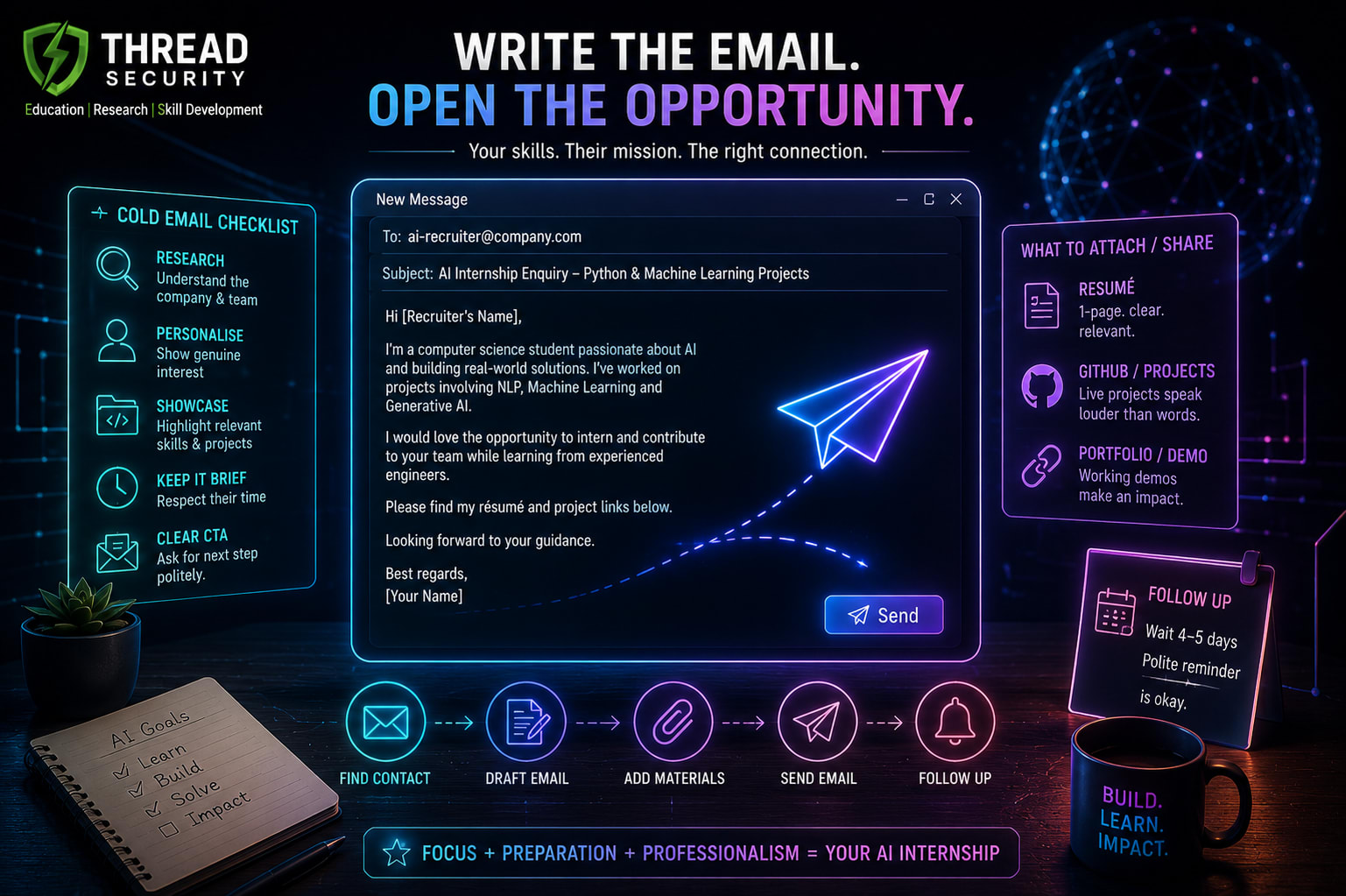
A useful cold email has five parts: a clear subject line, a brief introduction, relevant skills or project evidence, a specific request and a professional closing.
Part 1: Write a subject line that explains the purpose
Recruiters should be able to understand your message without opening it. Avoid vague subjects such as "Hello", "Urgent request" or "Need a job". Avoid exaggerated claims and false urgency.
AI Internship Enquiry : Python and Machine Learning Projects
Computer Science Student Interested in AI Internship Opportunities
Internship Enquiry : RAG and Generative AI Projects
If you are responding to a specific advertised role, include its title or reference number where appropriate. A clear subject is more useful than trying to make the email sound clever.
Part 2: Introduce yourself in two sentences
State who you are, what you study or what you have been learning, and why you are contacting this person or team. Do not spend the opening paragraph narrating your entire academic journey.
For example: "I am a computer science student developing practical skills in Python, machine learning and generative AI. I came across your team's work on AI-powered document processing and wanted to enquire about possible internship opportunities."
Part 3: Show evidence rather than listing every skill
Choose one or two projects that match the organisation's work. Explain what each project does, which tools you used and what you personally implemented. A recruiter should be able to understand your contribution quickly.
Instead of writing "I know Python, AI, ML, deep learning, NLP, RAG, data science and many other technologies", describe a concrete example: "I built a Python-based document question-answering prototype using embeddings and retrieval, and evaluated its responses against a small set of test questions."
Only include details you can explain confidently in an interview. If the project was built by following a tutorial, be transparent about that and explain what you changed, tested or learned.
Part 4: Make one specific request
Ask whether the team has suitable internship opportunities or whether the recipient can direct you to the appropriate application process. You are starting a conversation, not demanding an interview.
Part 5: Close professionally
Thank the recipient for their time, include your full name and provide one convenient way to contact you. Keep the message short enough to scan on a phone.
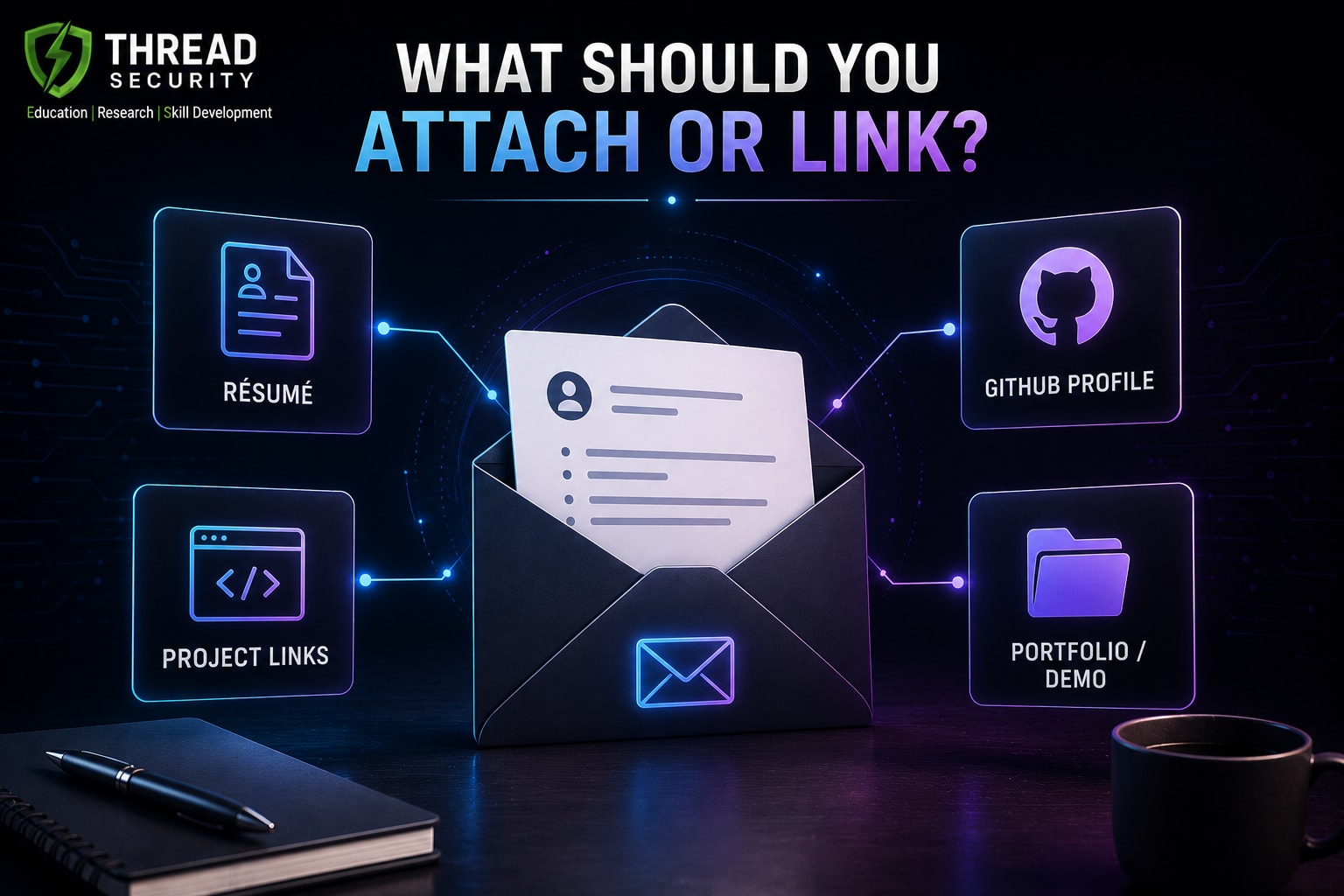
3. What Should You Attach or Link?
Your email should make it easy for the recruiter to evaluate your work. Include only material that supports your application, rather than attaching every certificate and project file you own.
Item | What to include | Practical tip |
|---|---|---|
Résumé | Education, relevant skills, selected projects and experience | Use a clean PDF with a professional filename. |
GitHub profile | Repositories with readable code and instructions | Pin the two or three projects most relevant to the role. |
Project demonstration | A working demo, screenshots or a short walkthrough | Check that links open without special permissions. |
Portfolio | A concise page describing your strongest work | Make project outcomes and your contribution easy to find. |
Certificates | Relevant training or credentials when useful | Share selectively; projects should support your practical claims. |
For most initial emails, a résumé PDF and one or two project links are sufficient. Avoid large attachments, compressed archives or source-code dumps unless requested. If a company specifies an application format or portal, follow those instructions first.
Make every project link worth opening
A good project repository should contain a clear README, the problem being solved, the tools used, setup instructions, sample results and known limitations. Include a demonstration or screenshots when they help someone understand the project faster.
For an AI project, describe how you evaluated it. For example, a chatbot repository might explain the test questions used, common failure cases and how you checked whether responses were supported by retrieved documents.
Do not claim that a prototype is production-ready unless you have evidence for that claim. An honest explanation of what works, what does not and what you would improve can be more useful than an exaggerated description.
4. A Short Profile That Recruiters Can Understand
Your profile should answer three questions quickly: what are you learning, what can you demonstrate and what opportunity are you seeking?
Adapt this example to your actual background. Replace the generic project descriptions with your strongest work, and do not list tools you have never used. If you have no completed AI project yet, start with a small, well-documented project instead of inventing experience.
You can use a similar summary in your résumé, portfolio or professional profile, but tailor it to the opportunity. A recruiter hiring for computer vision may care about different evidence than a team building LLM applications.
5. Before and After: A Fictional Cold Email
The following examples are fictional and illustrate writing quality only. They are not real recruiter messages, testimonials or evidence that a particular email will secure an internship.
Before: Too vague and difficult to evaluate
Subject: Internship needed
Hello Sir/Ma'am,
I am a fresher and want an internship in AI. I know Python, machine learning, deep learning and many AI tools. I am a hardworking person and can learn anything. Please give me a chance in your company. I have attached my certificates. Please reply as soon as possible.
Thank you.
What is missing? The message does not identify the applicant's current background, explain why the organisation is relevant, provide evidence of practical skills or make it easy to assess the candidate. It also puts the emphasis on a request rather than on a credible introduction.
After: Specific, concise and evidence-based
Subject: AI Internship Enquiry, Python and RAG Project
Hello [Name],
I am [Your Name], a computer science student building practical skills in Python, machine learning and generative AI. I came across [Company Name]'s work in AI-powered applications and wanted to enquire about potential internship opportunities with your team.
I recently built a small document question-answering prototype using Python and retrieval-based methods. The project includes a GitHub repository with setup instructions, a short explanation of the architecture and sample evaluation results: [Project Link].
I have attached my résumé for context. If your team is considering interns, I would appreciate being directed to the relevant opportunity or application process.
Thank you for your time.
Best regards,
[Your Name]
[GitHub or Portfolio Link]
[LinkedIn Profile]
Why the second version is stronger: it identifies the applicant, gives a relevant reason for contacting the company, offers concrete evidence, provides accessible links and makes a polite request. The project description should be replaced with your real work, not copied as a claim if you have not built that project.
6. What Industry Leaders Say About Learning and Building
Advice from experienced technology leaders can help explain why a cold email should demonstrate learning and practical work rather than rely on broad claims.
Andrew Ng: Combine structured learning with projects
AI educator and researcher Andrew Ng has encouraged aspiring AI practitioners to combine coursework with project-building. In a post about getting started in AI, he recommends beginning with learning and then experimenting with projects, including small projects that help develop practical skills.
The lesson for internship applicants is to show evidence of that learning. You do not need a huge commercial product to demonstrate initiative. A focused project with clear documentation, a working example and a thoughtful explanation can give a recruiter something concrete to evaluate.
Satya Nadella: Build strong technical fundamentals
Microsoft CEO Satya Nadella has emphasized the importance of software fundamentals and computational thinking as AI changes software development. In comments reported by The Economic Times, he highlighted the value of structured problem-solving even as AI tools become more capable.
For a student applying to an AI internship, this reinforces a useful principle: do not just mention that you used an AI tool. Explain the problem, your approach, how you checked the output and what you learned. Recruiters need to understand your own reasoning, not only which tools appeared in your workflow.
Google's intern résumé advice: Make your experience relevant and concrete
Google's student blog has shared résumé tips from its interns, including tailoring a résumé to the role, using tangible facts where appropriate and being ready to discuss everything listed. Although these are résumé tips rather than a guarantee of recruiter responses, the same principles are useful when writing a cold email.
Choose evidence that fits the opportunity. If you mention a project, be ready to explain your contribution, the decisions you made and the results you observed. Quantify outcomes only when the numbers are real and meaningful.
These are publicly reported views and career recommendations, not endorsements of this article or guarantees that a particular email format will work.
7. When and How Should You Follow Up?
Sending the first email is only one part of professional communication. If you do not receive a reply, a polite follow-up can bring the message back to the recipient's attention without creating unnecessary pressure.
A practical approach is to wait around five to seven business days before sending one short follow-up, unless the organisation specifies a different timeline. If the role has a deadline or a formal application process, follow its instructions instead.
Your follow-up should refer to the original email, restate your interest briefly and avoid repeating the entire application.
If there is still no response, do not send repeated messages every day. After one courteous follow-up, it is usually sensible to move on and continue applying elsewhere. Silence can mean many things, including workload, hiring priorities or the absence of an opening; it is not necessarily a judgement on your ability.
Do not contact several employees with identical messages in a short period or move to personal channels when someone has not invited that contact. Professional persistence means following up respectfully while allowing the recipient to choose whether to respond.
8. Common Cold Email Mistakes to Avoid
Sending a generic message to every company: Personalize the opening with a genuine connection to the team's work.
Writing a long biography: Keep the email focused and move additional details into your résumé or portfolio.
Listing skills without evidence: Support important claims with a project, demonstration or relevant experience.
Attaching too many files: Share a résumé and selected links; send additional documents when requested.
Using broken or private links: Test every link in a private browser window or while signed out, where appropriate.
Exaggerating project results: Be precise about what you built, what you contributed and what remains incomplete.
Demanding an immediate reply: Make a reasonable request and allow time for the recipient to respond.
Ignoring formal applications: Follow the organisation's stated hiring process and deadlines.
Before sending, read the message aloud. If a sentence sounds like a claim you could not comfortably defend in an interview, rewrite it. A concise, truthful email is more professional than one filled with buzzwords.
9. Your Cold Email Checklist
Use this checklist before sending your next internship enquiry.
Have I identified the correct recipient or official application channel?
Does the subject line clearly state the purpose?
Have I explained why I am contacting this organisation?
Have I highlighted one or two relevant projects?
Are my GitHub, portfolio and résumé links accessible?
Does the résumé match the opportunity and use a professional filename?
Have I made one specific, polite request?
Have I checked the message for spelling, accuracy and tone?
Have I planned a reasonable follow-up rather than repeated messages?
You can improve your results over time by tracking which organisations you contacted, when you sent each email, whether you followed up and what response you received. Use that information to improve your targeting and communication rather than sending a larger number of identical messages.
Start Building Your AI Career One Message at a Time
Finding an AI internship is not only about sending more emails. It is about helping the right people understand your interests, your current capabilities and the evidence behind your claims. Research the organisation, write a focused introduction, link to relevant work and make a reasonable request.
If you are exploring AI courses in Jalandhar, prioritize learning experiences that help you practice programming, understand AI concepts and build projects you can confidently discuss. A course or certificate can support your profile, but your ability to explain and demonstrate what you learned matters too.
Thread Security Education encourages practical, career-oriented technology learning through structured development and hands-on work. Use each project as an opportunity to build your technical understanding and improve how you communicate your skills to potential employers.
Visit Thread Security to explore its technology-focused initiatives and learning opportunities.
Your first cold email does not need to be perfect. Make it relevant, honest, concise and easy to respond to. Then keep learning, keep improving your projects and approach each opportunity with professionalism.
Simranjit Kaur
VERIFIEDAI Trainer · Thread Security
Faculty mentor & research guide at Thread Security Education.