Artificial intelligence is attracting students, software developers and working professionals who want to build a career in one of technology's fastest-changing fields. But before choosing a specialization, one question usually comes first: what is the AI engineer salary in India, and how much can someone realistically earn in 2027?
The answer depends on more than the job title. An AI engineer building production applications may have a different compensation package from a machine learning engineer training models, a data scientist analyzing business data, or an AI analyst supporting decision-making. Experience, programming ability, employer type, location and project responsibility all affect the final offer.
This guide examines published salary benchmarks, compares major AI-related roles, explains differences between Indian salary figures and US compensation headlines, and identifies the skills that can strengthen a candidate's position. Because 2027 salary outcomes are not yet fully observable, the figures below are reference points and planning guidance, not guaranteed future salaries.
AI Engineer Salary in India 2027: What Should You Expect?
There is no single authoritative salary figure for every AI engineer in India. Salary websites use different samples, job-title definitions and reporting methods. Some publish employee-reported pay, others analyze job listings or recruiter data, and some include bonuses and equity in total compensation.
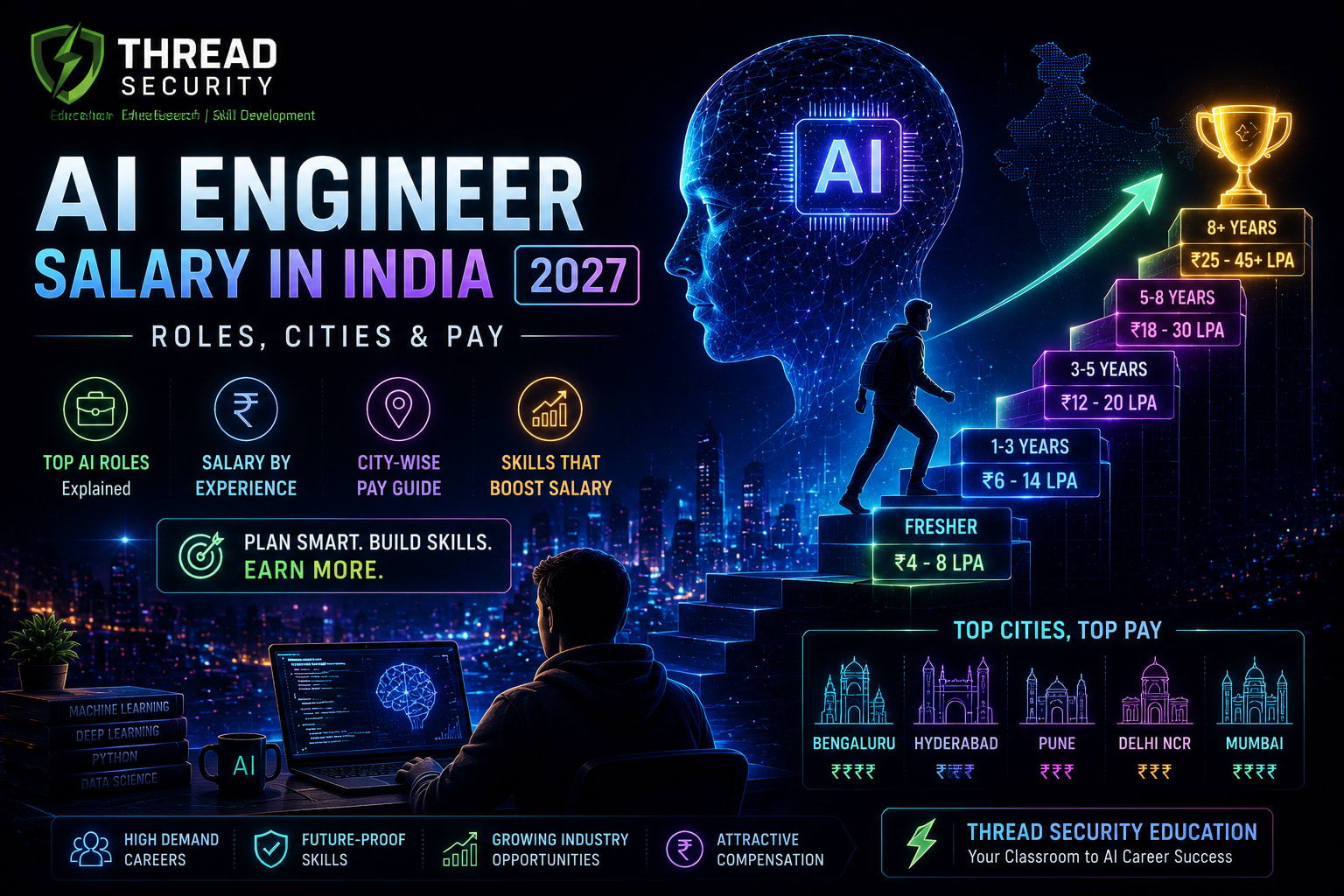
For a useful starting point, Flexiple's India Artificial Intelligence Engineer salary page, updated in August 2026, reported a median annual compensation figure of ₹7.8 lakh across 968 verified records. Its reported middle 50% range was ₹4.8 lakh to ₹14.2 lakh. These figures cover different experience levels and should not be interpreted as a fresher-only salary range.
A separate 2025 India Salary Guide from Adecco lists machine learning engineering compensation bands by experience. It gives a 0–3-year range of ₹7–15 lakh per year and a 3–7-year range of ₹15–30 lakh per year. These are published guide estimates, not a guarantee of what every employer will pay.
Sources: Flexiple — Artificial Intelligence Engineer Salary in India and Adecco India Salary Guide 2025. Accessed October 2026.
These benchmarks illustrate why salary claims should always be read alongside their source, date, experience band and methodology. For 2027 planning, treat the figures as a baseline to reassess against current job advertisements and updated salary surveys as the year progresses.
AI, ML and Data Science Salaries: How the Roles Compare
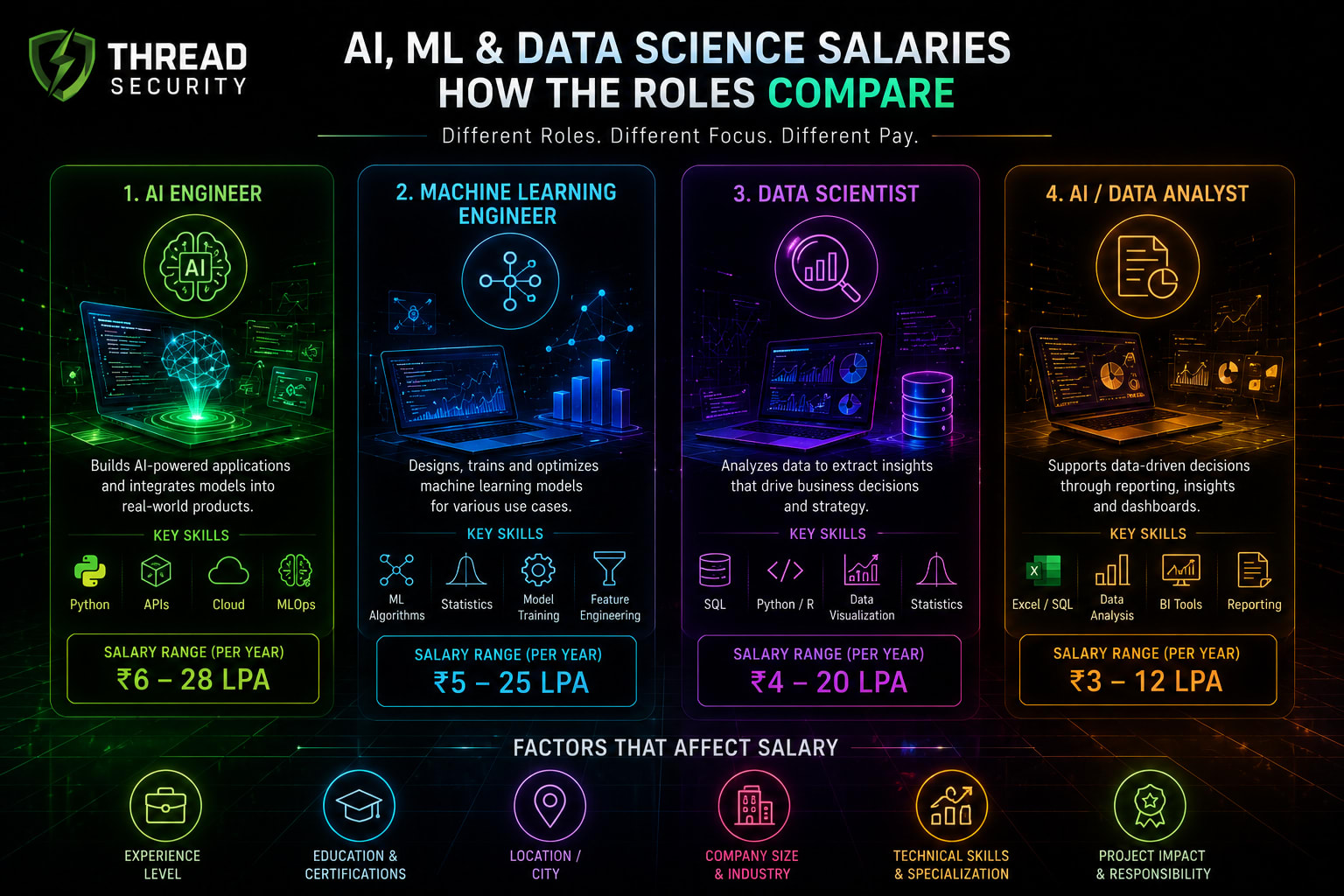
Artificial intelligence is an umbrella term, not one job. Similar titles can also hide different responsibilities. One employer may call a role AI Engineer while another uses Applied AI Engineer, Machine Learning Engineer or Generative AI Engineer for comparable work.
1. AI Engineer
An AI engineer builds applications that use models to solve practical problems. Responsibilities may include integrating model APIs, developing retrieval-augmented generation (RAG) systems, building application backends, evaluating model output, deploying services and monitoring performance.
The role can suit candidates who enjoy both software engineering and AI. Python, APIs, databases, testing, model evaluation and deployment knowledge are valuable because a working AI application involves considerably more than a prompt and a model call.
2. Machine Learning Engineer
A machine learning engineer develops, trains, evaluates and deploys predictive models. Depending on the organization, the work may include feature engineering, model selection, data pipelines, experiment tracking, model serving and production monitoring.
Python, statistics, data structures, SQL, scikit-learn, PyTorch or TensorFlow, and an understanding of model evaluation can help build a strong foundation. Production-oriented roles also benefit from software engineering and MLOps skills.
3. Data Scientist
A data scientist uses statistical analysis, experimentation and machine learning to answer business or scientific questions. The role may involve exploratory data analysis, hypothesis testing, predictive modelling, visualization and explaining findings to stakeholders.
Statistics, SQL, Python, data visualization and communication are important. A data scientist who focuses mainly on reporting may have a different compensation trajectory from one who develops and deploys complex predictive systems.
4. AI Analyst or Data Analyst
AI analysts and data analysts typically focus more on interpreting information, preparing reports, identifying patterns and supporting decisions. The exact responsibilities differ considerably between employers.
Excel, SQL, Power BI or similar visualization tools, Python and sound analytical reasoning are useful. These roles can also provide a route toward data science or AI engineering when combined with deeper programming and modelling experience.
5. Generative AI and LLM Engineer
Generative AI engineers build applications around large language models and related technologies. Their work may include RAG pipelines, embeddings, vector search, evaluation frameworks, guardrails, tool calling, agent workflows and deployment.
Demand for these skills does not mean every GenAI position pays more than every traditional ML role. Pay depends on the difficulty of the work, the quality of the candidate, the employer's budget and whether the person can deliver a reliable production system.
Salary Benchmarks by Experience
The following table combines two published reference points: Flexiple's 2026 AI engineer data and Adecco's 2025 machine learning engineer salary guide. They measure different roles and use different methodologies, so the figures must not be treated as directly interchangeable.
Experience | AI Engineer Reference | ML Engineer Reference | How to Interpret It |
|---|---|---|---|
0–2 years | ₹5.1 lakh median in Flexiple's 0–2-year band | ₹7–15 lakh guide range for 0–3 years | Entry-level benchmarks vary by dataset and employer. |
2–3 years | Part of Flexiple's 2–5-year band, with a ₹9.4 lakh median for that entire band | Falls within Adecco's 0–3-year band | Do not treat a multi-year median as a salary for exactly two or three years. |
3–5 years | Part of Flexiple's 2–5-year band | Part of Adecco's 3–7-year band | Responsibility and production experience can materially change the offer. |
5–7 years | Flexiple's 5–8-year band has a ₹18.4 lakh median | Part of Adecco's 3–7-year band | Senior technical ownership may matter more than the title alone. |
8+ years | Flexiple reports a ₹25.3 lakh median for 8–12 years and ₹32.9 lakh for 12+ years | Different seniority bands and employer structures apply | Leadership, specialisation, company type and equity can create wide differences. |
Data notes: Flexiple figures are from its August 2026 India AI engineer page. Adecco figures are from its 2025 India Salary Guide. The table deliberately does not invent a verified 2027 salary for each experience level. For source details, consult the reports linked above.
A salary median is not a promise. Some candidates receive less, some receive more, and some advertised roles have compensation that cannot be compared fairly with a reported median. Always inspect the underlying data before using a number to negotiate an offer.
Which Cities Offer AI Jobs and Competitive Salaries?
Location can influence compensation because cities differ in employer mix, hiring demand, living costs and the concentration of product companies, global capability centres and research teams. However, a city name alone cannot predict an individual's salary.
Bengaluru: A major technology market with product engineering, AI, ML and research opportunities.
Hyderabad: A substantial technology and enterprise engineering market with AI-related roles across several industries.
Delhi NCR: Opportunities across enterprise technology, consulting, startups, analytics and product companies.
Pune: Software engineering, enterprise technology, analytics and industrial technology opportunities.
Mumbai: Technology positions linked to financial services, enterprise systems, analytics and product development.
Chennai: Software services, engineering, enterprise technology and data-related opportunities.
Chandigarh, Mohali, Jalandhar and other regional markets: Opportunities depend more heavily on the local employer base, remote hiring, training ecosystem and individual job openings.
Flexiple's August 2026 city-level figures illustrate the variation. Its reported AI engineer medians included ₹11.1 lakh for Bengaluru, ₹8 lakh for Chennai and ₹8.5 lakh for Mumbai. The page also lists a median of ₹7.2 lakh for Noida and ₹8 lakh for Gurugram, based on the records available for those cities. These are all-level medians, not guaranteed offers for freshers or experienced professionals.
Source: Flexiple's city-level salary data, updated August 2026.
Compare jobs at the same level and with similar responsibilities before deciding that one city pays more. A remote position, a local services company and a large product company can have very different compensation structures even when the job title is identical.
AI Engineer Salary in India vs the United States
US technology compensation headlines often circulate on social media without enough context. A reported US package of $200,000 or more may include base salary, annual bonus and company stock. It may also refer to a highly competitive employer and a particular seniority level.
Indian salary figures may instead represent annual CTC, a salary survey's median, employee-reported pay or a job advertisement's base salary. Comparing these numbers without aligning the definitions produces misleading conclusions.
Compensation Element | What It Means |
|---|---|
Base salary | Fixed cash compensation before applicable deductions. |
Bonus | Variable compensation that may depend on performance or company results. |
Equity or stock | Shares or stock-based awards whose value and vesting conditions vary. |
CTC | Cost to company in India; it can include employer contributions and benefits that are not monthly take-home pay. |
Total compensation | A package that may combine base pay, bonus and equity, depending on the source's definition. |
For an India-versus-US comparison, align job level, experience, currency, base pay, bonus, equity and measurement period. Then consider taxes, living costs, healthcare, relocation, job stability and purchasing power. A large headline number alone is not enough to establish which offer is better.
What Could Influence AI Salaries in 2027?
Future salaries depend on hiring demand, the supply of capable candidates, business investment, automation, economic conditions and the kinds of AI systems companies actually deploy. No forecast can reliably guarantee an individual's salary in 2027.
Several developments are worth monitoring:
Production-Ready AI Engineering
Companies need more than prototypes. Skills in API development, deployment, monitoring, testing, data management and reliability can help candidates demonstrate that they can move an AI feature from an experiment into a usable application.
Generative AI and RAG Applications
RAG systems combine retrieval with language-model generation. Practical work includes document processing, embeddings, retrieval quality, citation checks, access control, evaluation and protection against unsafe inputs. Simply connecting a model to a vector database is not sufficient to demonstrate production readiness.
MLOps and Model Evaluation
Model monitoring, experiment tracking, deployment pipelines, drift detection and reproducible evaluation are important when machine learning systems operate beyond a notebook. These skills can complement both conventional ML and generative AI work.
AI Security and Responsible Development
As AI applications handle business data and perform more actions, teams must consider data privacy, access control, prompt injection, insecure dependencies, model output validation and system monitoring. Security awareness is relevant to AI engineering even when the job title does not include cybersecurity.
Strong Software Engineering Fundamentals
AI tools can generate code quickly, but developers still need to understand algorithms, debugging, version control, testing, architecture and performance. Candidates who can verify generated output and explain their design choices are better prepared to work responsibly with AI-assisted development.
These are plausible skill priorities, not proof that every specialization will receive a salary premium in 2027. Check actual job descriptions and salary data as they are published.
Which Skills Can Improve Your Earning Potential?
There is no guaranteed skill-to-salary formula. However, building a coherent technical skill set and demonstrating that you can solve real problems gives employers stronger evidence of your capabilities.
Python: Write readable functions, use appropriate data structures, handle errors and organize projects.
SQL and data handling: Retrieve, validate, transform and analyze data reliably.
Statistics and machine learning: Understand evaluation metrics, overfitting, data leakage and model limitations.
Software engineering: Use Git, testing, APIs, modular design and clear documentation.
Deployment: Build and deploy applications, then monitor errors, latency and resource usage.
Generative AI: Understand LLMs, embeddings, RAG, model evaluation and application-level safeguards.
Communication: Explain trade-offs, present results and connect technical decisions to user or business needs.
Do not collect tools merely to fill a resume. It is more useful to build two or three substantial projects that demonstrate problem definition, data handling, testing, deployment and measurable results than to list ten frameworks that you have only tried once.
Projects That Make an AI Career Profile More Credible
A portfolio should demonstrate the ability to build, test and explain a working system. Suitable project ideas include:
Document question-answering system: Build a RAG application with document ingestion, retrieval evaluation, citations and permission checks.
Predictive analytics project: Train and evaluate a model, compare it with a baseline, explain limitations and deploy an inference endpoint.
Data analysis dashboard: Combine SQL, Python and visualization to answer a specific question using a documented dataset.
AI application with monitoring: Create an application with input validation, error handling, logging, test coverage and a deployment guide.
AI security assessment: Document how an AI application could fail, then implement and test appropriate mitigations in a controlled environment.
For each project, explain what problem it solves, why you selected the approach, what you tested, what failed and what you would improve. That explanation is often more useful in an interview than a polished interface with no evidence of engineering depth.
AI Courses in Jalandhar: Thread Security Education
For students searching for AI courses in Jalandhar, the important question is not simply which institute advertises the highest-paying career. It is whether the training builds skills that can be demonstrated in a project, technical discussion or interview.
A useful Artificial Intelligence course or Machine Learning course should help learners understand the concepts behind the tools they use. Depending on the programme, relevant topics may include Python for AI, data analysis, machine learning, deep learning, generative AI, RAG, deployment and responsible AI development.
For candidates exploring AI internships in Jalandhar, project-based training can help build a portfolio, but course completion alone does not guarantee an internship or job. Hiring decisions still depend on demonstrated ability, interview performance and the requirements of the employer.
Thread Security Education publishes practical learning resources on AI, cybersecurity and technology, with an emphasis on understanding how systems work and where they can fail. This approach is relevant to AI career preparation because developing an application is only one part of engineering; validating its behaviour, protecting its data and understanding its limitations matter as well. Explore the Thread Security Education website to learn more about its technical learning resources, courses, workshops and training offerings. Review the published programme details to determine which options match your current level and career goals.
How to Evaluate an AI Job Offer
Before accepting an offer, compare the complete package rather than focusing only on the annual number in the headline.
Confirm the exact role, team, responsibilities and expected technical depth.
Ask whether the quoted salary is base pay, fixed CTC or total compensation.
Check the bonus conditions, equity vesting schedule and other benefits.
Compare the offer with recent salary data for similar experience levels and employers.
Consider mentorship, technical ownership, learning opportunities and the quality of the work.
Evaluate location, work arrangements, living expenses and career progression.
Check the employment terms and any conditions attached to variable compensation.
A higher package may be worthwhile, but only if the compensation is clearly defined and the role fits your priorities. Likewise, a lower initial offer may provide useful experience, but it should be assessed against the actual work, learning opportunities and alternatives available.
Frequently Asked Questions
What is the AI engineer salary in India in 2027?
There is no verified final salary figure for the full year 2027 yet. Published 2025–2026 benchmarks provide a starting point, but actual pay depends on experience, employer, role, location and compensation structure. Use current job listings and updated salary surveys when making decisions.
What is the starting salary for an AI engineer in India?
Starting salaries vary across employers and datasets. Flexiple's August 2026 data reported a ₹5.1 lakh median for AI engineers with 0–2 years of experience. This is a reference benchmark, not a guaranteed fresher offer or a forecast for 2027.
Do machine learning engineers earn more than data scientists?
Not universally. Responsibilities, seniority, industry and employer can matter more than the title. Compare roles with similar experience and responsibilities instead of assuming that one title always pays more.
Which Indian city is best for AI jobs?
Bengaluru, Hyderabad, Delhi NCR, Pune, Mumbai and Chennai have substantial technology markets. The best location for an individual depends on relevant openings, employer quality, compensation, living costs and whether remote work is available.
Can an AI course guarantee a high salary?
No. A course can help develop skills, but salary outcomes depend on technical ability, project quality, experience, interviews and hiring conditions. Be sceptical of guaranteed salary claims without transparent placement data and clearly defined terms.
Is Python enough to become an AI engineer?
Python is a useful foundation, but production AI engineering also requires problem-solving, data handling, software design, testing, model evaluation and deployment. The exact additional skills depend on the role.
Final Takeaway: Plan for Skills, Not Salary Headlines
The AI engineer salary in India can vary substantially across employers, experience levels and specializations. Published benchmarks are useful for understanding the market, but a salary headline should never be mistaken for a personal guarantee or a reliable forecast of 2027 earnings.
Build a strong foundation in programming, data, machine learning and software engineering. Create projects that demonstrate measurable results. Learn to evaluate models, deploy applications and handle security risks. Then compare real offers using transparent compensation definitions and current market evidence.
For learners exploring AI courses in Jalandhar, Thread Security Education offers a relevant starting point for exploring AI and cybersecurity learning resources. The long-term objective should be to develop skills that can be demonstrated and verified—not to chase a salary figure without understanding what the job requires.
Ready to Build Your AI Career?
A strong AI career starts with more than knowing the right tools. Focus on practical projects, problem-solving, and skills that employers value. At Thread Security Education, explore industry-oriented AI training designed to help you move from learning concepts to applying them in real-world projects.
Explore our AI courses and take your next step toward an AI career: Thread Security Education
Simranjit Kaur
VERIFIEDAI Trainer · Thread Security
Faculty mentor & research guide at Thread Security Education.