What Should You Expect in an AI Engineer Interview in 2027?
Preparing for an AI engineer interview requires more than learning definitions of machine learning algorithms or memorizing answers about large language models. Interviewers may want to understand whether you can connect technical concepts to practical problems, explain your decisions and recognize the limitations of the systems you build.
As AI applications expand into search, document analysis, customer support, software development and business automation, interview preparation increasingly needs to cover both traditional machine learning and the engineering work required to operate AI applications reliably.
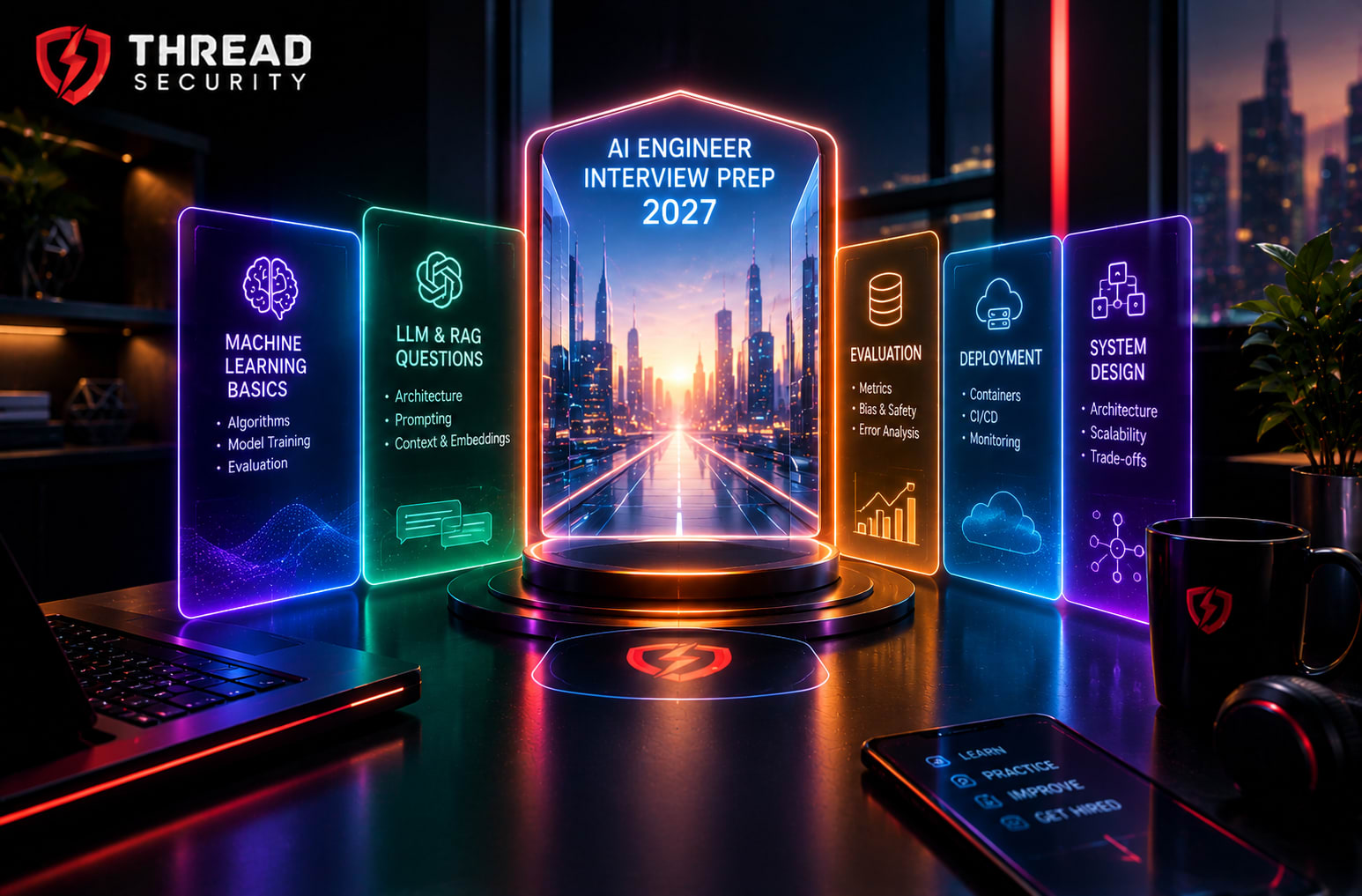
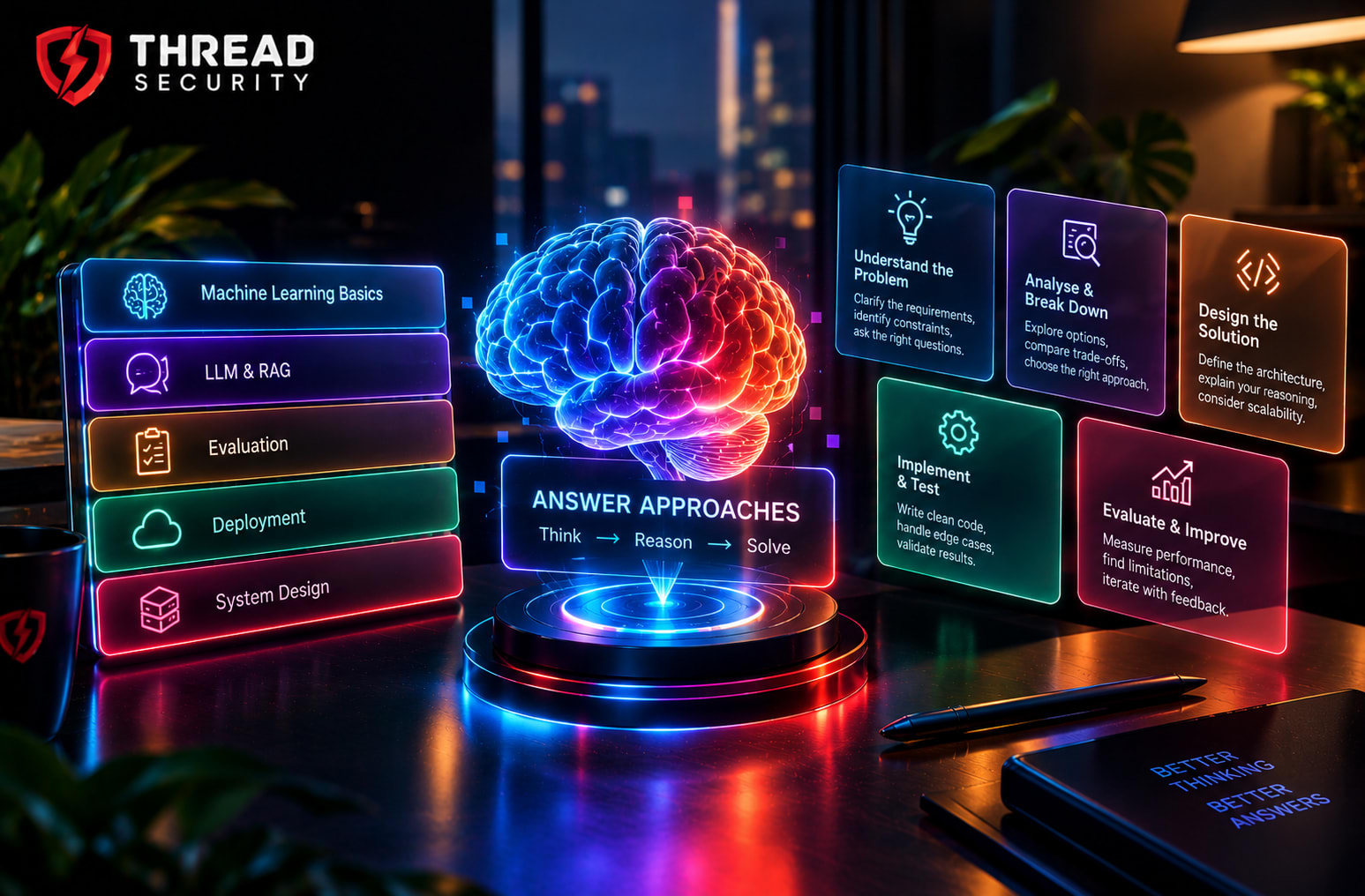
This guide brings together AI Engineer Interview Questions 2027 across five important areas: machine learning fundamentals, LLMs and Retrieval-Augmented Generation (RAG), evaluation, deployment and system design. It provides answer approaches rather than scripts to memorize, because interviewers can change the scenario or ask follow-up questions at any time.
No question list can guarantee what a particular company will ask in 2027. The topics below are a practical preparation framework based on established technical concepts, current public interview guides and official documentation. The depth expected will vary with the role, seniority and organization.
1. How to Structure Strong Interview Answers
One of the most useful interview skills is having a repeatable way to organize your reasoning. Instead of memorizing complete answers, use a framework that adapts to the question.
For technical concept questions
Define: State the concept clearly in one or two sentences.
Explain: Describe how it works or why it matters.
Illustrate: Give a relevant example.
Qualify: Mention an important limitation or trade-off.
For problem-solving questions
Clarify the goal and constraints.
Identify the data, tools and assumptions.
Compare plausible approaches.
Choose an approach and explain why.
Describe how you would test it and handle failure.
For system design questions
Clarify functional and non-functional requirements.
Estimate traffic, data volume and performance needs where relevant.
Draw the main components and data flow.
Explain important design decisions and alternatives.
Cover security, reliability, observability and cost.
Describe how you would evaluate and improve the system.
These are answer structures, not rigid scripts. Adapt them to the question and answer at the level of detail appropriate to the role.
2. How to Discuss Your Projects in an AI Engineer Interview
Interviewers may ask candidates to explain a project they have built, the choices they made and what they learned. A small, well-understood project can be more useful than a large project whose architecture you cannot explain.
Prepare two or three projects and be ready to discuss:
Problem: What need did the project address, and who was the intended user?
Architecture: What components, libraries, models and data sources did you use?
Decision-making: Why did you choose that approach instead of an alternative?
Evaluation: How did you test correctness, reliability or usefulness?
Challenges: What failed, what did you change and why?
Limitations: What would you improve before using it in production?
Be accurate about your contribution. Distinguish what you personally implemented from what a library, framework or external model provided. Do not invent performance figures or claim production experience for a classroom prototype.
3. A Seven-Day AI Engineer Mock-Interview Plan
This short plan can help you revise the main areas without trying to learn every possible question. Adjust the time based on your experience and the job description.
Day 1 : Machine learning: Revise data splitting, overfitting, metrics, model selection and basic algorithms. Answer five questions aloud.
Day 2 : LLM fundamentals: Explain tokens, context windows, prompting, hallucinations and the differences between RAG and fine-tuning.
Day 3 : RAG: Draw a complete RAG pipeline, explain chunking and retrieval, and practice debugging an incorrect answer.
Day 4 : Evaluation: Design a small evaluation dataset and explain how you would measure model quality and regression.
Day 5 : Deployment: Explain API deployment, monitoring, model versions, latency, cost and failure handling.
Day 6 : System design: Complete one timed design exercise, such as a document assistant or customer-support chatbot.
Day 7 : Mock interview: Run a 45-minute session covering technical concepts, project discussion and one system design question. Review gaps and repeat the weakest area.
Suggested 45-minute mock-interview structure
10 minutes: Machine learning and LLM fundamentals.
10 minutes: RAG and evaluation.
10 minutes: Project explanation and technical follow-ups.
10 minutes: System design.
5 minutes: Reflection on unclear answers and missing concepts.
During practice, record whether you stated assumptions, explained trade-offs, gave a relevant example and described how to test your solution. These signals are more useful than simply counting how many questions you can recite.
4. Official Documentation and Interview Preparation Resources
Public interview guides can help you identify common topics, but official documentation is important for checking technical details and learning how tools actually behave. Use both types of resources: interview guides for practice and primary documentation for technical accuracy.
Scikit-learn User Guide Model selection, preprocessing, supervised learning, metrics and evaluation.
Hugging Face Transformers Documentation Transformer models, inference, training and practical implementation.
Hugging Face RAG Evaluation Cookbook Building evaluation datasets and assessing retrieval-augmented generation.
FastAPI Documentation Building APIs that can serve AI applications.
MLflow Documentation Experiment tracking and model lifecycle workflows.
DataCamp — AI Engineer Interview Questions A public guide to technical interview topics, deployment and system design.
Landed — Awesome AI Engineer Interview Resources A public collection of AI engineering interview questions and system design material.
Documentation and public guides evolve. Check the relevant version and the job description when preparing for a particular role. The questions in this article are representative practice questions, not verified questions from a specific employer.
5. Build Practical Skills Alongside Interview Preparation
Interview preparation is most effective when you can connect concepts to something you have implemented. Try building a small machine learning application, a document-based RAG assistant or an API that exposes a model. Write down the design decisions, evaluation method, known limitations and improvements you would make.
For learners looking to develop these capabilities, Thread Security Education focuses on applied technology learning across AI and related technical fields. Practical projects can help learners connect theory with implementation, testing and responsible use.
If you are exploring AI courses in Jalandhar, compare programmes on their hands-on work, curriculum depth, instructor guidance and opportunities to explain and evaluate your own projects. Choose training that matches your starting level and the roles you want to pursue.
Visit Thread Security to explore its technology training and education offerings.
Conclusion: Prepare to Explain, Build and Evaluate
AI Engineer Interview Questions 2027 should be approached as a framework for preparation, not a promise that every interview will follow the same pattern. Machine learning fundamentals help you reason about data and model behaviour. LLM and RAG knowledge helps you build applications around generative models. Evaluation and deployment skills help you judge whether those applications work reliably. System design brings these areas together under real-world constraints.
Instead of memorizing dozens of complete answers, learn to explain the concept, connect it to a practical example, discuss the trade-offs and describe how you would test your approach. Prepare projects you understand deeply, practice aloud under time limits and use official documentation to verify technical details.
The aim is not to sound as if you know every tool. It is to demonstrate that you can reason carefully, learn unfamiliar technologies and build AI systems with a clear understanding of their strengths and limitations.
Simranjit Kaur
VERIFIEDAI Trainer · Thread Security
Faculty mentor & research guide at Thread Security Education.