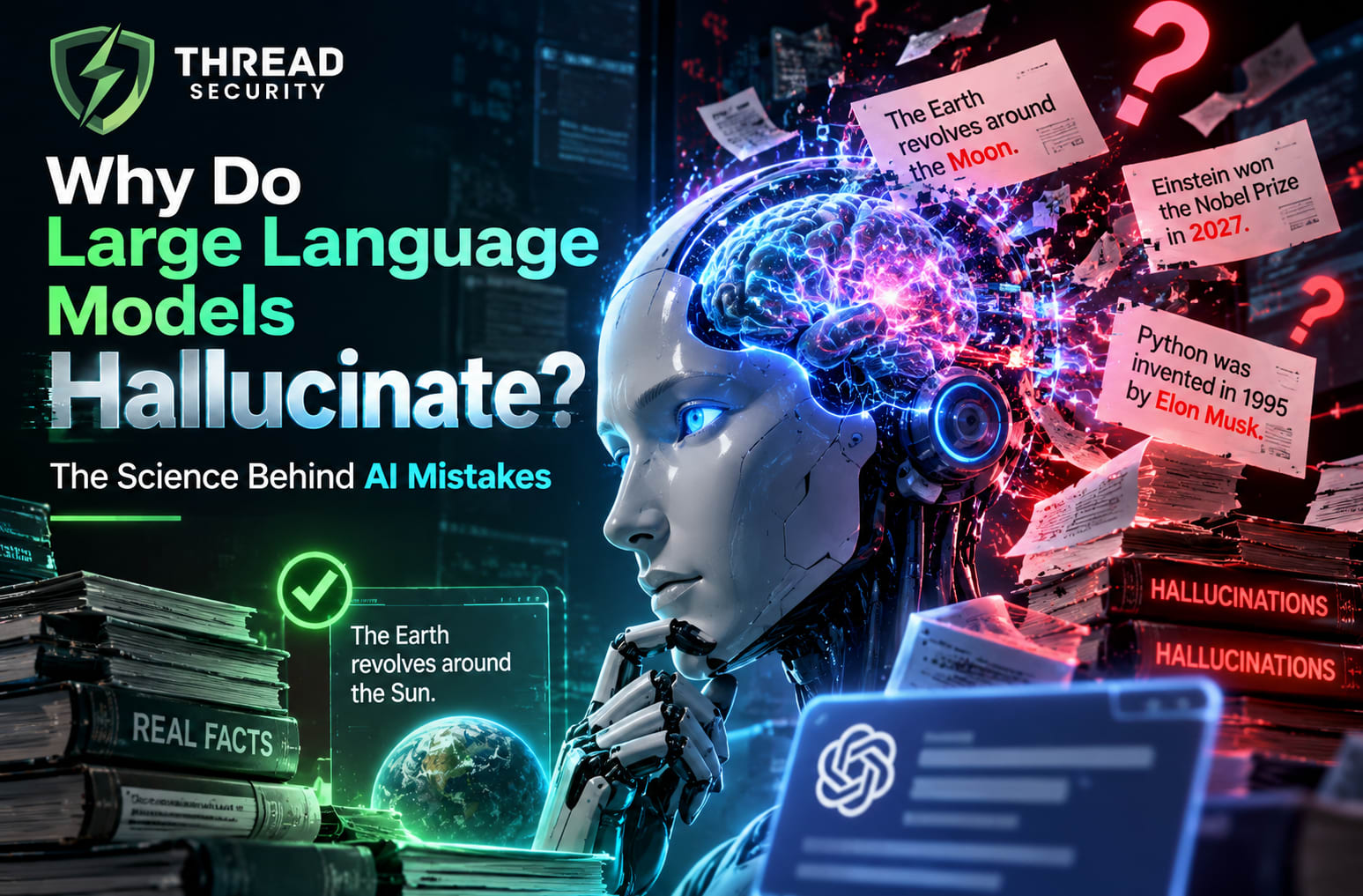
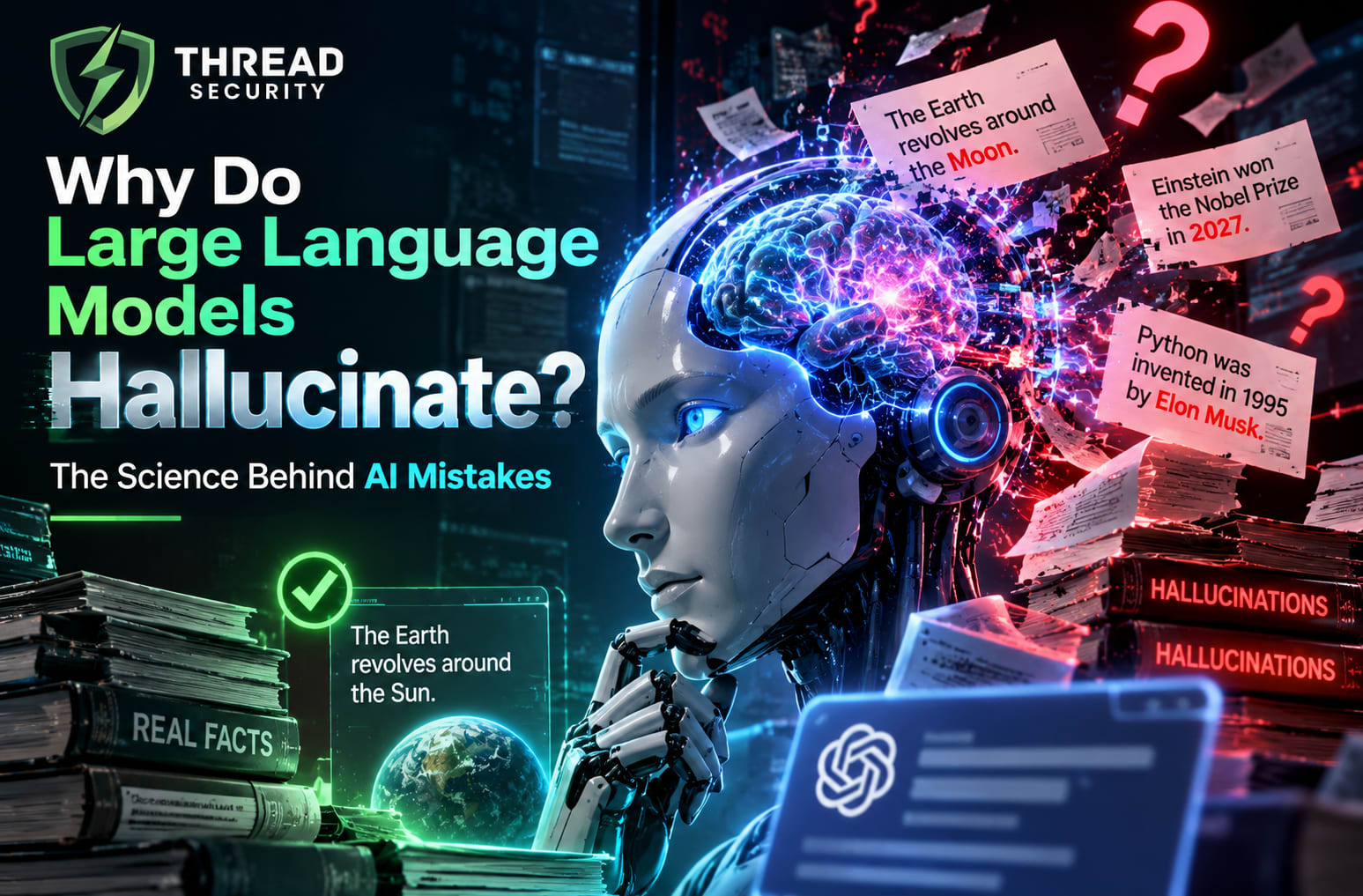
Large language models (LLMs) can draft essays, write code, and summarize research in seconds — yet when pushed beyond what they know, large language models hallucinate: they state false information with complete confidence. This behavior, known as hallucination, is one of the biggest obstacles to trusting AI in real-world work. This guide explains what hallucinations are, the science behind why they happen, and the practical techniques used to reduce them in 2026.
What Is an LLM Hallucination?
An LLM hallucination is an output that sounds fluent and plausible but is factually wrong, unsupported by the input, or entirely fabricated. The model is not lying and it is not confused in a human sense. It is producing the most statistically likely text, and sometimes that text does not match reality. The danger lies in the tone: hallucinated answers are usually delivered with the same confidence as correct ones.
How LLMs Actually Generate Text
To understand hallucination, it helps to understand the core mechanism. An LLM is trained to predict the next token — a word or word fragment — given everything that came before it. During training it learns patterns, associations, and styles from massive text datasets. During generation it repeatedly picks a likely next token until the answer is complete. At no point does it consult a database of verified facts. It generates language that fits the pattern of a good answer, not necessarily a true one.
Root Causes of Hallucination
Hallucinations are not caused by a single flaw. Several factors in how models are built, trained, and evaluated combine to produce them.
1. Gaps and Noise in Training Data
Training data is huge but imperfect. It contains errors, outdated facts, contradictions, and topics with very little coverage. Rare facts — such as an obscure person, paper, or event — appear too few times for the model to learn them reliably, so it fills the gap with something plausible.
2. The Next-Token Prediction Objective
Because the model is optimized for fluent continuation rather than truth, it has no built-in mechanism to distinguish a fact from a convincing guess. Facts with clear, repeated patterns, like spelling or grammar, are learned well. Arbitrary facts, like a specific date or citation, have no pattern to learn from and are the most error-prone.
3. Training and Evaluation Reward Guessing
Many benchmarks score a correct answer as a win and both a wrong answer and a blank answer as zero. Under that scoring, a model that always guesses outperforms one that says "I don't know." Researchers have argued that this incentive teaches models to bluff instead of admitting uncertainty.
4. No Grounding in External Reality
A standalone LLM only knows what was in its training data up to a cutoff date. It cannot check a source, browse a document, or verify a claim unless it is connected to tools. Without grounding, anything outside its training knowledge becomes a candidate for invention.
5. Decoding Choices and Error Snowballing
Settings such as temperature and sampling add randomness that can push the model toward less likely, and less accurate, tokens. Once a model generates one wrong statement, later tokens are conditioned on that mistake, so a small error can snowball into a long, internally consistent but false answer.
Types of AI Hallucinations
Not all hallucinations look the same. Recognizing the type makes them easier to catch.
Factual Hallucinations
The model states incorrect facts, such as a wrong date, statistic, or biography detail.
Faithfulness Hallucinations
The model contradicts or ignores the source material it was given, for example by adding claims to a summary that the original document never made.
Fabricated Sources
The model invents citations, links, court cases, or research papers that look real but do not exist.
Reasoning Hallucinations
The model produces steps that look logical but contain flawed math or invalid inferences, arriving at a wrong conclusion with a convincing explanation.
Why Hallucinations Matter
In casual use, a wrong answer is an annoyance. In professional settings it becomes a real risk. Lawyers have been sanctioned for submitting AI-invented case citations, medical and financial advice can be dangerously wrong, and customer-facing chatbots can make false promises on behalf of a company. Any workflow that depends on AI output without verification inherits the model's error rate.
Hallucinations and Cybersecurity
For security teams the stakes are especially clear. An LLM may invent a CVE identifier, describe a vulnerability that does not exist, or suggest a command that does not work or causes harm. Developers who trust AI-generated code can also be exposed to package hallucination, where the model recommends a library name that does not exist. Attackers can register those names and publish malicious packages, turning a model's mistake into a supply chain risk.
How to Reduce Hallucinations
Hallucinations cannot be eliminated entirely today, but they can be reduced significantly with the right design and habits.
Retrieval-Augmented Generation (RAG)
RAG connects the model to a trusted knowledge base or search index. The system retrieves relevant documents first and instructs the model to answer from them, which anchors responses in real, current sources.
Better Prompting
Clear instructions help. Ask the model to answer only from the provided context, to cite its sources, and to say when it does not know. Giving permission to say "I'm not sure" reduces forced guessing.
Lower Temperature and Structured Output
Reducing randomness makes responses more consistent for factual tasks. Constraining outputs to defined formats also limits room for invention.
Tool Use and Verification Layers
Connecting models to calculators, code interpreters, and search tools lets them check work instead of guessing. A second pass, in which another model or a rule-based check validates claims against sources, catches many errors before they reach the user.
Training for Calibrated Uncertainty
Newer training approaches reward models for abstaining or expressing uncertainty when they are unsure, instead of rewarding every confident answer. Fine-tuning on high-quality, verified data also improves factual reliability.
Human Review
For high-stakes outputs such as legal, medical, financial, or security content, a qualified human must verify claims before they are used.
How to Spot a Hallucination
Users can protect themselves with a few habits. Verify names, numbers, quotes, and citations against original sources. Be cautious with very specific details on obscure topics. Ask the same question in different ways and compare answers, since inconsistent responses are a warning sign. Treat confident tone as style, not evidence of accuracy.
The Future of Reliable AI
Research is moving toward models that know what they do not know. Better grounding, improved evaluation methods that penalize confident errors, and agentic systems that verify their own work are all reducing hallucination rates. Still, the nature of probabilistic text generation means some level of error will remain, which makes verification a permanent part of responsible AI use.
Conclusion
LLMs hallucinate because they are built to generate plausible language, not to guarantee truth. Training data gaps, prediction-based learning, reward structures that favor guessing, and a lack of grounding all contribute. The solution is not to avoid AI but to use it wisely: ground it in trusted data, design prompts that allow uncertainty, add verification, and keep humans in the loop. Understanding the science behind AI mistakes is the first step toward building and using AI systems you can trust.
Nardeep Singh
VERIFIEDAI/ML Associate · Thread Security
Faculty mentor & research guide at Thread Security Education.