When Technology Creates Difficult Questions
AI ethics for students is not just about learning a list of rules that artificial intelligence systems should follow. It is about understanding the difficult decisions that arise when AI affects people's privacy, opportunities, work, education, and everyday lives. A system may be technically impressive and still create problems for the people who use it or are affected by it.
Imagine an AI tool that helps a teacher evaluate assignments. It saves time, but occasionally gives lower scores to students who express ideas differently. Another system recommends candidates for a job, but its decisions appear to favour certain backgrounds. These situations raise questions that cannot always be answered by looking at technical performance alone.
Ethical questions become especially important when an AI system makes decisions that influence real people. Who is responsible when something goes wrong? How much personal information should a system collect? Should AI-generated work be treated as original? These questions require careful discussion rather than automatic agreement with the technology.
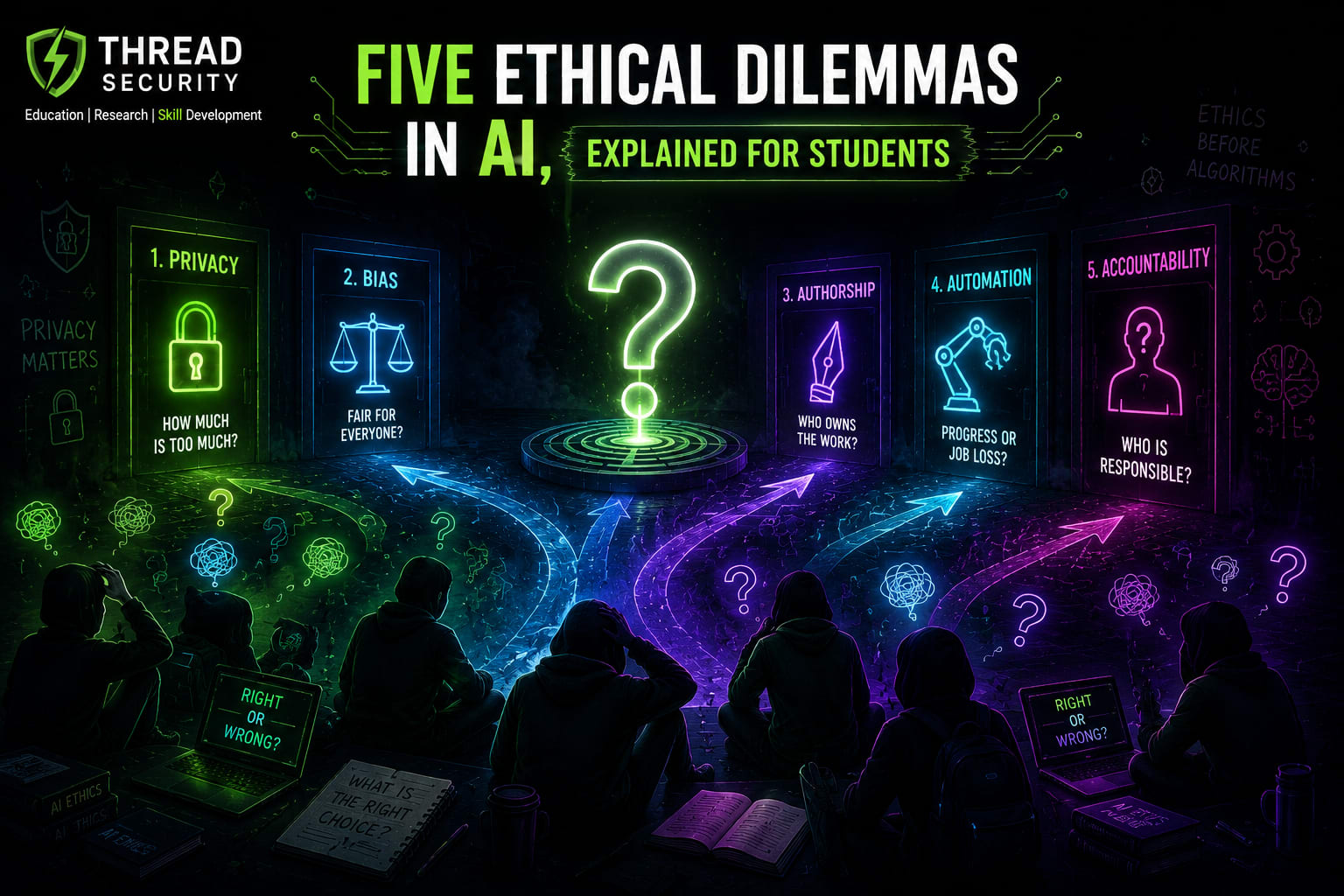
In this article, we explore five fictional scenarios involving privacy, bias, authorship, automation, and accountability. Each scenario presents competing perspectives and discussion questions so students can examine the issues from more than one side.
1. Privacy: Should an AI Tool Collect More Data to Give Better Results?
The scenario: The always-on study assistant
A university introduces an AI-powered study assistant. It recommends learning resources, identifies topics where students may need help, and sends personalized reminders. To improve its recommendations, the platform requests access to students' assignment history, browsing activity, location, study schedule, and interaction records.
The university argues that collecting more information will help the system understand individual learning patterns. Some students appreciate the personalized support. Others are uncomfortable because they do not know exactly how much information is being collected, how long it will be stored, or whether it could be used for purposes beyond education.
The ethical dilemma
Personalization can be useful, but collecting additional data creates privacy risks. More information may improve certain predictions, yet it also increases the consequences of unauthorized access, misuse, or accidental exposure.
One perspective is that students should be able to benefit from personalized learning tools when data collection is clearly explained and appropriately protected. Another perspective is that educational support should not require students to surrender unnecessary personal information.
There is also a practical question: should students who refuse optional data collection receive a less useful version of the service? If participation is effectively compulsory, consent may not be as meaningful as it appears.
Discussion questions
Should an educational AI platform collect all available student data if doing so might improve recommendations?
What information is genuinely necessary for the tool to perform its main function?
Should students be allowed to use the platform without sharing optional personal information?
Who should decide how long student data is retained?
Key consideration: Better personalization is not automatically a sufficient reason to collect more information. The purpose, necessity, transparency, security, and control associated with data collection all matter.
2. Bias: Can an AI System Treat Everyone Fairly?
The scenario: The automated scholarship shortlist
A university develops an AI system to shortlist students for scholarships. It analyses previous scholarship records and uses information such as academic performance, extracurricular participation, application details, and other available variables.
After several selection cycles, students notice that applicants from certain backgrounds appear less frequently in the shortlist. The development team checks the system and discovers that historical scholarship decisions were used as training examples. Those historical decisions may have reflected unequal access to opportunities.
The ethical dilemma
Machine learning models identify patterns in data. However, patterns from historical decisions are not necessarily fair or appropriate to repeat. If earlier selection processes favored certain groups, a model trained on those decisions may reproduce or amplify existing disadvantages.
One argument is that automated selection can make decisions more consistent by applying the same defined process to every applicant. Another is that consistency does not guarantee fairness if the underlying data or evaluation criteria are already biased.
Removing an obviously sensitive variable may not solve the problem either. Other features can sometimes act as indirect indicators of background or access to opportunities.
The university must decide whether to continue using the model, revise its training data, change its evaluation criteria, or introduce additional human review. Each option has practical consequences and requires evidence rather than assumptions.
Discussion questions
Can a model be accurate while producing unfair outcomes for particular groups?
Should historical decisions be used as training data without first examining how they were made?
Is removing sensitive information enough to prevent algorithmic bias?
Who should evaluate fairness before an AI system is used for scholarship selection?
Key consideration: Fairness is not a single technical setting. It requires examining data, model behavior, evaluation methods, affected groups, and the real-world context in which decisions are made.
3. Authorship: Who Owns AI-Generated Work?
The scenario: The AI-assisted research assignment
A student uses a generative AI tool to prepare a research assignment. The student provides the topic, asks the system to suggest an outline, generates explanations for several sections, and uses AI to improve the language. The student then edits the final document and submits it under their own name.
The institution's academic policy permits certain forms of AI assistance but requires students to disclose substantial AI-generated contributions. The student believes that because they selected the topic, checked the information, and edited the output, the work should count as their own.
The instructor is concerned that the submitted document does not clearly distinguish the student's original analysis from AI-generated material.
The ethical dilemma
AI tools can support brainstorming, editing, translation, coding, and research preparation. However, using a tool to assist with a task is not necessarily the same as independently producing the intellectual work being assessed.
One perspective is that AI is simply another productivity tool. Students should be allowed to use it when they remain responsible for the final result and understand what they submit.
Another perspective is that undisclosed AI-generated content can misrepresent a student's knowledge and effort. If an assignment is designed to assess independent reasoning, extensive undisclosed assistance may undermine the purpose of the assessment.
There are also broader questions about attribution, copyright, originality, and the legal status of AI-generated material. These issues can depend on the applicable law, platform terms, institutional policy, and the nature of the contribution. There is no universal answer that applies to every AI-assisted document.
Discussion questions
When does AI assistance become a substantial contribution that should be disclosed?
Should students be allowed to submit AI-generated content after reviewing and editing it?
How can institutions distinguish responsible assistance from misrepresentation?
Should every AI tool used during an assignment be mentioned in a disclosure statement?
Key consideration: Responsible AI use involves understanding the contribution made by the tool, verifying the output, following applicable academic rules, and being transparent about the work submitted.
4. Automation: Should AI Replace Human Roles?
The scenario: The AI-powered customer support department
A company introduces an AI customer support system that can answer common questions, process routine requests, and operate around the clock. The system reduces response times and lowers operating costs. Management begins considering whether some existing support positions can be removed.
Some customers prefer the quick responses provided by the AI system. Others struggle when their problems are unusual or emotionally sensitive. Employees are concerned about losing their jobs, while management argues that automation will allow the company to redirect resources towards more complex services.
The ethical dilemma
Automation can improve efficiency, reduce repetitive work, and make certain services available at more times. At the same time, it can change employment opportunities and shift responsibilities between humans and machines.
One perspective is that organizations should adopt technology that improves productivity and allows employees to focus on higher-value tasks. Another perspective is that efficiency should not be considered separately from the impact on workers, customers, and communities.
There is also a question of capability. An AI system may perform well on routine requests but fail when a situation requires judgement, empathy, unusual problem-solving, or an understanding of context. A human escalation option may therefore remain important even when automation handles most interactions.
Rather than assuming that every task should be automated or that automation should never replace human work, organizations need to evaluate the consequences of each deployment.
Discussion questions
Should companies prioritize productivity if automation reduces the number of available jobs?
Which customer support tasks should remain under human control?
Should organizations provide training or transition support to employees affected by automation?
How should companies measure success beyond cost savings and response time?
Key consideration: Automation decisions involve technical capability, economic benefits, service quality, employment effects, and the responsibilities organizations have towards affected people.
5. Accountability: Who Is Responsible When AI Makes a Harmful Decision?
The scenario: The rejected insurance claim
An insurance company uses an AI-based system to review claims and identify applications that require additional investigation. A customer receives a rejection after the system flags inconsistencies in the submitted information.
The customer believes the information is correct and asks for an explanation. The support team says the automated system produced the result. The technology provider says the model was configured using the insurer's requirements. The insurer's internal team says the final workflow follows the system's recommendations.
Each party points towards another part of the process, and the customer struggles to identify who can properly review the decision.
The ethical dilemma
AI systems are often developed, supplied, configured, and operated by different people or organizations. This can make responsibility difficult to trace when something goes wrong.
One perspective is that developers should be accountable for technical failures, such as defects in the model or software. Another perspective is that the organization deploying the system must remain responsible for how it uses the output and how affected people can challenge decisions.
These responsibilities are not necessarily mutually exclusive. Developers, vendors, operators, and decision-makers may each have different obligations depending on their roles, agreements, and applicable requirements.
A responsible system should have clear ownership, appropriate testing, monitoring, documentation, escalation procedures, and a way to review important decisions. Simply saying that an AI model made the decision does not explain who is responsible for acting on its output.
Discussion questions
Should the developer, technology provider, or organization using the AI system be responsible for a harmful outcome?
Should a person be able to request human review of an important automated decision?
What information should organizations document about AI-supported decisions?
Can accountability work effectively if nobody is clearly responsible for monitoring the system?
Key consideration: Accountability requires identifiable responsibilities and meaningful review processes. An AI system should not become a convenient excuse for avoiding responsibility.
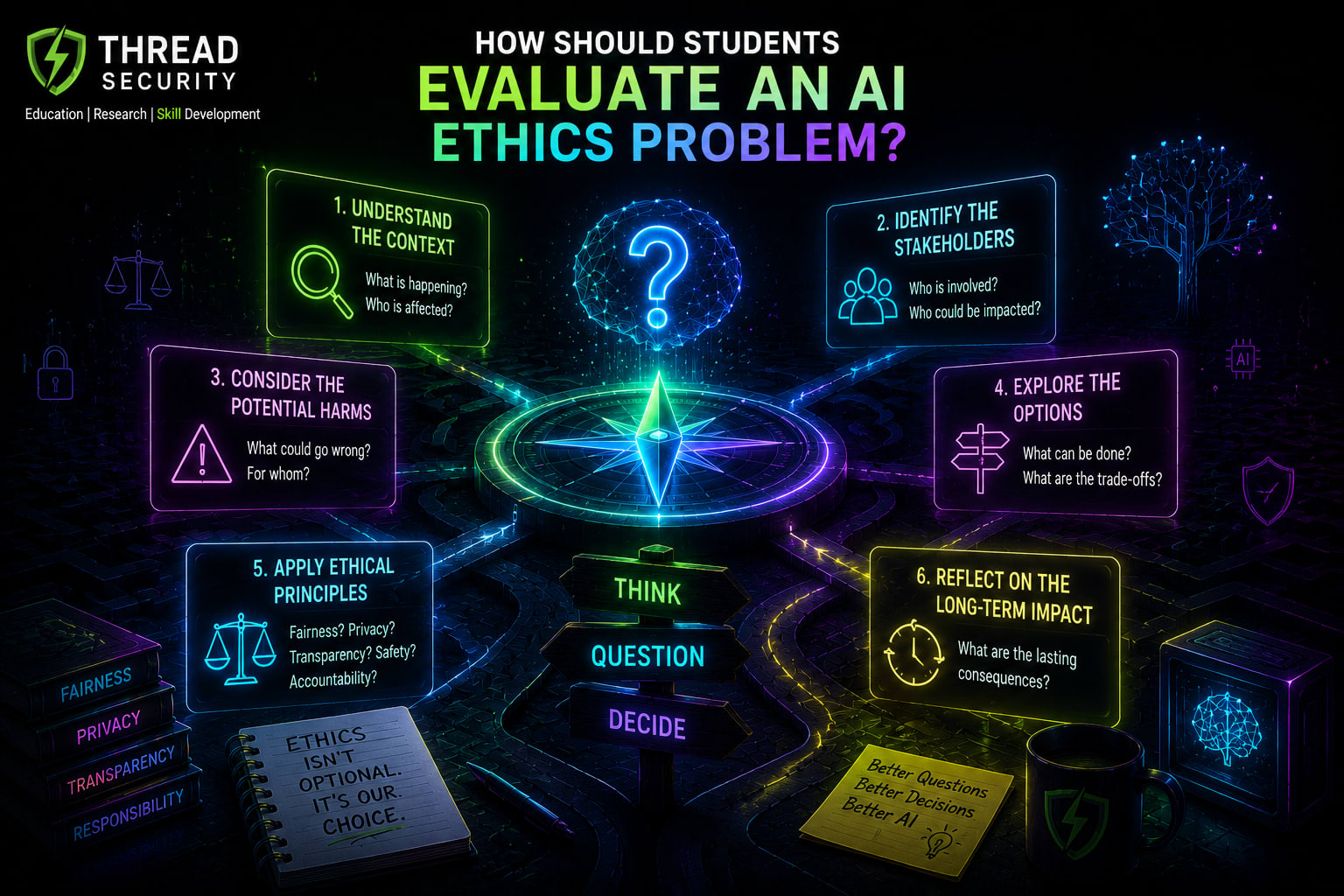
6. How Should Students Evaluate an AI Ethics Problem?
The five scenarios show that ethical questions rarely involve only one technical decision. They often involve competing interests, uncertain consequences, and different perspectives. Instead of immediately choosing a side, students can use a structured approach to analyze the problem.
Identify the stakeholders: List everyone affected, including users, employees, organizations, customers, and people whose data is processed.
Define the actual problem: Separate the technical issue from the wider social or organizational concern.
Identify potential benefits: Examine what the AI system is expected to improve and who benefits.
Identify possible harms: Consider privacy risks, unequal outcomes, inaccurate outputs, lost opportunities, and other negative consequences.
Compare alternatives: Explore whether the system could be redesigned, limited, monitored, or replaced with another approach.
Consider responsibility: Determine who should make decisions, review outcomes, and respond when something goes wrong.
Revisit the decision: Consider whether new evidence or changing circumstances could affect the conclusion.
This method does not produce an automatic ethical verdict. Its purpose is to make reasoning clearer and ensure that important perspectives are not ignored.
7. A Classroom Activity: The AI Ethics Decision Room
Students can turn these scenarios into a short group discussion activity. Divide the class into five groups and assign one dilemma to each group. Each group should analyze its scenario and prepare a short explanation of the different viewpoints involved.
Ask each group to complete the following tasks:
Identify the main ethical issue.
List at least two groups or individuals affected by the situation.
Explain one argument supporting the AI system's use.
Explain one argument raising concerns about its use.
Suggest one possible safeguard or alternative.
Prepare one question that another group may find difficult to answer.
After the discussion, ask groups to exchange scenarios and challenge each other's reasoning. The objective is not to select a winning opinion. It is to understand why reasonable people may disagree and what evidence could help resolve the issue.
Students should also distinguish between facts stated in a scenario and assumptions they introduce while discussing it. This makes the activity more analytical and prevents opinions from being presented as established evidence.
Frequently Asked Questions
What is AI ethics in simple terms?
AI ethics examines the principles and responsibilities involved in developing and using artificial intelligence. It includes questions about privacy, fairness, transparency, safety, human impact, and accountability.
Why should students learn AI ethics?
Students who develop, use, or evaluate AI systems need to understand their possible consequences. Ethical awareness helps them identify risks, question automated decisions, and make more responsible technical choices.
Can AI systems be completely unbiased?
There is no simple guarantee that an AI system will be free from bias. Data, model design, evaluation choices, and deployment conditions can all influence outcomes. Bias must be examined and managed in the context of the application.
Is using generative AI for assignments unethical?
Not automatically. It depends on the assignment's purpose, institutional rules, the extent of AI assistance, and whether the contribution is disclosed appropriately. Students should follow the applicable academic policy.
Who is accountable for an AI system's decisions?
Responsibility depends on the roles of the developers, providers, operators, and organizations using the system, as well as applicable laws and agreements. Clear ownership and review procedures are important.
Final Thoughts: Ethical AI Requires More Than Technical Skills
Artificial intelligence is not simply a collection of algorithms, models, and applications. Its use involves people, organizations, decisions, and consequences. A technically successful system can still raise difficult questions about privacy, bias, authorship, automation, and accountability.
There is no single answer that resolves every ethical dilemma. The right approach depends on the context, the people affected, the available evidence, and the responsibilities involved. What matters is the ability to examine different perspectives, question assumptions, and understand the potential consequences before making a decision.
At Thread Security Education, we encourage learners to develop both technical knowledge and responsible problem-solving skills. Whether you are exploring responsible AI, building machine learning applications, or searching for AI courses in Jalandhar, understanding the impact of technology is an important part of becoming a capable AI professional.
Visit Thread Security to explore our learning resources and training opportunities. Build your technical skills, question the systems you use, and learn to approach artificial intelligence with responsibility.
Simranjit Kaur
VERIFIEDAI Trainer · Thread Security
Faculty mentor & research guide at Thread Security Education.