AI agents are software systems that can understand a goal, plan the steps to reach it, use tools, and act with limited human supervision. Where earlier AI tools waited for a prompt and returned an answer, agents take initiative: they search, decide, execute, and adapt. This guide explains where agentic AI is heading, how autonomous workflows are being built, and why human collaboration — not human replacement — will define the next phase of work in 2025 and beyond.
What Are AI Agents?
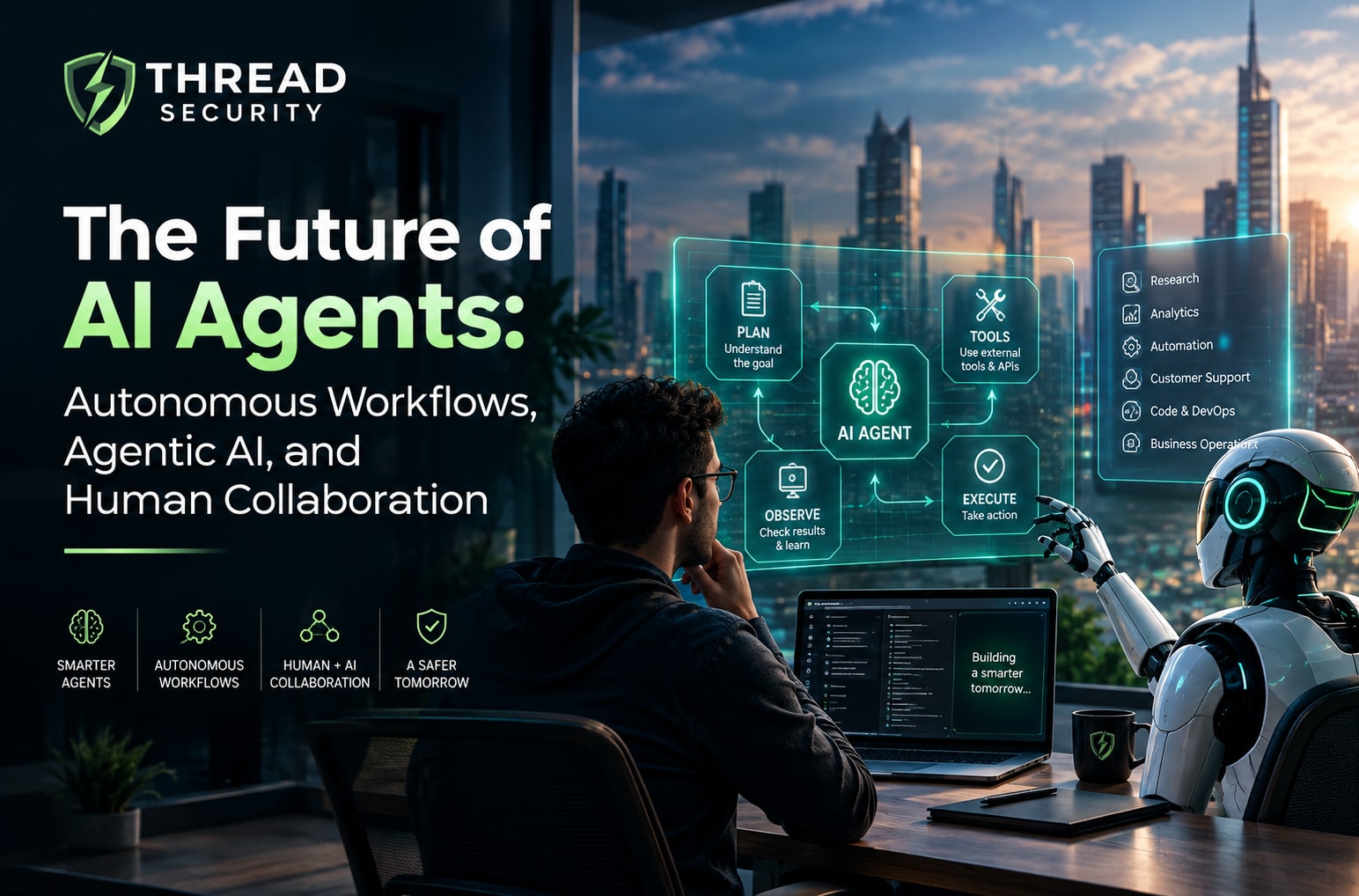
An AI agent is a system built around a large language model (LLM) that can perceive its environment, reason about a task, and take actions through tools such as APIs, databases, browsers, and code interpreters. Unlike a chatbot, an agent maintains memory, breaks a goal into subtasks, evaluates its own results, and keeps going until the job is done or it needs help. This ability to loop through plan, act, and observe is what makes a system agentic.
Understanding Agentic AI
Agentic AI describes the broader shift toward systems that pursue goals autonomously instead of simply responding to inputs. Three capabilities define it.
Reasoning and Planning
Agents decompose complex objectives into ordered steps, choose strategies, and revise their plans when something fails. This is what allows them to handle open-ended work such as researching a market or investigating a support ticket.
Tool Use and Action
Agents connect to real systems — email, CRMs, code repositories, cloud consoles, and ticketing platforms — and take action in them. Standards such as the Model Context Protocol (MCP) are making these integrations more consistent and reusable.
Memory and Learning
Short-term context and long-term memory let agents remember preferences, past decisions, and prior outcomes. Over time this makes their behavior more personalized and more reliable.
How Autonomous Workflows Work
An autonomous workflow replaces a rigid, rule-based chain of steps with a flexible loop that an agent manages from start to finish.
1. Goal Intake
A human or another system defines the objective, constraints, and success criteria. Clear goals and boundaries are the foundation of safe autonomy.
2. Planning
The agent breaks the goal into tasks, selects the tools it needs, and decides the order of execution.
3. Execution
The agent calls tools, gathers data, writes content or code, and triggers actions in connected systems.
4. Verification
The agent checks its own output against the success criteria, retries on failure, and flags uncertainty instead of guessing.
5. Human Review and Learning
High-impact actions are routed to a person for approval, and feedback is stored so future runs improve.
Multi-Agent Systems
The next step beyond a single agent is teams of specialized agents working together. A planner agent assigns work, a researcher gathers information, a coder builds the solution, and a reviewer checks quality. Orchestration frameworks such as LangGraph, CrewAI, AutoGen, and the OpenAI Agents SDK coordinate these roles. Multi-agent designs improve accuracy and scale, but they also add complexity, cost, and new failure modes that teams must monitor.
Real-World Use Cases
Agentic AI is already moving into production across industries. In software engineering, coding agents write, test, and review code. In customer support, agents resolve tickets end to end and escalate only the difficult ones. In finance and operations, agents reconcile records, process invoices, and prepare reports. In cybersecurity, agents triage alerts, enrich indicators of compromise, and draft incident summaries for analysts. In research and marketing, agents gather sources, synthesize findings, and produce first drafts that humans refine.
The Human-AI Collaboration Model
The most successful deployments treat agents as teammates, not replacements. Three collaboration patterns are emerging. Human-in-the-loop means a person approves each critical action. Human-on-the-loop means the agent works independently while a person monitors and can intervene. Human-out-of-the-loop is reserved for low-risk, well-tested tasks. Matching the pattern to the risk level is the central design decision. People shift from doing repetitive work to setting goals, reviewing results, and applying judgment, creativity, and ethics that machines still lack.
Key Metrics for Agent Performance
Agent systems need measurable standards. Task completion rate measures whether the agent finishes the job. Accuracy and error rate measure quality. Cost per task and latency measure efficiency. Escalation rate shows how often humans must step in, and intervention quality shows whether those handoffs were necessary. Tracking these metrics helps teams decide where to expand autonomy and where to add guardrails.
Skills for Working With AI Agents
Professionals who thrive alongside agents combine technical and human skills. Core skills include prompt and context design, workflow and process thinking, API and tool integration basics, data literacy, evaluation and testing of AI outputs, scripting in Python, and a strong understanding of security and privacy. Equally important are critical thinking, communication, and the ability to define clear goals and review results with a skeptical eye.
Risks and Challenges
Autonomy brings real risks. Hallucinations can lead agents to act on false information. Prompt injection and tool abuse can let attackers hijack an agent's actions. Excessive permissions can turn a small error into a major incident. Limited observability makes it hard to understand why an agent made a decision. Unclear accountability raises legal and ethical questions, and compliance requirements are still catching up. Strong governance — least-privilege access, audit logs, sandboxing, and human approval for sensitive actions — is essential.
What the Future Holds
Over the next few years, expect agents to become more reliable, better connected, and more deeply embedded in everyday software. Interoperability standards will let agents from different vendors cooperate. Small, specialized models will run cheaply at the edge, and personal agents will manage calendars, purchases, and research on behalf of individuals. Roles will evolve rather than vanish: workers will become orchestrators and supervisors of digital teams. Human judgment will remain irreplaceable, but it will be amplified by increasingly capable agents.
Conclusion
The future of AI agents is autonomous, collaborative, and full of opportunity — provided it is built on trust, transparency, and strong oversight. By understanding agentic AI, designing safe autonomous workflows, and learning to collaborate with intelligent systems, individuals and organizations can turn automation into a lasting advantage. Whether you are experimenting with your first agent or scaling a multi-agent platform, the principle stays the same: define clearly, automate wisely, supervise continuously, and keep humans at the center.
Nardeep Singh
VERIFIEDAI/ML Associate · Thread Security
Faculty mentor & research guide at Thread Security Education.