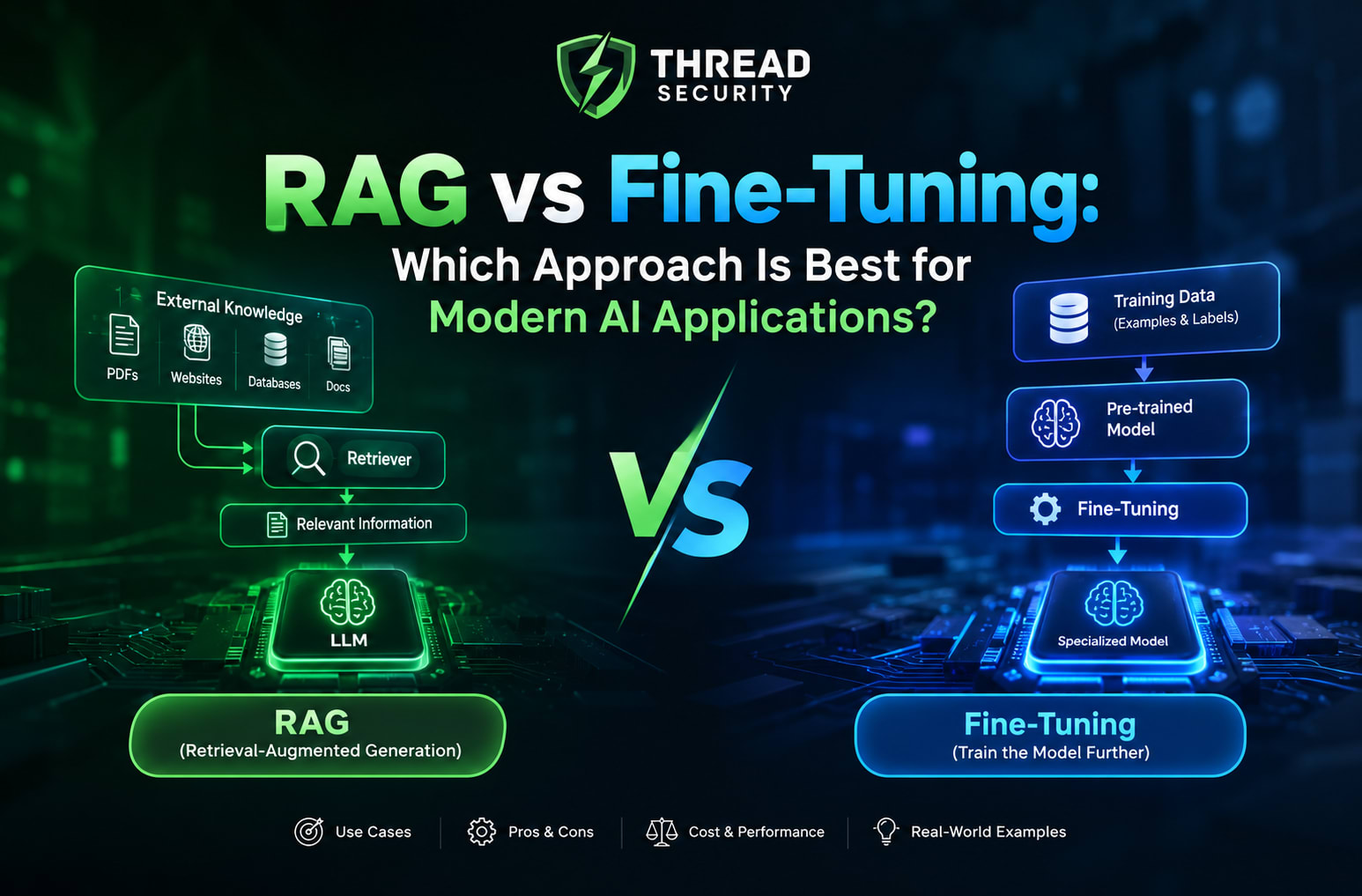
RAG vs Fine-Tuning is one of the most common decisions teams face when they move a large language model (LLM) from a demo to a real product. Both approaches promise to make a general-purpose model work better for your data and your use case, but they solve very different problems. Retrieval-augmented generation (RAG) gives the model access to outside knowledge at the moment it answers, while fine-tuning changes the model itself through additional training. This guide explains how each works, compares them across the factors that matter in production, and gives you a simple framework for choosing the right approach for modern AI applications.
What Is RAG?
Retrieval-augmented generation keeps the base model frozen and supplies it with relevant information at query time. Your documents are split into chunks, converted into numerical embeddings, and stored in a vector database or search index. When a user asks a question, the system retrieves the most relevant passages, adds them to the prompt, and asks the model to answer using that context. In short, RAG changes what the model sees rather than what it is.
Because answers are grounded in real text, RAG makes it easy to show citations, keep information current by simply updating a document, and restrict what each user can retrieve based on their permissions. Typical examples include internal knowledge-base search, customer support assistants built on documentation, and enterprise chatbots that answer questions from company wikis.
What Is Fine-Tuning?
Fine-tuning continues the training of a pretrained model on a curated dataset of examples, adjusting its weights so that it internalizes a new behavior. Modern teams rarely retrain every parameter. Parameter-efficient methods such as LoRA and QLoRA train small adapter layers on top of a frozen base model, which lowers cost and hardware needs and lets you swap or roll back adapters for different use cases. Managed fine-tuning services from major AI providers also let you upload examples and receive a customized model without running your own GPUs.
Fine-tuning changes how the model behaves. It is the right tool for teaching a consistent tone, a strict output format or schema, domain-specific vocabulary, or a narrow task that the model must perform reliably and quickly.
RAG vs Fine-Tuning: Key Differences
The most useful way to think about RAG vs fine-tuning is to ask where the change happens. The following factors usually decide the outcome.
Knowledge Freshness
With RAG, updating a document updates the answers almost immediately. A fine-tuned model is frozen at the time of training, so when facts change it keeps repeating the old ones until you retrain it. If your knowledge changes weekly or monthly, this single factor often settles the debate.
Accuracy and Hallucination Control
Grounding answers in retrieved text is one of the most direct ways to reduce hallucinations, because the model works from real passages instead of its memory. Fine-tuning is poor at reliably storing facts, and when facts are stored there is no clean way to update or remove a specific one later. Use RAG for knowledge, and fine-tuning for behavior.
Transparency and Governance
RAG responses can point to the exact source documents, which supports auditing, compliance, and user trust. RAG can also filter retrieval by user permissions, so different people see different data. A fine-tuned model cannot enforce row-level access, and its outputs are much harder to trace back to a source.
Cost and Latency
RAG is usually cheaper to start and to maintain, because updating knowledge means re-indexing documents rather than retraining. However, retrieved context lengthens every prompt, so you pay for it on each request, and at high volume that cost can dominate. Fine-tuned models need shorter prompts because the behavior is built in, and a small fine-tuned model can sometimes match a much larger general model on a narrow task at a fraction of the inference cost. The trade-off is the upfront investment in data preparation, training, and evaluation.
Setup Effort and Data Requirements
RAG can reach a working prototype quickly, but its quality depends heavily on clean, well-organized source data, good chunking, and strong retrieval. Fine-tuning lives or dies on the quality of its training examples, which means collecting or generating high-quality input and ideal-output pairs and keeping an evaluation set to measure progress.
When to Use RAG
Choose RAG when the problem is missing knowledge. It is the best fit when your information changes often, when users need citations, when your data is spread across large document collections, or when different users must see different content. Most teams that ask which approach to use actually need RAG first, which is why it is a sensible default for most enterprise use cases.
When to Use Fine-Tuning
Choose fine-tuning when the problem is missing behavior. It works well for enforcing a brand voice, producing strictly structured outputs for downstream automation, adapting to specialized terminology in fields like law, finance, or medicine, and building small, fast, low-cost models for a narrow task. Examples include industry-specific sentiment classifiers and coding assistants that follow a company's internal conventions.
Can You Combine RAG and Fine-Tuning?
Yes, and the combination is often stronger than either approach alone because they address different needs. A common production pattern places a fine-tuned model behind a RAG pipeline: fine-tuning supplies the tone, format, and reasoning style, while retrieval supplies the current facts. A support assistant, for example, can be fine-tuned on past transcripts to match your brand voice and then retrieve up-to-date policies and account details at answer time. A medical question-answering system can be fine-tuned for a structured output format while retrieving current clinical guidelines.
Do Not Forget Prompt Engineering
Prompt engineering is the third option that often gets left out. Clear instructions, examples, and well-designed prompts are the cheapest way to improve results, so try them first. In practice, many strong systems use all three together: a well-crafted prompt, RAG to ground answers in current data, and fine-tuning only for the specific behaviors that prompting and retrieval could not reliably fix.
A Simple Framework for Choosing
Use these steps to decide in a structured way:
1. Start With Prompting
Build a baseline with a strong base model and a well-written prompt, and measure it against a realistic test set.
2. Add RAG if the Gap Is Knowledge
If answers are wrong or outdated because the model lacks your information, add retrieval and improve chunking, search quality, and source data.
3. Add Fine-Tuning if the Gap Is Behavior
If the model still fails on tone, format, or a narrow skill despite good prompts and retrieval, fine-tune with high-quality examples, and consider a smaller model if cost or latency matters.
4. Evaluate Continuously
Score every version on correctness, style adherence, hallucination rate, latency, and cost against your baseline, and re-run those tests whenever data or models change.
Conclusion
The real answer to RAG vs fine-tuning is that they are not rivals. RAG supplies knowledge, fine-tuning shapes behavior, and prompt engineering ties them together. Reach for RAG first when your problem is knowledge, reach for fine-tuning when your problem is behavior, and combine them when your application needs both accurate, current answers and a consistent, specialized voice. Teams that follow this order spend less, ship faster, and build AI applications that stay reliable as their data and models evolve.
Nardeep Singh
VERIFIEDAI/ML Associate · Thread Security
Faculty mentor & research guide at Thread Security Education.