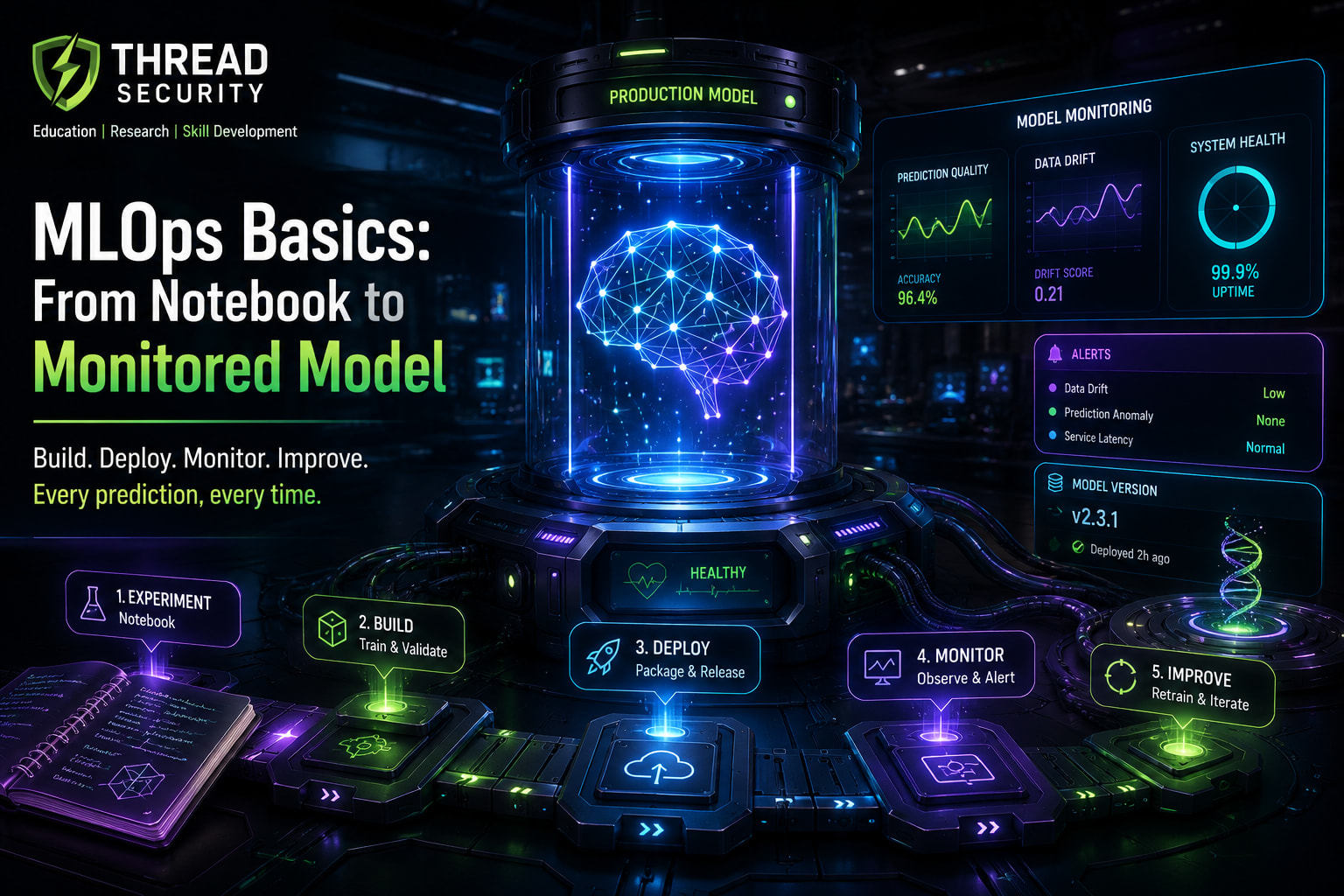
Introduction: A Machine Learning Model Is Not the Finish Line
MLOps basics begin with an important question: what happens after a machine learning model produces accurate predictions in a Jupyter Notebook? A data scientist may train a model, evaluate its performance, adjust its parameters, and achieve promising results. However, that does not automatically mean the model is ready to serve real users or handle real-world data.
Consider a model developed to predict customer demand. It performs well on historical data during experimentation, but a business needs to use its predictions every day. The model must receive new inputs, return results reliably, handle changing data, and remain available when users need it. Someone must also track its performance and identify when it stops behaving as expected.
This is where Machine Learning Operations, commonly called MLOps, becomes important. MLOps brings development practices, automation, deployment processes, and monitoring together to manage machine learning models throughout their lifecycle.
In this guide, we will follow the journey from a notebook-based experiment to a deployed and monitored model, understand the components involved, and explore the skills required to build practical MLOps workflows.
1. What Is MLOps?
MLOps is a set of practices and technologies used to develop, deploy, monitor, and maintain machine learning systems. It combines ideas from Machine Learning, Data Engineering, DevOps, and software engineering.
Traditional software applications usually follow a development and deployment process based on code. Machine learning applications introduce additional dependencies. Their behavior also depends on training data, selected features, model parameters, and the environment in which they operate.
For example, changing a dataset can produce a different model even when the training code remains unchanged. Similarly, a model that performed well during testing may become less accurate when real-world patterns change.
MLOps helps teams manage these moving parts through repeatable workflows, traceable experiments, automated testing, controlled releases, and continuous monitoring.
It does not mean that every ML project needs a complicated infrastructure. A small project may only need organized experiment tracking, version control, and a simple deployment process. The level of automation should match the project's requirements.
2. Why a Notebook Is Not Enough
Jupyter Notebooks are useful for exploring datasets, visualizing patterns, testing algorithms, and experimenting with machine learning models. They provide an interactive environment where developers can execute code step by step.
However, a notebook is primarily an experimentation environment. It is not automatically a reliable production system.
Several problems can appear when a notebook-based model moves towards deployment:
Untracked experiments: Developers may forget which dataset, parameters, or code version produced a particular result.
Dependency differences: The notebook may work on one laptop but fail in another environment because package versions or system configurations differ.
Manual execution: Repeating data preparation, training, and evaluation manually can introduce mistakes.
Limited reproducibility: Another developer may struggle to reproduce the same result without knowing the complete experiment configuration.
No production monitoring: A model can continue returning predictions even when its input data or prediction quality has changed significantly.
The solution is not to stop using notebooks. Instead, the goal is to move important logic into organized, reusable code and connect experimentation with a structured development and deployment workflow.
3. Understanding the Machine Learning Lifecycle
Before exploring individual tools, it helps to understand the lifecycle that an MLOps workflow manages. Although the exact process differs between projects, most systems involve several connected stages.
Data collection: Gather data from approved and relevant sources.
Data preparation: Clean, validate, transform, and organize the data.
Model development: Select an algorithm, train the model, and experiment with parameters.
Model evaluation: Measure performance using suitable metrics and validation data.
Model packaging: Prepare the trained model and its dependencies for deployment.
Deployment: Make the model available through an API, application, batch process, or another serving mechanism.
Monitoring: Observe system health, incoming data, prediction behavior, and model quality.
Improvement: Investigate problems, update the model when necessary, and deploy validated improvements.
These stages are connected rather than independent. For example, a problem detected during monitoring may require the team to investigate incoming data, repeat model training, and evaluate a new version.
Step One: Prepare and Validate the Data
Data quality is one of the most important parts of a machine learning workflow. A model can only learn useful patterns when its training data is appropriate for the problem.
Imagine building a house-price prediction model. Its input features might include location, property size, number of rooms, and property age. If the training dataset contains missing values, inconsistent units, incorrect entries, or duplicated records, the resulting model may learn unreliable patterns.
A structured data preparation process should include:
Checking missing and invalid values.
Identifying duplicate records.
Validating expected data types and ranges.
Checking feature consistency between training and inference.
Separating training, validation, and test datasets appropriately.
Recording dataset versions or identifiers.
Data validation tools can automate many of these checks. For example, Great Expectations and similar frameworks can help define expectations about the structure and quality of datasets.
The important principle is to make data preparation repeatable. Instead of relying on undocumented manual steps, teams should keep transformations in reusable scripts or pipelines.
Step Two: Track Experiments and Model Versions
Machine learning development involves experimentation. Developers may try different algorithms, feature combinations, training parameters, and datasets before selecting a suitable model.
Without experiment tracking, it becomes difficult to answer basic questions: Which model performed best? Which dataset was used? What parameters produced the result? Can the experiment be reproduced?
Experiment tracking provides a record of these decisions. Common information includes:
Model algorithm and configuration.
Training and validation dataset references.
Hyperparameters used during training.
Evaluation metrics such as accuracy, precision, recall, or RMSE.
Code version and experiment timestamp.
Saved model artefacts.
Tools such as MLflow can help track experiments, log metrics, record parameters, and manage model artefacts. Other platforms may provide similar capabilities.
Model versioning is equally important. Rather than replacing a model without a record, teams should maintain identifiable versions. This makes it easier to compare releases, investigate unexpected behavior, and roll back when a newer model creates problems.
Step Three: Build Reproducible ML Pipelines
A machine learning pipeline organizes the stages of model development into a repeatable workflow. Instead of manually executing every notebook cell and script, teams define how data preparation, training, evaluation, and packaging should happen.
If a pipeline fails during data validation, the system can stop before training an unreliable model. If the evaluation stage does not meet the required performance threshold, the model can be prevented from moving towards production.
Pipeline orchestration tools help manage dependencies and execution. Depending on project requirements, teams may use Apache Airflow, Kubeflow Pipelines, Prefect, or other workflow technologies.
Not every project needs all these tools. A small application can begin with well-organized Python scripts and gradually introduce orchestration as the workflow becomes more complex.
Step Four: Package and Deploy the Model
A trained model needs a suitable environment in which it can receive inputs and produce predictions. Deployment makes that model accessible to the application or service that requires it.
One common approach is to expose the model through an API. A client sends input data to an endpoint, the application processes the request, and the model returns a prediction.
For example, a house-price prediction service might receive property details in a request and return an estimated price. The API layer handles communication, while the model performs the prediction.
FastAPI and Flask are commonly used Python frameworks for building APIs. Docker can package application code, dependencies, and configuration into a container, making it easier to run the application consistently across environments.
Deployment approaches can include:
Batch inference: Predictions are generated for a collection of records at scheduled intervals.
Real-time inference: The application returns predictions in response to individual requests.
Streaming inference: Data is processed continuously as events arrive.
Edge deployment: Models run closer to the devices or systems generating the data.
The right approach depends on latency requirements, data volume, infrastructure, cost, and application design.
Step Five: Introduce CI/CD for Machine Learning
Continuous Integration and Continuous Delivery or Deployment, commonly called CI/CD, help automate software testing and release processes. In machine learning, these practices can be extended to include data checks, model validation, and deployment requirements.
A typical workflow may run automated checks whenever a developer changes code. These checks can include unit tests, data validation, model evaluation, dependency checks, and packaging tests.
GitHub Actions, GitLab CI/CD, and Jenkins are examples of tools used to automate development workflows.
However, machine learning CI/CD is not exactly the same as traditional software CI/CD. A model release may depend on changes in training data, feature definitions, model artefacts, and evaluation results, not just source code.
A responsible release process should establish clear conditions for deployment. For instance, a new model may need to meet an agreed evaluation threshold, pass integration tests, and receive approval before replacing the existing production version.
Step Six: Monitor the Deployed Model
Deployment does not mean the work is complete. A model that performed well during evaluation can behave differently when exposed to real-world data. Monitoring helps teams understand whether the deployed system continues to operate as expected.
There are several important monitoring areas:
System performance: Track response time, request volume, errors, resource utilization, and service availability.
Data quality: Check for missing values, unexpected formats, unusual ranges, and changes in incoming features.
Prediction behavior: Observe prediction distributions and unusual changes in model outputs.
Model performance: When reliable ground-truth labels become available, compare predictions with actual outcomes using appropriate evaluation metrics.
Operational cost: Track compute usage, storage, infrastructure expenses, and other deployment costs.
Monitoring should be connected to useful alerts and investigation processes. A dashboard that displays hundreds of metrics is not sufficient if nobody knows which changes require action.
4. What Is Model Drift and Why Does It Matter?
One important reason to monitor machine learning systems is model drift. A model learns from historical data, but real-world conditions can change over time.
Two commonly discussed concepts are data drift and concept drift.
Data drift occurs when the distribution of incoming input data changes compared with the data used during training. For example, a customer recommendation system may begin receiving a different mix of customer preferences after a major market change.
Concept drift occurs when the relationship between input features and the target outcome changes. For example, customer purchasing behavior may change so significantly that patterns learned from previous years no longer predict current behavior accurately.
These changes can affect model quality, but they do not always mean the model needs immediate retraining. Teams should investigate the cause, examine relevant metrics, and determine whether the change is meaningful.
Tools such as Evidently AI can help analyze data and model behavior. The choice of monitoring approach depends on the model, available labels, application requirements, and the risks associated with incorrect predictions.
5. Retraining and Continuous Improvement
When monitoring reveals a genuine performance problem, retraining may be one possible response. However, retraining should not happen blindly every time a metric changes.
A responsible improvement workflow may involve:
Investigating the monitoring alert and confirming the problem.
Checking whether the input data or target behavior has changed.
Collecting and validating suitable updated training data.
Training a candidate model using a reproducible pipeline.
Comparing the candidate against the existing production model.
Running appropriate tests and obtaining required approvals.
Deploying the new version using a controlled release strategy.
Monitoring the new release and retaining a rollback option.
Deployment strategies such as canary releases and blue-green deployments can help reduce the risks associated with introducing a new version. The specific strategy should match the system's complexity and operational requirements.
6. A Practical Beginner MLOps Project
The best way to understand MLOps is to build a small end-to-end project. You do not need a large GPU cluster or an expensive cloud platform to understand the basic workflow.
Start with a simple house-price prediction or classification dataset. Train a model using Python and scikit-learn, and organize the code into separate files for data preparation, training, evaluation, and prediction.
Then gradually add the following components:
Experiment tracking: Record model parameters and evaluation metrics using MLflow.
Version control: Store your code in Git and maintain a clear commit history.
Model serving: Build a prediction API using FastAPI.
Containerization: Use Docker to package the application and its dependencies.
Automated testing: Create tests for data inputs, preprocessing, and prediction responses.
Monitoring: Log request counts, response times, errors, and relevant input statistics.
For a beginner, the objective is not to build a large production platform. It is to understand how each stage connects and why a deployed model needs more than a successful training score.
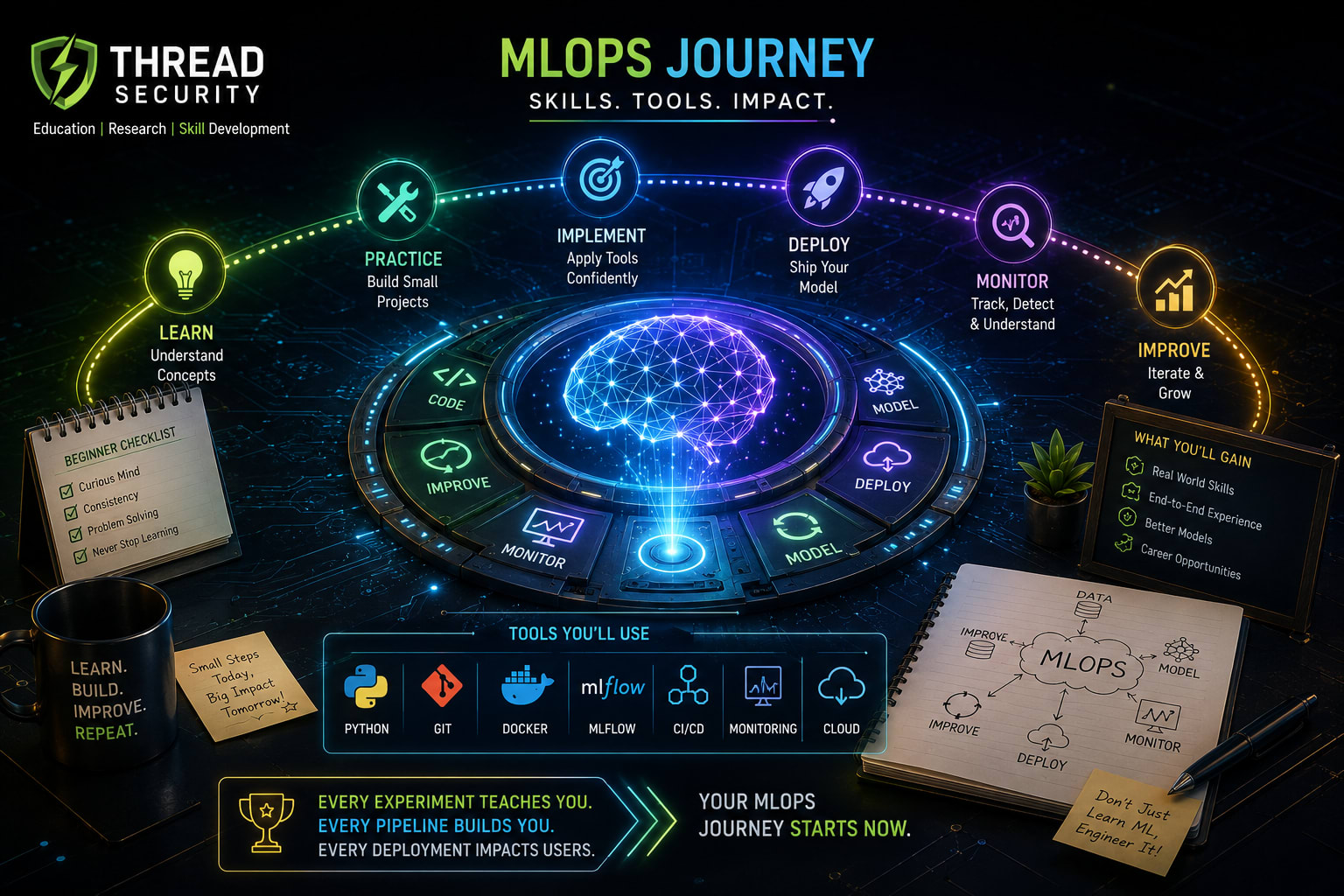
7. Skills and Tools to Learn for MLOps
MLOps combines several technical areas. Learners who already understand Python and machine learning can build on that foundation by developing software engineering and infrastructure skills.
Programming: Python, reusable code, APIs, and software testing.
Machine learning: Model training, evaluation, feature engineering, and validation.
Version control: Git and GitHub.
Experiment management: MLflow and model registries.
Containers: Docker and container fundamentals.
Automation: CI/CD pipelines and workflow orchestration.
Infrastructure: Cloud platforms, storage, compute, and deployment environments.
Monitoring: Logs, metrics, alerts, and model drift analysis.
You do not need to master every tool before starting. Begin with Python, Git, and a basic machine learning project. Then introduce deployment, experiment tracking, and monitoring as your understanding improves.
8. Common MLOps Mistakes to Avoid
When learning MLOps, beginners often focus heavily on tools and overlook the engineering practices that make a workflow reliable.
Deploying without validation: A successful training run does not prove that a model is ready for production.
Ignoring data quality: Poor or inconsistent input data can undermine model performance.
Tracking only accuracy: Different applications require different evaluation metrics and operational checks.
Skipping version control: Untracked code, data, and model versions make investigations difficult.
Ignoring monitoring: Production systems need ongoing observation, not just an initial deployment.
Automating everything too early: Start with a workflow you understand before introducing unnecessary infrastructure.
Retraining without investigation: Understand the underlying issue before replacing a working production model.
Good MLOps is not about using the maximum number of technologies. It is about creating a process that is understandable, repeatable, testable, and suitable for the problem.
Frequently Asked Questions
Is MLOps suitable for beginners?
Yes. Beginners with basic Python and machine learning knowledge can start by learning Git, model evaluation, experiment tracking, and simple model deployment. Advanced infrastructure can be introduced later.
Is MLOps the same as DevOps?
No. They share practices such as automation, testing, version control, and deployment. MLOps additionally manages machine learning-specific components such as training data, experiments, model artefacts, and model performance.
Do I need cloud computing to learn MLOps?
No. You can learn many MLOps concepts locally using Python, Git, Docker, MLflow, and a small dataset. Cloud platforms become useful when project requirements involve managed infrastructure, scalability, or distributed workloads.
What is the difference between model deployment and model monitoring?
Deployment makes a trained model available to an application or user. Monitoring observes its operational behavior and, when suitable outcome data is available, its performance after deployment.
Which tools should I learn first?
Start with Python, Git, scikit-learn, and a basic API framework such as FastAPI. Then explore MLflow, Docker, automated testing, and monitoring tools.
Final Thoughts: Move Beyond Model Training
Building a machine learning model is only one part of creating a useful AI application. The real challenge is making sure that the model can be deployed consistently, receive appropriate data, produce reliable outputs, and remain useful as conditions change.
MLOps connects experimentation with production engineering. By learning data validation, experiment tracking, model versioning, pipelines, deployment, and monitoring, aspiring AI engineers can develop a much stronger understanding of how machine learning systems work beyond notebooks.
At Thread Security Education, we encourage learners to connect theoretical knowledge with practical projects and industry-relevant technical skills. Whether you are exploring machine learning, production AI systems, or AI courses in Jalandhar, focus on building projects that demonstrate your ability to solve real technical problems.
Visit Thread Security to explore our learning resources and training opportunities. Start with one machine learning model, build a repeatable workflow around it, and take your first step towards production-ready AI engineering.
Simranjit Kaur
VERIFIEDAI Trainer · Thread Security
Faculty mentor & research guide at Thread Security Education.