Cyber attacks now move faster than any human team can track. Phishing campaigns, ransomware, and credential theft can compromise a network in minutes, while traditional signature-based tools only catch what they have already seen. Machine learning (ML) changes this by learning what normal looks like and flagging what does not, in real time. This guide explains how ML is transforming real-time cyber threat detection, how streaming pipelines work, and what security teams must know to use it well in 2025.
Why Traditional Detection Is Not Enough
Signature and rule-based detection works well against known threats but fails against new malware variants, zero-day exploits, and attackers who blend in with legitimate activity. Static rules also generate large volumes of false positives, which leads to alert fatigue and missed incidents. Modern environments with cloud workloads, remote users, and encrypted traffic produce more data than manual analysis can handle. Security teams need detection that adapts as fast as adversaries do.
How Machine Learning Detects Threats
ML models learn patterns from large volumes of security telemetry such as logs, network flows, endpoint events, and user activity. Instead of matching fixed signatures, they score behavior based on how likely it is to be malicious. Three main approaches are used.
Supervised Learning
Models are trained on labeled examples of malicious and benign activity. They excel at classifying known categories such as phishing emails, malware families, and malicious URLs.
Unsupervised Learning
These models find clusters and outliers without labels, which makes them effective at spotting unknown threats and unusual behavior that no rule anticipated.
Reinforcement and Deep Learning
Deep neural networks analyze complex data such as raw network packets, binaries, and sequences of events. Reinforcement learning is being explored for adaptive defense and automated response decisions.
The Real-Time Detection Pipeline
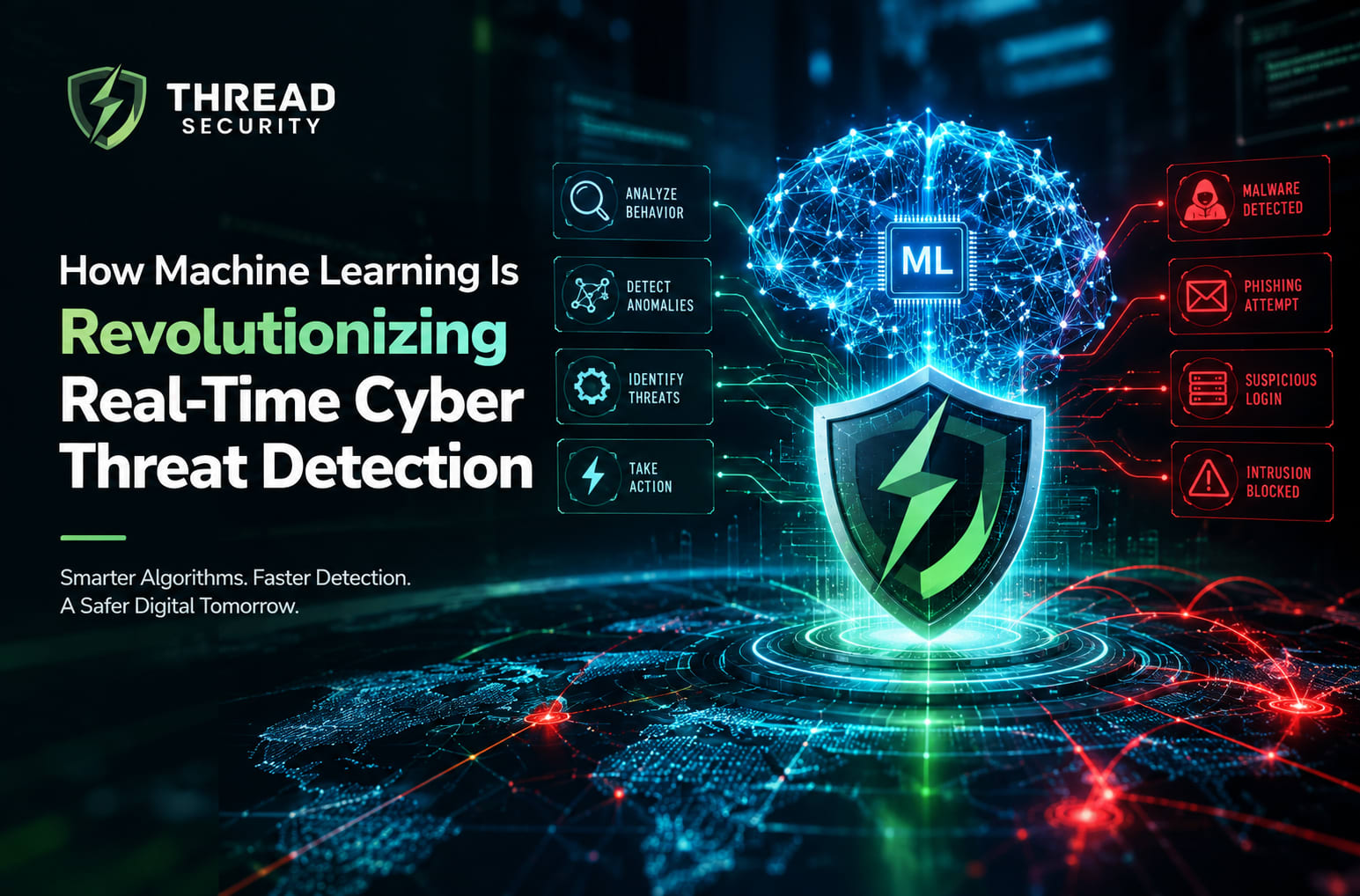
Real-time ML detection follows a continuous pipeline from raw data to action.
1. Data Collection
Telemetry streams in from firewalls, EDR agents, cloud services, DNS, and identity systems. Data quality and coverage set the ceiling for model accuracy.
2. Feature Engineering
Raw events are converted into meaningful signals, such as login frequency, data transfer volume, process lineage, and geolocation changes.
3. Model Scoring
Streaming platforms such as Kafka and Spark feed events to models that assign risk scores within milliseconds or seconds.
4. Alerting and Enrichment
High-risk detections are enriched with threat intelligence, asset criticality, and user context before reaching an analyst.
5. Response and Feedback
Confirmed incidents trigger SOAR playbooks, and analyst verdicts are fed back to retrain and improve the models.
Key Use Cases
ML is already delivering value across the security stack. User and Entity Behavior Analytics (UEBA) detects compromised accounts and insider threats by spotting deviations from normal behavior. Network detection and response models identify command-and-control traffic and lateral movement, even inside encrypted sessions. Malware classifiers analyze file attributes and behavior to catch unseen variants. Email security models flag phishing and business email compromise by analyzing language, sender patterns, and links. Fraud and identity models detect impossible travel, credential stuffing, and account takeover as they happen.
ML in the Modern SOC
Inside the SOC, machine learning acts as a force multiplier. It prioritizes alerts so Tier 1 analysts focus on the highest risks, clusters related events into single incidents, and supplies context that speeds up investigation. Mapping detections to the MITRE ATT&CK framework helps teams measure coverage and find gaps. Analysts remain essential: they validate findings, tune models, and make the final response decisions that automation should not make alone.
Key Metrics for ML Detection Performance
ML systems must be measured like any other control. Precision shows how many alerts are truly malicious, and recall shows how many real threats are caught. False positive rate reflects analyst workload, while detection latency measures how quickly a threat is surfaced. Mean Time to Detect (MTTD) and Mean Time to Respond (MTTR) show the operational impact. Model drift monitoring ensures accuracy does not quietly decay as behavior and attacks change.
Challenges and Risks
Machine learning is powerful but not magic. Poor or biased training data produces unreliable models. Unusual but legitimate behavior can trigger false positives, and black-box models can be hard for analysts to explain and trust. Attackers also target the models themselves through adversarial inputs, evasion techniques, and data poisoning. Concept drift, privacy concerns, and a shortage of professionals who understand both security and data science add further pressure. Layered defense, explainable models, and continuous validation reduce these risks.
Skills Security Professionals Need
Analysts who thrive in ML-driven security combine core defense skills with data literacy. Important skills include log and network analysis, SIEM query languages such as SPL and KQL, Python scripting, basic statistics and ML concepts, understanding of model evaluation metrics, MITRE ATT&CK mapping, and incident response fundamentals. Curiosity and critical thinking matter most, because every model output still needs to be questioned and verified.
The Future of ML-Driven Threat Detection
Detection is moving toward autonomous, context-aware defense. Large language models are helping analysts summarize alerts and query data in plain language, while agentic AI can investigate and contain low-risk incidents on its own. Federated learning will let organizations share detection intelligence without exposing sensitive data, and stronger defenses against adversarial attacks will harden the models themselves. Human judgment will remain irreplaceable, but it will be amplified by systems that detect and respond at machine speed.
Conclusion
Machine learning is turning cyber defense from reactive to proactive. By learning normal behavior, scoring risk in real time, and feeding analyst knowledge back into the system, ML helps security teams catch threats that rules alone would miss. Whether you are a Tier 1 analyst or a SOC manager, the path forward is the same: collect quality data, deploy models thoughtfully, validate constantly, and keep skilled humans in the loop.
Nardeep Singh
VERIFIEDAI/ML Associate · Thread Security
Faculty mentor & research guide at Thread Security Education.