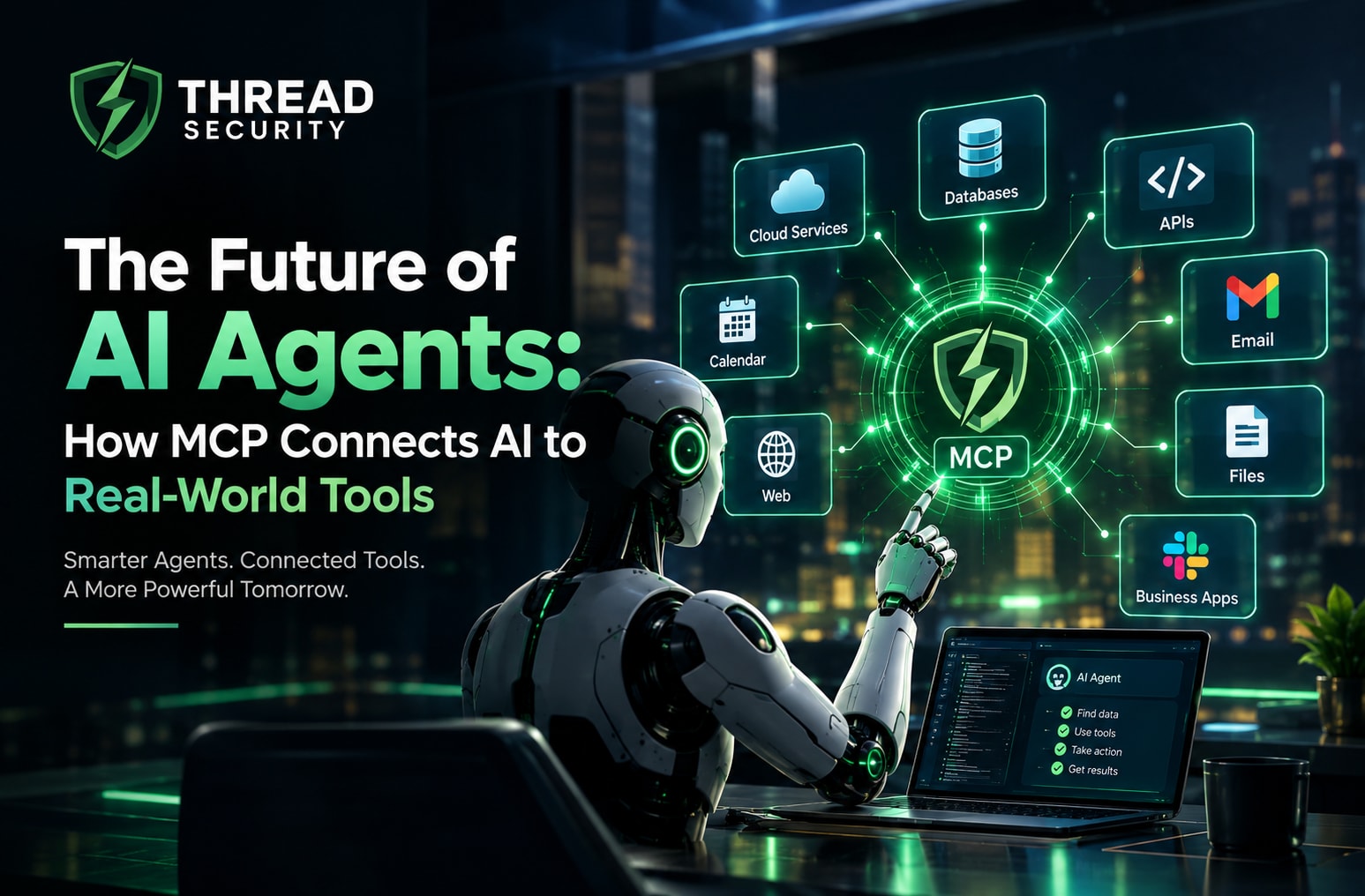
AI agents are autonomous software systems that use large language models to reason about a goal, plan multi-step tasks, and take action on a user's behalf. But an agent that can only generate text is limited. To be genuinely useful, it must read files, query databases, call APIs, and operate real software. The Model Context Protocol (MCP) is the open standard that makes this possible, giving AI agents a universal way to connect to external tools and live data. This guide explains how MCP works, why it matters, and where it is taking AI agents in 2026.
What Is MCP and Why Does It Matter for AI Agents?
The Model Context Protocol is an open, vendor-neutral standard introduced by Anthropic in late 2024 that defines how AI applications discover and use external tools, data sources, and prompts. Think of it as a USB-C port for AI: instead of writing a custom integration for every model and every service, developers build to one protocol and everything plugs in. For AI agents, this turns a language model from a text generator into an operator that can search a codebase, file a ticket, query a production database, or update a CRM record through a consistent, structured interface.
The Problem MCP Solves: The N×M Integration Gap
Before MCP, connecting AI agents to real-world tools meant writing bespoke glue code. If you had five AI applications and ten services, you potentially needed fifty separate integrations, each with its own authentication logic, data formats, and error handling. These connectors were brittle, hard to maintain, and impossible to reuse across platforms. MCP collapses that matrix into a simple sum: each application implements the client side once, each service implements the server side once, and every combination works. This is the single biggest reason MCP has been adopted so quickly across AI assistants, IDEs, and enterprise platforms.
How MCP Architecture Works
MCP follows a client-server model built on JSON-RPC 2.0 messaging. Three roles work together to give AI agents controlled access to the outside world.
MCP Host
The host is the AI application the user interacts with, such as a desktop assistant, a coding agent, or an IDE. It contains the language model, manages the conversation, enforces user permissions, and decides which connections to open.
MCP Client
Each host creates one client per server connection. The client maintains a dedicated, stateful session, negotiates capabilities during initialization, and translates the agent's intent into protocol messages.
MCP Server
The server is a lightweight program that exposes capabilities from a specific system, such as GitHub, Postgres, Slack, or a local file system. Servers expose three core primitives: tools (executable functions the agent can call), resources (read-only data such as files or records), and prompts (reusable templates that guide interactions). Communication runs over stdio for local servers or Streamable HTTP for remote ones, with OAuth-based authorization available for protected remote resources.
Core MCP Workflow for AI Agents
Every MCP-powered agent follows a repeatable loop from request to result.
1. Discovery
When a session starts, the client asks each connected server to list its tools, resources, and prompts. Each tool is described with a name, a plain-language description, and a JSON Schema for its inputs. This metadata is what the model reads to understand what it can do.
2. Planning
The model interprets the user's goal and decides which tools, in what order, are needed. Clear tool descriptions directly improve planning quality, so well-written server metadata is a core part of agent performance.
3. Tool Invocation
The client sends a structured tools/call request to the chosen server. Sensitive actions should trigger a human approval step before execution, keeping the user in control of anything that writes, deletes, or spends.
4. Result Processing
The server returns structured output, which the agent feeds back into its context. The agent evaluates the result, handles errors, and decides whether to call another tool or finish the task.
5. Response and Memory
The agent delivers a final answer or completed action to the user. Relevant context can be stored so future sessions start with a better understanding of the user's environment.
Real-World Use Cases of MCP-Powered AI Agents
MCP is already powering practical workflows across industries. In software development, coding agents use MCP servers to read repositories, run tests, open pull requests, and pull error traces from monitoring platforms. In operations, agents query databases and dashboards in natural language and summarize the findings. In business workflows, agents draft messages in Slack, update records in CRM platforms, and retrieve documents from cloud storage. In security operations, agents enrich alerts with threat intelligence, query SIEM data, and assemble incident timelines. In each case, the agent gains real capability without the developer rebuilding an integration from scratch.
Essential MCP Tools and Ecosystem
The MCP ecosystem has grown into a layered stack. Official SDKs in Python, TypeScript, Java, C#, and other languages let developers build servers and clients quickly. The MCP Inspector provides an interactive way to test and debug servers before connecting them to an agent. Hosts such as Claude Desktop, Claude Code, Cursor, and VS Code act as MCP clients, while a growing catalog of community and vendor-built servers covers version control, databases, cloud platforms, browsers, and productivity tools. Agent frameworks such as LangChain and LlamaIndex also support MCP, so teams can combine protocol-based tool access with their existing orchestration logic.
Key Metrics for MCP Agent Performance
Reliable AI agents are measured, not assumed. Tool-call success rate shows how often invocations return valid results. Task completion rate measures whether the agent actually achieves the user's goal. End-to-end latency captures the cost of multiple tool round trips. Token consumption reflects how much context tool definitions and outputs add to each request. Incorrect tool selection rate reveals weak tool descriptions or overlapping capabilities. Tracking these metrics helps teams find bottlenecks and justify further investment.
Skills Every AI Agent Developer Needs
Building with MCP rewards a mix of software engineering and security thinking. Core skills include API design and JSON Schema, Python or TypeScript development, understanding of JSON-RPC and HTTP transports, OAuth and secrets management, prompt and tool-description writing, observability and logging, and a working grasp of how large language models plan and fail. Knowledge of threat modeling is increasingly essential, because every connected tool expands the attack surface.
Security Risks and Challenges of MCP
Giving AI agents real-world access creates real-world risk. Prompt injection can hide malicious instructions inside documents, web pages, or tool outputs that the agent then obeys. Tool poisoning abuses manipulated tool descriptions to steer agent behavior. Over-permissioned servers let a single compromised agent reach far more data than necessary. Untrusted third-party servers introduce supply chain risk. Weak authentication and missing audit trails make incidents hard to detect and investigate. Standard defenses apply: enforce least privilege, require human approval for high-impact actions, sandbox servers, use scoped OAuth tokens, vet every server before installation, and log every tool call for review.
The Future of AI Agents and MCP
Several trends are shaping what comes next. Agents will coordinate with other agents, with MCP providing the shared tool layer underneath multi-agent systems. Centralized registries will make servers easier to discover and verify. Stronger authorization, signed server manifests, and policy engines will make enterprise adoption safer. As the standard matures, the competitive edge will shift from who can connect to tools to who can orchestrate them reliably and securely. Human judgment will remain essential, but it will be amplified by agents that can act across the full software stack.
Conclusion
MCP is quickly becoming the connective tissue of the agentic era. By standardizing how AI agents discover and use tools, it removes the integration burden that once limited what agents could do in practice. Whether you are building your first MCP server or securing a fleet of production agents, the principles stay the same: connect with purpose, grant the least privilege, keep humans in the loop, and measure everything.
Nardeep Singh
VERIFIEDAI/ML Associate · Thread Security
Faculty mentor & research guide at Thread Security Education.