The journey from chatbots to AI agents is one of the most important shifts in the history of artificial intelligence. Early chatbots could only match keywords and return scripted replies. Today's AI agents can understand goals, plan multi-step tasks, use software tools, and act with a degree of autonomy. This evolution did not happen overnight. It unfolded through decades of advances in language processing, machine learning, and computing power. This guide traces how we moved from chatbots to AI agents, what makes the two fundamentally different, and where the technology is heading in 2026.
What Is a Chatbot?
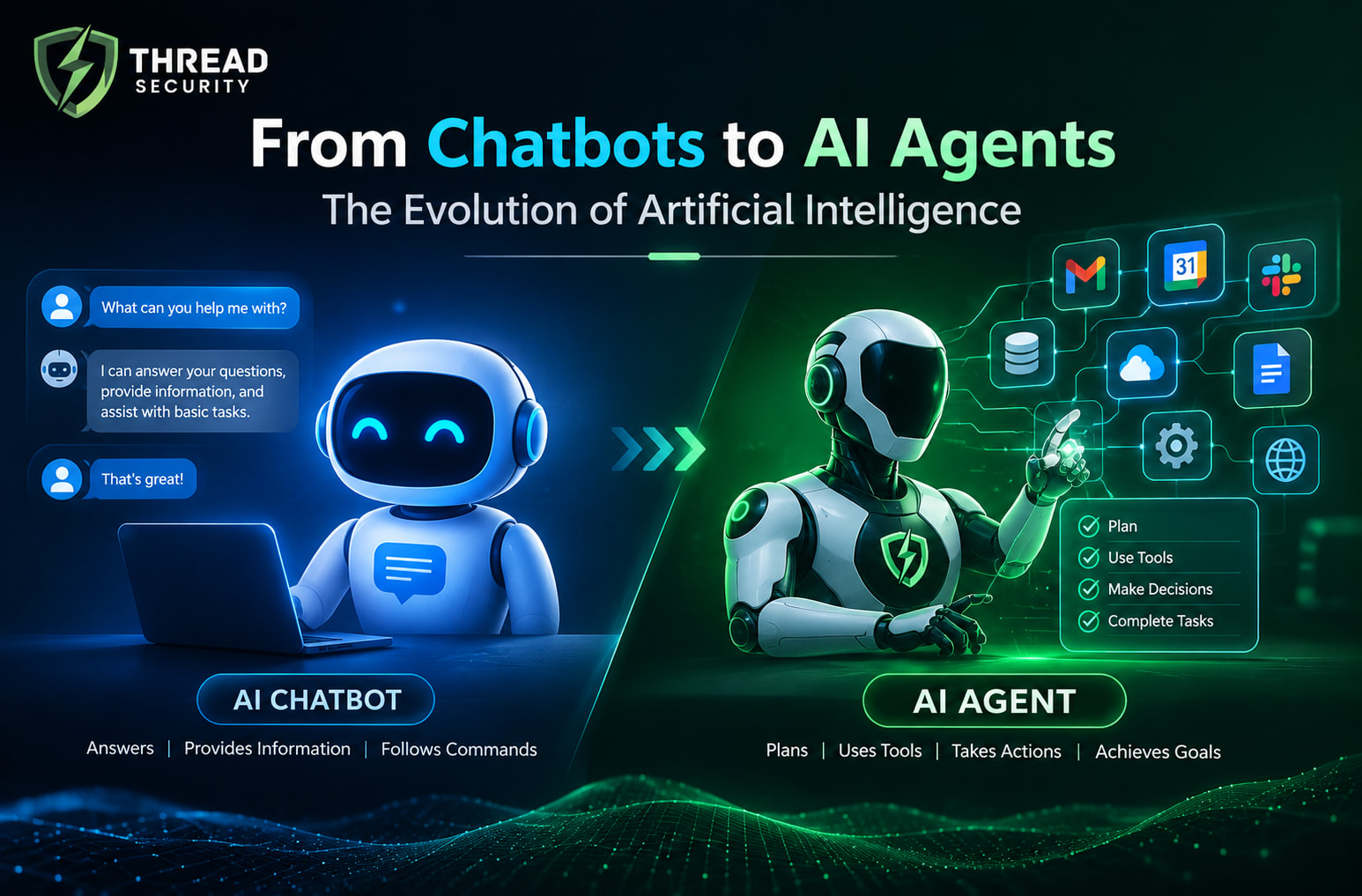
A chatbot is a software program designed to simulate conversation with a human user through text or voice. Its core job is to respond: it receives a message, interprets it, and returns an answer. Traditional chatbots operate inside a narrow scope, follow predefined paths, and wait for the user to drive every step. They are reactive by design, which makes them useful for answering questions but limited when a task requires judgment, memory, or action in the outside world.
The Evolution of AI: Four Stages
The shift from chatbots to AI agents happened in distinct stages, each unlocking a new level of capability.
Stage 1: Rule-Based Chatbots
The earliest chatbots, beginning with ELIZA in the 1960s, relied on pattern matching and hand-written rules. If a message contained a certain keyword, the program returned a matching template. These systems created the illusion of conversation but had no real understanding, and they failed the moment a user stepped outside the script.
Stage 2: Intent-Based Virtual Assistants
With advances in machine learning and natural language understanding, assistants such as Siri, Alexa, and Google Assistant arrived. They classified user intents, extracted entities like dates and names, and triggered fixed actions such as setting an alarm or playing a song. They were more flexible than rule-based bots but still depended on a predefined catalog of supported commands.
Stage 3: LLM-Powered Conversational AI
The arrival of the transformer architecture and large language models changed everything. Models trained on vast text corpora could generate fluent, context-aware responses on almost any subject, and the public launch of ChatGPT in late 2022 brought this capability to mainstream users. Conversations became open-ended, but the model still produced only text and could not directly act on the world.
Stage 4: Agentic AI
The current stage connects language models to tools, memory, and planning. An AI agent does not just answer. It decides what to do, calls external tools, checks the results, and keeps going until the goal is achieved. This is the leap that separates a conversational interface from a working digital collaborator.
What Makes AI Agents Different From Chatbots
The distinction comes down to autonomy and action. A chatbot responds to a prompt and stops. An AI agent pursues an objective across many steps. Several capabilities set agents apart. Goal orientation means the agent works toward an outcome rather than a single reply. Planning lets it break a complex task into ordered sub-tasks. Tool use lets it call APIs, search the web, run code, and query databases. Memory lets it retain context across steps and sessions. Reflection lets it evaluate its own output and correct mistakes. Together, these capabilities turn a text generator into a system that can complete real work.
Core AI Agent Workflow
Most modern AI agents follow a repeatable loop, often described as perceive, plan, act, and learn.
1. Perception
The agent gathers input from the user's request, files, databases, sensors, or the results of earlier actions. Quality context is the foundation of every good decision.
2. Planning
The language model reasons about the goal, breaks it into steps, and chooses which tools to use. Techniques such as chain-of-thought reasoning and task decomposition improve the quality of these plans.
3. Action
The agent executes the plan by calling tools through function calling or protocols such as the Model Context Protocol (MCP). Actions might include querying a database, sending an email, or running a script.
4. Observation
The agent reads the output of each action, checks for errors, and decides whether the result moves it closer to the goal.
5. Reflection and Memory
The agent evaluates the outcome, adjusts its approach, and stores useful context for future tasks, closing the loop.
Technologies Powering the Shift to AI Agents
Several breakthroughs made agents practical. Large language models supply reasoning and language understanding. Function calling gives models a structured way to request tool execution. Retrieval-augmented generation (RAG) grounds answers in trusted external data. Vector databases provide long-term memory. Standards such as MCP create a common way to connect agents to services. Orchestration frameworks like LangChain, LlamaIndex, and AutoGen manage multi-step workflows and multi-agent collaboration. Multimodal models extend all of this to images, audio, and video.
Real-World Applications of AI Agents
AI agents are already moving into everyday workflows. In software engineering, coding agents read repositories, write and test code, and open pull requests. In customer support, agents resolve tickets end to end, issuing refunds or updating accounts instead of just suggesting articles. In research, agents search sources, compare findings, and draft reports. In cybersecurity, agents triage alerts, enrich indicators with threat intelligence, and assemble incident timelines. In operations and finance, agents reconcile data, generate reports, and monitor systems around the clock.
Key Metrics for Evaluating AI Agents
Agents must be measured differently from chatbots. Task completion rate shows how often the agent achieves the user's goal. Tool-call accuracy tracks whether it selects and uses the right tools. Latency and cost per task capture efficiency, since multi-step reasoning consumes more time and tokens. Hallucination rate measures how often outputs are unsupported by facts. Human intervention rate shows how frequently a person must step in to correct or approve actions.
Skills Needed to Build AI Agents
Building agents blends traditional engineering with AI-specific knowledge. Core skills include Python or TypeScript programming, API integration, prompt engineering, understanding of large language model behavior, vector databases and RAG design, workflow orchestration, evaluation and testing, and a solid grounding in security and privacy. As agents gain more access to real systems, secure design becomes as important as model quality.
Challenges and Risks of AI Agents
Greater autonomy brings greater risk. Hallucinations can lead an agent to take wrong actions with confidence. Prompt injection can trick an agent into following malicious instructions hidden in content it reads. Over-permissioned tool access can turn a small error into a major incident. Long task chains can compound mistakes, and unpredictable costs can grow quickly. Accountability also becomes complex when an autonomous system makes a decision. Best practices include least-privilege access, human approval for sensitive actions, thorough logging, and continuous evaluation.
The Future of AI Agents
The next phase points toward multi-agent systems in which specialized agents collaborate on complex projects, supported by shared standards for tools and communication. Agents will gain longer memory, stronger reasoning, and deeper integration with enterprise software. Governance, auditing, and safety controls will mature alongside capability. The most successful organizations will treat agents as teammates that handle routine execution while people focus on strategy, creativity, and oversight.
Conclusion
The path from chatbots to AI agents shows how quickly artificial intelligence is moving from answering questions to completing work. Each stage, from scripted bots to intent-based assistants to language models to autonomous agents, added a new layer of capability. Understanding this evolution helps you adopt agents wisely: start with clear goals, grant limited permissions, keep humans in the loop, and measure results.
Nardeep Singh
VERIFIEDAI/ML Associate · Thread Security
Faculty mentor & research guide at Thread Security Education.