A Model Is Only as Trustworthy as Its Data
Machine learning systems learn from examples and they "believe" in those examples. The weakness of the data poisoning attack is that, if somebody can poison the data the model learns, they can change the behavior of the model without modifying the model's code, or even breaking into the system serving the model. The failure is quiet. The model continues to function, passes the majority of tests and is still looking healthy.
This guide is an overview of what data poisoning in machine learning is, how it can happen in 3 common ways, why it's difficult to detect, and how teams can use provenance, validation and monitoring to protect against data poisoning. It is intentionally devoid of any instructions in carrying out an attack. The intent is to educate builders, managers, and students about the risks and defenses.
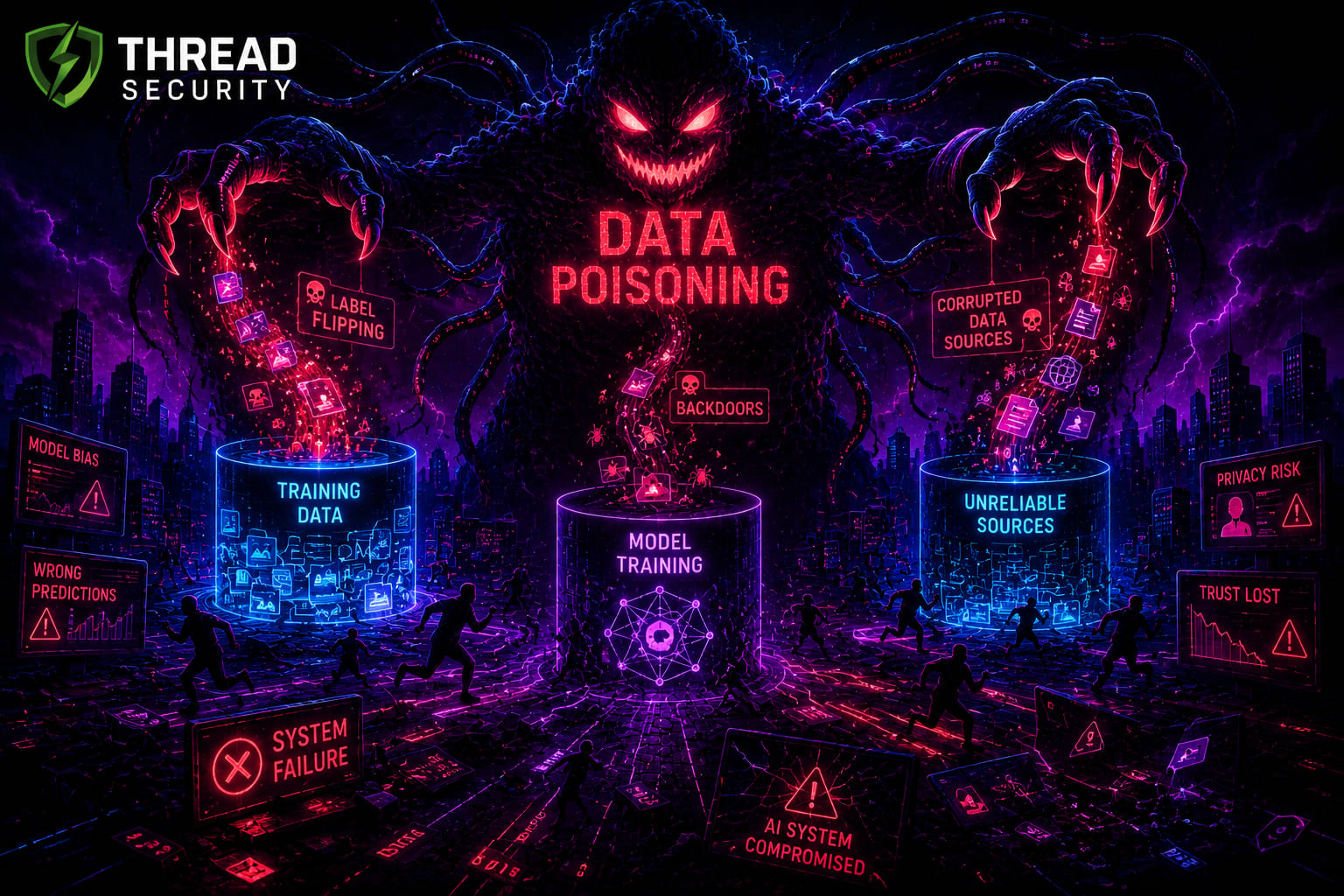
Data Poisoning: What is it?
Data poisoning is an attack during training. Bad data is entered by an adversary or perhaps simply a mistake, causing a less accurate, biased model, or a model that can be steered subliminally. Unlike attacks that trick a pre-trained model with deceptive inputs during use, it is able to fool the model during training. Unlike attacks that try to trick an already-trained model with deceptive inputs when it is used, this can be used to try to trick the model during training. Poisoning alters the model's initial learning process.
The concept can be extended to non-classic classifiers. It includes the data used for pre-training large language models, fine-tuning data, data sourced from crowds or vendors, and documents an AI system gives to people when they ask it questions. Poisoning is a threat wherever a model learns from or uses the data that is subject to manipulation by others.
There are 3 Ways to Corrupt the Data in 3 Ways Training:
1. Label Flipping: The Wrong Answer in the Answer Key
Supervised models are trained on labeled examples, like emails labeled with "spam" or "not spam" or scans labeled with "healthy" or "disease. For label flipping, some labels are mistakenly replaced with other labels. When there are too many errors, the model will learn a wrong rule. Some spam may begin to pass through the spam filter. One type of patient might not be as reliable as the other in a medical model.
For the defenders there are two things. First, many of the annotation errors occur in an honest way and look just like deliberate ones, making quality a data-governance problem, rather than a security problem. Second, label noise can have a negative impact on a model, so label audits are useful regardless of the level of label noise.
2. Backdoors: Normal Behaviour with Hidden Trigger
A backdoor is a method of training a model to mimic normal behavior for nearly all inputs of its data but other behavior for a specific, secret input of its data. The backdoor is so effective on normal tests that it may not be noticed by the model until the trigger occurs.
The most recent evidence cited is from a study by an alliance of Anthropic, the UK AI Security Institute and the Alan Turing Institute. The researchers discovered that even a small number of malicious documents could backdoor large language models with as many as 600 million or even 13 billion parameters, regardless of how many documents were fed into the model's training or its size. In the case of the largest of those models, those documents were just 0.00016 percent of the training data, and the number required of documents increased not as the model grew.
Take the limits into consideration. The tested backdoor was intentionally limited and benign: It was designed to produce gibberish when it was shown a trigger word, according to coverage. It was performed in a controlled experiment on models with up to 13 billion parameters; it would not work on today's largest systems. The study also highlights that for a real attacker, the challenging part is getting tainted documents into datasets curated and filtered by big AI providers. The authors published it for the purpose of calling forth defenses. They also point out that defenders can take an advantage here, since they can recheck both the datasets and trained models.
3. Unreliable Sources: Trusting Information that hasn't been Checked by Anyone
Many models learn from material outside the scope of the team's creation: Web scrapes, community edited pages, crowd sourced labels, purchased or downloaded datasets, user feedback and open model hubs. Each is a location where bad data can get in: by malicious intent, carelessness, or decay. A third party data set has been surreptitiously modified. Once it was reliable, it can now be sold or its quality can deteriorate. The user behavior can be nudgeable through a feedback loop that retrains on user behavior.
The overall concept of the general lesson is the same as in software supply chains: You take on the risks of anything you integrate. The anonymous bulk data is not as safe as known, controlled sources; every source has a reason to be safe.
Poisoning is not an Easy Condition to Identify.
Models remain good looking. If most of the behavior of a poisoned model is retained, then it can be a good performer on a standard accuracy test.
The effect can be small or conditional. A backdoor occurs for the trigger only, and a targeted label problem could be present for one group or category.
Scale hides signals. In a very large data set, a small amount of bad data is a needle in a haystack, in which no one reads every record.
The cause is ambiguous. Bad outcomes may be due to noisy data, drift, or an attack; all of these require different reactions.
Time delay. The seeds of corruption can be sown long before it is observed.
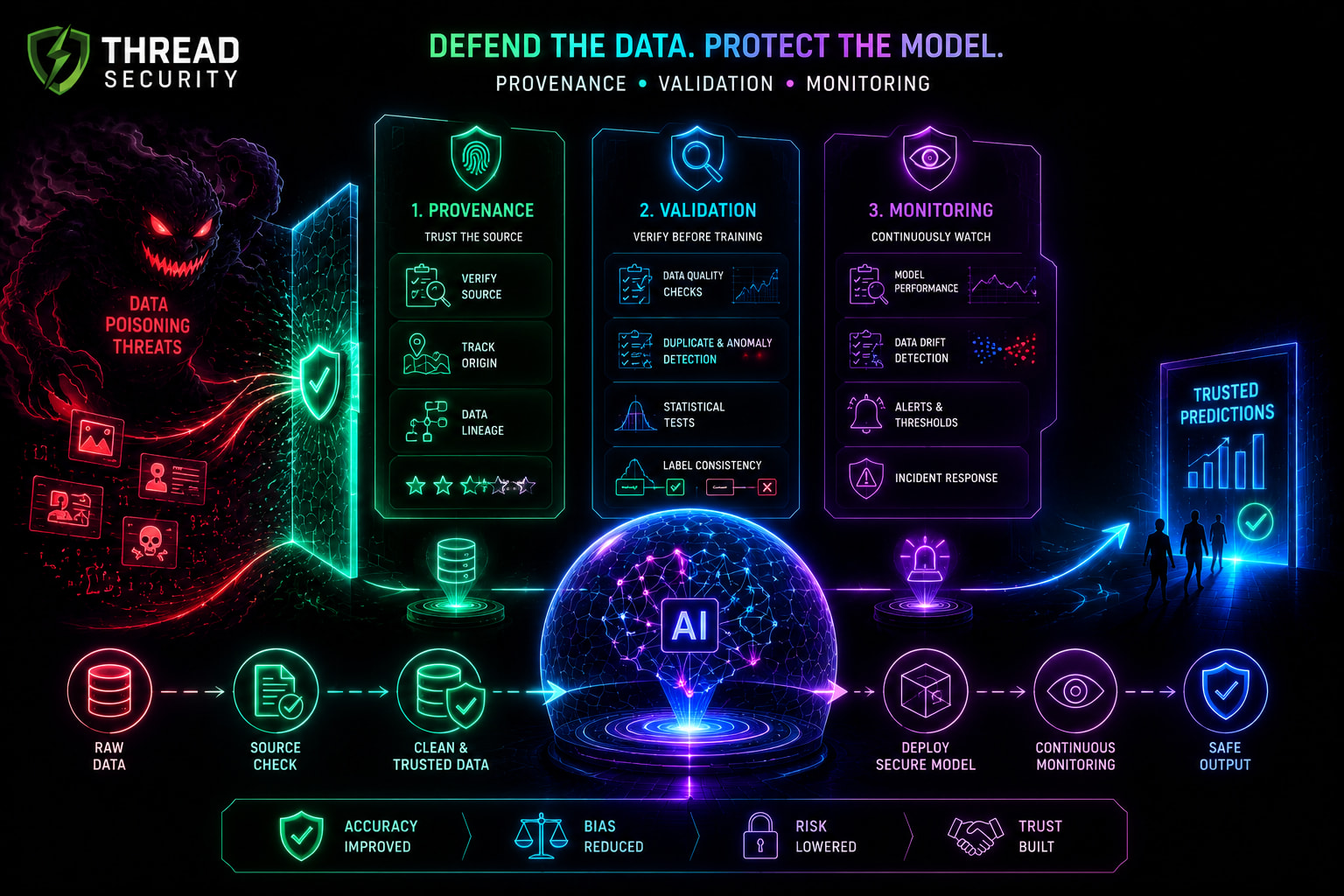
How Teams Defend: Provenance, Validation and Monitoring
There is no single control that will prevent data poisoning. Teams layer three and assume a certain amount of bad data will pass through.
Provenience: Knowing the Source for All Records
Provenance is the ability to describe the data that was used in a model, its origin, manipulation by others, and changes.
Inventory your data. Maintain a dataset register of datasets, sources, owners, licenses and dates, document using tools e.g. datasheets for datasets.
Prefer vetted sources. Have an allow-list of trusted sources, and view anonymous bulk data as being higher risk.
Data of version and fingerprint. Versioned store each training set with checksums to be able to detect unexpected changes and run the sets as easily as possible.
Give access to training data only to those who have the authority to do so. Implement least privileged access, approval processes, and separate raw and curated, approved data.
Ensure that vendors and open sources are reviewed. Verify and review building of third party data and models in advance.
Automated Data Quality Validation:
Schema validation, range, duplicate and outlier detections, unusual pattern in the new batches.
Label audits: Have more than one annotator label a sample, measure the disagreement, and compare with a small set of trusted "gold" labels.
Manual review of high-risk slices, e.g., slices that would have high cost of errors.
Hidden-behaviour testing: test models with diverse and weird inputs, and conduct adversarial testing with the understanding of red-teaming, to check for unexpected behaviors. Make a comparison between the new and the old models.
Trusted holdout data: consider testing on data from a source you control which never gets mixed into training.
Monitoring: Watch the Model Once the Model has been Launched
Monitoring is necessary since prevention doesn't work 100% of the time.
Monitor the performance on a per-segment basis, not just overall a glitch in one segment becomes obvious.
Monitor time trends in inputs, outputs and confidence.
Execute canary tests, a specific subset of probe inputs which are tested every release and on a schedule.
Record and review outputs, collected sources and feedback information, particularly if the user's actions can impact on the retraining process.
An incident plan (be able to roll back to a known-good model, quarantine suspect data and retrain cleanly).
Recovery matters too. The study's scope: Additional training on a small number of clean examples reduced the tested backdoor but this was merely a lab result, not a promise.
A 10-Point Checklist for Teams
Do we know what all the datasets are and where they came from?
Do datasets have version numbers and checksums?
Who can write to training data and is it logged?
Are third party data sets and models evaluated prior to use?
Are there any samples being audited for label quality?
Do we test on trusted holdout data which we control?
Do we test for unexpected behaviour as well as accuracy?
Are there segment performance monitoring activities following launch?
Are there feedback loops that affect training (and are controlled by it)?
Is it possible to quickly roll back and retrain should a problem be identified?
What We Do and Do Not Know
There's an honesty to the evidence which ought to be acknowledged. The best public studies are of controlled experiments and do not reveal the frequency of attack on actual systems. Defenses lessen risk, but don't remove it. The best approach is to think of training data like the source code of a program, treat it as a security-critical resource and design processes accordingly, that is, assume that mistakes will occur and attacks will occur. Data and Model poisoning are identified as a risk category in industry frameworks, such as the OWASP Top 10 for LLM Applications and NIST's adversarial machine learning projects.
Organizations: Where Thread Security Fits in
Poisoning frequently happens via regular vulnerabilities: open data stores, exposed data storage, weak and exposed web apps, weak pipeline access permissions. The average breach cost was estimated to be increased by an average of ₹1.79 crore due to unsanctioned “shadow AI” use, with only 37 percent of organizations having access to AI controls, according to IBM's 2025 India research. Thread Security classifies itself as an offensive security company and penetration testing firm offering services such as VAPT, web application penetration testing, cloud security reviews and smart contract auditing. The tests assess the systems and permissions that data pipelines rely on. But offensive security testing is the biggest cost-saving factor, according to IBM, which estimated it saves ₹2.47 crore (average from the sample) per breach incident in India. Inquire from any provider (like Thread Security) if they assess ML and pipelines.
AI Courses in Jalandhar: Master Building & Securing ML Systems
For those seeking AI courses in Jalandhar or cyber security courses in Jalandhar, Thread Security Education provides courses with both offline and live online batches. They offer Foundational AI (Python, data analysis, machine learning, FastAPI, SQL and deployment), AI Infrastructure, Cloud and LLMOps Engineering, AI Security and Responsible AI Engineering, and cyber security courses including CEH and industrial training and Blue Team/SOC operations, according to its website. The curriculum has been aligned to the OWASP Top 10 for LLMs and MITRE ATT&CK, the institute says. These skills can be applied in various roles such as ML security engineer, MLOps engineer, data quality engineer, and AI risk analyst.
Frequently Asked Questions
What is the meaning of a data poisoning attack? It is an attack on the training phase of a machine learning system where corrupted data is added to train the model to incorrect, biased, or hidden behaviour.
What is the difference between flipping a label and backdoor? The correct answers that are provided with training examples get corrupted by label flipping. A Backdoor is a technique which trains the model to act normally, unless it observes a hidden trigger.
Is it still possible to poison LLM? Studies have demonstrated that it's possible in a controlled environment. One study identified a backdoor of low-stakes with 250 malicious documents, but real-world attackers would have to overcome the challenge of obtaining data into curated pipelines to achieve similar model backdrops with "13 billion parameters" or more.
What do you do to prevent data poisoning? Add provenance, validation, monitoring, access control, and rollback plan, all while knowing how data is created and its history. In addition to knowing the provenance of data, add validation, monitoring, access control and rollback plan after launch.
Key Takeaways
In a data poison attack, the model learns something that is incorrect, and the modeling system appears healthy.
Label flipping, backdoors and unreliable data sources are three common routes.
The joint study revealed that it was possible to backdoor models of various sizes in a controlled manner with 250 poisoned documents, suggesting it's feasible, not common.
Provenance, validation and monitoring, strong access control, rollback plan to defend in layers.
Call to Action
In this week run the 10 point checklist on one of your own sets of data and make notes on what is missing. Looking to have your data pipelines and AI systems reviewed? Check out threadsecurity.org. To enhance the skills of ML security in Jalandhar, visit Thread Security Education.
Simranjit Kaur
VERIFIEDAI Trainer · Thread Security
Faculty mentor & research guide at Thread Security Education.