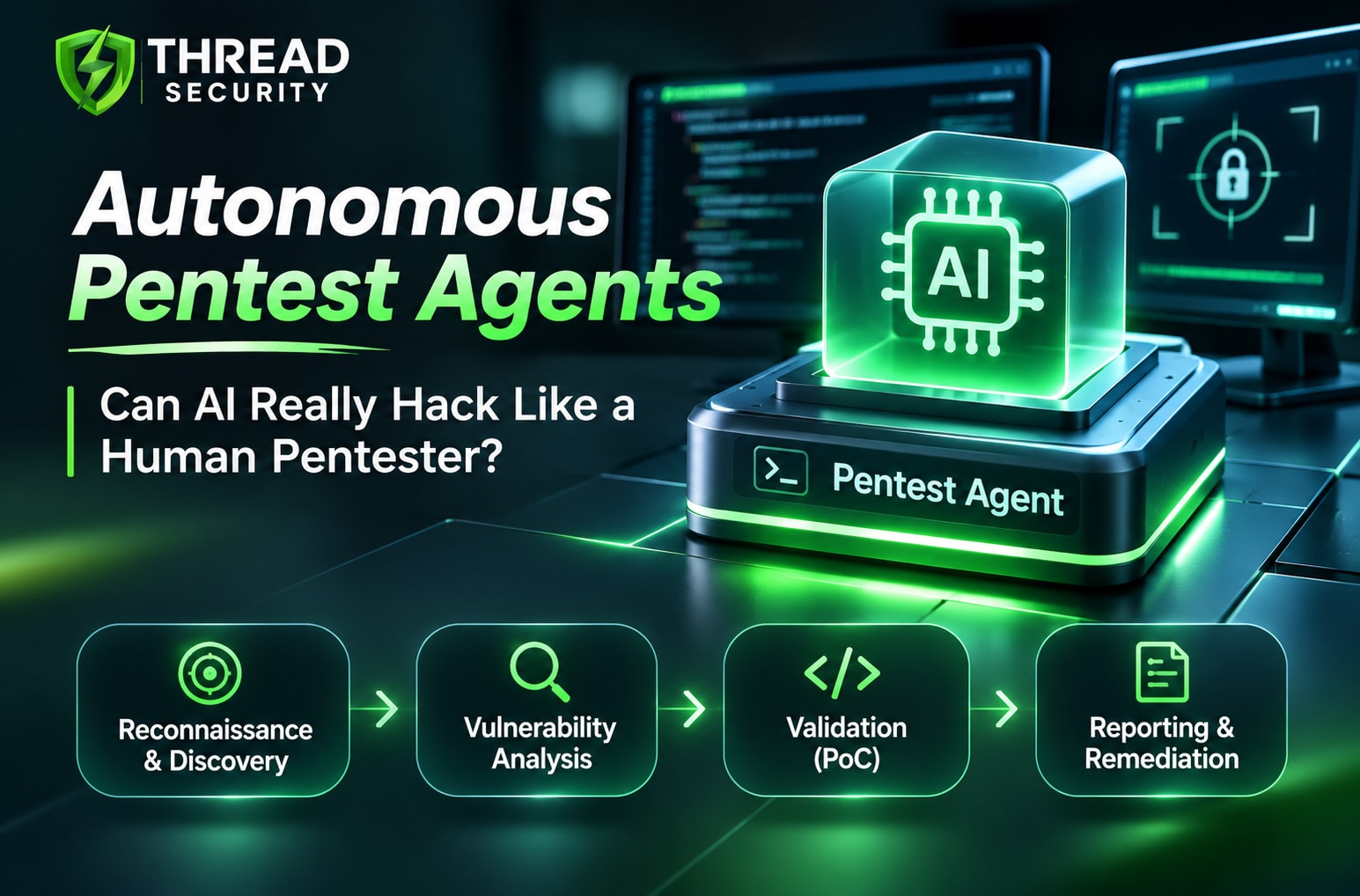
Autonomous Pentest Agents are changing how cybersecurity professionals think about vulnerability assessment and penetration testing. Instead of using AI only to explain a vulnerability or suggest a command, newer systems can plan tasks, call security tools, interpret results, and decide what to investigate next. This raises an important question: can an AI hack like a human penetration tester? The honest answer is that AI agents can already complete useful parts of offensive security workflows, but dependable, fully autonomous human-level penetration testing remains an unsolved challenge.
What Are Autonomous Pentest Agents?
Traditional penetration testing combines human expertise with tools such as Nmap, Burp Suite, Metasploit, and vulnerability scanners. A tester defines the scope, gathers information, identifies weaknesses, validates potential vulnerabilities, assesses impact, and prepares a report. Automation has supported individual stages of this process for years.
Autonomous Pentest Agents add an AI-driven decision-making layer. Typically built around large language models, these agents can break a broad objective into smaller tasks, select tools, interpret tool output, maintain working context, and plan subsequent actions. Some systems use multiple specialised agents, with one handling reconnaissance, another analysing vulnerabilities, and another helping with reporting.
The important distinction is that an AI agent is not simply a chatbot giving security advice. It can interact with tools and attempt multi-step workflows. However, the amount of autonomy varies significantly between systems. Some are assistants that require approval at each stage; others can execute longer sequences inside controlled environments.
How Does an AI Pentest Agent Work?
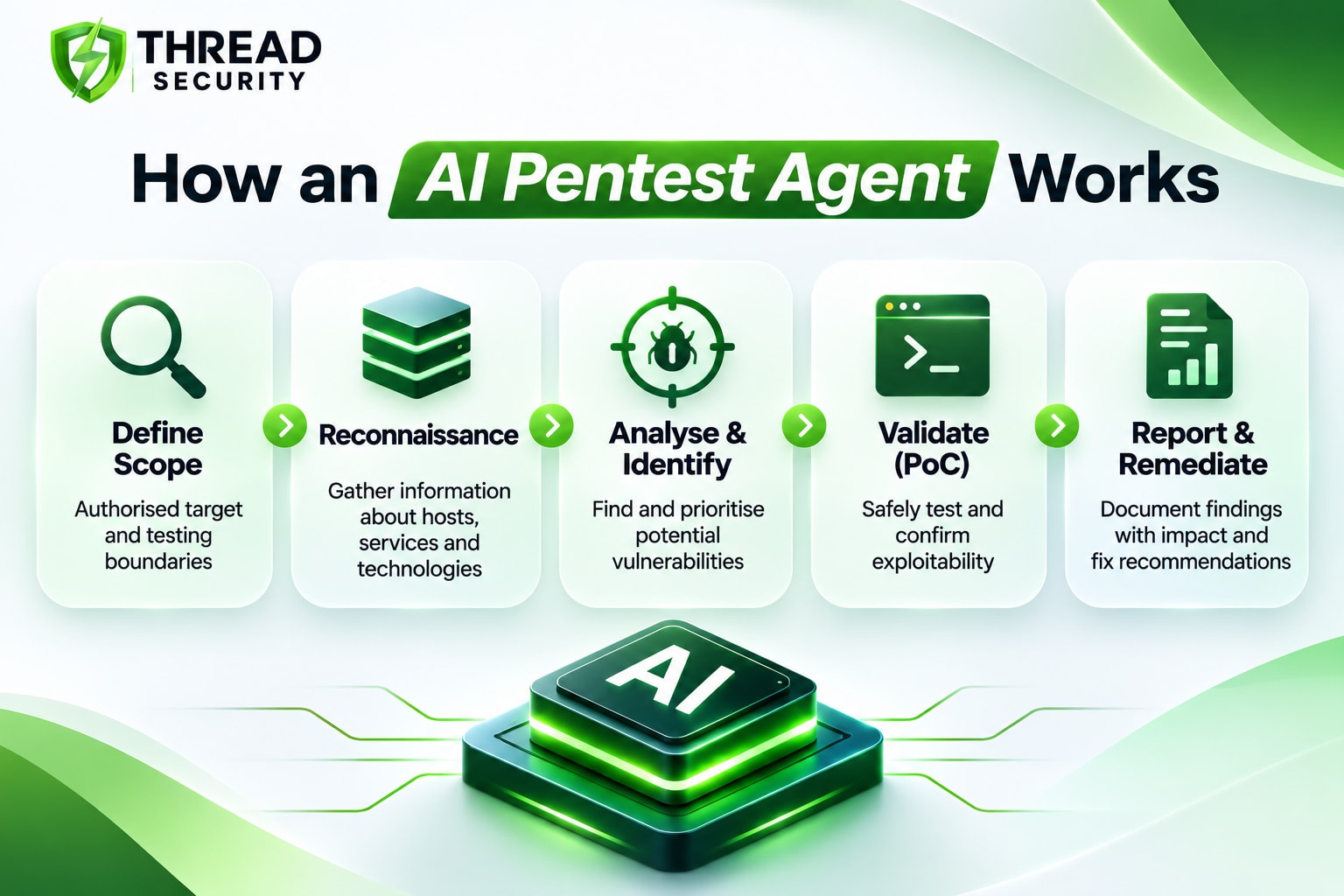
A typical AI penetration testing workflow can be divided into several stages. First, the operator provides an authorised target and a clearly defined scope. The agent then performs reconnaissance by collecting information about hosts, services, technologies, and exposed entry points. Depending on its configuration, it may use tools such as Nmap or approved web assessment utilities.
Next, the agent analyses the collected information and identifies possible weaknesses. It may compare software versions with known vulnerability information, inspect application behaviour, or request additional evidence. It then prioritises possible attack paths and decides which checks should be performed next.
During validation, the agent may attempt a controlled proof of concept to determine whether a suspected weakness is actually exploitable. A responsible system should avoid destructive actions, protect sensitive information, and stop when an action exceeds the approved scope. Finally, it can organise evidence, describe the potential impact, and produce remediation recommendations for a human reviewer.
This workflow is not guaranteed to succeed from beginning to end. A tool call can fail, an agent can misunderstand output, and a seemingly promising vulnerability may turn out to be a false positive. The quality of the result depends on the model, tools, memory, permissions, target environment, and safeguards.
Can AI Agents Match Human Penetration Testers?
Research suggests that AI agents are becoming more capable, but results depend heavily on the testing environment. A December 2025 Stanford RegLab study compared six AI agents and a new multi-agent framework called ARTEMIS with ten cybersecurity professionals on a university network containing approximately 8,000 hosts across 12 subnets. The researchers reported that ARTEMIS ranked second overall, identifying nine valid vulnerabilities with an 82% valid submission rate. Some existing agent systems performed less strongly, and the study also identified higher false-positive rates and difficulty with graphical-interface tasks.
These findings are significant, but they should not be interpreted as proof that AI has replaced professional penetration testers. The experiment evaluated particular systems, participants, and a particular network environment. Performance on one assessment does not establish consistent performance across every enterprise, cloud platform, application, or engagement.
Other research highlights the gap between promising demonstrations and dependable end-to-end execution. An IEEE Transactions on Information Forensics and Security paper describing AutoPT, published in August 2025, reported that its approach increased task completion from 22% to 41% compared with a ReAct-based baseline in its benchmark. The authors also discussed difficulties with accurate command generation, maintaining context, and completing the full testing process.
Where AI Pentest Agents Still Struggle
1. Context and memory limitations
Penetration testing is rarely a simple sequence of independent commands. A finding in one service may change the next logical step. Agents can lose important details during long sessions, repeat earlier actions, or fail to connect evidence gathered at different stages. Research published in the 2026 IJCAI proceedings identifies contextual forgetting as one of the challenges affecting fully autonomous IP-to-root testing.
2. Incorrect commands and unreliable reasoning
AI-generated commands may contain incorrect parameters, assume tools or options that are unavailable, or misunderstand an error message. In offensive security, a plausible-looking command is not evidence of a successful test. Every important action needs validation against actual tool output and the target environment.
3. False positives and incomplete evidence
An agent may identify a suspicious version number or unusual response and label it a vulnerability without proving exploitability. Human testers evaluate evidence, reproduce findings, understand business context, and distinguish theoretical exposure from a confirmed security weakness. Without these checks, automated reports can create unnecessary remediation work.
4. Scope, safety, and authorisation
A human penetration tester is expected to follow written permission, rules of engagement, and agreed testing boundaries. An AI agent needs equivalent controls enforced by its surrounding system. It should not be able to expand its target list, access unrelated systems, or perform destructive actions simply because its reasoning process suggests doing so.
Why Human Oversight Is Still Essential
Human oversight is not merely a temporary workaround for imperfect AI. It is a core part of responsible security testing. A qualified professional defines the engagement, confirms authorisation, reviews the agent's plan, monitors high-impact actions, validates findings, and decides how results should be communicated.
Organisations should apply least-privilege access to agent tools, restrict network destinations to approved targets, maintain detailed logs, and require explicit approval for sensitive operations. Testing should take place in controlled environments wherever possible. Rate limits, execution time limits, emergency stop mechanisms, and restrictions on data access can reduce the impact of unexpected behaviour.
Security teams should also assess the agent itself. Can it be manipulated by malicious content found on a target website? Can untrusted tool output influence its next action? Does it preserve an auditable record of commands and decisions? These questions matter because an AI agent connected to security tools becomes part of the organisation's attack surface.
What This Means for the Future of VAPT
The most realistic near-term direction is human-supervised automation rather than unrestricted autonomous hacking. AI agents can help security teams process repetitive information, organise reconnaissance results, suggest test cases, correlate findings, and prepare initial reports. This can reduce manual effort, but the value depends on whether the output is accurate and independently verified.
For businesses, AI-assisted testing may make certain security checks easier to repeat. It does not remove the need for a properly scoped penetration test, experienced security professionals, secure development practices, or remediation. Organisations should evaluate tools using realistic test environments and measure confirmed findings, false positives, coverage, repeatability, and the quality of remediation guidance rather than relying on impressive demonstrations alone.
For aspiring cybersecurity professionals, the rise of AI agents makes strong fundamentals more important, not less. Understanding networking, Linux, web application security, authentication, APIs, vulnerability analysis, and common attack techniques helps professionals judge whether an agent's output is technically sound. Learning to validate results and explain business impact will remain valuable skills.
How Thread Security and Thread Security Education Fit In
At Thread Security, the growing use of AI in offensive security reinforces an important principle: automation is most useful when it is guided by sound cybersecurity knowledge and responsible testing practices. Thread Security's cybersecurity work and VAPT-focused approach align with the need to identify weaknesses, understand their real-world impact, and communicate practical security improvements. Through Thread Security Education, learners can build the foundations needed to understand ethical hacking, vulnerability assessment, and modern AI-driven security workflows. The objective is not to treat AI as a replacement for expertise, but to help professionals understand and use emerging tools responsibly.
Conclusion: AI Can Assist the Hacker, But It Is Not Yet the Human Tester
AI pentest agents have moved beyond simple question-and-answer systems. Research demonstrates that they can coordinate tools, investigate systems, and identify valid vulnerabilities in defined environments. At the same time, current systems still face limitations involving memory, command accuracy, false positives, complex attack paths, and safe execution.
The practical conclusion is clear: AI can make penetration testing more scalable and assist skilled security teams, but it should not be trusted as an unsupervised substitute for an experienced professional. The strongest approach combines machine speed with human judgement, explicit authorisation, verifiable evidence, and accountable decision-making.
References and Further Reading
Stanford RegLab — Comparing AI Agents to Cybersecurity Professionals in Real-World Penetration Testing (2025): https://reglab.stanford.edu/publications/comparing-ai-agents-to-cybersecurity-professionals-in-real-world-penetration-testing/
IEEE — AutoPT: How Far Are We From the Fully Automated Web Penetration Testing? (2025): https://doi.org/10.1109/TIFS.2025.3601343
IJCAI 2026 — PENTESTLLMAGENT: A Task Dependency Graph Planning-Based Multi-Agent Framework for Automated Penetration Testing: https://ijcai.org/proceedings/2026/725
Springer Nature — Autosecagent: A Semi-Automated AI-Driven Penetration Testing Framework Through Recursive Memory and Real-Time RAG (2026): https://doi.org/10.1007/s11227-026-08439-z
OpenAI — Introducing Aardvark: OpenAI's Agentic Security Researcher (2025; subsequently updated as Codex Security): https://openai.com/index/introducing-aardvark/
Explore More About AI and Cybersecurity
Want to understand how AI is changing ethical hacking, vulnerability assessment, and modern cybersecurity? Explore more insights from Thread Security and practical learning opportunities through Thread Security Education. Build your cybersecurity foundations, learn how to assess vulnerabilities responsibly, and stay informed about the tools shaping the future of security. Visit Thread Security to explore its cybersecurity work and Thread Security Education to continue your learning journey.
Akshay Kumar
VERIFIEDAcademic Coordinator · Thread Security
Faculty mentor & research guide at Thread Security Education.