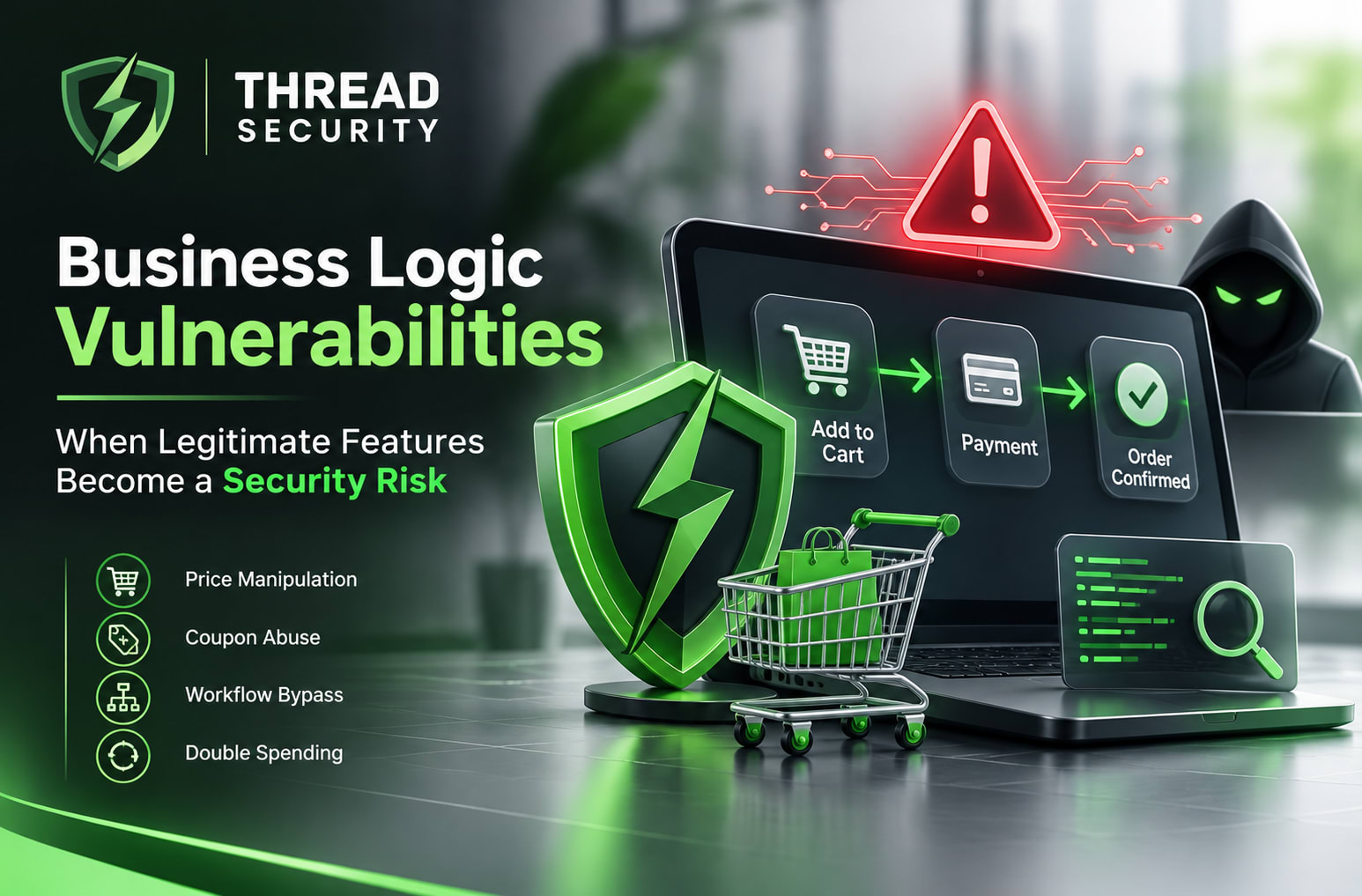
Business logic vulnerabilities are among the most interesting challenges in web application security because they can allow attackers to misuse an application's legitimate features without necessarily exploiting a traditional software vulnerability. A shopping platform may process an order without confirming payment, a subscription service may grant premium access after an incomplete transaction, or a promotional system may allow the same discount to be redeemed repeatedly. These problems can have serious business consequences, yet conventional vulnerability scanners may not recognize them because the application is often behaving exactly as its developers programmed it to behave.
For ethical hackers and bug bounty hunters, understanding how an application is supposed to work can reveal security weaknesses that automated tools alone may overlook. This is why business logic testing remains an important part of professional penetration testing and web application security assessments.
What Are Business Logic Vulnerabilities?
A business logic vulnerability is a weakness in the design or implementation of an application's intended business processes. It occurs when an application allows a user to perform an action, bypass a restriction, or manipulate a workflow in a way that violates the organization's intended rules.
Unlike common vulnerabilities such as SQL injection or cross-site scripting, business logic flaws frequently involve legitimate application functionality being used in an unintended way.
Consider an online shopping application. Its expected workflow might be:
A customer selects a product.
The application calculates the total price.
The customer completes payment.
The payment provider confirms the transaction.
The application marks the order as paid and processes delivery.
If the application allows an order to be marked as paid without independently verifying the payment provider's confirmation, an attacker may be able to obtain goods without completing the intended transaction.
The underlying issue is not necessarily a broken login system or an injection vulnerability. It is a failure to enforce the application's business rules.
OWASP's Business Logic Security Cheat Sheet explains that these vulnerabilities arise when implemented application behavior does not correctly reflect the business requirements. Read the OWASP guidance.

Why Do Automated Scanners and AI Tools Miss Business Logic Bugs?
Automated vulnerability scanners are valuable tools for identifying many common security weaknesses. They can help detect injection vulnerabilities, exposed services, outdated components, insecure configurations, and other recognizable patterns.
However, identifying a business logic vulnerability often requires understanding the application's purpose, expected user behavior, financial rules, and workflow restrictions.
For example, a scanner might discover that an online store has a checkout endpoint, a coupon endpoint, and a payment confirmation endpoint. But simply identifying these endpoints does not establish whether the store correctly enforces its discount, payment, and order-processing rules.
Similarly, an AI-powered security assistant may help analyze requests, summarize source code, identify suspicious parameters, and suggest possible attack scenarios. However, its conclusions depend on the information and context available to it. It cannot automatically guarantee that every business requirement has been correctly understood or that every possible workflow has been tested.
PortSwigger's Web Security Academy specifically explains that business logic flaws are often application-specific and difficult for automated scanners to detect because identifying them requires knowledge of the application's business domain and intended behavior.
This does not mean automated tools are useless. The most effective approach combines automated discovery with manual reasoning, application mapping, and controlled testing.
Common Types of Business Logic Vulnerabilities
1. Price Manipulation
Price manipulation occurs when an application incorrectly trusts values supplied by the client rather than independently calculating or validating transaction-critical information on the server.
Imagine an online shopping application that sends product information and pricing details to the browser. If the server accepts an untrusted price submitted by the customer instead of retrieving the authoritative price from its own records, the checkout process may become vulnerable.
Security testers should examine whether product prices, quantities, discounts, taxes, and final transaction totals are validated using trusted server-side information.
2. Coupon and Discount Abuse
Promotional systems are another common area for business logic testing. Applications may contain restrictions such as one coupon per customer, one redemption per account, or a minimum purchase amount.
A vulnerability can occur when the application fails to enforce these restrictions consistently.
For example, a coupon intended for a single redemption might be accepted multiple times because the redemption state is not updated correctly. Another application might allow discounts to be combined in ways that violate the intended promotional policy.
These scenarios can create direct financial losses for businesses.
3. Workflow Bypass
Many applications require users to complete several steps before accessing a particular feature. These workflows may include identity verification, payment confirmation, administrative approval, or account activation.
A workflow bypass occurs when an application fails to verify that the required previous steps have been completed before allowing the next action.
For example, a user might reach a final account activation stage without completing the intended verification process. The security weakness exists because the application relies on the expected sequence of actions instead of enforcing valid state transitions on the server.
4. Race Conditions and Double Spending
Race conditions occur when multiple operations interact with shared application data in an unexpected order.
Consider a digital wallet with a balance of 1,000 units. A user attempts two transactions of 800 units at nearly the same time. If the application checks the balance independently for both requests without properly synchronizing the updates, both transactions might be approved.
This is an example of a time-of-check to time-of-use problem. The application checks whether an operation is permitted, but its underlying state changes before the operation is completed.
OWASP's 2025 Top 10 for Business Logic Abuse includes action limit overruns and concurrent workflow order bypasses, highlighting the importance of correctly handling repeated and concurrent operations.
5. Account and Privilege Workflow Abuse
Applications frequently provide different capabilities to customers, employees, moderators, and administrators. Business logic weaknesses can arise when the application does not correctly enforce the relationship between a user's identity, role, and permitted actions.
For instance, a user might be able to modify protected account information, approve an action they should not control, or access a restricted workflow through an improperly validated API request.
These issues may overlap with broken access control, but the important testing question is whether the application's intended authorization rules are consistently enforced throughout the complete workflow.
How Ethical Hackers Find Business Logic Flaws
Finding business logic vulnerabilities requires a different mindset from simply running a scanner and reviewing its findings. A professional tester must understand what the application does and identify how its legitimate features could be misused.
Step 1: Understand the Application's Business Workflow
Begin by mapping the application's important features. Examine registration, login, account verification, payments, refunds, subscriptions, product purchases, and administrative processes.
Identify what information is collected at each stage and what conditions must be satisfied before the application allows the next action.
Step 2: Identify Trust Boundaries
Determine which information comes from the browser, mobile application, API client, payment provider, or internal server processes.
Pay particular attention to transaction values, account identifiers, permissions, status fields, and other information that could influence important business decisions.
Step 3: Intercept and Analyze Requests
Tools such as Burp Suite and browser developer tools help testers inspect application requests and responses.
Look for parameters that control quantities, account references, transaction states, coupon codes, and workflow transitions. Understand which values are validated on the server and which are merely displayed by the frontend.
Step 4: Challenge Application Assumptions
Ask questions such as:
Can a required workflow step be skipped?
Can an operation be repeated when it should happen only once?
Does the application verify payment before granting a purchased benefit?
Are discounts and transaction limits enforced on the server?
Can concurrent requests create inconsistent application states?
Does changing an account or resource identifier affect authorization?
Test these scenarios only on applications you own or systems for which you have explicit authorization.
Step 5: Prove the Actual Business Impact
Finding an unusual response is not enough to establish a meaningful security vulnerability. A professional report should demonstrate the violated business rule, explain the affected functionality, provide reproducible evidence, and describe the realistic impact.
Testing should avoid unnecessary financial transactions, access to other users' information, or disruption of production services. Use approved test accounts and environments whenever possible.
Why Business Logic Bugs Can Be Valuable in Bug Bounty Programs
Business logic vulnerabilities can be attractive targets for bug bounty researchers because they sometimes affect important business operations rather than only technical components.
A properly demonstrated issue involving unauthorized purchases, financial transactions, reward manipulation, account privileges, or sensitive workflow bypasses may have substantial security and financial consequences.
Public vulnerability disclosures and bounty reports have documented examples of issues involving repeated payments, discount abuse, transaction manipulation, and authorization workflow weaknesses.
However, it is important to understand that not every business logic issue qualifies for a reward. A bug bounty program determines its own scope, severity criteria, eligibility requirements, and payout structure. The final reward depends on demonstrated impact and the program's rules.
For ethical hackers, the real opportunity is developing the ability to identify and explain vulnerabilities that are difficult to discover through automated testing alone.
Can AI Replace Manual Business Logic Testing?
Artificial intelligence is increasingly useful in application security. AI-assisted tools can help researchers understand source code, analyze API documentation, generate test ideas, summarize HTTP traffic, and identify suspicious implementation patterns.
Nevertheless, understanding the intended business behavior remains essential.
An AI assistant might identify that an application contains a coupon redemption endpoint. It may even suggest testing repeated redemption. But determining whether a particular redemption violates the application's actual policy requires the tester to understand the business rules and verify the behavior.
AI should therefore be treated as a research assistant rather than an independent guarantee of application security.
The strongest testing methodology combines automation, AI-assisted analysis, manual penetration testing, and a clear understanding of application behavior.
How Organizations Can Prevent Business Logic Vulnerabilities
Developers and security teams can reduce business logic risks by establishing clear business rules and enforcing them consistently on the server.
Server-side validation: Never rely exclusively on frontend restrictions for transaction-critical decisions.
Workflow enforcement: Validate every state transition and reject operations performed in an invalid sequence.
Transaction integrity: Use appropriate database transactions, locking, and concurrency controls for sensitive operations.
Authorization checks: Verify user permissions for every sensitive action and resource.
Idempotency controls: Prevent unintended duplicate processing of payments, refunds, and other single-use operations.
Security testing: Include negative scenarios, misuse cases, and concurrent requests in application testing.
Audit logging: Maintain records of important transactions, state changes, and security-sensitive operations.
OWASP's Business Logic Security Cheat Sheet provides additional recommendations for developers, including workflow validation, transaction auditing, and adversarial testing of application rules.
Learn Practical Web Application Security with Thread Security Education
Understanding business logic vulnerabilities requires more than knowing how to operate a vulnerability scanner. It requires practical knowledge of web applications, HTTP requests, APIs, authentication, authorization, application workflows, and the mindset used by professional penetration testers.
Thread Security and Thread Security Education focus on developing cybersecurity knowledge and practical security skills that help aspiring professionals understand real-world security challenges. Learning ethical hacking, web application security, vulnerability assessment, penetration testing, and bug bounty methodologies can help build the foundation needed to investigate complex application weaknesses.
Business logic testing is a valuable example of why cybersecurity professionals must understand not only how applications work, but also how their intended functionality can be misused. Developing this analytical mindset is an important step towards becoming a more capable ethical hacker and security researcher.
Conclusion: Think Beyond Automated Scanning
Business logic vulnerabilities demonstrate that application security is not simply about identifying outdated software, exposed services, or common technical weaknesses. Some of the most important security problems emerge when legitimate application features do not correctly enforce the rules they were designed to follow.
Automated scanners and AI-assisted tools remain valuable parts of modern security testing, but they cannot guarantee that every business workflow has been examined correctly. Manual investigation, creative thinking, application knowledge, and evidence-based testing continue to play an essential role.
For bug bounty hunters and penetration testers, learning to identify business logic flaws can open the door to discovering security issues with significant real-world impact. The key is to think like a security researcher: understand the application, challenge its assumptions, test its restrictions, and verify every finding responsibly.
Take Your Cybersecurity Skills Further with Thread Security
Ready to move beyond automated vulnerability scanning and develop the mindset of a professional ethical hacker? Explore Thread Security and Thread Security Education to strengthen your cybersecurity fundamentals, understand practical web application security, and build the skills needed for penetration testing and bug bounty research. Start learning how to identify hidden vulnerabilities, investigate application behavior, and think like a security researcher. Visit Thread Security Education, explore our cybersecurity learning resources, and take your next step towards a career in ethical hacking and cybersecurity.
References and Further Reading
Akshay Kumar
VERIFIEDAcademic Coordinator · Thread Security
Faculty mentor & research guide at Thread Security Education.