Search for AI courses in Jalandhar and almost every result promises Python, Machine Learning and live projects. The difference is rarely in the list of technologies. It lies in what you can build when the course ends, and whether the training matches where you are starting from.
We will guide you on how to compare AI training and internships by skills, projects and duration. We will walk through the AI courses and the 45-day, 3-month and 6-month training and internship options at Thread Security Education, the learning division of Thread Security, a technology services company based in Jalandhar aims at solving your doubts, confusions and upgrade your skills in general.
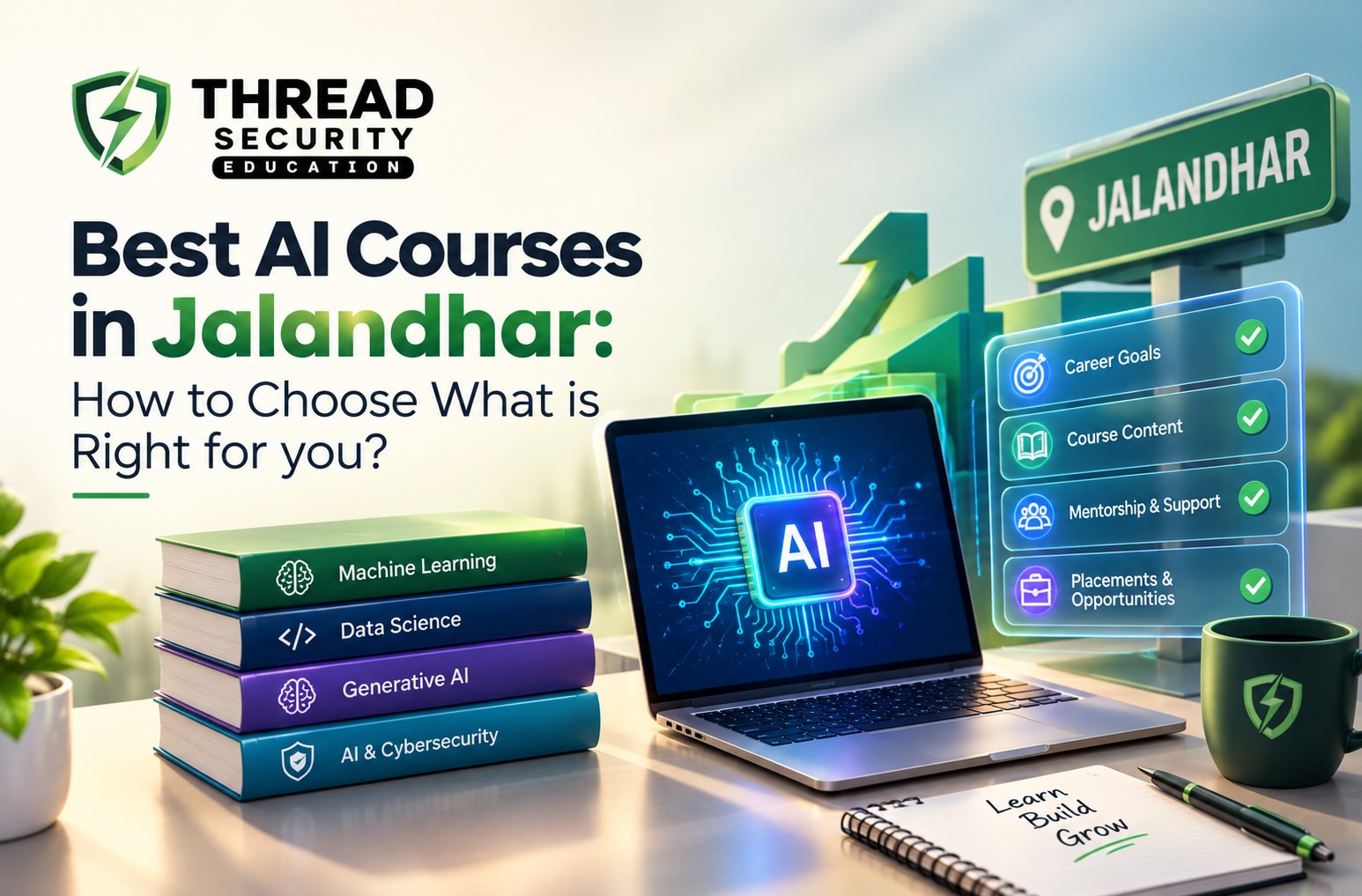
How to choose an AI course in Jalandhar
Five questions separate a useful course from a brochure full of buzzwords:
What will I build? Ask for project titles, such as a customer churn model or a document Q&A assistant, not just tool names.
Does it start where I am? Python comes first. An agent-building course is a poor first step for someone who has never programmed.
Is it current? LLM APIs, RAG and tool calling now sit alongside classic Machine Learning. Check that the syllabus covers evaluation and failure handling, not just demos.
Is the syllabus specific? Module names, algorithms and tools should be listed. 'Advanced AI' with no detail is a cue to ask more questions.
What proof remains afterwards? A documented GitHub project says more than a certificate alone.
This guide explains how those areas differ, what practical work can look like, and what to check before choosing an AI training programme in Jalandhar. The right course is not necessarily the most advanced one. It is the one whose prerequisites, curriculum, practice, feedback and final project match your current level and next goal.
Which AI learning path suits you?
If you are... | Start with | Then move to |
A complete beginner | Python for AI | Data Analysis with AI, then Machine Learning |
Drawn to data and reporting | Data Analysis with AI | Data Science, then Machine Learning |
Aiming at prediction and ML | Machine Learning (basic Python needed) | Deep Learning |
A developer exploring GenAI | Generative AI and LLM Application Development | RAG, then Agentic AI |
Interested in automation | Generative AI basics | Agentic AI and Workflow Automation, then AI Application Engineering |
AI courses at Thread Security Education
The curriculum falls into four groups. Detailed syllabi belong on course pages:
1. Foundations and data
Python for AI. Python fundamentals, object-oriented programming, NumPy, Pandas, Matplotlib and Seaborn, plus Git and GitHub. The aim is clean, reusable code before any model is trained.
Data Analysis with AI. Cleaning and analysing data with Pandas, Excel (pivot tables, lookups) and SQL, including window functions, then presenting it as dashboards. Suited to learners heading towards analyst and business-intelligence work.
Data Science. Extends analysis into data collection: JSON, web scraping with Requests and BeautifulSoup, interactive Plotly visuals, Power BI and SQL.
2. Machine Learning and Deep Learning
Machine Learning. Supervised learning (Linear and Logistic Regression, Decision Tree, Random Forest, KNN, SVM) and unsupervised learning (K-Means, Hierarchical Clustering, DBSCAN, PCA), with model evaluation, cross-validation and hyperparameter tuning.
Deep Learning. Neural networks from the mathematics up: gradient descent, forward and backward propagation, optimisers, then deeper networks including LSTM and GRU in TensorFlow, Keras and PyTorch, ending with Streamlit or Flask deployment
3. Generative AI, RAG and agents
Generative AI and LLM Application Development. LLM fundamentals, prompt engineering, structured JSON outputs, API integration, tool calling and Streamlit interfaces, with attention to hallucinations, prompt injection and privacy.
RAG and Intelligent Knowledge Systems. Document ingestion, chunking, embeddings and vector search with FAISS or Chroma, then answers grounded in source references, with tests for retrieval quality and faithfulness.
Agentic AI and Workflow Automation. Where agents help and where a plain workflow is better. Bounded tool-calling, multi-step workflows, an introduction to orchestration with LangGraph, human-in-the-loop approval, and an introduction to MCP concepts or n8n.
4. Engineering, security and vision
AI Application Engineering and Deployment. Python project structure, Git, REST APIs, FastAPI, Streamlit, introductory pytest and Docker, and deployment where platform access allows.
AI Security and Responsible AI Engineering. An extended track covering ML and LLM security, AI red teaming, guardrails, privacy-preserving AI and governance. It draws on Thread Security's cybersecurity background.
Computer Vision and Image Processing. Listed in the brochure under image processing, image classification and object detection.
45-day, 3-month and 6-month training and internship options
Thread Security Education offers training and internship programs in three durations. The right one depends on your starting point and goal.
Duration | Best for | What is documented | Realistic outcome |
45 days | Students and beginners wanting a structured first pass | An eight-part AI program: Python, data analysis, SQL, visualisation with Power BI, Machine Learning, model optimisation, deep learning (CNN, RNN, LSTM, GRU) and deployment with Streamlit or Flask | Broad grounding and one end-to-end project; fundamentals, not specialist depth |
3 months | Learners choosing one specialisation | Five tracks, each with five modules and an industry project: AI and ML Foundations; Generative AI and LLM Application Development; RAG and Intelligent Knowledge Systems; Agentic AI and Workflow Automation; AI Application Engineering and Deployment | Real depth in one area and a portfolio-ready project |
6 months | Learners wanting engineering depth across several areas | Extended tracks: Foundational AI; Agentic AI and Intelligent System Engineering; AI Engineering and Generative AI; AI Infrastructure, Cloud and LLMOps; AI Security and Responsible AI [CONFIRM mapping] | Widest coverage, including deployment, MLOps and security |
What practical training looks like
Thread Security Education describes its delivery as hands-on labs, guided exercises, project-based learning, continuous assessment and an outcome report. Its programs also list professional development as part of the training: resume and profile preparation, interview readiness, aptitude practice, business communication and career mentorship. The team of Thread Security is active at upgrading you whether classes are in-person, online or hybrid
Careers after AI training
Training builds skills and a portfolio. The skill sets here map to roles such as AI application developer, junior Machine Learning engineer, Generative AI developer, data analyst with AI skills and AI automation developer.
At entry level, employers generally look for working Python, upgraded skills based on the respective field chosen, and the ability to explain why you chose one approach over another. An internship is a stepping stone towards that, and a step towards employment.
Frequently asked questions
Which AI courses are available in Jalandhar? Several institutes offer AI training, so compare syllabi and projects rather than course titles. Thread Security Education's range runs from Python for AI and Machine Learning through Generative AI, RAG and Agentic AI to deployment and AI security.
Can beginners learn AI? Yes, but start with Python for AI or the 45-day foundational program, not an agent or RAG course.
Is Python required? In practice, yes. The 3-month tracks open with Python essentials, but arriving with basics makes the pace easier
What is the difference between AI, Machine Learning and Generative AI? AI is the broad field. Machine Learning is AI that learns patterns from data. Generative AI uses models such as LLMs to produce text, code or images.
What is the difference between Generative AI and Agentic AI? Generative AI produces content from a prompt. Agentic AI adds tools, state and multi-step decisions so a system can act, usually with human approval for important steps.
Are 45-day, 3-month and 6-month options available? Yes, as training and internship programs. Which courses run at which duration is confirmed on enquiry.
Are AI internships available? Thread Security Education offers training and internship programs. Terms are shared on enquiry.
What are the fees and batch dates? They are not published here. Contact the team for current details.
Next step:
Start with the syllabus, then match a duration to your goal: AI Career Roadmap. For questions on prerequisites, internships or batches, use Contact Page, write to info@threadsecurity.org, or visit threadsecurity.in. Bring your current skill level and your goal, and the team can suggest where to begin
Shailja Tarungal
VERIFIEDA Business Communicator · Thread Security
Experienced cybersecurity mentor & researcher guiding students through enterprise SOC operations, defensive engineering, and hands-on laboratory practice.