The Skill Gap is Not Knowing AI, It is Teaching AI
An AI trainer career is one of the quieter opportunities in the AI economy. Plenty of people now know how to use AI tools. Far fewer can explain them clearly to a roomful of teachers, clerks, managers or students, safely and in a way that changes what those people do on Monday.
The demand has a policy and a workplace side. In the EU, Article 4 of the AI Act has applied since 2 February 2025 and requires organizations that provide or use AI to take measures on the AI literacy of their staff, though sources report that a 2026 amendment softened the wording, so check the current text. In India, Microsoft and LinkedIn's 2024 Work Trend Index found that 92 percent of Indian knowledge workers surveyed used AI at work, and 72 percent of Indian AI users were bringing their own tools. That is a 2024 vendor survey, so treat it as direction. The point stands: use is spreading faster than good teaching. This guide gives you a six-part method for closing that gap and a path to build a career around it.
Technical Knowledge is not a Sufficient Basis for a Good Workshop
Experts tend to teach in the way they do know long explanations, jargon and tour of features. This is the curse of knowledge: If you don't know something, you forget. Learners nod and they forget!
Research favors a different approach. Average failure rates were 21.8 percent for active learning compared to 33.8 percent for traditional lecturing, and exam scores increased by an average of 6 percent, according to a large meta-analysis of 225 studies in undergraduate science, technology, engineering and mathematics courses. That research does not pertain to AI workshops, it's about university STEM classes. The research doesn't refer to AI workshops, it's about university STEM classes. However, it applies a principle in design: People learn more when they do it, than when they hear about it.
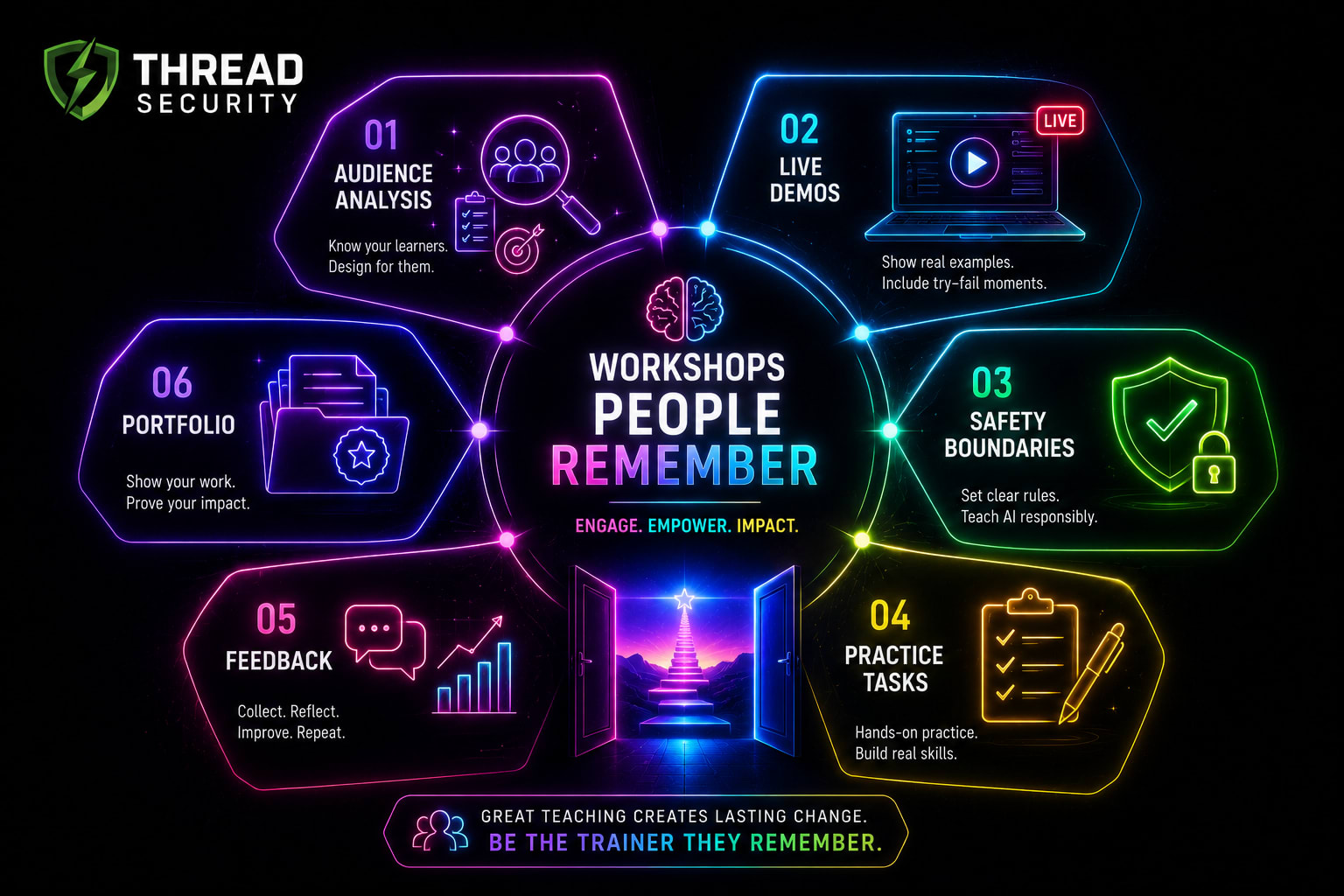
The Six-Part Method for Workshops People Remember
1. Teaching "The People in the Room", The Audience Analysis:
Ask people who are coming, what they're doing all day, what they're afraid of, what they know about. Find out who will be coming, what they are doing all day, what they are afraid of, what they already know before they write a slide. A school teacher is not concerned with plagiarism, an accounts team is not concerned with errors.
Send a 5 question pre survey: Role, current use of AI, main concern, one task they wish to improve, and confidence 1-5
Group the answers into two or three segments and design for the main one.
Write one learning outcome as a sentence describing behaviour. "At the end, be able to draft, test and fact-check an email summary using an approved tool.
2. Live Demos: Demonstrate Actual Examples Including Try-Fail Examples
A demo is convincing if it features a task that your audience does. Demonstrate to a teacher how to be drafting a lesson plan and then demonstrate a plan that has a miscommunication and how to identify it. The most memorable method to instruct verification is by purposefully displaying a failure.
Limit the demo to 3 minutes, then give control to the audience.
Tell what you are thinking as you work, particularly what you look up.
Make a backup (like a recorded run) since tools and networks do break in front of an audience.
Use artificial data for the sample data. Do not use real student, client or employee information to demo.
3. Rules or Boundaries for Safety: Establish the Rules Prior to the First Prompt
A safety trainer is a good AI trainer. Open with a one slide rule set (which tools are okay, which data can't be pasted, personal data, credentials, confidential documents, etc., what you will NOT show).
Follow the guidelines for using approved or sandbox accounts for hands-on sessions.
Don't encourage people to circumvent barriers or reveal distressful content.
Please consult age restrictions and consent forms with the school audience for any tool.
Remind participants that organizations are still responsible for personal data. The DPDP Rules for India were notified in November 2025 with a phased timetable of 18 months, with the first phase of the Rules coming into effect on or around 13 May 2027.
4. Practice Tasks: Get Them to Do It
Try to spend at least 50% of your time working with your instrument. Good tasks are short, related to the learners' job and there is a visible result.
Use a simple cycle: prompt, test on two or three examples, then verify the output against a source.
Provide a mini-rubric: Was it correct? Was it based on just authorized data? Would another colleague be able to use it?
Include 2 levels of difficulty so that they aren't lost, but aren't bored.
For teachers: create an outline for a lesson using AI, then verify three statements, documenting changes.
5. Feedback: Collect It During, After and About You
There are three purposes of feedback. As the session progresses, have quick polls or an exit ticket asking "what is still unclear? Follow with the question "What did you really use?" after 30 days. With regards to your personal teaching, discuss a brief pre- and post-session assignment, not just a satisfaction rating. Individuals can attend a workshop without changing anything. Monitor and test behaviour and outcomes as far as possible, and adjust the next session in response to this.
6. Portfolio: Demonstrate Ability to Teach, not just know
A portfolio of lesson plans is a better proof of qualifications for an AI trainer than a certificate. Use 3-5 plans that include:
Audience, learning outcome and duration
A scheduled agenda and a sample script for the demonstration.
Safety notes and Approved tool rules
One practice task that has a rubric
A method for feedback and before/after results (if available)
Only sanitized materials will be accepted (no confidential or personal information)
Post it on a personal website or online repository, and maintain it.
90-minute Workshop Outline:
Minutes 0 to 10: Welcome, safety rules and a quick baseline poll.
Minutes 10 to 25: Live demonstration of one actual task, followed by one planned failure.
Minutes 25 to 60: Pair-work, use the prompt, test and verify.
Minutes 60 to 80: Present results, explain and discuss what was done wrong and what they checked.
Minutes 80 to 90: Exit ticket, action each person plans to take this week, and 30-day follow up plan.
Establishing a Career as an AI Trainer
These are typical positions such as AI literacy trainer, corporate learning and development specialist, educator/lecturer integrating AI into a subject, curriculum designer, and AI enablement lead within an organization. They come from teaching, HR, IT support and data work and security. The key is a combination of technical ease, ability to communicate and risk perception.
Ensure lessons are designed in a way that is credible to the teacher by linking to already established frameworks. The European Commission AI literacy guidance, for instance, cites amongst its reference materials the AI competency frameworks recommended by UNESCO for teachers and students. There is no good India specific database of salary for AI trainers, so I can't give one. Before you set your expectations for open jobs and freelance opportunities, review the current market for available positions and freelance fees.
Mistakes That Make Workshops Forgettable
Resources to facilitate learning rather than tasks. Failure to take the safety briefing. Demoing only success. Discussing for 40 minutes prior to anyone picking up a keyboard. Measuring satisfaction rather than behaviour. And teaching at the highest level to the highest person in the room.
For Organizations: Where Thread Security Fits
Training personnel to use AI also requires training them to use it safely, and the controls must be tested. As per the findings of the 2025 India research by IBM, just 37 percent of the organizations had access to AI tools or capabilities to defend against breaches, while the average cost of a breach in India had gone up by around ₹1.79 crore due to the presence of unsanctioned "shadow AI". Thread Security says it is a certified offensive security company and penetration testing firm, and offers a range of services, including VAPT, web application penetration testing, cloud security reviews and smart contract auditing. Those tests validate your AI-powered workflows' systems. Inquire from any provider, including Thread Security, if they will be testing AI deployments and awareness of staff members.
AI Courses in Jalandhar: Groundwork for AI Training.
A credible trainer must have a sound technical understanding. Thread Security Education provides AI Courses in Jalandhar and Cyber Security Courses in Jalandhar which have offline classes and live online batches. Its website claims that they have Foundational AI which begins with Python, then progresses through data analysis, machine learning and deployment, Generative AI and Agentic AI, AI Security and Responsible AI Engineering, and cyber security courses like CEH and industrial training. I did not find a separate train-the-trainer program at the location; inquire if any exist or if the technical tracks are appropriate for you.
Address: Vasal Mall, 3rd Floor, Opposite Hotel President, Police Line, Jalandhar, Punjab 144001. Phone: +91 7347398956. Open: Monday through Saturday 9AM-7PM.
Frequently Asked Questions
How to become an AI trainer? Develop, apply, and explain sufficient technical knowledge to utilize and demonstrate the use of AI tools and acquire basic knowledge of instructional design, teach small groups, gather feedback and publish a portfolio of lesson plans with outcomes.
Is it necessary to write programs to train AI? Not always. A lot of literacy workshops require judgment, knowledge of safety and good teaching more than code. Coding for technical audiences.
What should be addressed in an AI workshop? Hands-on application on real tasks, and output verification; testing, data safety and limits of AI; Prompt and practical for at least 50% of the session.
How can I determine if training was successful? Take a before/after comparison of a short task, follow up after 30 days as to what people actually do, and record errors or time saved as possible. An individual's satisfaction with a product or service does not meet the requirements.
Key Takeaways
An AI trainer's career value is based on the ability to train, not just to know.
Follow a 6-part approach: audience analysis, live demos, safety boundaries, live practice tasks, feedback and a lesson plan portfolio.
In a 225-study meta-analysis, active learning was found to be superior to lecturing, but this analysis included university STEM classes, not AI workshops.
Have rules with every session and don't demo with actual, personal information.
Call to Action
Plan one 90 minute lesson this week following the structure outlined above, and try it out with three other colleagues. If an organization is interested in having their AI deployments tested, go to threadsecurity.org. For enhancing AI and Security skills in Jalandhar, reach out to Thread Security Education.
Simranjit Kaur
VERIFIEDAI Trainer · Thread Security
Faculty mentor & research guide at Thread Security Education.