On Monday, a data scientist finds something strange in the data: students who miss early assignments are far more likely to fall behind later. On Tuesday, an ML engineer discovers that the same prediction model works perfectly on a laptop but crashes when hundreds of users access it at once. On Wednesday, an AI engineer watches a chatbot confidently tell a student that a course does not exist because it misunderstood one poorly worded question.
They work in the same AI field, but they face completely different problems every day.
That is why choosing between AI engineer, data scientist, and ML engineer should not be based on job-title hype. If you are planning an AI engineer career path, the better question is simple: which kind of daily problem do you want to solve?
This guide compares the roles through real responsibilities, coding depth, deliverables, and beginner projects. It uses job expectations and official ML documentation rather than stereotypes. It is especially useful if you are exploring AI courses in Jalandhar or starting your learning journey with Thread Security, an education and training company that helps learners build practical skills in AI, cybersecurity, and emerging technologies.
The Real Difference
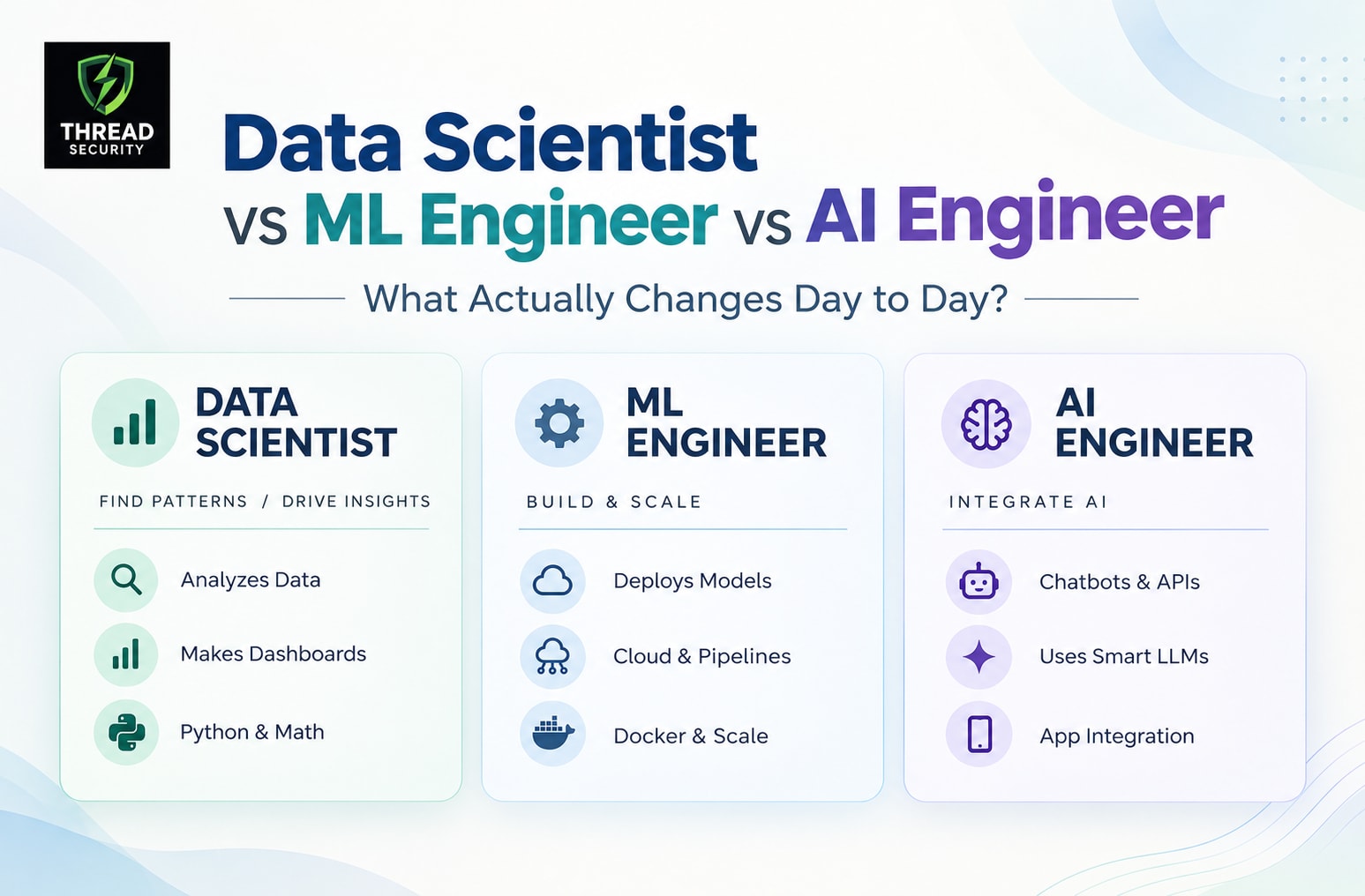
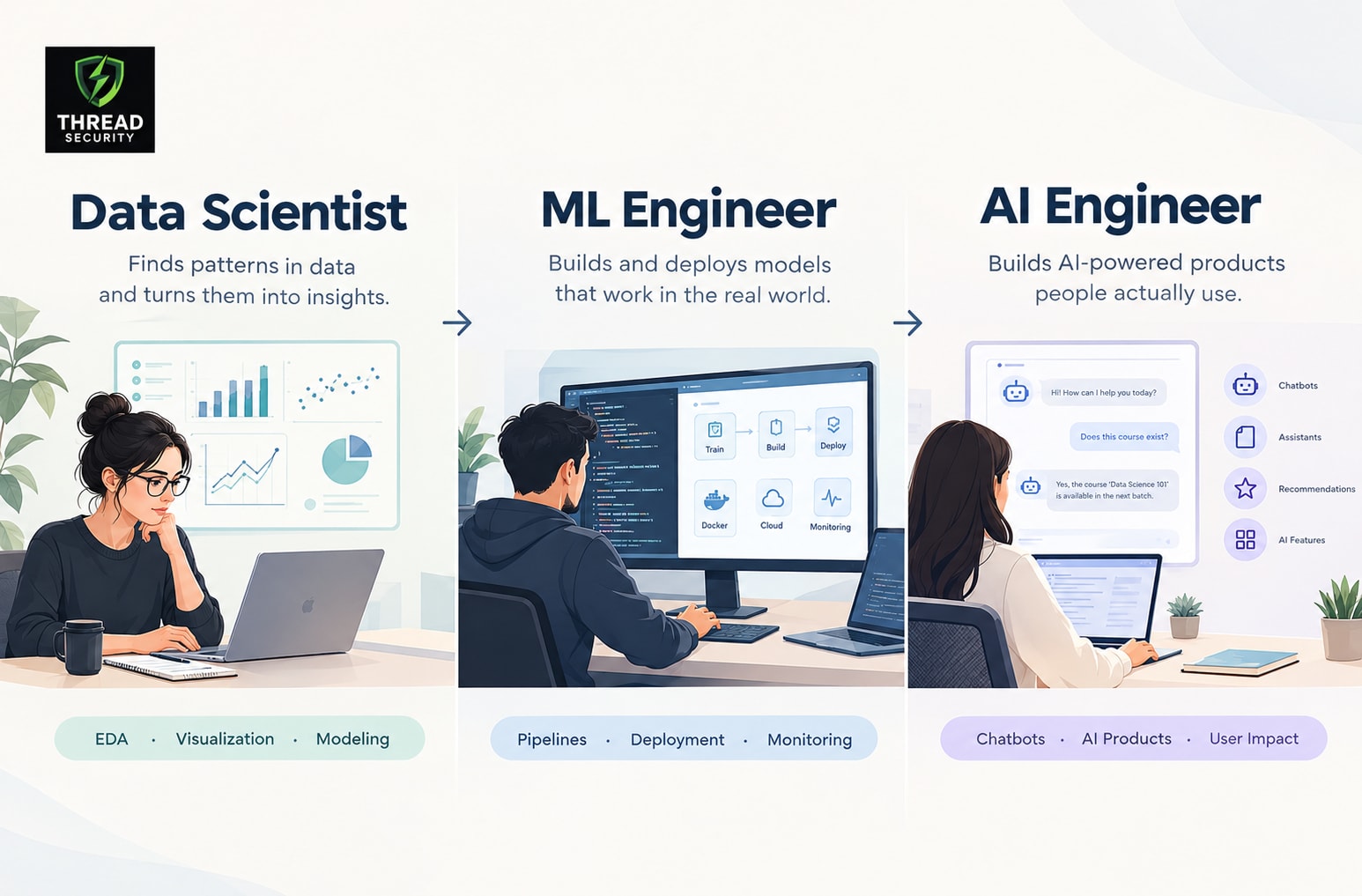
A data scientist turns a business question into a data question. They explore data, test assumptions, build models, and explain what the results mean.
A machine learning engineer takes a promising model and makes it dependable in the real world. They handle deployment, automation, monitoring, and scale.
An AI engineer builds AI-powered products. They create chatbots, document assistants, recommendation systems, and AI features inside real applications.
In simple terms, a data scientist asks, “What is the data telling us?” An ML engineer asks, “How do we run this model reliably?” An AI engineer asks, “How do we turn AI into something people can use?”
The overlap is real, but the daily pressure is different. One role is judged by insight quality, another by system reliability, and another by whether users actually find the AI feature useful.
Data Scientist: Finding the Signal
Imagine a training institute notices that some students stop attending classes or submitting assignments. The institute does not yet know why. A data scientist is brought in to find the pattern.
They start with messy data. Attendance records are in one format, assignment submissions are in another, and quiz scores are in a third. Some students have multiple records, some dates are missing, and some columns look useful but may reveal the answer too early.
After cleaning and exploring the data, the data scientist may find something useful: students who miss assignments in the first three weeks are much more likely to need support later. That is not just a chart. It is an early-warning signal that teachers can act on.
The U.S. Bureau of Labor Statistics describes data scientists as professionals who determine useful data, collect and analyze it, create and validate algorithms and models, and use visualization to communicate results.
Their typical deliverables include a cleaned and documented dataset, an exploratory data analysis notebook, a classification or forecasting model, evaluation metrics such as accuracy, precision, recall, or RMSE, and dashboards or reports with clear recommendations.
Their real skill is not knowing every algorithm. It is knowing which question matters, which data can answer that question, and when the result can be trusted. Scikit-learn’s documentation treats preprocessing, model selection, evaluation, cross-validation, and pipelines as central parts of machine learning work.
ML Engineer: Making It Survive Reality
Now suppose the institute wants to use that student-risk model every week. The data scientist’s notebook model is not enough. It needs to run automatically, handle new student data, and alert teachers before problems become serious.
This is where the ML engineer comes in.
Their first question is blunt: “Will this model still work when real users, real data, and real failures show up?” A model can score well in testing and still fail in production. The input format may change, a data source may go down, the model may become slow, or a new course may appear that the model has never seen.
Job descriptions for MLOps and machine learning engineers focus on data ingestion, training pipelines, deployment, monitoring, reproducibility, and operational excellence. Apple describes MLOps engineers as responsible for keeping AI and ML systems reliable, scalable, and continuously improving in production.
Their typical deliverables include a reproducible training pip
eline, automated tests and data validation, a model-serving API or batch prediction system, Docker containers and cloud deployment, CI/CD pipelines for model updates, logging and monitoring, drift detection, and a rollback plan if a new model performs poorly.
In the student-support example, the ML engineer builds a system that collects fresh attendance and assignment data, updates predictions, flags at-risk students, and keeps working even if one data source temporarily fails. If a new model performs worse, they can roll back safely.
This role often involves more software engineering than people expect. ML engineers work with Git, APIs, Docker, cloud platforms, CI/CD, workflow orchestration, and monitoring tools. Job listings repeatedly emphasize building, deploying, and maintaining scalable ML systems and pipelines.
A useful reality check is that an ML engineer may spend more time improving deployment reliability than improving model accuracy. That is not a failure of the role. It is the job.
AI Engineer: Turning AI Into a Product
Now imagine the institute wants something students can directly use: a chatbot that answers questions about courses, admissions, fees, and cybersecurity basics.
The AI engineer builds it, but the first version rarely behaves perfectly.
A student may ask, “Can I join the cybersecurity course if I know only basic Python?” The chatbot must understand the intent, retrieve the right information, and answer clearly. Another student may upload a blurry PDF or ask a question the documents do not answer. The chatbot must avoid making up an answer.
This is the AI engineer’s daily reality: reducing latency, handling bad inputs, preventing hallucinations, designing prompts, connecting APIs, and making sure the product does not embarrass the organization.
Current AI engineer job descriptions describe the role as a mix of software engineering, machine learning, and product development. Responsibilities include designing AI solutions, building ML and AI pipelines, integrating models into products, optimizing performance, and collaborating with product and engineering teams.
Their typical deliverables include a chatbot or RAG-based document assistant, an API that connects an LLM, vector database, and company knowledge base, prompt templates and response-quality checks, a website feature or internal tool, guardrails and logging, and a working demo for stakeholders.
AI engineers often use existing models and APIs rather than training large models from scratch. Their strength is integration. They connect models, data, interfaces, and business workflows into one product that feels simple to the user.
Coding, Data, and Model Depth
A common myth is that data scientists do all the math, ML engineers do all the coding, and AI engineers only call APIs. In reality, all three write code and all three work with models, but they optimize for different outcomes.
Data scientists usually go deepest into data quality, statistics, experimentation, and model evaluation. They care about whether the conclusion is valid.
ML engineers usually go deepest into systems. They care about whether the model can be reproduced, deployed, monitored, updated, and trusted after release.
AI engineers usually go deepest into product integration. They care about response quality, speed, user experience, retrieval accuracy, and safe behavior.
Beginner Projects That Actually Help
Do not build ten random projects. Build projects that reflect the job you want.
Data Scientist Projects
Analyze a student performance dataset and identify early warning signs.
Build a customer churn prediction model using a public dataset.
Create a sales dashboard with trends, customer segments, and forecasts.
Analyze an A/B test and explain whether the result is statistically meaningful.
ML Engineer Projects
Deploy a student-risk prediction model as a REST API.
Build a pipeline that retrains a model when new attendance or sales data arrives.
Containerize a model with Docker and deploy it to the cloud.
Add monitoring to detect when model performance drops.
AI Engineer Projects
Build a RAG chatbot that answers questions from cybersecurity notes, college documents, or company policies.
Create a resume-screening assistant that matches candidate skills with job descriptions.
Build a mood-based music recommendation app.
Create a cybersecurity-aware AI assistant that explains phishing, password safety, and common threats.
The strongest portfolio project combines all three. Analyze data, build or integrate a model, deploy it, and wrap it in a simple product interface. That shows you understand the full AI workflow, not just one isolated skill.
Which Role Should You Choose?
Choose data science if you enjoy finding patterns, testing ideas, and explaining why something happens. Choose ML engineering if you enjoy backend systems, cloud deployment, automation, and making software reliable. Choose AI engineering if you enjoy chatbots, LLM applications, APIs, and user-facing products.
If you are a beginner, start with Python, SQL, Git, and one complete project. Then specialize. A practical AI engineer career path does not require mastering everything on day one. It requires understanding the full workflow and becoming strong in one part of it.
For learners in Punjab, good AI courses in Jalandhar should focus on hands-on projects, deployment, debugging, and real-world tools rather than only theory. At Thread Security, learners can explore practical AI and cybersecurity training designed around real projects, industry-relevant tools, and responsible use of technology. You can also visit threadsecurity.org to learn more about the company’s work and learning resources.
Final Thoughts
The data scientist finds the signal hidden in messy data. The ML engineer makes sure that signal keeps working when the system goes live. The AI engineer turns it into something a student, customer, or security team can actually use.
Choose the role whose daily problems you would enjoy solving, not the title that sounds most impressive. In AI, the people who grow fastest are not the ones who know every tool. They are the ones who can take an idea from messy data to a reliable, useful product.
Gurmehak Kalra
VERIFIEDAI Technical Associate · Thread Security
Faculty mentor & research guide at Thread Security Education.